
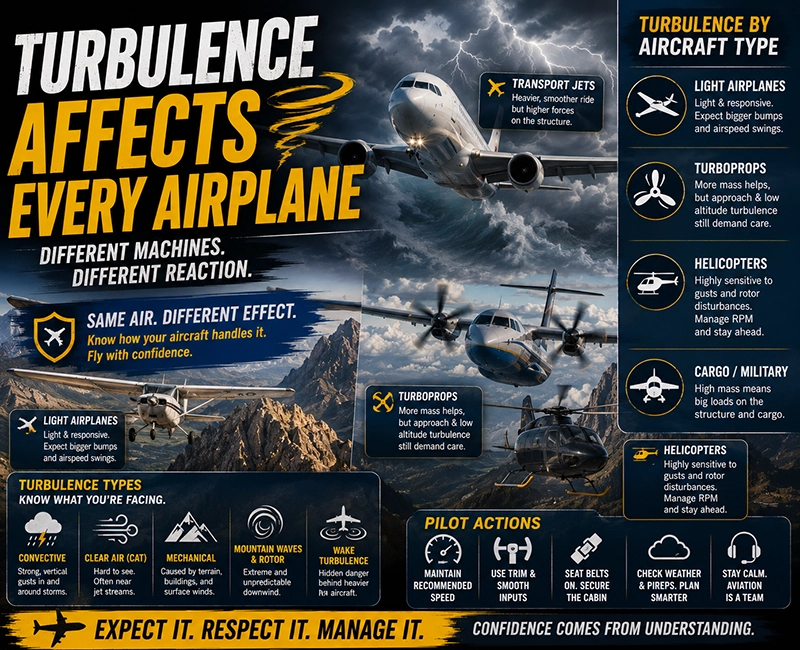
Turbulence is a normal part of flying, but its effect varies significantly between aircraft types. Understanding how turbulence interacts with mass, wing loading, control systems, and flight dynamics helps pilots make better decisions in climb, cruise, descent, and approach. This article explains the physical mechanisms of turbulence, how those mechanisms show up differently in light airplanes, transport-category jets, turboprops, and rotorcraft, and what pilots should do in practical operations.
Read on for the operational and training implications, common misunderstandings, a realistic scenario to practice in the simulator, and concise best practices you can apply on your next flight. The primary goal is to give aviators an accurate, technically grounded understanding so they can manage aircraft state, maintain margins, and reduce risk when turbulence appears.
How Turbulence Works: The Core Ideas
Turbulence is chaotic, irregular motion in the atmosphere caused by a range of factors. At the simplest level pilots need to know two things: turbulence produces rapid changes in the local airflow around an aircraft, and those changes become forces and moments acting on the airframe. The resulting motion depends on the amplitude and frequency of the gusts, the aircraft's mass and inertia, aerodynamic damping, and the response of any flight control systems.
Think in terms of accelerations rather than just motion. A small, light aircraft exposed to a short, sharp gust will show larger instantaneous vertical acceleration than a heavier aircraft exposed to the same gust intensity. Conversely, a heavy aircraft can carry greater kinetic energy and therefore transmit greater forces to its structure and occupants even when accelerations are smaller. Wing loading, control harmony, and aerostructural design determine how those forces translate into attitude changes, airspeed deviations, and structural load.
Why This Matters in Real-World Aviation
Pilots, instructors, and operations personnel must translate the physics into actions. Turbulence affects operational decisions including planned speeds, route choices, fuel reserves, and passenger briefings. It affects training by changing how certain upset-recovery maneuvers are practiced and how students are taught to scan instruments and hold configuration in rough air. For maintenance and safety, turbulence events can contribute to fatigue loads over time and, in extreme cases, cause in-flight structural damage or injuries when seat belts are not used.
From a regulatory and safety perspective, operators and pilots should be aware that different aircraft handle turbulence differently. The same encounter that is annoying in a large jet can be demanding for a light-sport aircraft. Conversely, the same encounter can impose significant forces on a transport-category aircraft that are not obvious to passengers. That difference affects such things as turbulence penetration speeds, the advisability of using autopilot, and how to brief passengers and crew.
How Pilots Should Understand Turbulence by Aircraft Type
This section breaks down common aircraft categories and articulates the practical implications for flight handling, performance, and safety. These descriptions emphasize qualitative behavior and operational recommendations rather than numeric limits. Always consult the aircraft flight manual and the manufacturer for specific guidance for your airplane.
Light Single-Engine Fixed-Wing Aircraft
Characteristics: Low mass, lower wing loading, relatively simple control systems, and less aerodynamic damping than larger airplanes. Many light singles are more susceptible to rapid attitude and altitude changes for a given gust input.
Operational implications: Expect larger instantaneous excursions in pitch and vertical speed from short, sharp gusts. Airspeed can fluctuate quickly, so maintaining an appropriate turbulence penetration speed is important to retain margin above stall without overstressing the airframe. Instructors should emphasize smooth, anticipatory control inputs and avoiding abrupt corrective control movements that can induce secondary oscillations.
Human factors: Light airplanes transmit motion to the pilot more directly, increasing workload. Secure loose items and brief passengers. Consider delaying nonessential takeoffs or choosing altitudes and routes that minimize exposure to convective or rotor turbulence.
Turboprops and Small Commuter Aircraft
Characteristics: Generally heavier than light singles, often with higher wing loading and turboprop-specific aerodynamic behavior. Some models have more complex propeller slipstream and engine response characteristics.
Operational implications: Turboprops usually absorb short-period gusts better than light singles, but they can still experience significant vertical accelerations, especially when heavily loaded. Propeller slipstream over the wings and tail can change how gusts affect handling. During approaches and low-level flight, turbulent air can generate airspeed fluctuations and require careful power management to maintain a stable approach profile.
Maintenance and structural considerations: Repeated strong turbulence encounters can impose cumulative loads on the airframe and installations such as external antennas and gear doors. Operators should pay attention to post-flight inspections after severe turbulence encounters.
Transport-Category Jets (Airliners)
Characteristics: Much higher mass and inertia, higher wing loading, sophisticated high-gain flight control systems on some aircraft, and often robust autopilot and flight-envelope protection systems.
Operational implications: A heavy jet will generally show smaller instantaneous vertical accelerations for the same gust intensity than a light airplane. That reduces the motion felt by passengers relative to a smaller aircraft, but the forces transmitted through the structure can still be significant. Turbulence can lead to large load cycles and structural stress even if the altitude excursions seem modest. In many transport category operations, manufacturers and operators publish turbulence penetration speeds and recommendations for autopilot use; pilots should follow the aircraft-specific guidance.
Flight control systems: Modern transport aircraft may have flight-envelope protections and autopilot gains tuned for stability. In some cases keeping the autopilot engaged during turbulence can result in smoother control inputs than manual flying, but that depends on the system and published guidance. Crew coordination and timely passenger/crew restraint briefings remain important because sudden vertical accelerations can cause injuries.
Rotary-Wing Aircraft (Helicopters)
Characteristics: Lift is produced by rotating blades that respond differently to gusts than a fixed wing. Helicopters can be particularly sensitive to vertical gusts, retreating blade stall in high-speed flight, and phenomenon such as mast bumping in certain flight regimes.
Operational implications: Gusts can change the angle of attack on the rotor blades quickly, causing pitch and roll moments that require prompt pilot inputs. Helicopter pilots must consider rotor RPM management, collective control to manage airspeed, and the increased risk of unusual attitudes in severe turbulence. Low-altitude operations near terrain are especially hazardous because of mechanical turbulence and rotor downwash interactions.
Large Cargo and Military Aircraft
Characteristics: Very high mass, sometimes unique aerodynamic arrangements, and variable load distributions. Cargo loads that are not properly restrained can amplify the consequences of turbulence-related accelerations.
Operational implications: Even if acceleration magnitudes are smaller, the high kinetic energy of a heavy aircraft means structural and cargo restraints see large forces. Pilots and loadmasters must ensure cargo is properly secured, and crews should monitor weight-and-balance considerations that can change how the aircraft responds in turbulence.
Common Turbulence Types and How They Differ by Aircraft
Not all turbulence is the same. Recognizing the type of turbulence helps pilots anticipate how an airplane will respond and what measures to take.
Convective Turbulence
Occurs in and around cumuliform clouds and convective updrafts and downdrafts. Convective turbulence is often energetic and can include vertical gusts with a broad range of frequencies. Light airplanes feel sharp vertical accelerations; transport-category aircraft may avoid it by rerouting, changing altitude, or slowing to a manufacturer-recommended penetration speed.
Clear Air Turbulence (CAT)
Associated with wind shear in the upper atmosphere, often near jet streams or strong temperature gradients. CAT can be hard to predict and is a concern for high-altitude flights. Because it often occurs without visual cues, maintaining current weather information and following ATC advisories are critical. Large jets have procedures to request altitude changes to escape CAT; smaller aircraft may need to adjust route or speed.
Mechanical or Surface-Induced Turbulence
Produced by terrain, buildings, or other obstacles interacting with surface winds. Light aircraft operating near hills, ridges, or during takeoff and landing in gusty conditions can encounter severe attitude excursions. Helicopters and low-level turboprops must be careful in rotor-prone or mechanically turbulent areas.
Mountain Waves and Rotor Turbulence
Produced by stable airflow over mountain ranges. Mountain waves can produce significant vertical motions and severe turbulence in lee-side rotor zones. Larger aircraft might cruise above the wave if possible; smaller aircraft should avoid the lee side where rotor turbulence can be violent and unpredictable.
Wake Turbulence
Produced by the vortices left behind by an aircraft, wake turbulence affects following aircraft and is strongly dependent on the generating aircraft's weight, wing configuration, and speed. Light aircraft following heavier airplanes can experience hazardous rolling moments. Pilots must observe wake separation guidance and be vigilant during takeoff and landing phases where wake encounters are most likely.
How Pilots Should React in Turbulence
When turbulence is encountered, pilots must manage energy, configuration, and workload. The principles are similar across types but the specifics vary by aircraft. The universal priorities are protecting the airframe, maintaining control, and preserving margins above stall while ensuring passenger and crew safety.
General operational guidance for handling turbulence includes maintaining a safe, recommended penetration speed, trimming to hands-off attitude when appropriate, reducing abrupt control inputs, and briefing the cabin. On approach, aim for a stable approach path and consider a go-around if the approach becomes unstable due to gusts or wind shear. In heavy turbulence, secure loose items and ensure all occupants are restrained.
Pilot technique differences by aircraft type:
- Light airplanes: Use smooth, anticipatory control inputs and avoid large corrections. Prioritize airspeed control and maintain adequate power to prevent unwanted descent.
- Turboprops: Manage power changes carefully, particularly close to the ground. Be aware of propeller and slipstream effects during gusts.
- Jets: Follow manufacturer guidance on turbulence penetration speeds and autopilot usage. Coordinate with ATC for altitude changes when encountering clear air turbulence or convective lines.
- Helicopters: Control rotor RPM and be ready to adjust collective promptly. Avoid low-level flight in known rotor zones or lee-side turbulence.
Common Mistakes, Misunderstandings, and Safety Risks
Several recurring errors increase risk in turbulent conditions. Understanding them helps instructors emphasize the right habits during training and helps pilots avoid unnecessary exposure to hazard.
Overcontrol and pilot-induced oscillations: Pilots often respond to a gust with abrupt control movements that overshoot the correction and create an oscillation. This is especially common in light airplanes and contributes to increased structural loads and passenger discomfort. Practice smooth amplitude-limited inputs and use trim to reduce sustained control forces.
Chasing the airspeed indicator: Rapid attention to every fluctuation in indicated airspeed can lead to abrupt power or pitch changes that make the situation worse. Instead, aim for a target turbulence penetration speed range appropriate for the aircraft and keep control inputs coordinated.
Ignoring aircraft-specific guidance: Using a generic technique that contradicts the aircraft flight manual or operator procedure can be unsafe. For example, some transport-category aircraft have explicit guidance on autopilot use and maximum recommended turbulence penetration speeds. Always follow the AFM/POH and operator SOPs.
Poor passenger and cabin management: Unsecured passengers or loose items are a major source of injury during turbulence. Failing to brief passengers or the cabin crew and not ensuring seat belts are fastened increases risk.
Underestimating wake turbulence: Light aircraft sometimes operate in terminal areas without appreciating the wake left by larger airplanes. Wake encounters can rapidly roll a small airplane; proper spacing and awareness are essential.
Practical Example: Approaching a Mountain Range in Variable Conditions
Scenario: You are flying a high-performance single-engine airplane on a cross-country route that requires crossing a mountain range. Weather reports indicate strong winds aloft and scattered convective buildups over the mountains. During descent into the valley on the lee side, you encounter an abrupt series of updrafts and rotor turbulence.
How to prepare and react: Before the flight, consult the latest winds and mountain wave forecasts, choose fuel and altitude planning that allows flexibility, and brief passengers on the possibility of turbulence and the importance of seat belts. Consider an alternate route that avoids the lee side if rotor activity is forecast. If you must cross the range, maintain a recommended penetration speed for turbulence, keep a positive power setting to arrest unexpected sink, and trim for stable hands-off attitude to reduce pilot workload. If encountering severe rotor or mechanical turbulence, exit the area laterally if possible, or climb above the wave if your airplane and performance allow.
Training application: Use the scenario in a simulator or dual flight to practice judgment about diversion vs. penetration, speed control in turbulence, and coordination with ATC for reroute or altitude changes. Discuss post-flight inspection criteria and logging any potential structural concerns if you felt significant loading.
Best Practices for Pilots
These principles apply across aircraft types and operational contexts. They are meant to be concise reminders rather than prescriptive rules. Consult the AFM/POH and operator manuals for aircraft-specific guidance.
- Preflight planning: Review current winds, turbulence forecasts, SIGMETs, and pilot reports for your route and altitudes. Plan a speed and altitude strategy that allows escape from severe conditions.
- Passenger and crew briefing: Brief occupants on turbulence procedures, emphasize seat belt use, and secure cabin items before flight in expected rough air.
- Maintain energy and margin: Keep a safe margin above stall speed and use power to control vertical speed rather than abrupt pitch changes.
- Use trim and coordinated controls: Trim to relieve control forces and reduce the tendency toward overcontrol. In many aircraft, small, measured inputs are superior to large corrections.
- Follow aircraft and operator guidance: Use recommended turbulence penetration speeds and follow autopilot guidance from the manufacturer or operator procedures.
- Be conservative near terrain and in terminal areas: Mechanical and wake turbulence are most hazardous near the ground. Increase separation and be prepared for abrupt roll or yaw inputs on landing and takeoff.
- Post-encounter inspection: After encountering severe turbulence, conduct a thorough check of the airframe and systems per the aircraft’s post-turbulence checklist or maintenance guidance.
Frequently Asked Questions
How does aircraft mass influence turbulence response?
Mass influences how rapidly an aircraft accelerates in response to gusts. A lighter airplane will typically show higher instantaneous accelerations for the same gust, producing larger attitude and altitude excursions. Heavier aircraft respond more slowly but can transmit larger forces through the structure due to greater inertia. Both cases require pilots to manage energy and maintain control margins.
Should I turn off the autopilot in turbulence?
There is no universal answer. Some aircraft manufacturers recommend keeping the autopilot engaged within its operational envelope because it can provide smoother, more consistent control inputs. Other situations call for manual control, particularly if the autopilot is exhibiting unusual behavior or is unable to cope with repeated large gusts. Consult your aircraft’s AFM/POH or operator SOPs for recommended practice, and train both manual and autopilot-handling techniques in simulated turbulence.
How can I avoid wake turbulence from larger aircraft?
Avoiding wake turbulence requires situational awareness and adherence to published separations and procedures. On approach and departure, stay above the flight path of a preceding heavy airplane and land beyond its touchdown point when following an aircraft of greater weight. When airborne, increase lateral spacing if possible, and be especially cautious in light aircraft near airports with heavy traffic. If wake is encountered, apply aileron into the vortex and maintain positive control while avoiding large, abrupt control reversals.
Is it safe to fly through clouds in turbulence?
Flying through clouds in turbulent air increases the risk of severe updrafts and downdrafts, reduced visibility, and icing where conditions permit. If turbulence in clouds is forecast or observed, consider rerouting, changing altitude, or diverting until conditions improve. For instrument-rated pilots, keep in mind that spatial disorientation risk increases in turbulent cloud conditions, reinforcing the need for instrument proficiency and disciplined control technique.
When should I request an altitude change from ATC due to turbulence?
Request an altitude change when turbulence is persistent and you determine another altitude offers smoother air, or when you are instructed by company procedures or the AFM to do so. Coordinate with ATC and provide a clear rationale such as encountering moderate or severe turbulence. Remember that ATC may not be able to immediately accommodate altitude requests due to traffic, so plan alternates and consider lateral deviations when safe and appropriate.
Key Takeaways
- Practical takeaway: Turbulence affects aircraft differently because of mass, wing loading, and control systems; adjust speed and control technique to match your airplane.
- Safety takeaway: Secure passengers and cargo and follow aircraft-specific guidance to reduce injury and structural risk during turbulence.
- Training and decision-making takeaway: Practice smooth control inputs, learn autopilot behavior in turbulence, and use conservative diversion or reroute decisions when forecasts indicate significant turbulence.