
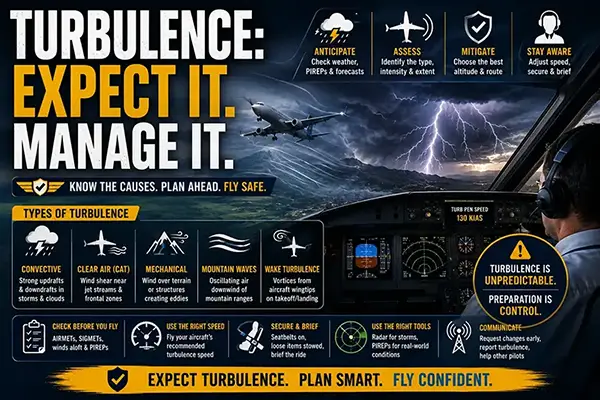
Turbulence is the irregular motion of air that makes an aircraft ride feel bumpy or rough. For pilots, student pilots, instructors, and aviation professionals, understanding turbulence is essential for safe operation, accurate flight planning, and effective decision-making. This article explains what causes turbulence, how it behaves in different flight conditions, and what practical steps pilots can take to reduce risk and maintain safety.
Readers will find a technical but practical explanation of the major turbulence types, guidance on interpreting weather products and pilot reports, and operational advice that aligns with common aircraft performance practices and pilot operating handbooks. The goal is to improve judgment in the cockpit so crews can anticipate turbulence, reduce injuries and damage, and make informed route and altitude choices.
What Turbulence Is and How It Forms
Turbulence is a fluid-dynamic phenomenon: the atmosphere moves in eddies and currents of different scales. Those motions produce changes in wind speed and direction over time and space. When an aircraft flies through those variations, it experiences vertical and lateral accelerations that passengers and crew feel as bumps.
There are several distinct causes of turbulence that pilots encounter most often:
- Convective turbulence: Generated by strong vertical motion around cumuliform clouds and thunderstorms. Updrafts and downdrafts in convective cells can be intense and variable.
- Clear air turbulence (CAT): Turbulence occurring in otherwise clear skies, commonly associated with wind shear near jet streams, frontal zones, and upper-level wind gradients.
- Mechanical turbulence: Created when wind flows over terrain, buildings, or other surface features and becomes turbulent in the lee. This is most pronounced at low levels.
- Mountain waves: Oscillatory motions that form downwind of mountain ranges. They can produce strong turbulence, lenticular clouds, and rotor zones in the lower atmosphere.
- Wake turbulence: Vortices shed from the wingtips of leading aircraft. These can be hazardous, especially for following light aircraft during takeoff and landing phases.
Why This Matters in Real-World Aviation
Turbulence affects operations across general aviation, commercial air transport, and flight training. In the flight deck, turbulence influences workload, autopilot performance, and fuel planning. In the cabin, unsecured passengers and loose items pose injury risks. From an operational perspective, significant turbulence can force changes in altitude, route deviations, and even unscheduled diversions.
Weather products and pilot reports that describe turbulence help dispatchers and pilots plan flights that minimize exposure. Anticipating turbulent areas improves passenger comfort, reduces wear on the aircraft, and lowers the chance of injury to crew and passengers.
How Pilots Should Understand Turbulence
Pilots should interpret turbulence in terms of cause, intensity, and expected vertical or horizontal extent. That mental model helps when choosing mitigation actions like changing altitude, adjusting airspeed, or selecting a different routing.
Key elements to consider in-flight are the vertical profile of winds, proximity to convective clouds, terrain-induced effects, and the traffic situation for wake avoidance. Use all available information: preflight weather briefings, AIRMETs and SIGMETs where issued, PIREPs, satellite and radar products, and onboard weather radar when applicable.
Aircraft-specific guidance matters. The airplane flight manual or pilot operating handbook contains recommended turbulence penetration speed and structural limits. Pilots should know those values for their aircraft and consider whether to engage or disengage the autopilot based on the type of turbulence and the autopilot's demonstrated behavior in such conditions.
Common Mistakes or Misunderstandings
Pilots sometimes underestimate turbulence risk because it is invisible or because clear air turbulence can occur without clouds. Other frequent mistakes include relying solely on onboard radar for convective situations, misunderstanding the vertical extent of mountain waves, and failing to consider wake turbulence exposure during arrivals and departures.
Misapplying airspeed is another risk. Flying too fast in turbulence increases aerodynamic loads; flying well below recommended turbulence penetration speed may reduce control authority and lead to larger excursions. Always reference the POH/AFM for airline and light-aircraft specific guidance.
Practical Example
Imagine a single-engine trainer on a cross-country at 3,500 feet toward a destination that requires a low-level pass over rolling ridges. The forecast includes moderate winds from the ridge direction and scattered cumulus. The pilot notices a steady increase in bumpiness and sees rotor-like cloud strands downwind of the ridge.
Operational responses include: slowing to the aircraft's recommended turbulence penetration speed from the POH, closing the windows and securing loose items, briefing any passengers and the instructor or safety pilot, and considering an altitude change to fly above the affected layer if climb performance and airspace allow. If the turbulence is mechanical near terrain and a safer routing exists, diverting around the ridgelines is often the prudent option.
Best Practices for Pilots
Practical actions you can adopt in training and operations:
- Preflight: Review AIRMETs, SIGMETs, turbulence forecasts, and PIREPs for the planned route and alternate options.
- Plan speed: Identify and use the aircraft's recommended turbulence penetration speed from the POH/AFM when turbulence is likely.
- Secure the aircraft: Ensure passengers and loose objects are belted or stowed and that the cabin is briefed on expected conditions.
- Use weather tools appropriately: Onboard radar helps with convective cells but not clear air turbulence. Combine data sources for a complete picture.
- Communicate: File PIREPs for significant turbulence so other pilots can benefit; request clearances for altitude or routing changes early.
Frequently Asked Questions
How do I know when to change altitude to avoid turbulence?
Consider altitude changes when you have objective indicators that turbulence is confined to a layer, such as PIREPs, satellite imagery showing cloud layers, or forecast wind profiles. If a change is possible without compromising fuel, weight-and-balance limits, or airspace restrictions, request the new altitude from ATC and monitor the change closely. Always weigh the benefits of smoother air against the operational costs of the climb or descent.
Should I turn off the autopilot in turbulence?
Not necessarily. Modern autopilots can reduce pilot workload and keep the aircraft stable in moderate turbulence. However, if the autopilot commands abrupt or inappropriate control inputs, or the turbulence exceeds the autopilot's capability, hand-flying may be safer. Make decisions based on the autopilot's behavior, the aircraft's handling qualities, and training experience.
Can light aircraft handle severe turbulence?
Light aircraft are certified for a range of structural loads, but severe turbulence can exceed design margins and lead to structural damage or loss of control. Avoid known severe turbulence, follow POH guidance, and consider delaying or rerouting flights when forecasts or observations indicate extreme conditions.
How to Use Weather Products and Reports
Integrate multiple sources. AIRMETs describe widespread lower-level phenomena relevant to smaller aircraft, while SIGMETs warn of more severe conditions for all aircraft. Pilot reports are among the most valuable resources because they describe real conditions along specific routes. For upper-level flights, consult winds aloft and jet-stream analyses to assess the risk of clear air turbulence.
Onboard weather radar is effective for identifying convective activity but has limitations: it does not detect clear air turbulence or mountain rotor zones. Use it for situational awareness and avoid relying on it exclusively.
Key Takeaways
- Include one clear practical takeaway: Know your aircraft's turbulence penetration speed and use it when encountering rough air.
- Include one safety or operational takeaway: Secure passengers and cargo, brief the flight, and file or use PIREPs to inform others.
- Include one training, regulatory, or decision-making takeaway: Use AIRMETs, SIGMETs, and PIREPs to shape route and altitude decisions and practice turbulence scenarios in training flights.