
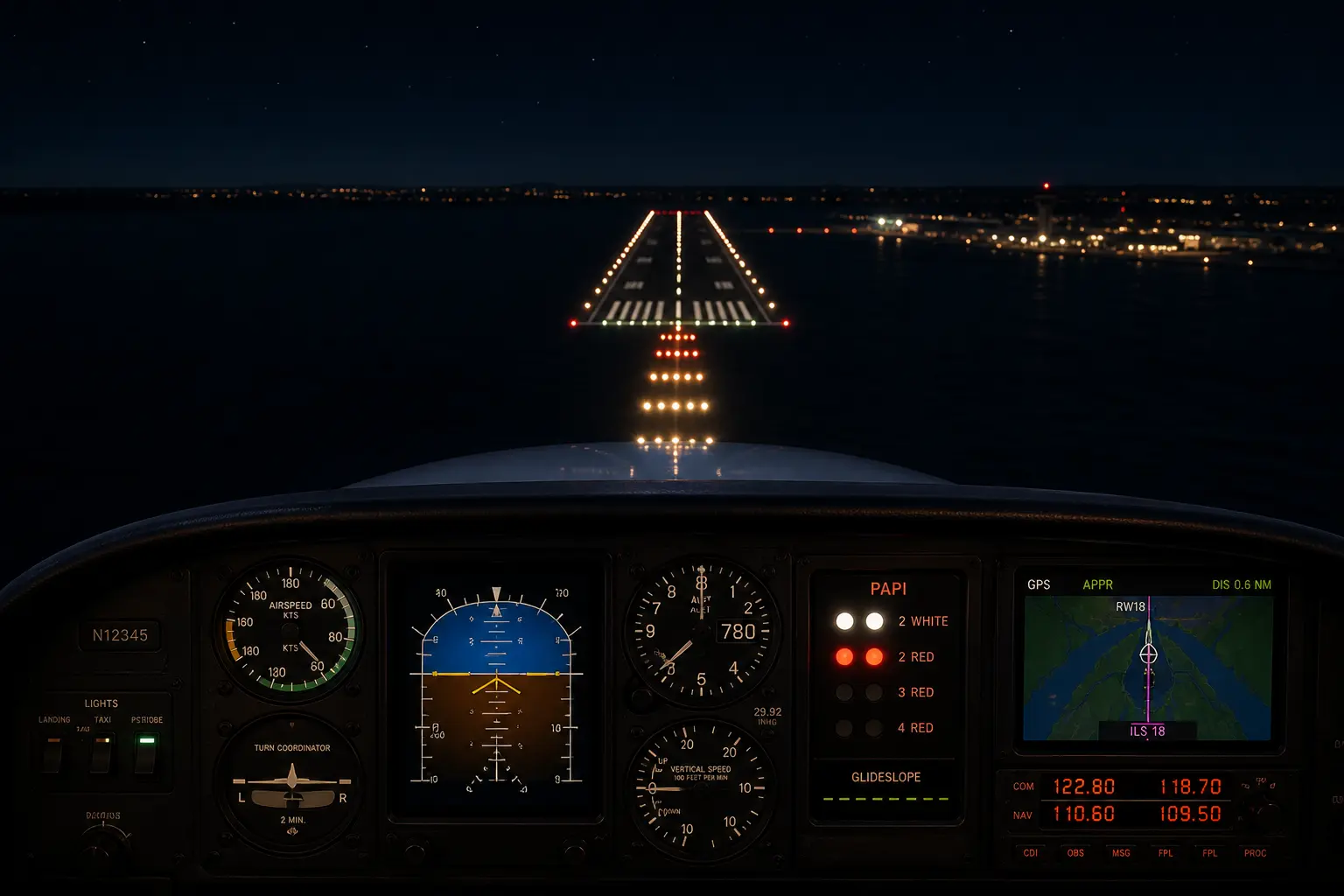
Visual approach illusions can make a benign final approach feel dangerously low or deceptively high. Pilots who understand the common illusions that affect glide path judgment are better equipped to recognize misleading visual cues, maintain a stabilized approach, and make timely decisions such as initiating a go-around. This article focuses on three recurring visual illusions that affect glide path perception: the black hole illusion, runway width and length illusions, and sloped runway effects.
If you fly night approaches, unfamiliar fields, nonprecision approaches, or visual segments after an instrument approach, the material below explains what creates these illusions, why they matter, how to spot them, and how to manage them in everyday operations and training.
How Visual Illusions Affect Glide Path Judgement
Pilots judge their position relative to the runway with a combination of instrument indications and visual cues. Visual cues include the runway, approach lighting, surrounding terrain, and ground features such as roads or buildings. Illusions occur when those visual cues distort depth, distance, or slope perception. The result can be an incorrect assessment of the glide path and a misjudged descent that increases risk during the visual segment.
Understanding the mechanisms behind the common illusions helps you translate visual input into safer control inputs. Below are the three primary illusions that consistently affect pilots during approach and landing.
Black Hole Illusion
The black hole illusion typically appears during a night approach to a runway surrounded by a large area of featureless terrain, water, or unlit fields. With few peripheral lights or terrain cues, pilots can perceive the runway as being closer and lower than it really is. This often leads to a low approach and can result in a hard landing or inadvertent terrain contact.
How it forms: at night the eyes use contrast and surrounding lights to estimate distance. When an airport sits in a dark bowl of terrain or water, a pilot’s visual system lacks the usual reference points. The pilot may then judge the runway as being nearer and lower, which prompts a pilot to fly a shallower glide than intended or to reduce power prematurely.
Runway Width and Length Illusions
Runway geometry influences perceived height and distance. Narrow runways appear farther away and can induce a higher-than-normal approach. Conversely, a wider runway can make the threshold appear closer, inducing a low approach. Similarly, long runways may suggest greater available stopping distance and encourage a lower approach, while short runways can appear closer, prompting a steeper approach.
Contributing factors include runway markings, lighting intensity, and adjacent visual features such as taxiways or parallel roads. Pilots transitioning between airports with different runway dimensions can be surprised if they rely primarily on their visual estimation instead of cross-checking instruments and visual glide path aids.
Sloped Runway Effects
Runways that slope uphill or downhill change the apparent angle between the aircraft and the landing surface. An uphill runway can create the impression that the aircraft is higher than it is, which may lead a pilot to fly a lower approach path. A downhill runway produces the opposite effect and may lead to an approach judged as high, causing the pilot to fly too steeply or to float during flare.
Sloped runways can also change the touchdown point relative to the pilot’s expected aim point. When operating into airports you do not normally use, brief the runway slope and adjust your visual aim accordingly.
Why This Matters in Real-World Aviation
Visual illusions are not just an academic topic. They influence pilot decision-making, approach stability, and the safety margins available in the last phase of flight. Night and visual meteorological conditions, combined with nonprecision approach profiles or visual segments after an instrument approach, are situations where these illusions are more likely to produce an unstable approach.
In training and line operations, illusions often surface as reduced margins for error. A stabilized approach policy and clear go-around criteria are practical mitigations. Pilots who routinely cross-check visual cues with flight instruments and visual glide path indicators have a better chance of recognizing and countering misleading cues.
How Pilots Should Understand These Illusions
Think of visual illusions as competing inputs. Your brain receives visual information, your instruments provide objective measures, and your training supplies heuristics for resolving contradictions. The goal is not to eliminate visual cues. The goal is to validate them against instruments and external aids and to anticipate where they are likely to be misleading.
Key concepts to internalize:
- Visual cues are influenced by peripheral lighting, surrounding terrain, and runway geometry.
- Night operations and approaches over featureless surfaces reduce reliable peripheral cues and increase dependence on instruments and approach lighting systems.
- Visual glide path indicators such as PAPI or VASI and approach lighting systems are designed to provide reliable references. Use them where available.
Common Mistakes or Misunderstandings
Several recurrent errors increase the likelihood that visual illusions will influence performance:
- Relying solely on the visual impression of height and distance without cross-checking instruments such as the altimeter, vertical speed indicator, or electronic glideslope when available.
- Fixating on a single visual feature, such as the runway threshold lights, and failing to use other visual cues like approach lighting or PAPI indications.
- Assuming runway appearance remains constant between airports. Differences in width, lighting, and slope can create abrupt misperceptions when flying into an unfamiliar field.
- Delaying a go-around because the runway now looks close enough, even though the approach is unstable by stabilized approach criteria.
Practical Example
Scenario: You are flying a single-engine airplane on an evening VFR flight to a coastal airport. The approach is over water and the shoreline has few lights. The runway is wide and equipped with a PAPI, but the featureless darkness beyond the shoreline creates a classic black hole environment.
You begin the visual segment and notice the runway looks unusually close and the required descent feels shallower than expected. The PAPI shows two white and two red lights, indicating a slightly high glide path. If you trust your visual impression alone, you might reduce power to sink toward what looks like the runway threshold. Instead, cross-check instruments. Confirm altitude relative to the expected descent profile, verify PAPI indications, and maintain a stabilized approach. If the approach feels unstable or visual cues and instruments conflict and cannot be reconciled quickly, execute a go-around and reposition for another approach or an instrument approach if conditions and charts allow.
Best Practices for Pilots
Practical actions to reduce the impact of visual illusions:
- Brief the approach with attention to runway slope, length, and available visual glide path aids before descent or before the visual segment.
- Use PAPI, VASI, and approach lighting as primary visual references rather than relying on apparent runway size or surrounding lights.
- Maintain a stabilized approach profile with clearly defined speed, descent rate, and power settings. If any parameter goes out of tolerance, go around.
- During night or featureless approaches, raise your level of instrument cross-check and be cautious about early power reduction or configuration changes based solely on visual impressions.
- Practice approaches to different runway geometries during training so you develop a calibrated visual sense for varying runway widths and slopes.
Frequently Asked Questions
What is the black hole illusion and when is it most likely?
The black hole illusion occurs at night when an airport sits in a large area of unlit terrain or water. Lack of peripheral reference lights makes the runway appear closer and lower than it actually is. It is most likely on night visual approaches over featureless surfaces.
How can runway width trick my perception on final?
Wide runways can appear closer and induce a low approach. Narrow runways can appear farther away and induce a high approach. The effect comes from size-distance perception; pilots transitioning between different runway geometries should adjust their visual aim and rely on cross-checks.
Should I trust PAPI or my visual impression?
Trust the PAPI as a reliable visual glide path aid when it is available and functioning. Cross-check PAPI indications with altitude and descent rate to reconcile visual and instrument information.
When should I initiate a go-around because of visual illusions?
If your approach is unstable, if visual cues and instrument indications cannot be reconciled quickly, or if you are unsure about your glide path, initiate a go-around. Avoid trying to salvage an approach based on uncertain visual impressions.
Key Takeaways
- Practical takeaway: Cross-check visual cues with instruments and visual glide path aids such as PAPI or approach lights.
- Safety takeaway: Maintain a stabilized approach and execute a go-around promptly if the approach becomes uncertain or unstable.
- Training takeaway: Practice approaches to runways of varying widths, lengths, and slopes, and include night approaches over featureless terrain in recurrent training.