
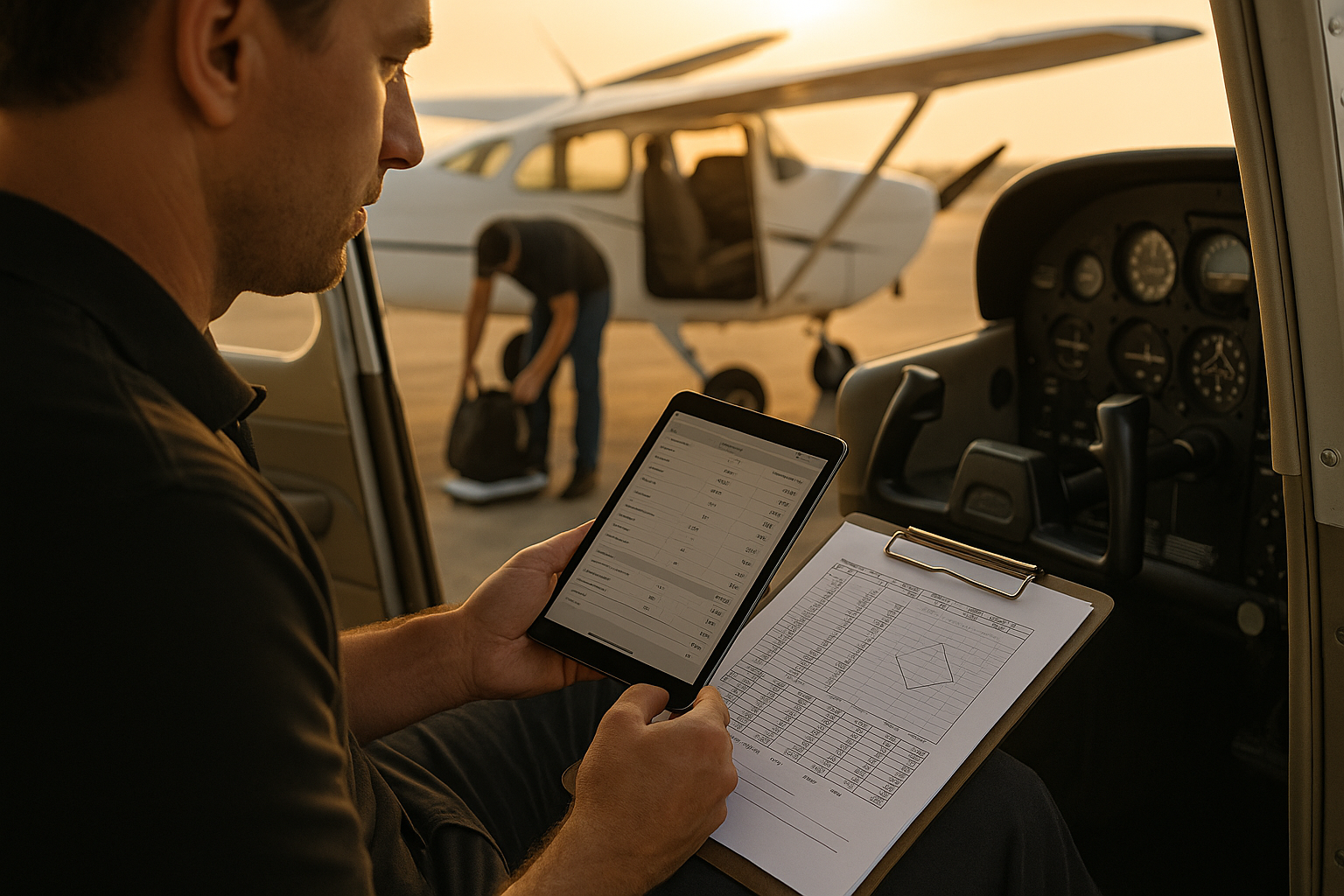
Weight and balance is the foundation of safe aircraft performance. Understanding how weight, center of gravity, and their interaction with performance parameters affect every phase of flight is a basic pilot responsibility. Modern technology has changed how we calculate, record, and manage weight and balance, but technology does not replace judgement. Pilots, student pilots, flight instructors, and operators must know the principles and the limits of the tools they use.
This article explains practical, operational best practices for weight and balance using modern tools. You will find clear explanations of key concepts, how technology changes the workflow in the cockpit and flight planning, common mistakes to avoid, a realistic training scenario, and concrete practices that improve safety and decision-making. The primary keyword, weight and balance, appears early because it is central to the decisions pilots make before every flight.
Understanding the Core Concepts of Weight and Balance
At its core, weight and balance covers two interrelated concepts. Weight is the total mass the aircraft carries, including the aircraft empty weight, usable fuel, passengers, baggage, and any cargo. Balance refers to the distribution of that weight along the aircraft longitudinal axis, represented by the center of gravity or CG. The CG location relative to the aircraft reference datum changes handling, stability, and performance.
Two practical measures pilots use are the moment and the arm. The arm is the distance from the reference datum to where an item of weight is located. The moment equals weight multiplied by arm. Dividing total moment by total weight yields the CG position. Modern weight and balance tools automate this arithmetic, but pilots must still understand the variables and the assumptions behind the numbers.
Manufacturers publish weight and balance limits, procedures, and sample loading calculations in the airplane flight manual or pilot operating handbook. Those limits are specific to the airframe and often to optional equipment or modifications. Many modern aircraft also provide placards and supplements that further constrain weight and balance in operational configurations.
Why Weight and Balance Matters in Real-World Aviation
Weight and balance directly affects controllability, stall behavior, longitudinal stability, and structural loading. An aft CG tends to reduce longitudinal stability and can make stall recovery more difficult. A forward CG increases stability but can raise stall speeds and make rotation or flare difficult in landing. Excess weight increases takeoff and landing distances, reduces climb performance, and can cause the aircraft to exceed structural or performance limitations in emergency conditions.
From a training perspective, weight and balance errors are common learning points for students and recurrent trainees. In operations, inaccurate weight and balance calculations can complicate crosswind takeoffs, high-density altitude departures, and single-engine performance after an engine failure. Weight and balance also affects load planning for commercial operations and maintenance scheduling for airframe fatigue analysis.
How Modern Technology Changes the Workflow
Tools that pilots and operators now use include digital calculators, mobile apps, integrated avionics loading pages, electronic weight and balance sheets, and load management systems for larger aircraft. These tools speed calculations, reduce arithmetic errors, and can archive load sheets for later review. They can also embed POH data like arms and moments, automate interpolation for partial fuel loads, and provide warnings when calculated CG is out of limits.
Despite the efficiency gains, modern tools introduce new risk points. Data entry errors, incorrect aircraft configuration selection in an app, or reliance on outdated aircraft weight data can produce misleading results. Integration between tools and flight planning platforms can create an appearance of automation that masks necessary pilot verification steps.
How Pilots Should Understand Weight and Balance Practically
Think of weight and balance as an active decision process, not a single checkbox. Before every flight, confirm the aircraft basic empty weight and moment for the actual aircraft you will fly. Verify installed equipment, optional baggage, and any modifications that affect empty weight or arm. Confirm usable fuel figures and density assumptions if flying in conditions where fuel density is relevant for weight conversions.
When using a digital tool, follow these verification steps. First, ensure the tool is configured for your exact aircraft make, model, serial number, and any STC-installed equipment that may change the basic empty weight or arm. Second, enter current weights and arms carefully, and review every input. Third, cross-check the resulting total weight and CG against the values the POH indicates for typical configurations. Finally, document the load sheet in the aircraft’s log or electronic archive so the calculation can be reviewed later if necessary.
Remember that a single discrepancy can change the result. An error entering passenger baggage weight, or forgetting to subtract unusable fuel or oil, can shift CG or push weight beyond limits. Use a consistent sequence for data entry and a verbal or written crosscheck with a crewmember when possible.
Common Mistakes and Misunderstandings
Pilots make predictable mistakes when managing weight and balance. One common error is applying sample or generic weight and balance data rather than data specific to the aircraft and its installed equipment. A sample table in the POH may not match an individual aircraft with additional avionics or interiors. Another common mistake is neglecting to account for unusable fuel and oil or failing to update fuel weight as fuel is burned en route on long flights where in-flight weight and balance shift matters for certain operations.
Relying blindly on an app or an avionics page is another frequent problem. Technology can present a clear numeric result without context. Pilots must interpret that result in light of aircraft configuration, runway length, density altitude, and emergency scenarios where a different CG or weight could worsen outcomes. Some pilots assume that a load within published CG limits is automatically safe. While within-limits loading meets certification standards, it does not guarantee acceptable handling for a given flight profile, especially at extreme ends of the range or with substantial fuel burn planned.
Training gaps are also notable. Student pilots and new certificated pilots may be taught the arithmetic but not the practical checks that reveal bad inputs. Flight instructors should emphasize the habit of verifying empty weight entries, confirming fuel densities, and performing a reasonableness check against expected takeoff weights. For commercial and charter operations, organizational procedures and dispatch systems should include audit trails and error-capture mechanisms to catch incorrect entries.
Practical Example: A Cross-Country with Variable Fuel Burn
Consider a four-seat single-engine airplane flying a 400 nm cross-country with two passengers and full baggage. The aircraft departs with full fuel but plans fuel stops. At dispatch, the pilot calculates weight and balance using a smartphone app configured to the aircraft serial number and verifies the CG is within limits. Shortly after takeoff, the pilot realizes the planned fuel stop will be delayed, requiring more fuel burn and a longer flight segment with a different final landing weight. The pilot should re-evaluate weight and balance for the landing configuration if the fuel burn will shift the CG or if passenger movement during flight is possible.
In this scenario, good practice includes computing expected weight and CG for takeoff, en route low-fuel phases, and landing at the destination. If the aircraft will burn enough fuel to move the CG into a less favorable region, the pilot should consider redistributing baggage or moving passengers if safe, or alter fuel planning. Use the app to model fuel burn and create alternate loading scenarios so that each critical phase stays within acceptable handling characteristics.
Best Practices for Pilots Using Modern Tools
Adopt a predictable workflow. Create a standard sequence for weight and balance checks and make it part of your briefing. A practical sequence might include confirming aircraft serial number and empty weight, verifying installed equipment entries, recording passenger and baggage weights, entering fuel figures, and running the calculation. After the calculation, perform a reasonableness check comparing computed takeoff weight to expected numbers. If a value is surprising, stop and re-check every input.
Use two independent methods when feasible. For mission-critical flights, perform the calculation with both an app and a manual sheet, or have a second pilot or dispatcher perform an independent calculation. This redundancy catches data-entry mistakes and software misconfiguration.
Keep weight and balance records. For training and operational safety, archive load sheets electronically or keep printed copies in the aircraft logbook. These records are useful for training debriefs, weight audits, and post-flight analyses. When an aircraft receives modifications or equipment changes, update the basic empty weight and arms promptly and include documentation for crew reference.
Understand software limitations. Not all apps handle special configurations correctly. Verify the app’s reference datum, units, and whether arms are defined relative to the same datum the POH uses. Watch for unit mismatches between pounds and kilograms, or inches and centimeters in international contexts. Confirm whether the app interpolates moments correctly for partial fuel loads and whether it accounts for unusable fuel.
Train with scenarios that reveal the operational effects of CG extremes. During dual instruction, include simulated aft and forward CG conditions within the aircraft’s allowable range so students experience differences in stability, stall characteristics, and rotation behavior. Always conduct these exercises in safe training environments and follow instructor guidance on margins and safety protocols.
Tools and Techniques to Improve Accuracy
Select reputable apps and keep them updated. Use tools from established aviation publishers, avionics manufacturers, or operators with a track record for accuracy. Confirm that the tool supports your aircraft serial number and any supplemental type certificates. Regularly update the app and its aircraft database to reflect manufacturer corrections or technical service bulletins that change weight or arm data.
Use physical scales for precise cargo and baggage measurements where weight is critical. Portable scales for baggage and, when practical, for passengers can improve accuracy. For larger aircraft or company operations, invest in calibrated platform scales and procedures to reconcile actual aircraft empty weight after maintenance, or after major interior or avionics changes.
Automate checks where possible. Integrations between dispatch systems and weight and balance tools can pre-fill passenger counts and cargo manifests to reduce manual entry. However, automation requires oversight. Establish quality-control checks that compare automatic entries to receipts or passenger manifests prior to departure.
Regulatory and Operational Context
Pilots should be familiar with any regulatory guidance applicable to their operations, but do not treat an app’s output as regulatory compliance alone. Commercial operators and air carriers often have company manuals and dispatch procedures that define how weight and balance is calculated and documented. Part 91, 135, or other operational rules may establish different expectations or oversight mechanisms. Always follow the applicable operator procedures and aircraft-specific documentation.
When in doubt, consult the aircraft POH or AFM. Those documents remain the authoritative source for weight and balance data, limits, and sample calculations. If the aircraft has been modified, ensure the modifications are documented and that the basic empty weight and arm in your calculations reflect the current configuration.
Frequently Asked Questions
How often should a pilot compute weight and balance?
Compute weight and balance before every flight that could be affected by loading differences. That includes any flight with changes in passenger count, baggage, fuel load, or configuration. Recompute when fuel burn, payload changes, or passenger movement could change the CG for critical flight phases.
Can I rely solely on an app or avionics page for weight and balance?
While apps and avionics provide valuable speed and error reduction, do not rely on them exclusively. Verify the app is configured correctly for your specific aircraft and cross-check results with the POH or a manual calculation when possible. Use redundancy for critical or non-routine operations.
What should I do if the calculated CG is near a limit?
Near-limit CG results require careful evaluation. Consider redistributing baggage or passengers, adjusting fuel planning, or reducing payload. If the CG is within published limits but near an extreme, account for how fuel burn or passenger movement could move the CG during flight and mitigate those changes before departure.
How do fuel burn and in-flight changes affect CG?
Fuel burn changes total weight and can shift the CG depending on where fuel tanks are located relative to the datum. For flights where fuel will be significantly reduced before a critical phase like landing, compute weight and CG for expected landing conditions and make adjustments on the ground if needed.
Are sample weight and balance forms reliable for my aircraft?
Sample forms are useful as templates but may not reflect the exact empty weight or arm of your specific aircraft. Always use aircraft-specific data, and update your entries after modifications or equipment changes.
Common Misunderstandings Summarized
One misunderstanding is assuming that being within published limits ensures ideal handling. Certification limits ensure minimum safe behavior across a range of conditions, but every aircraft will handle differently within that range. Another misunderstanding is failing to consider dynamic changes during a flight. Fuel burn, passenger movement, and baggage shifts can change the CG and affect handling in ways pilots must anticipate and manage.
Key Takeaways
- Practical takeaway: Make weight and balance a routine, documented step with verification, not a last-minute calculation.
- Safety takeaway: Use redundancy and reasonableness checks to catch data-entry errors and configuration mistakes that could compromise handling or performance.
- Training and decision-making takeaway: Train for CG extremes within limits so pilots recognize and manage differences in control, stall behavior, and rotation characteristics.
Closing Thoughts
Modern technology offers significant improvements for managing weight and balance, but it also requires disciplined application. Treat tools as aids that reduce arithmetic errors and speed workflows. Maintain a skeptical operational mindset about inputs and outcomes. Verify aircraft-specific data, archive load sheets, and train for CG-related handling differences. With appropriate habits, digital tools will enhance safety, efficiency, and decision-making in everyday flying.