
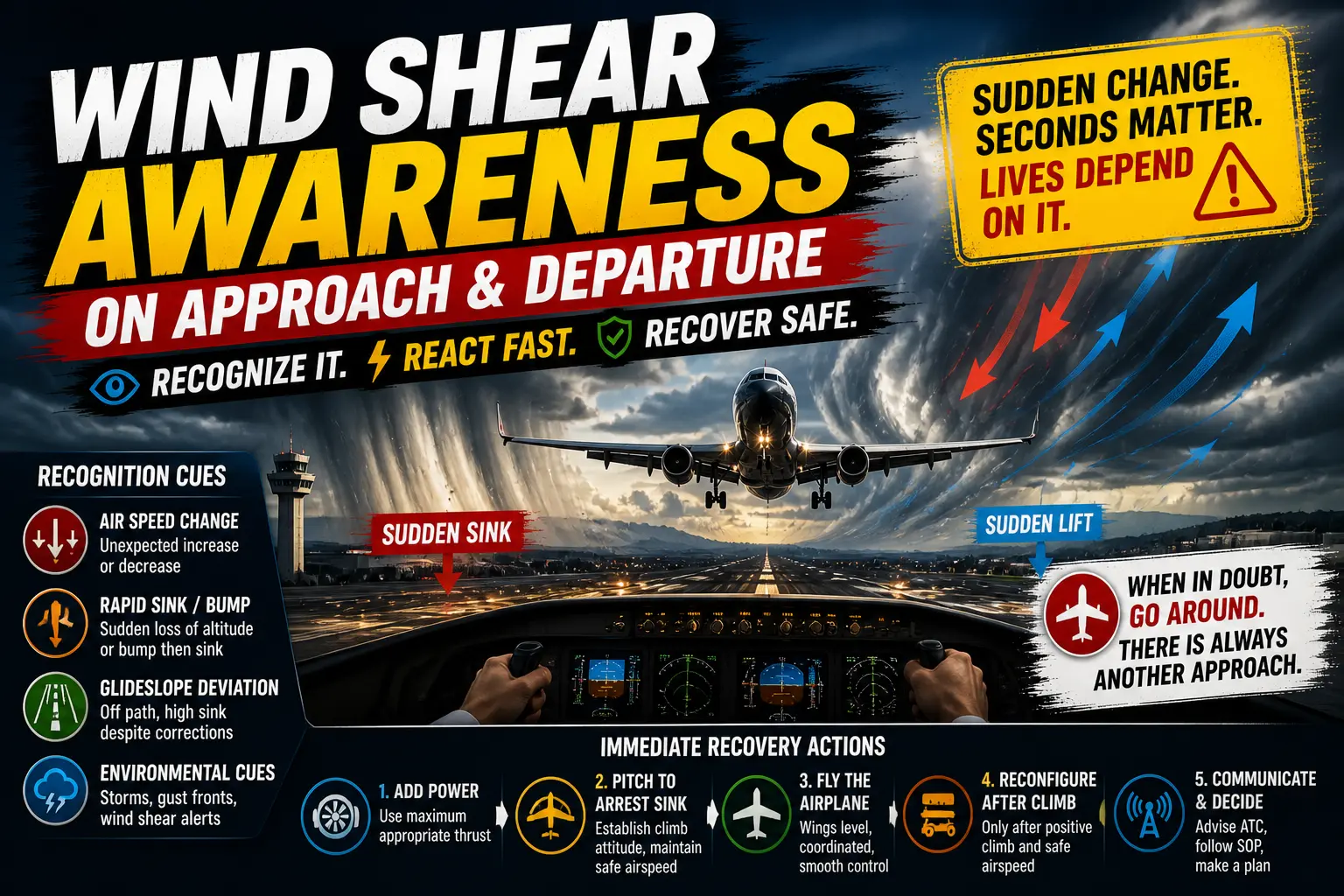
Wind shear is a sudden change in wind speed and/or direction over a short distance. For pilots, recognizing wind shear on approach and departure is critical because low-altitude encounters leave little time to diagnose the problem and execute a safe recovery. This article explains how to spot wind shear cues, what immediate recovery actions should focus on, and how to practice realistic training scenarios so pilots, instructors, and operators can manage risk effectively.
The practical value of this article is straightforward: better recognition plus practiced recovery reduces hesitation and poor control inputs when an encounter occurs. The primary keyword "wind shear" appears naturally here because awareness of wind shear is essential to safe approaches and departures. Read on for clear explanations, training recommendations, and a realistic example you can use in the simulator or briefing room.
What Wind Shear Is and Why It Matters
Wind shear describes a rapid change in wind vector that can produce abrupt variations in airspeed, ground speed, and vertical acceleration. At cruise altitudes some wind shear is benign. Near the surface it can transform a stable approach into an energy-deficit situation within seconds. Microbursts and convective downdrafts are dramatic examples, but shear also occurs near fronts, terrain-induced flow, and during gusty wind conditions around airports.
On approach and departure, the airplane is typically at low altitude, with limited climb performance and close to landing or takeoff configuration. That combination reduces margins for error, so early recognition and decisive response are the keys to survivability and safety.
Recognition Cues: How Pilots Detect Wind Shear
Wind shear recognition is a combination of instrument indications, external cues, and pilot feel. No single signal proves shear; use multiple cues together.
- Airspeed trends: Sudden, uncommanded increases or decreases in airspeed with no change in power or pitch are a primary cue. A quick drop in indicated airspeed on final deserves immediate attention.
- Vertical speed and sink/bump: Rapid increase in descent rate, or an abrupt bump followed by a sink, often signals a shear layer or downdraft passing through the aircraft's flight path.
- Energy and control feel: A change in control forces or the sensation of the airplane being pushed up or down while power and attitude remain constant is important tactile feedback.
- Flight path anomalies: Loss of glideslope tracking, overshooting the glidepath, or unexpected increases in required pitch to maintain the approach path.
- Environmental and operational cues: Active convective activity, microburst warnings, low-level wind shear alerts from tower or automated systems, and rapidly shifting wind indicators at the airport (wind sock, ASOS/ATIS updates) all increase risk.
Immediate Recovery Actions
When wind shear is suspected on approach or encountered on departure, recovery actions must be prompt, coordinated, and focused on keeping the aircraft within safe energy margins. The specific maneuvers vary by aircraft type and manufacturer guidance, so pilots should follow the aircraft flight manual or operator standard operating procedures. The general priorities are the same across types.
- Apply maximum appropriate thrust: Use available power to arrest a descent and regain energy. In turbine aircraft this often means applying takeoff or go-around thrust; in piston aircraft it usually means advancing to full or best-power setting suitable for the situation.
- Pitch to an attitude that arrests the descent: Adjust pitch to stop the sink and establish a positive climb rate while ensuring airspeed remains above safe maneuvering or approach speed. Avoid over-rotating to a high pitch that causes a rapid airspeed decay.
- Fly the airplane first: Maintain wings-level or coordinated flight. Control inputs should be smooth and effective; abrupt bank or rudder may compound the problem.
- Reconfigure only after positive climb and safe airspeed: Retracting flaps or gear prematurely can reduce lift and increase sink. Follow the sequence published in the POH or SOP once a positive climb and controlled airspeed are established.
- Communicate and make decisive decisions: If on approach, execute a go-around or missed approach early rather than trying to salvage a rapidly deteriorating landing. On departure, climb away from the hazard, request assistance if needed, and consider returning to the field if safe to do so.
These principles emphasize energy management and aerodynamic control. The exact pitch attitudes and thrust settings are aircraft-specific and should be practiced in the simulator using the aircraft's recommended procedures.
Why This Matters in Real-World Aviation
Wind shear has been a factor in many accidents and incidents because it reduces the predictability of the aircraft's response. For flight instructors, student pilots, and operators, understanding typical shear environments and practicing recovery builds the reflexes needed to act decisively. Dispatchers and flight planners also benefit by considering shear risk when selecting runways and departure procedures.
Operationally, wind shear awareness affects decision-making during go/no-go calls, approach briefings, and in-flight changes. For instrument operations, timely ATC wind shear alerts and onboard predictive systems can be lifesaving, but pilots must still be prepared to fly the aircraft when automation or alerts are unavailable.
How Pilots Should Understand Wind Shear in Practical Terms
Treat wind shear as an energy management problem. Think in terms of airspeed, thrust, pitch, and configuration — and how each affects the airplane's kinetic and potential energy. When airspeed suddenly drops because of a headwind loss or downdraft, you need to restore energy fast. That typically means adding thrust and adjusting pitch, but the order and magnitude should match the airplane's handling characteristics and the pilots' training.
Use your instruments: the airspeed indicator, vertical speed indicator, attitude indicator, and engine instruments provide objective cues when external visual cues are limited. In two-pilot operations, verbalize observed trends immediately and call for the established recovery. In single-pilot operations, practice prompt, high-fidelity recognition and recovery responses in the simulator so the correct actions become automatic.
Common Mistakes and Misunderstandings
Pilots make several recurring errors when dealing with wind shear. Recognizing these pitfalls helps instructors tailor training and helps pilots avoid common traps.
- Delaying a go-around: Trying to salvage an unstable approach instead of executing a missed approach or go-around early reduces time to correct and increases risk.
- Fixating on one instrument: Relying only on airspeed or only on pitch without integrating a full picture can lead to inappropriate inputs.
- Improper configuration changes: Retracting flaps or gear before establishing a positive climb can remove lift and worsen the situation.
- Overcontrolling: Aggressive pitch or bank inputs can rapidly bleed energy and create a more hazardous state.
- Ignoring environmental cues: Disregarding ATIS/ATC shear advisories, towering cumulus near the field, or rapidly changing surface winds reduces situational awareness.
Practical Example: A Realistic Training Scenario
Scenario: Single-engine airplane on short final to a busy airport on a gusty day. The ATIS indicates gusty winds and wind shear advisories are not available. As you cross the final approach fix, indicated airspeed begins to decay without a change in power setting, and you feel a bump followed by increased sink. The runway is close.
Training application: In the simulator, set up a gusty-wind profile that causes a sudden loss of headwind component when the aircraft reaches the final segment. Instruct the pilot to recognize the airspeed decay and sink, add maximum appropriate power, and pitch to arrest the descent while maintaining wings level. Then, once a positive climb is established and airspeed stabilizes, practice the procedure for retracting flaps incrementally or executing a missed approach. Debrief on timing, control inputs, and whether the pilot maintained energy margins throughout.
Variants for training: introduce a microburst-like downdraft on departure so the pilot practices a low-altitude climb with a sudden sink. Repeat with two pilots so the non-flying pilot can practice callouts and monitoring flight instruments under stress.
Best Practices for Pilots
Consistent habits and preflight planning reduce wind shear risk and improve recovery success.
- Include wind shear in every approach and departure briefing when conditions justify it.
- Practice recovery maneuvers regularly in the simulator or training aircraft under instructor supervision.
- Follow aircraft-specific procedures from the POH or operator SOP for engine power and configuration changes during wind shear recovery.
- Use available weather products, ATC advisories, and predictive wind shear systems to inform decisions.
- If in doubt, choose a stabilized approach or a go-around early rather than continuing an unstable approach close to the runway.
Frequently Asked Questions
How quickly should I react when I suspect wind shear on final?
React immediately. Early recognition and decisive action preserve altitude and airspeed. The typical response is to add appropriate power and adjust pitch to arrest descent, then follow your aircraft-specific procedures. Practice will reduce reaction time and improve execution.
Should I retract flaps or gear during a wind shear recovery?
Only reconfigure once you have a positive climb and safe airspeed and after following the procedures in your POH or SOP. Premature retraction can reduce lift and increase sink; reconfiguration should be a secondary action after energy is regained.
Can small general aviation airplanes safely climb out of a microburst?
Microbursts are hazardous because they create rapidly changing winds and strong downdrafts. The ability to escape depends on the aircraft's performance, weight, and proximity to the downdraft center. Avoid taking off into convective activity and train to recognize cues; if you encounter a severe downdraft, focus on maximum available power and pitch to regain positive climb per your aircraft guidance.
How can I practice wind shear recovery effectively?
Use a flight simulator or FAA-approved training device to practice a variety of shear encounters at different altitudes and configurations. Include both approach and departure scenarios and train with instructor-led debriefs. Emphasize recognition cues, correct power/pitch responses, and the timing of configuration changes.
Key Takeaways
- Practical takeaway: When you suspect wind shear, prioritize energy—apply available power and pitch to stop the descent before reconfiguring.
- Safety takeaway: Execute a go-around or missed approach early rather than trying to salvage an unstable approach close to the runway.
- Training and decision-making takeaway: Practice recognition and recovery in a simulator using aircraft-specific procedures so responses become automatic under stress.