
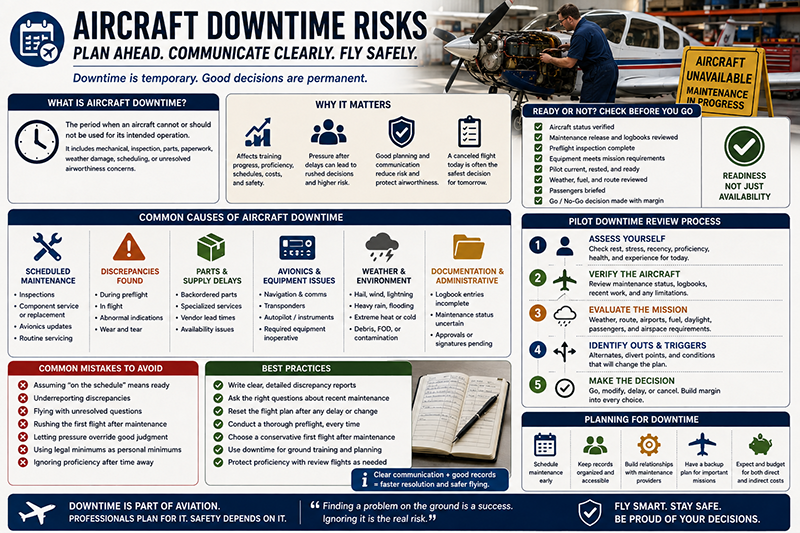
Aircraft downtime risks affect far more than a maintenance calendar. For pilots, student pilots, flight instructors, aircraft owners, and aviation managers, an airplane that is unexpectedly unavailable can disrupt training progress, delay trips, increase costs, and create pressure to make decisions too quickly when the aircraft returns to service. Downtime is not only a business issue. It is also a safety, planning, proficiency, and judgment issue.
In aviation, downtime usually means an aircraft is not available for flight because of maintenance, inspection, parts availability, paperwork, weather-related damage, scheduling conflicts, or unresolved airworthiness concerns. Some downtime is planned, such as an inspection or scheduled component replacement. Other downtime arrives without warning, such as a discrepancy found during preflight, an inoperative system discovered before dispatch, or a maintenance item that takes longer than expected. Understanding the difference helps pilots plan smarter, communicate better, and avoid letting schedule pressure influence airworthiness decisions.
What Aircraft Downtime Really Means
Aircraft downtime is the period when an aircraft cannot or should not be used for its intended operation. That definition matters because an aircraft can be physically sitting on the ramp, visually intact, and still not be ready for flight. It may need maintenance signoff, a required inspection, a logbook entry, an operational check, a replacement part, or a decision about whether an inoperative item can be deferred under the applicable rules and procedures.
For a training aircraft, downtime might mean a student loses a stage check slot or misses an important continuity window. For a private owner, it may mean canceling a family trip or delaying a business flight. For a flight school, downtime can ripple through instructor schedules, student progress, aircraft utilization, maintenance capacity, and customer expectations. For commercial operators, aircraft availability is closely tied to operational reliability, passenger service, contractual commitments, and crew scheduling.
The most important point for pilots is simple: downtime is not wasted time if it protects airworthiness. The risk begins when downtime is treated only as an inconvenience rather than as a signal that the aircraft, documentation, or operating plan needs attention. A grounded aircraft may be frustrating, but launching in an aircraft with unresolved concerns can create much greater consequences.
Downtime also has several forms. Scheduled downtime is planned in advance and usually has a maintenance purpose, such as an inspection, service, avionics update, tire replacement, brake work, or routine engine-related maintenance. Unscheduled downtime occurs when something unexpected is discovered. Administrative downtime occurs when the airplane may be mechanically ready but documentation, approvals, logbook entries, or release processes are incomplete. Operational downtime occurs when the aircraft is technically available but unsuitable for the mission, such as when required equipment for a particular operation is not functioning or weather conditions require capabilities the aircraft does not have.
Why This Matters in Real-World Aviation
Aircraft downtime risks matter because aviation decisions rarely happen in isolation. A delayed aircraft can affect pilot currency, instructor availability, passenger expectations, maintenance workload, fuel planning, rental schedules, insurance requirements, and overall operational tempo. When several of those pressures build at once, pilots may become more vulnerable to get-there thinking, incomplete preflight planning, or assumptions about aircraft status.
In flight training, aircraft downtime can interrupt learning momentum. Skills such as landings, instrument scan, radio communication, navigation, and emergency procedures improve with repetition and recency. A student who misses several scheduled flights because an aircraft is unavailable may return with weaker rhythm and confidence. That does not mean the student has regressed permanently, but it does mean instructors should consider whether a review flight is needed before continuing with more advanced tasks.
For certificated pilots, downtime can affect proficiency in subtler ways. A pilot who has not flown a specific aircraft for several weeks may be legally current for certain operations but not as sharp in that aircraft’s avionics, sight picture, checklist flow, fuel system, or performance characteristics. If the airplane returns from maintenance with a new component, updated equipment, or a recently corrected discrepancy, the first flight back deserves additional attention.
For aircraft owners and managers, downtime can expose weak points in planning. If one aircraft supports too many missions with no backup plan, any unscheduled maintenance event becomes a crisis. If parts availability is uncertain, a small discrepancy may keep the aircraft parked for longer than expected. If logbooks are not organized, administrative delays can extend downtime even after maintenance work is complete. None of these issues require dramatic failure to create disruption. Small delays can compound quickly.
Downtime also intersects with safety culture. A healthy aviation organization does not punish pilots for identifying discrepancies or refusing an aircraft that does not appear ready. Instructors should model this for students by treating maintenance write-ups as part of professional flying, not as an annoyance. Aircraft owners should encourage clear communication with maintenance providers and avoid pressuring technicians for unrealistic return-to-service timelines. Pilots should remember that a canceled flight is often the most professional outcome when aircraft condition is uncertain.
How Pilots Should Understand Aircraft Downtime Risks
Pilots do not need to become maintenance technicians to understand aircraft downtime risks, but they do need to understand how aircraft availability connects to airworthiness and operational decision-making. The practical question is not only, “Is the airplane on the schedule?” The better question is, “Is the airplane ready, legal, documented, and suitable for this flight?”
Airworthiness has both a mechanical and a documentation component. An aircraft may look fine but still require maintenance documentation, inspection status confirmation, or proper handling of an inoperative item. Conversely, a logbook may show recent work, but the pilot still needs to conduct a careful preflight inspection and verify that the aircraft performs normally before departure. The maintenance release or logbook entry does not replace pilot observation.
Pilots should also understand that downtime risk changes with mission complexity. A local day VFR training flight in familiar weather may have more flexibility than an IFR cross-country, night flight, mountain operation, or trip into busy airspace. If an aircraft recently returned from maintenance, the first mission after downtime should be selected thoughtfully. A short local flight in good weather may be a more conservative way to confirm normal operation than launching immediately on a demanding trip.
Another practical concept is the difference between availability and readiness. Availability means the aircraft is not blocked on the schedule. Readiness means the aircraft, pilot, maintenance status, weather, fuel, equipment, and documentation all support the intended operation. Pilots who focus only on availability may miss readiness issues. A flight school aircraft may be assigned to a student, but if a discrepancy appears during preflight, the aircraft is no longer ready until the issue is evaluated properly.
Downtime risk also includes human factors. When a flight has already been delayed, pilots may feel pressure from passengers, instructors, employers, customers, or their own expectations. That pressure can make a minor uncertainty feel inconvenient rather than important. A professional pilot mindset treats uncertainty as information. If a gauge indication, fluid leak, tire condition, avionics abnormality, or logbook question does not make sense, the right move is to slow down and ask for qualified help.
Common Causes of Aircraft Downtime
Aircraft downtime can result from many ordinary aviation realities. Some are predictable, while others are not. Understanding common causes helps pilots prepare for delays without being surprised by them.
Scheduled inspections and routine maintenance are normal sources of downtime. Aircraft require periodic inspections and continuing maintenance appropriate to their operation and maintenance program. The details vary by aircraft, operation, and applicable rules, so pilots should avoid assuming that every aircraft follows the same schedule. What matters operationally is that scheduled maintenance is planned early enough to prevent last-minute cancellations whenever possible.
Discrepancies found during preflight are another frequent source. A soft tire, low strut, fluid leak, damaged fairing, loose fastener, abnormal control movement, missing fuel cap, cracked lens, or inoperative light may require maintenance evaluation before flight. Some discrepancies are minor and quickly resolved. Others reveal a deeper issue. Pilots should avoid diagnosing beyond their competence, but they should be observant and specific when reporting what they found.
Parts availability can significantly extend downtime. Even when a maintenance provider identifies the issue quickly, the aircraft may remain out of service while waiting for approved parts, repair services, or specialized expertise. This can be especially challenging for older aircraft, less common models, or avionics systems that require specific components. Pilots and owners should resist the temptation to view parts delays as merely administrative. The correct part and proper installation matter.
Avionics issues can create operational downtime even when the aircraft is otherwise flyable. A navigation display, transponder, communication radio, GPS unit, autopilot, or instrument indication problem may limit the missions the aircraft can safely or legally perform. A pilot planning an instrument flight, for example, must consider whether the installed and functioning equipment supports the intended route, procedures, alternates, and airspace requirements. If not, the flight may need to be delayed, rerouted, or conducted under different conditions only if appropriate.
Weather and environmental exposure can also contribute. Hail, wind, lightning, heavy rain, extreme temperatures, contamination, and ramp debris can damage aircraft or create inspection concerns. Even a parked aircraft can experience risk when tiedowns, covers, control locks, or hangar protection are not managed properly. After severe weather, a careful inspection is not optional in spirit. It is a fundamental part of determining whether the aircraft is fit for flight.
Documentation and communication gaps can create downtime as well. Missing logbook entries, unclear discrepancy notes, incomplete maintenance status information, or confusion over whether an item has been corrected can keep an aircraft grounded. Good paperwork does not make an unsafe airplane safe, but poor paperwork can make a safe airplane unavailable or create uncertainty that no pilot should ignore.
The Safety Risk Behind Schedule Pressure
One of the most important aircraft downtime risks is not mechanical. It is psychological. When a flight has been delayed by maintenance, pilots often feel a strong desire to recover the schedule. That desire may be understandable, but it can become hazardous if it causes a pilot to compress planning, rush preflight, accept unclear information, or depart into deteriorating conditions.
Schedule pressure can be obvious, such as passengers waiting in the FBO lobby. It can also be quiet, such as a student pilot wanting to finish a lesson before a checkride, an instructor trying to keep a full day on track, or an owner trying to justify the cost of maintenance by getting the airplane back in the air immediately. Professional decision-making requires recognizing that pressure before it shapes the flight.
A useful habit is to reset the flight after downtime. Treat the departure as a new decision, not a continuation of the original plan. Recheck weather, NOTAMs as applicable, fuel requirements, aircraft status, performance expectations, passenger briefings, and personal readiness. If maintenance delays pushed the flight later in the day, lighting, temperature, wind, convective activity, and pilot fatigue may all have changed. The airplane returning to service does not automatically restore the original risk picture.
Maintenance return-to-service flights deserve particular care. After maintenance, pilots should pay attention to the systems that were worked on and to any adjacent systems that could reasonably have been affected. This does not mean assuming maintenance was performed incorrectly. It means applying disciplined observation. Verify normal indications, use checklists carefully, and consider staying close to the airport until the aircraft is clearly performing as expected.
Common Mistakes or Misunderstandings
A common mistake is assuming that if an aircraft is on the schedule, it is ready to fly. Scheduling systems are useful, but they are not a substitute for maintenance status, logbook awareness, preflight inspection, and pilot judgment. Pilots should verify aircraft status through the procedures used by their school, club, company, or ownership arrangement.
Another misunderstanding is treating all downtime as a maintenance department problem. Maintenance personnel play a critical role, but pilots contribute by writing clear discrepancies, avoiding vague descriptions, reporting changes promptly, and not flying with unresolved questions. A note such as “radio weird” is less helpful than a specific description of what happened, when it happened, which frequency or radio was involved, and whether the issue was intermittent or continuous.
Some pilots underreport discrepancies because they do not want to be blamed for grounding the airplane. That mindset is unhealthy. A discrepancy is not a personal failure. It is information needed to keep the aircraft reliable and safe. Flight instructors should teach students that finding a problem during preflight is a success, not an inconvenience.
Another mistake is overconfidence after a repair. Pilots may assume a fixed item is permanently resolved and pay less attention to it on the next flight. A better approach is to be respectfully alert. If an alternator, brake, fuel indication, landing gear component, avionics unit, or engine accessory was recently serviced, monitor related indications and aircraft behavior carefully during the first flight after maintenance.
Pilots also sometimes misunderstand deferred maintenance. Not every inoperative item automatically grounds every aircraft for every operation, but the rules and procedures for determining whether an aircraft can be flown with inoperative equipment are specific and must be followed correctly. This is not an area for guesswork. If a pilot is unsure, the appropriate response is to consult the aircraft’s approved information, the operator’s procedures, and qualified maintenance or operations personnel.
Finally, pilots may fail to account for proficiency downtime. If an aircraft is unavailable for several weeks, the pilot may not be flying either. A return to flying after a gap should include a personal proficiency assessment, not just an aircraft status check. This is especially true for instrument flying, night operations, complex avionics, tailwheel operations, high-performance aircraft, or any operation where skill fade can matter quickly.
Practical Example: A Training Aircraft Returns Late
Consider a student pilot scheduled for a dual cross-country flight in a four-seat training aircraft. The airplane was down for brake maintenance and was expected back in service in the morning. The maintenance work is completed later than planned, and the aircraft becomes available midafternoon. The student and instructor still want to go because the student has already canceled twice due to weather.
At first glance, the problem seems solved. The aircraft is back, the weather is still VFR, and both pilots are present. But a more careful review shows the risk picture has changed. The flight will now return closer to sunset. The winds at the destination have increased. The student is frustrated and eager to complete the lesson. The instructor has another commitment later in the day. The aircraft has just had brake work, so taxi, runup, landing rollout, and brake feel deserve extra attention.
A conservative instructor might reset the plan. Instead of launching on the full cross-country, they may conduct a shorter local flight to verify normal aircraft operation, review landings, and rebuild the student’s confidence. If everything is normal, the cross-country can be rescheduled under better time margins. That decision may feel inefficient, but it demonstrates excellent risk management. The goal is not to avoid flying after maintenance. The goal is to match the flight to the aircraft status, pilot readiness, environmental conditions, and available time.
This example also shows why downtime risk is not just about the broken part. The brake work was only one factor. The bigger issue was the combined effect of delay, changing weather, fading daylight, student pressure, instructor schedule, and a recently serviced system. Real-world aviation risk often builds through combinations like this.
Best Practices for Pilots
The best way to manage aircraft downtime risks is to build habits that make good decisions easier before pressure appears. Pilots should treat aircraft availability as one part of a larger readiness picture. That includes maintenance status, documentation, mission suitability, weather, fuel, pilot proficiency, passenger expectations, and time margins.
Clear discrepancy reporting is one of the most practical contributions pilots can make. When something does not look, sound, smell, or feel right, describe it accurately. Include the phase of operation, system involved, indications observed, and whether the issue repeated. Avoid diagnosing unless you are qualified to do so. Good information helps maintenance troubleshoot faster and reduces the chance of misunderstanding.
Pilots should also develop a habit of asking focused questions when an aircraft returns from downtime. What work was performed? Which systems were affected? Were any operational checks completed? Are there any limitations, placards, or procedures the pilot needs to know before flight? The goal is not to second-guess maintenance personnel. The goal is to understand the aircraft you are about to operate.
For owners and operators, planning reduces downtime impact. Schedule routine maintenance before the last possible moment, maintain organized records, build relationships with qualified maintenance providers, and plan alternatives for important trips. If a mission is time critical, consider whether airline travel, a backup aircraft, or a different schedule is more appropriate than pressuring a maintenance timeline.
For flight instructors, downtime should be part of training. Students should learn how to respond when an airplane is grounded, how to document a discrepancy, how to assess whether a flight should be modified, and how to avoid emotional pressure after a cancellation. These are professional pilot skills, even at the private pilot level.
- Verify aircraft status through the correct school, club, company, or owner process before assuming the airplane is ready.
- Conduct an unhurried preflight inspection, especially after maintenance or weather exposure.
- Reset the flight plan after a maintenance delay rather than trying to force the original plan.
- Use qualified maintenance and operational guidance when an inoperative item or unclear discrepancy is involved.
- Protect proficiency by scheduling review flights after extended gaps or aircraft-specific downtime.
Managing Downtime in Flight Training
Flight training is particularly sensitive to downtime because learning depends on continuity. A student who flies frequently often develops better pattern recognition, checklist flow, aircraft control, and radio confidence than a student whose lessons are repeatedly interrupted. When aircraft downtime interrupts that continuity, the instructor should adapt the training plan rather than simply resume where the previous lesson ended.
Ground training can help preserve momentum during aircraft downtime. Instead of treating a canceled flight as a lost lesson, instructors can use the time for cross-country planning, weather interpretation, systems review, performance calculations, emergency procedures, airspace review, avionics practice, or scenario-based decision-making. A well-used ground session can make the next flight more productive.
Simulators and aviation training devices may also help, when appropriate for the training objective and available under the program’s procedures. They are not a replacement for every aircraft lesson, but they can support instrument scan, checklist discipline, navigation flows, radio procedures, and cockpit resource management. The key is to use them intentionally rather than as a generic substitute.
Students should also learn the emotional side of downtime. Cancellations are part of aviation. Weather, maintenance, scheduling, and personal readiness all affect operations. A student who learns to handle cancellations professionally is developing real aeronautical decision-making. The pilot certificate is not only about manipulating the controls. It is about knowing when not to fly and how to manage the consequences of that decision.
Maintenance Communication and Pilot Responsibility
Good communication between pilots and maintenance personnel reduces downtime risk. Pilots see and feel the aircraft in operation. Maintenance technicians inspect, repair, test, and document the aircraft within their scope of work. When both sides communicate clearly, small problems are more likely to be resolved before they become larger operational disruptions.
Pilots should avoid minimizing symptoms. If an engine indication fluctuated, an electrical smell appeared, a radio failed intermittently, or a control felt abnormal, write it up or report it through the proper process. Intermittent problems can be difficult to troubleshoot, but that makes accurate pilot reporting more important, not less. Time, temperature, vibration, phase of flight, and recent maintenance history may all be relevant.
At the same time, pilots should avoid overstating certainty. There is a difference between “the alternator failed” and “the ammeter showed discharge and the low-voltage light illuminated during cruise.” The second statement gives maintenance a clearer starting point and avoids premature diagnosis. Professional language improves the maintenance process.
Pilot responsibility does not end when maintenance signs off work. Before flight, the pilot still needs to review the aircraft in the context of the intended operation, complete the preflight inspection, use checklists, and make a go or no-go decision. If something does not seem right, the fact that the aircraft was recently released does not require the pilot to depart. Safety depends on continuous verification.
Operational Planning for Owners and Aviation Managers
Owners and aviation managers should treat downtime as a predictable part of aircraft operation, even when exact timing is uncertain. Aircraft are machines operated in demanding environments. They require inspections, servicing, repairs, cleaning, updates, and occasional troubleshooting. A plan that assumes constant availability is not a plan. It is a vulnerability.
Good downtime planning begins with realistic scheduling. Leave space around inspections and maintenance events. Avoid booking critical missions immediately after major work unless there is time for verification and contingency planning. Keep aircraft records organized so status questions can be answered quickly. Maintain a list of trusted maintenance providers, avionics shops, parts sources, and support contacts appropriate to the aircraft type.
Financial planning also matters. Downtime can create direct maintenance costs and indirect costs such as canceled travel, replacement transportation, lost training revenue, or schedule disruption. The exact amounts vary widely by aircraft and operation, so pilots and owners should avoid relying on generic estimates. What matters is recognizing that downtime has both mechanical and operational consequences.
For multi-aircraft organizations, downtime planning includes fleet assignment strategy. Training programs may rotate aircraft to balance utilization, reserve certain aircraft for specific missions, or adjust schedules when maintenance demand rises. Small operators may not have the luxury of spare aircraft, but they can still create communication plans so customers, students, and crews receive timely updates.
Frequently Asked Questions
What are aircraft downtime risks?
Aircraft downtime risks are the safety, operational, training, financial, and scheduling concerns that arise when an aircraft is unavailable or not ready for its intended flight. The risk is not just the delay itself. It is the pressure, uncertainty, and decision-making challenge that can follow.
Is aircraft downtime always a sign of poor maintenance?
No. Downtime can result from responsible maintenance, scheduled inspections, proper discrepancy handling, parts delays, or cautious decision-making. Frequent or poorly managed downtime may indicate planning or reliability issues, but downtime itself is a normal part of aircraft operation.
Should a pilot fly an aircraft immediately after maintenance?
A pilot may fly an aircraft after maintenance when it has been properly returned to service and is suitable for the intended operation, but the first flight should be approached thoughtfully. Review what work was performed, complete a careful preflight, monitor related systems, and consider a conservative mission profile when appropriate.
How can student pilots use downtime productively?
Student pilots can use downtime for ground training, weather review, systems study, flight planning, radio practice, simulator sessions, and aeronautical decision-making scenarios. A canceled flight does not have to be a canceled learning opportunity.
What should pilots do if they find a discrepancy during preflight?
Pilots should follow their school, club, company, or owner reporting procedure and avoid flying until the discrepancy is properly evaluated. The report should be specific, factual, and timely. If there is uncertainty about airworthiness or required equipment, get qualified guidance before proceeding.
How does downtime affect pilot proficiency?
Downtime can reduce recency and confidence, especially in aircraft-specific procedures, avionics use, instrument flying, night operations, or other skill-sensitive areas. After a long gap, a review flight or instructor session may be a wise risk management step even when not specifically required.
Key Takeaways
- Aircraft downtime risks include more than maintenance delays. They affect readiness, planning, proficiency, and pilot decision-making.
- Schedule pressure after downtime can lead to rushed preflight planning, weak risk assessment, and poor go or no-go decisions.
- Pilots should verify aircraft status, communicate discrepancies clearly, and reset the flight plan whenever downtime changes the original risk picture.