
Aircraft insurance considerations for pilots begin long before a premium quote appears in an email. Insurance affects how pilots rent, borrow, own, operate, instruct in, and make decisions around aircraft. It also influences risk management in ways that are not always obvious during flight training. A pilot may understand weather minimums, aircraft performance, and airspace procedures, yet still be surprised by how insurance conditions can shape who may act as pilot in command, what training is expected, where the aircraft may be operated, and what happens after an incident.
This article is written for pilots, student pilots, instructors, aircraft owners, flying club members, and aviation professionals who want a practical understanding of aircraft insurance without turning the subject into legal or financial advice. The goal is to help you ask better questions, read policy language more carefully, and integrate insurance awareness into sound aeronautical decision-making. Insurance cannot make an unsafe flight safe, and it does not replace regulations, aircraft limitations, or good judgment. But when understood properly, it becomes part of a broader safety and operational risk picture.
What Aircraft Insurance Is Really Protecting
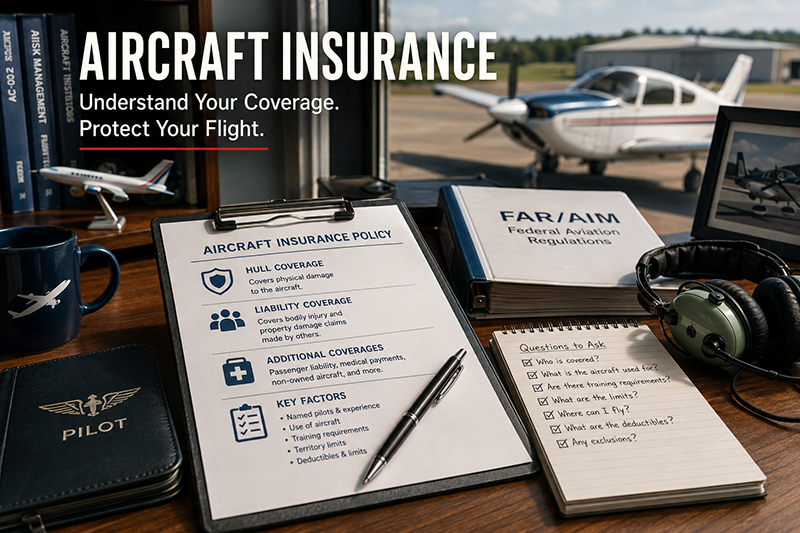
Aircraft insurance is a contract that defines what types of aviation-related losses may be covered, who may be covered, under what conditions, and to what limits. Pilots often think of insurance as protection for the airplane itself, but a complete aviation insurance discussion usually includes multiple exposure areas. These may include physical damage to the aircraft, liability for bodily injury or property damage, passenger liability, medical payments, damage to non-owned aircraft, and specialized coverage for commercial or instructional operations.
The two broad categories pilots hear most often are hull coverage and liability coverage. Hull coverage generally refers to physical damage to the aircraft. Liability coverage generally addresses claims made by others for injury or property damage arising from aircraft operations. The details matter because policy wording, exclusions, deductibles, named pilot provisions, territory limits, use limitations, and training requirements can significantly affect whether a loss is covered.
For aircraft owners, insurance is part of the operating cost structure, similar to maintenance reserves, hangar fees, fuel, inspections, and avionics support. For renters and flying club members, insurance determines how much personal financial exposure remains if an aircraft is damaged or a claim occurs. For instructors, insurance affects whether giving instruction in a particular aircraft is properly covered. For student pilots, understanding insurance early helps prevent a common misconception: being authorized to fly by a school or club does not automatically mean every possible loss is fully covered for the student personally.
It is also important to separate insurance from regulatory compliance. A pilot certificate, medical qualification when required, flight review, required endorsements, and aircraft airworthiness are regulatory and operational matters. Insurance may reference some of those items, but it is not the source of the pilot’s regulatory authority. Conversely, a pilot may be legal under the regulations and still not meet a policy condition or aircraft owner requirement. That distinction is one of the most important insurance concepts for pilots to understand.
Why This Matters in Real-World Aviation
Insurance considerations appear in everyday aviation situations. A private pilot borrows a friend’s airplane for a weekend trip. A student pilot solos a training aircraft. A flight instructor provides transition training in an owner’s high-performance aircraft. A flying club member takes an aircraft across state lines for a family visit. A commercial pilot flies a company aircraft that is insured under a business policy. In each case, the pilot’s operational decisions may intersect with policy language.
The practical risk is not only whether an accident occurs. The risk is also whether the pilot, owner, school, club, or instructor assumed coverage that was not actually in place. Insurance questions often arise after a problem: a propeller strike during taxi, a hard landing, a runway excursion, hangar rash, a bird strike, weather damage while parked away from base, or damage caused during maintenance handling. The best time to understand coverage is before the flight, not after the aircraft is in a repair shop.
From a safety standpoint, insurance can also influence behavior. If a policy or owner requires specific checkout training, recent experience, or dual instruction before solo operation, those requirements may encourage better preparation. However, pilots should not confuse insurance minimums with personal proficiency. Meeting an insurance requirement does not mean a pilot is ready for every operational situation. A checkout in calm weather at a familiar airport may not prepare a pilot for mountain terrain, short runways, dense traffic, night operations, or rapidly changing weather.
Aircraft insurance also matters in aircraft purchasing decisions. A pilot shopping for a first airplane may compare purchase price, avionics, speed, and useful load, but insurance availability and premium cost can affect the real affordability of ownership. Aircraft type, pilot experience, aircraft value, intended use, storage location, and training plan can all influence underwriting. Before committing to a purchase, prudent buyers often discuss insurance early so they are not surprised by training requirements, exclusions, or coverage limitations.
How Pilots Should Understand Policy Language
Pilots do not need to become insurance attorneys, but they should become comfortable reading aviation policy concepts. A policy is not a general promise that “the airplane is insured.” It is a defined agreement. The meaning of that agreement is found in the named insured, approved pilots, aircraft description, covered uses, limits, deductibles, exclusions, conditions, and endorsements.
The named insured is the person or organization primarily insured under the policy. In a privately owned aircraft, this may be an individual, partnership, corporation, or limited liability company. In a flight school or club, it may be the business or organization. A pilot who flies the aircraft may or may not be a named insured. The difference can matter. Being an approved pilot for purposes of operating the aircraft is not always the same as being fully protected against every claim or financial responsibility.
Named pilot provisions are especially important. Some policies identify specific pilots by name. Others may allow pilots who meet stated qualifications, such as certificate level, total time, time in type, or required training. If a pilot does not meet the applicable policy language, the coverage implications can be serious. Because policy wording varies, pilots should avoid relying on verbal assumptions. Ask for the relevant wording or confirmation from the aircraft owner, school, club, or insurance professional.
Use limitations are another major area. An aircraft insured for personal and pleasure use may not automatically be covered for flight instruction, rental, commercial operations, aerial work, or business use beyond the policy’s definition. The exact meaning of these terms depends on the policy. A flight that seems casual to the pilot may appear different to an insurer if money, compensation, instruction, carriage of people, or business purpose is involved. Pilots and instructors should be especially careful when an aircraft is used for training, checkout, ferrying, demonstration flights, or shared-cost arrangements.
Territory limits define where coverage applies. Many pilots operate locally and never think about geographic boundaries, but cross-country flights, international trips, remote operations, and overwater routes may raise questions. If a pilot plans to fly outside the usual operating area, reviewing territory language is a practical preflight item. The same applies to aircraft storage. Hangared versus tied down, home airport versus temporary away-from-base parking, and storm exposure may all be relevant depending on the policy and underwriter.
Deductibles also deserve attention. A deductible is the amount the insured is responsible for before coverage responds to a covered loss. Some pilots focus only on whether coverage exists, but the deductible can affect the financial impact of relatively common aircraft damage events. Renters should ask whether they could be responsible for a deductible, loss of use, administrative fees, or damage not fully covered by the owner’s policy.
Renter and Non-Owned Aircraft Insurance
Renter insurance, often called non-owned aircraft insurance, is one of the most misunderstood topics in general aviation. A flight school, FBO, or flying club may insure its aircraft, but that does not automatically mean the renter has complete personal protection. The aircraft owner’s policy is designed primarily around the owner’s interests. It may protect the owner’s aircraft and liability exposure, but the renter may still face financial responsibility depending on the rental agreement, policy language, waiver provisions, and circumstances of the loss.
Non-owned aircraft insurance can provide liability protection and, when selected, coverage for physical damage to an aircraft the pilot rents or borrows. Pilots should pay close attention to the difference between liability coverage and physical damage coverage. A renter may buy liability protection but not enough coverage for damage to the rented aircraft. Another renter may choose physical damage coverage that is lower than the aircraft value or lower than a deductible and loss exposure described in the rental agreement.
Student pilots should discuss this topic early with their instructor or school. During training, aircraft damage can occur during taxi, landing practice, ramp operations, or solo flights. A student should understand what the school’s insurance covers, what the rental agreement requires, whether a deductible could be charged, and whether non-owned aircraft coverage is recommended or required. These questions are not pessimistic. They are part of becoming an informed aircraft operator.
Flight instructors should be equally careful. A CFI giving instruction in a student-owned or customer-owned aircraft should verify whether instruction is covered and whether the instructor is protected. The fact that the aircraft owner has insurance does not automatically mean the instructor has adequate coverage for instructional activity. Instructors who provide freelance training, transition training, flight reviews, instrument proficiency work, or aircraft checkout services should treat insurance review as part of professional risk management.
Owner Considerations: Aircraft Value, Use, and Pilot Qualifications
Aircraft owners face a different set of insurance questions because they are insuring both an asset and an operation. The aircraft’s insured value should be reviewed thoughtfully. Underinsuring may create problems if the aircraft is damaged and repair cost approaches or exceeds insured value. Overinsuring may increase premiums without producing the expected benefit, depending on the policy and claim handling. Owners should work with qualified aviation insurance professionals to determine an appropriate insured value that reflects the aircraft, avionics, engine status, modifications, and market conditions.
Use is another major owner consideration. A privately flown aircraft used only by the owner for personal transportation presents a different underwriting picture than an aircraft used for rental, primary instruction, leaseback, business transportation, aerial survey, or other specialized operations. Owners should describe intended use accurately. If plans change, such as adding instruction, leasing the aircraft to a school, allowing another pilot to use it, or using it for business travel, the policy should be reviewed before the new operation begins.
Pilot qualifications are often central to owner policies. An insurer may want to know who will fly the aircraft, their certificate level, ratings, total time, make and model experience, recent experience, and training history. This is particularly relevant when stepping up to a faster aircraft, a technically advanced aircraft, retractable gear, tailwheel aircraft, multiengine aircraft, turbine aircraft, or an aircraft with specialized systems. Training expectations may be a condition of coverage, an underwriting requirement, or an owner-imposed standard. Pilots should read these requirements carefully and document completion of training when appropriate.
Owners should also consider who has permission to operate the aircraft. Informal arrangements can create insurance complications. A friend who is a competent pilot may not meet the policy’s open pilot warranty or named pilot requirement. A mechanic may need to perform a post-maintenance test flight. A prospective buyer may request a demonstration flight. A CFI may conduct transition training. Each situation deserves a coverage check before the airplane leaves the ground.
Insurance Is Not a Substitute for Aeronautical Decision-Making
One of the healthiest ways to think about insurance is to place it behind risk prevention, not in front of it. Insurance may help address financial consequences after a covered event, but it does not reduce stopping distance on a wet runway, improve climb performance on a hot day, prevent spatial disorientation, or make a marginal weather decision wise. Pilots should never accept a flight risk simply because an aircraft is insured.
Good aeronautical decision-making starts with the fundamentals: pilot proficiency, aircraft condition, weather, runway performance, fuel planning, terrain, airspace, passengers, and escape options. Insurance belongs in the same risk management conversation, but it serves a different purpose. It asks, “If something goes wrong, who is financially exposed and what conditions apply?” That question should complement, not replace, “Should we make this flight?”
For example, a pilot planning a long cross-country in a rented aircraft may be legal, current, checked out, and insured. Yet if weather is deteriorating, the pilot is fatigued, and the destination has strong gusty crosswinds near personal limits, insurance status is not a reason to continue. A careful pilot uses insurance awareness to protect against financial surprise, while using training and judgment to avoid the accident or incident in the first place.
Common Mistakes and Misunderstandings
The most common insurance mistake in aviation is assuming. Pilots assume the aircraft is covered because it is on the flight line. Renters assume the school’s policy protects them personally. Owners assume any qualified pilot may fly their aircraft. Instructors assume customer-owned aircraft policies cover dual instruction. Club members assume the club’s rules and the insurance policy say the same thing. These assumptions may be correct in some situations and wrong in others.
Another common misunderstanding is treating regulatory legality as identical to insurance acceptability. A pilot may hold the correct certificate and ratings, be current for the intended operation, and still fail to meet a policy requirement. The reverse can also be confusing. A pilot may satisfy an insurer’s checkout requirement, but that does not necessarily mean the pilot has met all regulatory requirements for the flight. Pilots should treat these as related but separate questions.
Many pilots also underestimate the significance of aircraft use. A casual flight with a friend, a flight review, a ferry flight, a shared expense flight, a company business trip, or instruction given in someone else’s aircraft may each raise different coverage issues. The more the flight departs from routine personal flying, the more important it becomes to confirm that the policy matches the operation.
A fourth mistake is ignoring written agreements. Rental contracts, flying club bylaws, leaseback agreements, hangar leases, aircraft partnerships, and instructor service agreements may allocate financial responsibility in ways pilots do not expect. A pilot may be responsible for a deductible, loss of use, or damage caused by negligence depending on the agreement. Reading these documents is not just administrative housekeeping. It is part of aviation risk management.
Finally, pilots sometimes purchase non-owned insurance without matching limits to their actual exposure. A policy with very low physical damage coverage may not meaningfully protect a renter flying a higher-value aircraft. Liability limits should also be discussed with a qualified insurance professional, especially when carrying passengers, flying in congested areas, or operating aircraft owned by others.
Practical Example: Renting an Aircraft for a Weekend Trip
Consider a private pilot who normally rents a four-seat training aircraft for local flights and short cross-countries. The pilot wants to take the aircraft for a weekend trip with two passengers to an airport several hundred miles away. The pilot is properly certificated, current, and checked out under the school’s rules. The weather looks acceptable, the aircraft is available, and the route is familiar.
Before departure, the pilot asks the school about insurance. The school confirms that the aircraft is insured and explains the rental agreement. The agreement states that renters may be responsible for the deductible if they damage the aircraft. It also describes responsibilities for returning the aircraft late, paying for parking, and complying with school policies. The pilot then reviews personal non-owned aircraft insurance and notices that the physical damage limit is lower than the school’s deductible exposure and far lower than the aircraft’s value. The pilot contacts an aviation insurance professional to discuss appropriate limits before the trip.
During planning, the pilot also asks whether the destination and overnight parking are acceptable under school policy. The aircraft will be tied down outside, so the pilot checks forecast winds and convective weather carefully. The insurance discussion does not change the flight plan by itself, but it prompts better operational thinking. The pilot now understands the financial exposure, confirms permissions, reviews weather risk more carefully, and updates passenger expectations if the aircraft must remain overnight due to weather.
This scenario illustrates the right mindset. The pilot does not treat insurance as a paperwork obstacle or a guarantee. Instead, the pilot uses it as one part of a complete preflight risk review. The result is a better-informed decision and fewer surprises if plans change.
Best Practices for Pilots
The best insurance habit is to ask specific questions before the flight or before signing an agreement. Vague assurances are less useful than clear answers. If you rent, ask what the owner’s policy covers, what it does not cover, and what you may be responsible for. If you own, ask your broker or insurer how changes in use, pilots, storage, avionics, value, or training may affect coverage. If you instruct, confirm that instructional activity in the specific aircraft is covered and that you are protected.
Documentation also matters. Keep records of checkouts, flight reviews, endorsements, recurrent training, make and model training, instrument proficiency, and other relevant experience. Good records support both safety and administrative clarity. They may also help demonstrate that a pilot met owner, club, school, or policy training requirements.
Before flying an aircraft you do not own, consider these practical questions:
- Am I an approved pilot under the aircraft owner’s policy or operating rules?
- Does the intended use match the aircraft’s insurance and rental or club agreement?
- Could I be responsible for a deductible, loss of use, or damage to the aircraft?
- Do I have non-owned aircraft coverage with limits that fit the aircraft and operation?
- Are there territory, storage, passenger, training, or checkout limitations I should know about?
For aircraft owners, an annual insurance review is a sound practice. Aircraft values, pilot experience, avionics equipment, home base, aircraft use, and market conditions can change. A policy that made sense three years ago may not match the current operation. Owners should also review coverage before adding a partner, allowing a new pilot, leasing the aircraft, changing hangars, beginning commercial activity, or planning international travel.
Flight schools and clubs should communicate insurance responsibilities in plain language. Students and members should not have to guess. A clear explanation of renter responsibility, deductibles, solo rules, overnight trips, instructor coverage, and required non-owned insurance can prevent confusion and strengthen safety culture.
Special Considerations for Flight Instructors
Flight instructors operate at the intersection of training, aircraft control, customer expectations, and professional liability. A CFI may give instruction in school aircraft, club aircraft, privately owned aircraft, or aircraft used for transition training. Each arrangement can present a different insurance picture. The instructor should know whether the aircraft policy permits instruction, whether the instructor must be named or meet open pilot requirements, and whether the instructor’s own professional coverage is appropriate.
Instructors should be careful with assumptions during flight reviews, instrument proficiency checks, aircraft checkouts, complex or high-performance transitions, tailwheel endorsements, and owner training. Even if the flight is routine from a training perspective, the insurance treatment may depend on policy language and aircraft use. A professional instructor does not need to alarm the client, but should normalize insurance review as part of responsible flight planning.
Instructors can also help students develop good insurance awareness without overwhelming them. A student pilot does not need a deep underwriting lesson during the first few flights, but should understand that aircraft rental involves financial responsibility. Before solo, cross-country, or practical test preparation, insurance and rental agreement questions are appropriate topics. This is not only about money. It teaches students that aviation decisions include operational, legal, financial, and safety dimensions.
Questions to Ask Before Buying or Renewing a Policy
When buying or renewing aircraft insurance, pilots and owners should move beyond price alone. Premium matters, but the lowest premium may not provide the best fit for the operation. The better question is whether the policy aligns with how the aircraft is actually used and who actually flies it.
Useful questions include whether the aircraft value is appropriate, whether all intended pilots are acceptable, whether training requirements are clear, whether the use description is accurate, whether the deductible is manageable, whether territory limits fit planned flights, and whether any exclusions are especially important to understand. Owners should also ask how changes must be reported. If the aircraft is modified, relocated, placed into a leaseback, used for instruction, or flown by a new pilot, the insurer or broker may need to know before the operation changes.
For renters, the renewal question may involve personal non-owned coverage. If you move from a basic trainer to a technically advanced aircraft, retractable gear aircraft, multiengine aircraft, or higher-value rental aircraft, your previous limits may no longer fit your exposure. If you start carrying passengers more often, flying longer trips, or instructing, your coverage needs may change.
Frequently Asked Questions
Is aircraft insurance required by the FAA?
Aircraft insurance is generally not the same as an FAA pilot certification or aircraft airworthiness requirement. Insurance requirements may come from aircraft owners, lenders, airports, lease agreements, state or local rules, business contracts, or operational risk management. Pilots should verify requirements for their specific operation rather than assuming one universal rule applies.
Does a flight school’s insurance automatically protect a student pilot?
Not necessarily. A school may insure its aircraft, but a student may still have responsibility under the rental agreement or may benefit from non-owned aircraft coverage. Student pilots should ask the school what happens if the aircraft is damaged during training, solo flight, or ramp operations.
What is non-owned aircraft insurance?
Non-owned aircraft insurance is coverage a pilot may purchase for aircraft they rent, borrow, or otherwise operate but do not own. Depending on the policy selected, it may include liability coverage and physical damage coverage for the non-owned aircraft. Limits, exclusions, and conditions vary, so pilots should review the details carefully.
Can I be legal to fly but not covered by insurance?
Yes, that is possible depending on the policy. A pilot may meet regulatory requirements but not satisfy a policy’s named pilot, training, experience, use, or territory provisions. Pilots should treat regulatory compliance and insurance compliance as separate checks.
Should flight instructors carry their own insurance?
Many instructors discuss professional and non-owned aircraft coverage with an aviation insurance professional, especially if they instruct outside a single flight school environment. The right answer depends on where the instructor teaches, whose aircraft is used, and what protection is already provided by existing policies.
How often should aircraft owners review insurance coverage?
Owners should review coverage at renewal and whenever the operation changes. New pilots, different aircraft use, major avionics upgrades, changes in aircraft value, relocation, leaseback arrangements, or planned international flying are all reasons to review coverage before continuing operations.
Key Takeaways
- Aircraft insurance should be reviewed before renting, borrowing, instructing in, or purchasing an aircraft, not after a loss occurs.
- Being legal and current to fly does not automatically mean a pilot satisfies every policy condition or owner requirement.
- Insurance supports financial risk management, but safe flight still depends on proficiency, aircraft condition, weather judgment, and disciplined aeronautical decision-making.