
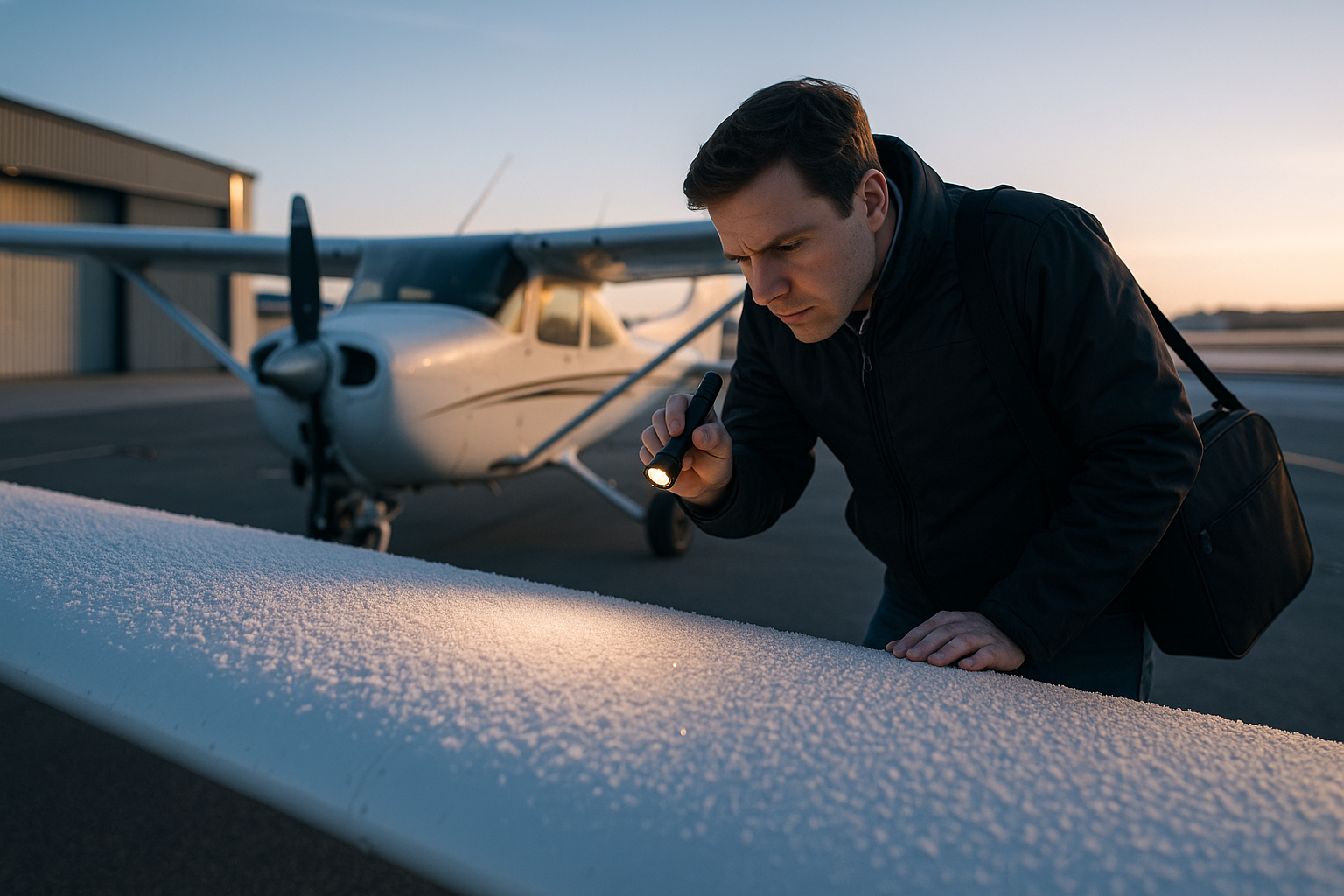
Airframe frost before takeoff is one of those aviation hazards that can look harmless while creating a serious performance and control problem. A thin, rough coating on a wing, tail, propeller, windshield, or sensor can change how the airplane flies before the pilot ever reaches rotation speed. For student pilots, instructors, aircraft owners, and commercial operators, the important point is simple: frost is not just frozen moisture. On an airplane, it is aerodynamic contamination.
The danger is easy to underestimate because frost often appears light, uniform, and almost cosmetic. It may not look like snow accumulation or clear ice, and it may not seem heavy enough to matter. Yet airplanes are designed around smooth, predictable airflow. When frost roughens the surface, airflow can separate earlier, lift can be reduced, drag can increase, stall characteristics can change, and takeoff performance can degrade. This article explains why a thin layer of airframe frost can be dangerous, how pilots should evaluate it, and what practical decisions reduce risk before takeoff.
What Airframe Frost Does to an Airplane
Frost forms when moisture in the air deposits and freezes on a surface that is at or below freezing. On an aircraft parked outside overnight, this can happen even when there is no active precipitation. Clear skies, light wind, high humidity, and a cold-soaked airframe can create frost on exposed surfaces. The upper wing surface is a common concern, but frost can also appear on the horizontal stabilizer, elevator, rudder, propeller blades, windshield, antennas, fuel caps, static ports, and other exterior components.
From a pilot’s point of view, the most important issue is not just the weight of the frost. The greater concern is surface roughness. A wing depends on smooth airflow over its upper and lower surfaces to create lift efficiently. Frost changes the texture of that surface. Even when the contamination is thin, it can disturb the boundary layer, which is the thin layer of air that flows immediately next to the aircraft surface. Once that airflow is disrupted, the wing may not produce the lift or drag characteristics assumed in the airplane’s performance data.
The same concept applies to tail surfaces. The horizontal stabilizer and elevator help control pitch and trim. The vertical stabilizer and rudder help with directional stability and control. If these surfaces are contaminated, the airplane may still appear normal during taxi, but the true penalty may not show up until takeoff acceleration, rotation, climbout, flap retraction, or maneuvering close to the ground.
Propeller contamination also deserves attention. Frost on a propeller blade can reduce propeller efficiency and may contribute to vibration if the accumulation is uneven. On many light airplanes, the propeller is the first aerodynamic component to turn high rpm during takeoff, and its surface condition affects thrust production. A pilot who removes frost from the wings but ignores the propeller has not addressed the whole aircraft.
Why Thin Frost Can Be More Dangerous Than It Looks
Aviation teaches pilots to respect visible hazards such as thunderstorms, low ceilings, fuel contamination, and runway contamination. Frost can be more deceptive because it often appears small. The airplane may look nearly clean from several feet away, especially in weak morning light or when frost blends into a white paint scheme. The hazard is not its dramatic appearance. The hazard is its effect on airflow at a critical phase of flight.
Takeoff is an unforgiving time to discover that the aircraft is not performing normally. The airplane is heavy, slow, close to the ground, and often configured with flaps or high power. The available runway is finite, obstacle clearance margins may be limited, and the pilot has little time to diagnose a problem. If frost has increased drag and reduced lift, the airplane may accelerate more slowly, require more runway, rotate sluggishly, climb poorly, or feel less responsive than expected.
A thin layer can also be uneven. Frost may be thicker near wing roots, flap gaps, rivet lines, leading edges, windshield frames, or shaded areas. Uneven contamination can create asymmetrical aerodynamic effects. One wing may begin producing less lift or more drag than the other, especially during rotation or at a higher angle of attack. The result can be a control problem precisely when the pilot is trying to establish a positive climb.
Another reason frost is dangerous is that pilots tend to compare it to inflight icing. Inflight icing often looks more obvious and is associated with clouds, precipitation, and freezing temperatures. Ground frost is different. It may occur on a calm, clear morning with otherwise excellent weather. A pilot may mentally categorize the day as safe because visibility is good and the winds are light. That mindset can make it easier to rationalize a contaminated departure.
The Aerodynamics Behind Frost Contamination
Airfoils are shaped to manage pressure and airflow. At takeoff speeds, the wing is working at a relatively high angle of attack compared with cruise. The aircraft needs enough lift to leave the runway and then climb safely. A clean wing is expected to produce lift in a known way across the range of angles of attack and configurations used for takeoff.
Frost changes the equation by roughening the surface. Roughness can trip the boundary layer earlier than expected and make airflow more turbulent. In some cases, disturbed airflow separates sooner from the wing. Earlier separation means the wing can reach its critical angle of attack at a lower margin than the pilot expects. Practically, this may show up as higher stall speed, less lift at a given speed, degraded climb, or a less predictable stall warning and buffet pattern.
Drag is the other half of the problem. If frost increases drag, the airplane needs more thrust to achieve the same acceleration and climb performance. In a light training airplane on a long, cold runway, the penalty may not be immediately obvious until climbout. In a heavily loaded airplane, a short runway environment, high terrain, or an operation with obstacles near the departure end, the same contamination can become much more consequential.
Tailplane aerodynamics can be less intuitive for pilots. In many airplanes, the horizontal tail produces a downward aerodynamic force during normal flight. That force helps balance the airplane around its center of gravity. If frost disrupts airflow over the tail, pitch control and stability can be affected. The exact behavior depends on aircraft design, configuration, flap setting, center of gravity, and speed, which is why aircraft-specific guidance matters.
Frost can also affect instruments and systems. Static ports, pitot tubes, angle-of-attack vanes, stall warning openings, fuel vents, and other sensors must be clear and functional. A blocked or partially obstructed sensor can create misleading cockpit information. The pilot may be dealing with both aerodynamic degradation and unreliable indications, which is a poor combination during departure.
Why This Matters in Real-World Aviation
Real-world aviation is full of time pressure. A morning training flight is scheduled. A passenger expects to depart. A business trip has a meeting time. A rental aircraft has another booking later in the day. Frost often appears during exactly these periods, when pilots are tempted to hurry through preflight inspection and assume the sun, taxi airflow, or a brief engine run will take care of it.
That assumption is unsafe. Taxiing may remove loose snow or melt small amounts of moisture in some areas, but it does not guarantee that critical surfaces are clean. Sunlight may warm one wing while the other remains shaded. Engine heat may clear part of a windshield while frost remains on the tail. A surface can look acceptable from the ramp but still feel rough to the touch. The aircraft needs to be evaluated as an entire aerodynamic system, not as a collection of visible surfaces from one side of the airplane.
Flight training is especially important here. Student pilots may learn early that weight, density altitude, runway length, and wind affect takeoff performance. Frost belongs in that same mental category. It is a performance and controllability threat. The difference is that it can be physically removed before flight if the pilot recognizes it and acts conservatively.
For instructors, frost is also a valuable lesson in aeronautical decision-making. A no-go decision because of contamination is not an inconvenience. It is an example of professional risk management. When students see instructors insist on a clean aircraft, they learn that preflight inspection is not a ritual. It is a technical evaluation of whether the airplane is airworthy and suitable for the planned operation.
How Pilots Should Understand This Topic
Pilots should think of airframe frost as a clean-aircraft problem. Before takeoff, the aircraft’s critical surfaces should be clean enough to perform as the manufacturer intended and as the pilot expects. Critical surfaces normally include wings, control surfaces, tail surfaces, propellers, windshields needed for visibility, and sensors or openings required for safe flight. The specific items to inspect depend on the aircraft type and operating procedures.
The most reliable preflight habit is to combine visual inspection with tactile inspection when conditions suggest frost may be present and when it is safe and appropriate to touch the surface. Looking alone can miss clear, polished, or thin frost. A hand passed lightly over the upper wing surface can reveal roughness that is difficult to see. Pilots should use care around sharp edges, static wicks, antennas, and control surface gaps, and should follow local procedures for aircraft access and safety.
It is also important to understand that frost can reform. An aircraft may be cleaned and then sit outside while humidity remains high and surface temperature stays below freezing. If the airplane waits on the ramp or in a run-up area, the pilot should remain alert for renewed contamination. In cold-weather operations, a clean preflight at one moment does not always guarantee a clean takeoff later.
Aircraft-specific documentation and operator procedures matter. Different aircraft use different materials, systems, sensors, deicing equipment, anti-icing fluids, and approved cleaning methods. A technique that is appropriate for one airplane may be unsuitable for another. Pilots should know the approved methods for their aircraft, including any limitations on scraping, brushing, heated hangars, deicing fluids, or use of covers.
The decision should not be framed as, “Can the airplane probably handle it?” A better question is, “Do I have a clean aircraft and reliable performance information for this takeoff?” If the answer is no, the safe response is to remove the contamination, delay the flight, use an approved deicing method, move the aircraft into a heated space, or cancel.
Common Mistakes or Misunderstandings
One common mistake is believing that frost is acceptable if it is thin. Thin contamination can still be aerodynamically significant because the wing is sensitive to surface roughness, not just weight. A light coating that feels like sandpaper may be more important than it looks.
Another misunderstanding is assuming that cold air improves performance enough to offset frost. Cold air can improve engine and wing performance compared with hot, high-density-altitude conditions, but it does not make a contaminated wing behave like a clean wing. Good density altitude does not cancel poor surface condition.
Pilots also sometimes focus only on the wings. Wings are critical, but they are not the only concern. Frost on the tail, elevator, rudder, propeller, pitot-static components, stall warning devices, or windshield can create serious safety issues. A complete preflight must include all surfaces and systems necessary for safe flight.
A related error is trusting rotation speed as if it were a guarantee. Published speeds assume an aircraft in an appropriate configuration and condition. If frost has changed lift and drag, reaching a familiar airspeed does not ensure that the airplane will lift off or climb normally. Airspeed is essential information, but it must be interpreted in the context of aircraft condition and performance.
Some pilots rely on the idea that airflow during the takeoff roll will blow the frost away. This is not a sound plan. Frost can adhere strongly, especially if it has bonded to a cold surface. Waiting for takeoff acceleration to solve a contamination problem delays the decision until the aircraft is already committed to a high-risk phase.
Finally, there is the subtle pressure of embarrassment. A pilot may not want to delay passengers, call maintenance, ask for deicing, or explain a cancellation. Professional pilots learn to treat that discomfort as normal and secondary. The primary task is to protect the aircraft, passengers, and people on the ground.
Practical Example
Consider a student pilot and instructor arriving for an early morning training flight in a single-engine training airplane. The sky is clear, the wind is calm, and the outside air temperature is near freezing. From the office window, the airplane looks fine. During preflight, the student notices a slight sparkle on the upper wing surface but says it seems too thin to matter.
The instructor asks the student to compare the shaded wing with the sunlit wing and then gently feel the upper surface in an approved inspection area. The shaded wing feels rough. The frost is not thick, but it is clearly present. The instructor uses the moment to connect the observation to takeoff performance. The airplane’s book values, rotation speed, and expected climb assume clean wings and tail surfaces. The instructor explains that the lesson cannot begin with a contaminated aircraft.
The flight is delayed. The aircraft is moved into a warmer hangar, inspected again after the frost has melted and water has been removed, and the crew checks that control surfaces, hinges, pitot-static components, and the windshield are clear. The lesson starts later, but it begins with a clean airplane and a better student understanding of winter preflight judgment.
This is not a dramatic story, and that is the point. Many good safety decisions are quiet. They happen before engine start, before a clearance, before a takeoff roll, and before the pilot has to solve an avoidable problem in the air.
Best Practices for Pilots
Good frost management begins before the pilot reaches the airplane. Review the overnight temperature, dew point spread, humidity, precipitation history, and ramp conditions. If temperatures are near or below freezing, assume frost is possible until inspection proves otherwise. An aircraft parked on grass, near moisture, in a shaded tie-down, or under a clear night sky may be especially vulnerable to frost formation.
During preflight, slow down. Look at the upper wing surfaces from different angles. Use a flashlight when lighting is poor. Inspect the tail carefully, including the top of the horizontal stabilizer if it can be safely viewed. Check the propeller, windshield, control surfaces, hinges, vents, pitot tube, static ports, fuel caps, and any stall warning or angle-of-attack components. If frost is found on one area, continue searching because other areas may be affected differently.
Use approved removal methods. Depending on the aircraft and operation, this may involve placing the aircraft in a heated hangar, using approved deicing fluid, using appropriate soft tools, or removing covers that prevented frost formation. Avoid improvised methods that can damage paint, composite surfaces, antennas, windows, seals, or sensors. Do not use unapproved chemicals or aggressive scraping on aircraft surfaces.
After removal, inspect again. Melting frost can leave water that refreezes, runs into gaps, or collects near control surfaces. Confirm that controls move freely and that drainage, vents, and sensors are clear. If deicing or anti-icing fluid is used, follow applicable procedures and be aware that protection time can be limited by weather conditions and fluid type.
A few practical habits make a difference:
- Plan extra time for cold-weather preflight rather than treating frost removal as a delay.
- Use aircraft covers when appropriate and approved, especially for wings, windshield, pitot tube, and engine inlets.
- Do not depart with roughness or contamination on critical surfaces unless an approved aircraft-specific procedure clearly permits the condition.
- Reinspect if the aircraft sits outside after being cleaned.
- Teach students and passengers that a clean aircraft is a safety requirement, not a preference.
Training and Operational Takeaways for Instructors
Instructors have a special opportunity to shape habits before pilots fly on their own. Frost should be discussed not only as a winter weather topic, but as a practical preflight and takeoff performance topic. Students should understand how to recognize frost, why tactile inspection may matter, how to use aircraft-specific guidance, and how to communicate a delay or cancellation confidently.
Scenario-based training is useful. Ask the student what they would do if frost is present on only one wing, if the aircraft is needed for a checkride, if the sun is melting the frost unevenly, or if passengers are waiting. These questions move the discussion beyond memorization and into decision-making. They also reinforce that external pressure is part of the risk environment.
For operators, standardization helps. Clear cold-weather procedures, access to approved deicing resources, ramp lighting, training for line personnel, and a culture that supports conservative decisions all reduce the chance that a pilot will normalize contamination. Frost is easier to manage when the organization expects pilots to address it rather than work around it.
Frequently Asked Questions
Can a very thin layer of frost really affect takeoff?
Yes. The main concern is surface roughness and airflow disruption, not just the thickness or weight of the frost. A thin rough layer on a wing or tail can reduce aerodynamic efficiency and change how the airplane performs during takeoff and climb.
Is frost only a problem on the wings?
No. Wings are a major concern, but frost on the horizontal stabilizer, elevator, rudder, propeller, windshield, pitot-static components, stall warning devices, and other critical areas can also create safety problems. The aircraft should be evaluated as a complete system.
Will frost blow off during the takeoff roll?
Pilots should not count on that. Frost can adhere to a cold surface, and waiting for takeoff airflow to remove it means accepting aerodynamic uncertainty during one of the most critical phases of flight.
Can cold weather performance offset the effect of frost?
No. Cold dense air may improve certain aspects of aircraft performance, but it does not restore a contaminated wing or tail to a clean aerodynamic condition. Performance planning assumes the aircraft is in the proper condition for flight.
What is the best way to remove frost from an aircraft?
The best method is the one approved for the aircraft and operation. Common approaches include using a heated hangar, approved deicing fluids, appropriate covers, or approved soft removal tools. Pilots should avoid improvised methods that could damage aircraft surfaces or systems.
What should a pilot do if frost returns after the aircraft was cleaned?
The pilot should treat the aircraft as contaminated again and reinspect before takeoff. If frost has reformed on critical surfaces, the aircraft should be cleaned again or the flight delayed until the aircraft can be maintained in a clean condition for departure.
Key Takeaways
- Airframe frost before takeoff is dangerous because even a thin rough layer can disrupt airflow over wings, tail surfaces, propellers, and sensors.
- A safe takeoff decision depends on a clean aircraft, not on hope that frost will melt, blow off, or be offset by cold-weather performance.
- Pilots should use aircraft-specific procedures, conservative judgment, and thorough cold-weather preflight habits before operating in frost conditions.