
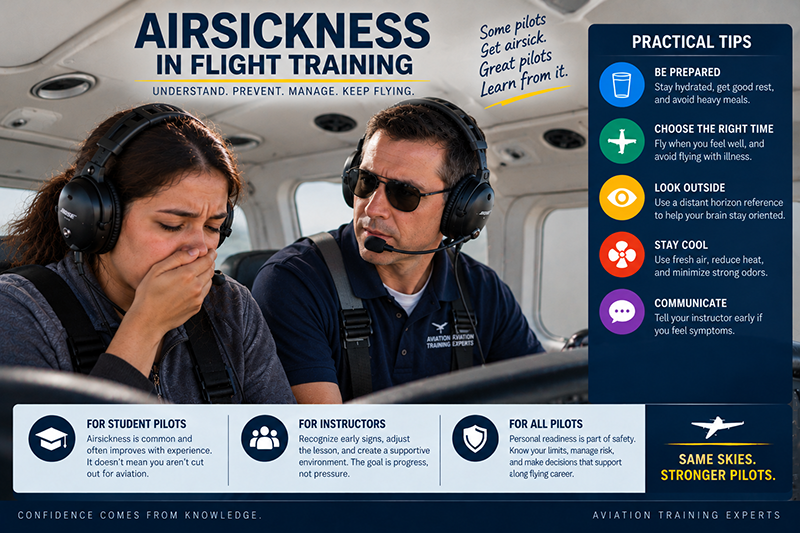
Airsickness in flight training is common enough that instructors should be prepared for it, yet it is personal enough that many student pilots hesitate to mention it. A new pilot may feel embarrassed, frustrated, or worried that motion sickness means they are not suited for aviation. In most training environments, the better response is calmer and more practical: airsickness is a physiological reaction to unfamiliar motion, visual cues, stress, temperature, workload, and expectation. It deserves respect, not shame.
For student pilots, airsickness can interfere with learning at exactly the moment they need attention, coordination, and confidence. For flight instructors, it can change the lesson plan, affect cockpit resource management, and require immediate decisions about continuing, modifying, or ending a flight. The goal is not to force a student through discomfort. The goal is to understand what triggers the problem, reduce the risk before flight, use smart instructor techniques in the airplane, and recover in a way that protects safety and preserves the student’s long-term progress.
Understanding Airsickness in Flight Training
Airsickness is a form of motion sickness. It often occurs when the brain receives conflicting information from the eyes, inner ear, and body. In an aircraft, especially a light training airplane, the student may see a relatively stable instrument panel while the inner ear senses pitch, roll, yaw, acceleration, turbulence, or changes in vertical speed. During turns, stalls, steep turns, slow flight, ground reference maneuvers, or recovery from unusual attitudes, the sensory mismatch can become more noticeable.
Flight training adds another layer: cognitive workload. A student may be trying to maintain altitude, listen to radio calls, scan for traffic, interpret instruments, respond to an instructor, and manage anxiety all at once. Even modest turbulence or routine maneuvering can feel more intense when the student is task saturated. The body may respond with sweating, yawning, headache, stomach discomfort, salivation, burping, dizziness, pallor, nausea, or vomiting. Some students also become quiet, stop looking outside, or lose the ability to process instructions quickly.
It is useful to separate airsickness from other in-flight problems. Nausea can be caused or worsened by dehydration, fatigue, hunger, overheating, fumes, anxiety, illness, medications, or other medical conditions. Carbon monoxide exposure, for example, is a serious hazard that can produce symptoms that should never be dismissed as simple motion sickness. If symptoms are unusual, severe, sudden, or accompanied by confusion, chest pain, shortness of breath, neurological symptoms, or signs affecting more than one occupant, the crew should treat the situation conservatively and seek appropriate medical help after landing.
For most student pilots who experience ordinary airsickness, the important message is that improvement is often possible with conditioning, better lesson design, and honest communication. Many people adapt to the motion environment after repeated, well-managed exposure. The adaptation process should be gradual and safety-focused, not rushed.
Why This Matters in Real-World Aviation
Airsickness is not only a comfort issue. It affects safety margins because it reduces a pilot’s ability to aviate, navigate, communicate, and make decisions. A student who is fighting nausea may stop scanning for traffic, fixate on the panel, miss altitude deviations, or delay telling the instructor that they feel unwell. If the instructor does not notice the early signs, a manageable situation can become a cockpit distraction at a poor time, such as during pattern work, maneuvering, or changing weather.
In training aircraft, the cockpit environment can be hot, noisy, busy, and physically close. A student who becomes ill may need air vents opened, the lesson simplified, or a return to the airport. If vomiting occurs, there may be contamination, distraction, odor, and temporary impairment. The instructor must maintain aircraft control, communicate if necessary, protect the student’s dignity, and avoid turning a human factors issue into a training setback.
The training impact also matters. A student who associates flying with nausea may begin to dread lessons, cancel flights, or assume that every maneuver will make them sick. That anticipation can increase stress and make symptoms more likely. A thoughtful instructor can break the cycle by reducing the trigger intensity, giving the student more control, and building success in small steps.
Airsickness also teaches a broader aviation lesson: personal minimums include human performance. Fitness to fly is not limited to legal qualifications or aircraft airworthiness. A pilot who is dehydrated, exhausted, overheated, anxious, or unwell may have less tolerance for normal motion. In real-world operations, the same self-assessment skill applies before cross-country flights, night flights, instrument training, aerobatic training, and passenger-carrying flights.
How Pilots Should Understand This Topic
Student pilots should understand that airsickness is not a character flaw and not necessarily a career-ending problem. It is a signal that the body is not yet comfortable with the motion, workload, or environment. The best response is early communication. Telling the instructor, “I am starting to feel nauseated,” is far better than waiting until the student cannot participate or the instructor has to manage a messy cockpit problem.
Instructors should watch for subtle cues. A student who was talkative and responsive may become silent. Their control inputs may become rough or delayed. They may stop looking outside and stare at one instrument. They may sweat, breathe shallowly, loosen their grip repeatedly, or answer questions slowly. These signs are not always obvious, especially when the instructor is busy monitoring airspace, radios, and aircraft state. A short, matter-of-fact check-in can help: “How are you feeling? Any nausea or dizziness?”
Prevention begins before the engine starts. The student should arrive rested, hydrated, and fed with a light, sensible meal that agrees with them. Flying on an empty stomach can be a problem for some people, while a heavy or greasy meal can be a problem for others. Alcohol, recreational drugs, and sedating medications are incompatible with safe flight training. Any medication used for motion sickness should be discussed with an aviation medical examiner or qualified medical professional because many common motion sickness medications can cause drowsiness, slow reaction time, or otherwise impair pilot performance.
Lesson design is equally important. A student who has had airsickness should not be surprised with a long maneuvering lesson on a hot, turbulent afternoon if a shorter, calmer flight would build more progress. The instructor can schedule early in the day when air is often smoother, keep the first recovery flights brief, and place nausea-provoking maneuvers later only after the student has settled in. The instructor can also choose a training area with adequate altitude, manageable workload, and a direct route back if the lesson needs to end early.
Visual strategy matters. Many students do better when they keep their eyes outside and look toward the horizon rather than burying their attention in the panel or looking down at a kneeboard. A steady outside reference gives the brain visual information that better matches the aircraft’s motion. That does not mean ignoring instruments, but it does mean avoiding prolonged head-down tasks during high-motion phases. Instructors can time written notes, chart work, or avionics programming for smoother, lower-workload periods.
Control involvement also matters. Some people feel worse as passive passengers than they do as active pilots. When appropriate, allowing the student to fly simple, predictable tasks can improve anticipation and reduce the feeling of helpless motion. The instructor should avoid sudden, unnecessary control inputs and should explain upcoming maneuvering before it happens. Predictability is a powerful tool.
Prevention Before the Flight
The most effective airsickness plan starts on the ground. A preflight conversation should be normal, professional, and nonjudgmental. The instructor can ask whether the student has experienced motion sickness in cars, boats, simulators, or previous flights. The point is not to screen the student out. The point is to plan the lesson intelligently.
Students should be encouraged to manage basic physiology. Sleep matters because fatigue lowers tolerance to motion and workload. Hydration matters because dehydration can worsen headache, dizziness, and nausea. Temperature matters because a hot cabin can accelerate discomfort. Nutrition matters because extremes tend to backfire. A small meal or snack that the student knows they tolerate is usually more sensible than experimenting on a training day.
Clothing and cockpit preparation can help. Overdressing for a warm cockpit, wearing tight collars, or sitting in direct sun for extended ground operations may add stress before takeoff. Air vents should be checked and used early. If the aircraft has sun visors or vents that can improve comfort, the instructor should not wait until the student is already nauseated to use them. A sickness bag should be available and reachable without drama. Its presence should be treated like having a checklist or flashlight: simple preparation, not a prediction of failure.
Scheduling is an instructional tool. For a student prone to airsickness, shorter lessons may be more productive than long lessons. Smooth air, cooler temperatures, and predictable conditions can make the difference between a positive training experience and an avoidable setback. A local flight with a simple objective may be more valuable than trying to complete several maneuver blocks in one sortie.
The lesson briefing should set expectations. If steep turns, stalls, slow flight, or unusual attitudes are planned, the instructor can explain what sensations are normal and how long each maneuver will last. Students often tolerate motion better when they know what is coming and why. The instructor can also establish a plain-language stop signal, such as “I need straight and level,” so the student does not have to negotiate or explain while symptoms are building.
Instructor Techniques During Flight
Once airborne, the instructor’s priorities are aircraft control, student wellbeing, and effective learning. A student who is mildly uncomfortable may still learn if the instructor reduces workload and stabilizes the environment. A student who is clearly nauseated or deteriorating is no longer in an ideal learning state, and continuing to press the syllabus may waste time while increasing risk.
Smooth handling helps. Abrupt pitch changes, unnecessary rudder inputs, rapid roll reversals, and steep bank angles can intensify symptoms. Training maneuvers still need to be demonstrated accurately, but the instructor can avoid adding extra motion that is not needed for the lesson. When a maneuver is complete, returning to straight-and-level flight and allowing a short recovery period can be more effective than immediately starting the next task.
Ventilation should be used early. Cool, fresh air across the face can help some students. Loosening tight clothing, adjusting cabin heat, and reducing sun exposure may also help. The instructor should avoid strong odors in the cockpit, including heavy food smells, fuel odors, or scented products when possible. If fumes are suspected or symptoms seem inconsistent with simple airsickness, the situation should be handled conservatively.
Communication should be calm and direct. An instructor who sounds annoyed or alarmed can make the student more anxious. A better tone is matter-of-fact: “No problem. Look outside at the horizon. I have the airplane. Let’s level off and get some air moving.” That kind of language tells the student that the situation is manageable and that speaking up was the correct decision.
Visual focus is one of the most useful in-flight techniques. The instructor can have the student look outside, identify the horizon, and focus on distant references rather than cockpit details. If the student is handling the controls, the task should be simple: maintain heading and altitude in smooth, shallow corrections. If the student cannot comfortably continue, the instructor should take the controls and stabilize the aircraft.
Workload reduction is essential. The instructor can stop teaching new concepts, pause nonessential questions, handle radios if appropriate, and navigate toward a suitable recovery plan. The student may not be able to process a full explanation while nauseated. Short instructions work better than a lecture.
The instructor should also consider when to end the lesson. There is a point at which continuing serves no training purpose. If symptoms increase, if the student vomits, if the student cannot participate safely, or if the instructor’s attention is being drawn away from aircraft operation, returning to the airport or landing at a suitable airport may be the safest and most professional option. Ending early should be framed as good aeronautical decision-making, not as failure.
Recovery After Airsickness Occurs
Recovery begins with stabilization. In the air, that usually means straight-and-level flight, reduced maneuvering, fresh air, and a clear decision about whether to continue or return. After landing, the student may need time, water, shade, and privacy. The postflight environment should be supportive. Embarrassment is often worse than the physical symptoms, especially for a motivated student pilot.
The debrief should be specific but kind. Instead of saying, “You got sick during steep turns,” the instructor can ask what the student noticed first, what seemed to help, what made it worse, and how quickly symptoms built. The instructor and student can identify triggers such as heat, turbulence, looking down, maneuver duration, anxiety, or flying too soon after a meal. This turns an unpleasant experience into useful data.
For the next lesson, the instructor should reduce the chance of repeating the same pattern. That may mean a shorter flight, smoother time of day, more outside visual references, more gradual maneuvering, or a lesson focused on basic aircraft control rather than high-motion tasks. If the student has repeated or severe symptoms, or if symptoms seem unusual, medical advice may be appropriate before continuing.
Some students benefit from gradual exposure. They may start with short, smooth flights and simple straight-and-level tasks, then progress to shallow turns, climbs, descents, and eventually more demanding maneuvers. The idea is to build tolerance and confidence without repeatedly pushing the student into full nausea. Over time, the student learns what early symptoms feel like and how to intervene before the episode escalates.
Recovery also includes mindset. A single airsickness event should not define the student’s ability. However, ignoring repeated symptoms is not productive either. The professional path is to manage the risk, adapt the training plan, and involve appropriate medical guidance when needed.
Common Mistakes or Misunderstandings
One common mistake is treating airsickness as a weakness. That attitude discourages honesty. Students may hide symptoms to avoid disappointing the instructor, which can make the flight less safe. A professional cockpit culture makes it normal to report discomfort early.
Another mistake is assuming the student should “push through it.” Mild discomfort may pass if the aircraft is stabilized and the student uses good visual reference, but worsening nausea is not usually improved by adding more steep turns or stall practice. Once a student is focused mainly on not becoming sick, learning has already degraded.
A third misunderstanding involves medication. Many over-the-counter motion sickness medications can cause drowsiness or impaired performance. A student pilot should not self-medicate before a lesson and assume it is compatible with flying. Any medication question should be handled with qualified medical guidance, and pilots should consider both legality and actual fitness to fly.
Some pilots also misunderstand the role of simulators. A simulator or aviation training device can help with procedures and cockpit familiarization, but simulator motion, visuals, or screen movement can also provoke motion sickness in some people. Conversely, a non-motion simulator may not condition the body to the real aircraft environment. Simulators are valuable tools, but they are not a guaranteed cure.
Another risk is poor cockpit housekeeping. Not having a sickness bag available, letting loose items clutter the cockpit, or failing to brief what to do if the student becomes nauseated can increase stress at the wrong time. A small amount of preparation prevents a minor issue from becoming a major distraction.
Finally, instructors sometimes overlook environmental contributors. Heat, turbulence, fuel odor, exhaust concerns, dehydration, and fatigue may be more important than the maneuver itself. If two people in the aircraft develop symptoms, or if symptoms include unusual headache, confusion, or weakness, the crew should not assume routine airsickness. The safest response is to increase ventilation as appropriate, use available safety equipment, terminate the flight if needed, and seek help after landing.
Practical Example
Consider a private pilot student on their fourth flight. The lesson plan includes climbs, descents, medium turns, and an introduction to slow flight. The weather is clear, but the afternoon is warm and the air is bumpy below 3,000 feet. During the climb to the practice area, the student becomes quiet. During the first demonstration of slow flight, the student begins sweating and gives shorter answers. The instructor asks how they feel, and the student admits they are getting nauseated.
A poor response would be to continue the planned maneuver sequence, hoping the student adapts. A better response is to stop the maneuver, return to cruise flight, open vents, ask the student to look outside at the horizon, and reduce workload. The instructor takes the radios and gives the student a simple task, such as keeping wings level while looking outside. After a few minutes, the student improves but is still uneasy. The instructor decides to return to the airport, conducts a normal arrival, and saves the remaining objectives for another day.
In the debrief, the instructor learns that the student skipped lunch, was nervous about slow flight, and spent much of the climb looking down at the checklist and panel. For the next flight, they schedule an early morning lesson, bring water, brief a simple stop signal, and begin with straight-and-level flight and shallow turns. Slow flight is reintroduced later in shorter segments with clear explanation and recovery breaks. The student gains confidence because the instructor managed the problem professionally rather than turning it into a test of endurance.
Best Practices for Pilots and Instructors
The best airsickness strategy is a partnership. Students should speak up early, prepare physically, and avoid guessing about medication. Instructors should normalize the conversation, design lessons intelligently, and remain flexible. Training quality is not measured by how much discomfort a student can tolerate. It is measured by how safely and effectively the student learns.
Several practices are especially useful in primary flight training:
- Brief airsickness as a normal human factors topic before it becomes a problem.
- Schedule shorter flights in smoother, cooler conditions for students who are susceptible.
- Encourage outside visual references and minimize unnecessary head-down time during maneuvering.
- Use smooth, predictable control inputs and explain maneuver sensations before demonstrating them.
- Keep fresh air available and manage cockpit temperature early.
- Have a reachable sickness bag and a simple plan for what the student should do if symptoms start.
- End or modify the lesson when symptoms interfere with safety or learning.
- Debrief triggers and improvements without embarrassment or blame.
For pilots beyond initial training, the same habits apply to passengers. A private pilot taking friends or family flying should avoid aggressive maneuvering, explain what to expect, keep the cabin cool, and encourage passengers to speak up before they feel seriously ill. A passenger who becomes sick can become a cockpit distraction, especially in a small aircraft. Passenger comfort is part of good pilot judgment.
When to Seek Medical Guidance
Many cases of airsickness are mild and improve with training adjustments, but pilots should be conservative about health questions. Medical guidance is appropriate when symptoms are severe, repeated, unusual, associated with other concerning signs, or not clearly related to aircraft motion. Guidance is also important before using any medication, supplement, patch, or remedy that could affect alertness, coordination, vision, or judgment.
Student pilots should be careful with advice from non-aviation sources. A remedy that is acceptable for a passenger on a boat ride may not be appropriate for a person manipulating flight controls. Aviation places a high demand on attention, reaction time, and decision-making. If there is any doubt, consult an aviation medical examiner or other qualified medical professional familiar with pilot performance considerations.
Instructors should avoid practicing medicine from the right seat. They can recommend hydration, rest, fresh air, better scheduling, and honest self-assessment, but they should not tell students that a specific medication is safe for flight unless that guidance comes from an appropriate medical authority. The instructor’s role is to manage training risk and encourage proper medical consultation when needed.
Building Confidence After an Airsickness Event
Confidence returns through successful flights. The first goal after an airsickness episode should be a comfortable, controlled training experience, not necessarily completing the most demanding remaining lesson. A student who completes a short flight without symptoms may regain trust in the aircraft, the instructor, and their own body. That confidence can then support more challenging tasks.
The instructor can use a gradual progression. Start with a good briefing and a simple objective. Fly in smoother conditions. Keep the cockpit cool. Let the student fly predictable attitudes while looking outside. Add turns gradually. Introduce maneuvering in short blocks with pauses between them. Celebrate practical improvements, such as the student recognizing early symptoms sooner or using the horizon more effectively.
It is also helpful to distinguish discomfort from danger. Some unfamiliar sensations in flight are normal: lightness during a pitch change, pressure changes during climbs and descents, or unusual feelings during coordinated turns. When students understand what is normal, they are less likely to interpret every sensation as a warning sign. Good instruction replaces uncertainty with knowledge.
Frequently Asked Questions
Can student pilots overcome airsickness?
Many student pilots improve as they gain experience, learn to use outside visual references, reduce anxiety, and build tolerance to aircraft motion. Progress should be gradual and safety-focused. Repeated or severe symptoms should be discussed with a qualified medical professional.
Should I take motion sickness medicine before a flight lesson?
Do not assume a motion sickness medication is compatible with flying. Many products can cause drowsiness or impair performance. Student pilots and certificated pilots should seek guidance from an aviation medical examiner or qualified medical professional before using any medication for flight.
What should I tell my instructor if I start feeling sick?
Tell the instructor early and directly. A simple statement such as “I am starting to feel nauseated” gives the instructor time to level the aircraft, increase ventilation, reduce workload, and decide whether to continue or return. Waiting usually makes the situation harder to manage.
Are certain maneuvers more likely to cause airsickness?
Maneuvers involving repeated pitch, bank, yaw, acceleration, or prolonged head movement can be more provocative for some students. Examples may include steep turns, stalls, slow flight, unusual attitudes, or extended maneuvering in turbulence. The response varies by person and conditions.
Is airsickness a reason to stop flight training?
Not automatically. A single episode, or even a few early episodes, does not necessarily mean a student cannot continue. The better approach is to adjust the training plan, identify triggers, use prevention techniques, and seek medical guidance when symptoms are persistent or concerning.
How can instructors prevent airsickness from damaging student confidence?
Instructors can normalize the issue, respond calmly, avoid blame, and modify the lesson before symptoms become severe. A supportive debrief and a successful follow-up flight often do more for confidence than trying to force completion of the original lesson plan.
Key Takeaways
- Airsickness in flight training should be managed early with honest communication, good preflight preparation, outside visual references, and smart lesson design.
- Instructor technique matters: smooth handling, fresh air, reduced workload, and a willingness to end the lesson can protect both safety and learning.
- Pilots should not self-medicate for motion sickness without qualified aviation medical guidance because alertness, judgment, and coordination are essential to safe flight.