
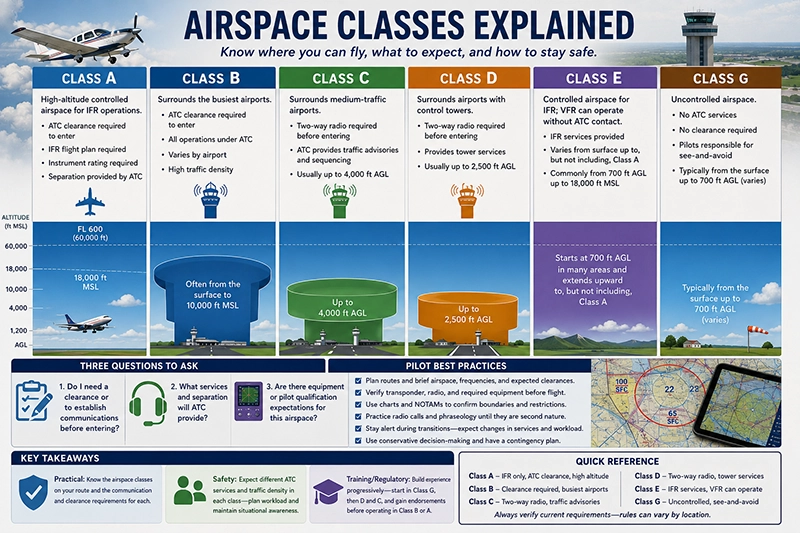
For any new pilot, mastering airspace classes is one of the most practical and safety-critical steps in flight training. Airspace defines where you can fly, when you need clearance or communications, and what services and traffic to expect. Understanding airspace classes helps student pilots, instructors, and operators make informed decisions about planning, communication, collision avoidance, and risk management.
This article explains airspace classes in clear, operational terms. You will learn the general purpose of each class, typical vertical and lateral dimensions in the United States, how services and equipment expectations change, and how to apply the information in real flying, cross-country planning, and flight instruction. The content focuses on helping you translate regulatory structure into safe aeronautical decision-making.
How Airspace Is Organized: The Core Idea
At its simplest, airspace structure is a way of organizing traffic and services to protect certain operations, control traffic flow, and provide safety margins around busy or sensitive areas. Different classes of airspace exist to match the level of traffic density, types of operations, and complexity of procedures. Class designations can affect requirements for pilot certification, communications, equipment, clearances, and separation responsibilities.
Think of airspace as layered zones with different rules and expectations. Some layers require direct air traffic control interaction and provide separation between aircraft, while others leave separation primarily to pilots. The classification system creates predictability: controllers know what flights to expect in a class, and pilots know what clearances and services are available or required.
Core Airspace Classes and What They Mean in Practice
In the United States, the most commonly discussed classes are A, B, C, D, E, and G. Each class has characteristic features you should understand as a pilot. Below, each class is explained in operational terms, with notes on typical pilot responsibilities and services.
Class A
Class A is high-altitude controlled airspace where all operations are under positive air traffic control. In practical terms, pilots operating in Class A must be instrument-qualified, use an IFR flight plan, and be under ATC clearance. For most general aviation pilots in single-engine aircraft, operations in Class A are rare because this airspace is at higher altitudes used mainly by commercial and high-performance aircraft.
Class B
Class B surrounds the busiest airports. It is designed to protect arriving and departing traffic to and from major hubs. The defining feature of Class B is that all aircraft must receive an explicit ATC clearance to enter. From a pilot’s perspective, expect controlled, structured arrival and departure procedures, higher traffic density, and more stringent equipment or pilot qualification expectations at some airports. If you plan to operate into a Class B airport as a student pilot, ensure your instructor provides supervised experience, and review the specific airport’s sectional depiction and approach/departure corridors.
Class C
Class C surrounds medium-traffic airports and provides a service layer that includes radar approach control and some mandatory communications. Typically, pilots must establish two-way communication with ATC before entering, and controllers provide traffic advisories and sequencing. Class C is a common operating environment for instrument and VFR traffic, and it’s frequently encountered during training flights into and out of regional airports with commercial service.
Class D
Class D usually covers small control towers and surrounds airports with an operating control tower but lower traffic volume than Class C. Requirements are simpler: pilots must establish two-way radio communications with the tower before entering. Class D airspace often has a relatively limited vertical extent above the airport and is common for local training and commuter operations. Expect standard traffic patterns, light-tower instructions, and close coordination for arrivals and departures.
Class E
Class E is controlled airspace that provides IFR services but does not require VFR pilots to be in contact with ATC. It is a large, flexible category that fills in the controlled airspace between other classes and extends upward from various altitudes. For VFR pilots, Class E typically means you can operate without ATC communications, but controllers are available for IFR traffic and to provide traffic advisories when workload permits. Class E often overlays transition areas around airports and extends to cover airways and instrument approach paths.
Class G
Class G is uncontrolled airspace where pilots operating under VFR are entirely responsible for see-and-avoid separation. There is no requirement to communicate with ATC, and services are minimal or unavailable. Class G commonly covers lower altitudes away from busy terminal areas and is where many student pilots conduct primary dual instruction, pattern work, and local cross-country practice. Because services are limited, risk management and visual scanning are particularly important in Class G.
Why This Matters in Real-World Aviation
For pilots, airspace class affects multiple operational decisions: whether you need to file a flight plan, communicate with ATC, equip the aircraft with specific avionics, or obtain a clearance. It also determines the level of traffic separation you can expect and the services that ATC will provide. These factors directly influence risk management, workload, fuel planning, and route selection.
From a training perspective, early exposure to different classes builds skills progressively. Pattern work in Class G strengthens visual scan and collision avoidance. Trips into Class D and Class C teach radio communications, phraseology, and operating near a tower. Operating in Class B introduces strict adherence to clearances and airspace geometry. Eventually, awareness of Class E transitions and Class A IFR operations completes a comprehensive understanding of the national airspace system.
Operationally, airspace awareness informs decisions such as whether to accept an ATC visual approach, attempt a penetration into controlled airspace in marginal weather, or re-route to remain clear of complex terminal area procedures. It also determines the type of traffic to expect: high-speed jets at higher levels, continuous approach flows near Class B airports, and mixed VFR/IFR traffic in Class C and D environments.
How Pilots Should Understand Airspace in Practical Terms
Start with the big-picture role of each class, then layer in specific procedures and local variations. A useful mental model is to think of each class in terms of three operational questions:
- Do I need a clearance or to establish communications before entering?
- What services and separation will ATC provide?
- Are there equipment or pilot qualification expectations for this airspace?
Answering these three questions before flight — and reconfirming during preflight planning when reviewing charts and NOTAMs — will shape a safer, more predictable flight. For example, if your planned route goes through a Class C area, identify controller frequencies on your sectional and ensure your transponder and two-way radio are working. If crossing a Class B, plan an approved entry point or visual maneuver and brief the expected altitude profile and ATC communications with any passengers or instructors.
Navigation and situational awareness tools help, but they do not replace understanding. Electronic flight bags, GPS moving maps, and ADS-B traffic displays are valuable, but pilots must still know the regulatory and local procedures that apply. Establish clear points in your flight where you confirm entry requirements and contingency plans if ATC cannot accept you into controlled airspace.
Common Mistakes or Misunderstandings
Even experienced pilots sometimes misunderstand how airspace works. Common errors include assuming communications or transponder capability automatically grant entry, misjudging the vertical extent of a class, and failing to account for local or temporary airspace restrictions.
One frequent mistake is confusing two-way communication with ATC and an explicit clearance. Establishing two-way communication is required in several classes, but in Class B, you must receive an explicit clearance to enter. Another error is relying solely on a moving map to confirm airspace boundaries; while useful, moving maps can lag or use simplified depictions compared with current FAA charts. Always cross-reference sectional, terminal area charts, and ATIS/AWOS information where applicable.
Misunderstandings about Class E are common. Class E is controlled, but not all segments are obvious on a chart; it can begin at the surface around certain airports or at varying altitudes elsewhere. Pilots sometimes assume all controlled airspace requires ATC contact, which is not the case for VFR in most portions of Class E. Finally, pilots occasionally fail to plan for temporary flight restrictions or military operations areas, which can alter normal airspace availability and procedures.
Practical Example: A Typical Training Cross-Country Through Multiple Classes
Imagine a VFR cross-country flight from a small uncontrolled field to a medium-sized regional airport that lies beneath Class C, with a major hub (Class B) nearby. The flight will likely start in Class G, climb through transition altitudes into Class E, and then either enter the outer shelf of Class C or remain clear with a planned entry and communication sequence.
Before departure, the student and instructor brief the route, identify frequencies, verify transponder and radio functionality, and set up the navigation. The preflight briefing includes specific phrases the student will use to contact approach or tower, the expected readback of clearances, and contingency plans if two-way communication is not established at the planned point. During the flight, the student practices establishing two-way contact, listening for traffic advisories, and complying with ATC instructions for sequencing into Class C. On departure from the destination, the student practices asking for taxi and takeoff instructions, checking for airspace releases, and remaining vigilant for other VFR traffic in the pattern.
This scenario highlights how airspace knowledge integrates radio discipline, navigation, and risk assessment into routine training flights. It also demonstrates the importance of incremental learning: rather than overwhelming a student with rules for all classes at once, an instructor can design sorties that expose students to one new airspace class at a time.
Best Practices for Pilots
Good habits around airspace make flights safer and operations smoother. The following practices help pilots of all experience levels:
- Plan routes around known airspace constraints and brief expected communications and clearances before taxi.
- Verify transponder and radio functionality during run-up and maintain proper codes when required.
- Use sectional charts, terminal area charts, and current airport information to confirm class boundaries and procedural notes.
- Practice radio calls and phraseology during training flights so communications are concise, professional, and predictable.
- When flying near busy terminal areas, expect higher radio workload and plan cockpit tasks to minimize distractions during critical phases.
- Maintain a sterile cockpit mindset during critical airspace transitions to focus on traffic, clearances, and navigation.
Applying Airspace Knowledge to Safety and Decision-Making
Airspace awareness is a decision-making tool. If weather deteriorates, being clear about airspace boundaries helps you choose whether to continue, divert, or cancel. Knowing that Class B requires an explicit clearance, for example, may lead you to plan a diversion before reaching the outer shelf if ATC cannot accept you into that controlled airspace under current traffic conditions.
Similarly, when operating in uncontrolled Class G airspace near busy airports, understanding where controlled airspace begins will guide your altitude choices and traffic scanning. If you are not prepared to contact ATC or lack required equipment, plan to stay clear of classes that require those resources. Using conservative margins and pre-briefed alternatives reduces stress and improves safety when unexpected ATC restrictions or traffic congestion occur.
Special Considerations: Equipment, ADS-B, and Technology
Modern avionics, ADS-B, and traffic displays improve situational awareness but do not replace fundamental airspace knowledge. ADS-B Out may be required in certain airspace, and ADS-B In provides traffic information, but equipment requirements vary by airspace and region. Ensure you understand both the regulatory requirements that apply to your flight and the operational limitations of your avionics.
When relying on ADS-B or traffic displays, remember that these systems can show limited or latency-prone data and may not display non-transponder aircraft. Continue to perform visual scans, use appropriate radio calls, and follow ATC instructions. Treat electronic aids as enhancements, not substitutes, for seeing-and-avoiding and procedural compliance.
How Instructors Should Teach Airspace to Students
Teaching airspace is most effective when grounded in repeated, scenario-based practice. Start with local flights in Class G, focusing on visual scanning and basic radio discipline. Introduce Class D or C in controlled settings where students can practice phraseology and understand tower or approach roles. Use progressive challenges that add complexity: higher traffic density, more frequency changes, and the need to follow published arrival or departure procedures.
Instructors should emphasize the three operational questions: clearance/communication, services provided, and equipment/pilot expectations. Have students brief these points before each flight and debrief how the actual flight compared to the plan. Use real-world variations such as temporary flight restrictions, active military airspace, or special use airspace to teach adaptability and preflight checks.
Common Misconceptions and How to Avoid Them
Some pilots mistakenly believe that flying above the clouds keeps them clear of airspace complexity. Altitude choices must still account for controlled airspace vertical limits and whether you have the qualifications to operate there. Others assume that flying low avoids ATC entirely. Low-altitude flight may place you in uncontrolled Class G, but it also reduces time for spotting conflicting traffic and increases exposure to terrain and obstacles.
Avoid these misconceptions by practicing conservative decision-making: if you are uncertain about an airspace boundary or your clearance status, ask ATC or remain clear until you have confirmation. Use preflight briefings and inflight verification to remove doubt.
Frequently Asked Questions
Do I always need ATC clearance to enter controlled airspace?
Not always. Some controlled airspace requires only that you establish two-way communication with ATC, while other classes require an explicit clearance. Know the rules for the airspace class you will enter and confirm requirements during preflight planning.
Can a student pilot fly through Class B or Class C?
Student pilots can operate in Class C or D with proper instruction and supervision. Class B usually has additional requirements and often requires a student to have specific endorsements from an instructor; confirm local policies and ensure you practice communications and procedures under supervision before attempting operations in busy terminal areas.
How should I brief a cross-country that will pass through multiple airspace classes?
Identify all class boundaries on your route, note required frequencies and transponder settings, confirm equipment functionality, and brief expected communications for each transition. Establish contingency plans for denied or delayed clearances and add fuel and time margins for possible reroutes.
Does flying in Class G mean I have no responsibilities for traffic avoidance?
No. In Class G, pilots are primarily responsible for see-and-avoid separation. That increases the emphasis on visual scanning, collision avoidance techniques, and careful speed and altitude choices, especially near airports and along common arrival routes.
What role does ADS-B play in airspace operations?
ADS-B provides traffic and position information that can improve situational awareness. In some airspace, ADS-B Out is required. Even where it is not mandated, ADS-B In can help pilots detect traffic, but do not rely on it as the sole means of separation: not all aircraft are equipped, and system latency or range limitations can occur.
How do temporary flight restrictions affect my planned route?
Temporary flight restrictions can close or alter normal airspace access. Always check NOTAMs before flight for TFRs and other temporary changes. If a TFR affects your route, coordinate an alternate route or delay the flight until the TFR is lifted or you have authorization to enter.
Key Takeaways
- Practical takeaway: Before each flight, identify the airspace classes along your route and confirm communication, equipment, and clearance requirements.
- Safety takeaway: When transitioning between classes, expect changes in ATC services and workload; brief and manage cockpit tasks to maintain traffic awareness and compliance.
- Training/regulatory takeaway: Build exposure to classes progressively during training—practice in Class G first, then introduce D and C, and reserve Class B and A for advanced instruction and endorsement as appropriate.