
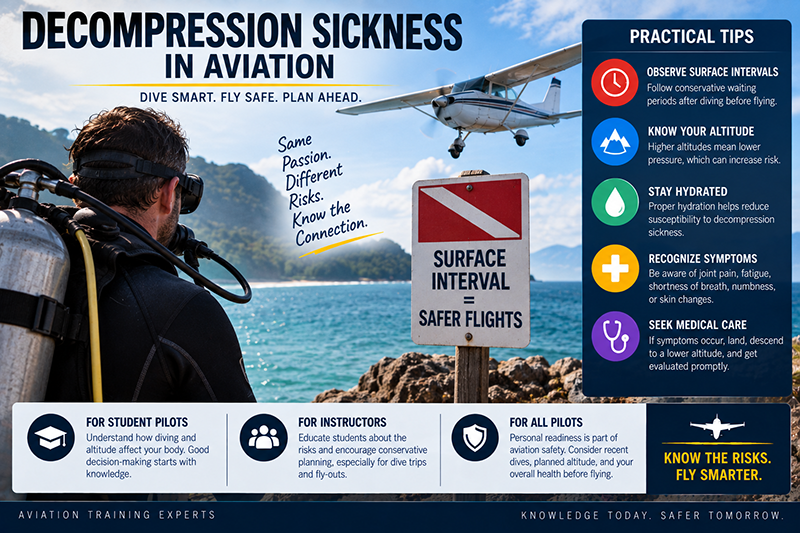
Decompression sickness in aviation is a risk every pilot should understand, especially when flying after scuba diving, operating unpressurized aircraft at altitude, or planning high-altitude training. The condition is associated with dissolved gases, primarily nitrogen, coming out of solution in the body as ambient pressure decreases. For aviators, that pressure change can occur during climb, high-altitude cruise, or cabin pressure loss.
This topic matters because decompression sickness can be subtle at first, distracting, painful, or incapacitating. It can also be confused with fatigue, dehydration, hypoxia, airsickness, anxiety, or a minor musculoskeletal problem. A pilot who dismisses early symptoms may continue climbing, delay oxygen use, or press on toward a destination when the safest decision is to descend, land, and seek medical evaluation.
For student pilots, instructors, commercial pilots, and aviation professionals, the goal is not to memorize medical theory. The goal is to make better go/no-go decisions, ask better preflight questions, and understand why scuba diving and altitude exposure require conservative planning. This article explains how decompression sickness relates to aviation, why post-dive flying deserves special caution, and how pilots can build practical safety margins into flight planning.
What Decompression Sickness Means in Aviation
Decompression sickness, often abbreviated DCS, is a medical condition associated with a reduction in surrounding pressure. At higher pressure, such as during a scuba dive, more inert gas can dissolve into body tissues. When pressure decreases, such as during ascent from a dive or climb in an aircraft, that dissolved gas can come out of solution. If gas bubbles form in tissues or the bloodstream, they can interfere with normal function and cause symptoms.
In aviation, the important idea is simple: altitude reduces atmospheric pressure. Even if an aircraft is operating normally, a climb from sea level to a higher cruising altitude exposes the body to lower pressure. Pressurized aircraft reduce that exposure, but they do not usually maintain a sea-level environment throughout flight. Unpressurized aircraft expose occupants directly to the pressure associated with the aircraft’s altitude. A rapid decompression or loss of pressurization can create an even more significant pressure change.
DCS is different from hypoxia, although both can involve altitude and both can threaten flight safety. Hypoxia is inadequate oxygen available to body tissues. Decompression sickness involves gas bubble formation after pressure reduction. A pilot can experience one without the other, and the corrective actions are not always identical. Supplemental oxygen helps address oxygen availability, but it does not erase the decompression stress created by altitude exposure after a dive.
The classic aviation teaching point is that scuba diving increases the amount of dissolved inert gas in the body. Flying too soon after diving can add a second decompression event. A diver may surface feeling normal, load the aircraft, climb to a moderate cruising altitude, and then begin experiencing symptoms once cabin or ambient pressure decreases further. That is why post-dive flight planning should be treated as a medical and operational risk issue, not merely a scheduling detail.
Altitude Exposure and the Pressure Problem
Atmospheric pressure decreases as altitude increases. The higher an aircraft climbs, the lower the external pressure becomes. In an unpressurized aircraft, the occupants experience that lower ambient pressure directly. In a pressurized aircraft, the cabin pressure is controlled, but it is still commonly maintained at an equivalent altitude rather than at sea-level pressure. The body therefore still experiences some reduction in pressure during flight.
For most healthy people who have not recently been diving, routine altitude exposure in general aviation is usually discussed in terms of oxygen requirements, night vision, fatigue, and hypoxia. Decompression sickness becomes a more prominent concern when there has been a recent dive, a rapid pressure change, prolonged high-altitude exposure, or another factor that increases susceptibility.
In practical terms, a pilot should view pressure exposure as cumulative. A dive loads tissues with additional dissolved inert gas. A climb reduces pressure and can encourage that gas to leave solution. A higher altitude, longer exposure, repetitive dives, deeper dives, strenuous activity, dehydration, cold stress, and individual physiology may all influence risk. Because these variables interact, a single universal answer for every post-dive flight is not a sound planning method.
Altitude also matters because pilots often normalize routine climbs. A short flight to a nearby airport may feel benign, and a moderate cruising altitude may not seem significant compared with airline cruise levels. However, decompression physiology is driven by pressure change, not by whether the flight feels demanding. For a recently surfaced diver, a flight that would normally be uneventful may create unnecessary medical risk.
Why Post-Dive Flying Requires Special Caution
Scuba diving changes the aviation risk picture because the diver breathes compressed gas underwater. As depth increases, pressure increases, and more inert gas dissolves into the body. Dive tables, dive computers, ascent rates, safety stops, and surface intervals are all designed to manage this process during the dive environment. Aviation introduces a different pressure environment after the diver has returned to the surface.
A common misunderstanding is that the risk ends when the diver exits the water. In reality, dissolved gas elimination continues after the dive. The body needs time at surface pressure to off-gas. If the person then flies before adequate off-gassing has occurred, the reduction in pressure during flight can increase decompression stress.
This is especially relevant for pilots because the person making the decision may also be the person at risk of impairment. A passenger who develops joint pain, tingling, dizziness, unusual fatigue, or neurologic symptoms is a serious concern. A pilot who develops those symptoms is an immediate flight safety problem. Even mild pain or distraction can affect checklist use, radio communication, traffic scanning, instrument interpretation, and decision-making.
Post-dive flying is also easy to underestimate because the symptoms may not appear before engine start. A pilot may feel rested, hydrated, and fit to fly during preflight. The problem may develop only after climb, when the cabin or ambient pressure is lower. That timing can place the aircraft away from the departure airport, possibly over terrain, water, weather, or congested airspace.
For that reason, pilots who scuba dive should plan flight activities conservatively before the trip begins. The safest planning is not to dive first and then decide later whether the flight home seems convenient. A better approach is to schedule adequate surface interval, review current diving medicine guidance, consider the planned aircraft altitude profile, and be willing to delay departure.
Symptoms Pilots Should Recognize Without Self-Diagnosing
Decompression sickness can present in different ways. Some symptoms are relatively mild at first, while others are more serious and may involve the nervous system. Pilots should not attempt to diagnose themselves in flight, but they should know which symptoms deserve immediate respect.
Possible symptoms may include joint or limb pain, unusual fatigue, skin changes, tingling, numbness, weakness, dizziness, difficulty walking, visual disturbance, confusion, shortness of breath, or chest discomfort. A pilot may also notice reduced coordination, unusual irritability, or difficulty concentrating. These symptoms can overlap with other aviation medical problems, which is one reason conservative action is important.
The most hazardous mindset is to treat early symptoms as inconvenience rather than warning. A pilot might explain away shoulder pain as lifting dive gear, tingling as pressure from a seatbelt, dizziness as dehydration, or fatigue as a long vacation day. Those explanations may be correct, but they are not reliable enough to justify continuing a flight after recent diving and altitude exposure.
In flight, the practical response is to reduce the pressure stress when safe and appropriate, use oxygen if available and trained to do so, communicate, and land as soon as practical. After landing, medical evaluation is the priority. If decompression sickness is suspected, prompt contact with appropriate medical resources is important. Pilots should not rely on symptom improvement alone as proof that the risk has passed.
Why This Matters in Real-World Aviation
Decompression sickness is not just a medical lecture topic. It affects real flight planning. A private pilot returning from a dive weekend, a flight instructor conducting high-altitude endorsement training, a charter pilot carrying divers, or an owner-pilot flying an unpressurized aircraft from a coastal airport to a mountain destination may all face decisions involving pressure exposure.
The risk becomes more operationally important when schedule pressure is present. Vacation flights, resort transfers, weather windows, rental aircraft return times, and passenger expectations can all push pilots toward launching when delay would be wiser. Unlike a mechanical discrepancy, post-dive decompression risk may not be visible during preflight. The aircraft may be perfect, the weather may be legal, and the pilot may still be making a poor aeromedical decision.
In flight training, this topic is a useful example of aeronautical decision-making. Regulations and checklists cannot cover every biological variable. A safe pilot must understand the underlying hazard well enough to build a margin. That includes recognizing that legal to fly does not always mean smart to fly.
For instructors, decompression sickness also provides a practical way to teach the difference between oxygen rules, pressurization concepts, and personal minimums. A student may assume that if oxygen is not legally required for a planned altitude, the flight has no altitude-related physiological concern. Post-dive operations demonstrate why that assumption is incomplete. Decompression risk can exist even when hypoxia risk appears manageable.
How Pilots Should Understand This Topic
Pilots do not need to become dive medicine specialists, but they do need a working mental model. The model is this: diving can increase dissolved inert gas, altitude can reduce pressure, and the combination can increase the chance of decompression sickness. The greater the decompression stress from the dive and the greater the altitude exposure afterward, the more conservative the pilot should be.
That mental model should influence flight planning before the dive trip. A pilot should consider the type of diving, number of dives, depth, repetitive dive schedule, surface interval, aircraft type, planned cruising altitude, pressurization, terrain, weather, night conditions, passenger condition, and availability of oxygen. None of these factors should be considered in isolation.
For example, a pilot planning a short daytime flight at a low altitude after a single shallow dive is dealing with a different risk profile than a pilot planning a high-altitude crossing after multiple days of repetitive diving. The correct operational response may differ. What should not differ is the need to respect current medical guidance and avoid casual assumptions.
Pilots should also understand that pressurization is helpful but not a guarantee. A pressurized cabin reduces the pressure change compared with an unpressurized climb to the same true altitude, but the cabin is still normally operated at a cabin altitude above sea level. Pressurization systems can also malfunction. If a flight absolutely depends on avoiding altitude exposure after diving, relying solely on pressurization may not be an adequate risk control.
Another important point is that decompression sickness is not limited to divers. High-altitude aviation exposure, especially in certain specialized operations, can also be associated with decompression stress. For typical general aviation pilots, however, the post-dive scenario is the most common way the topic enters routine flight planning.
Common Mistakes or Misunderstandings
One common mistake is treating a minimum waiting period as a universal guarantee. Waiting periods after diving are planning tools, not magic shields. Risk depends on dive profile, altitude exposure, individual physiology, and other conditions. A pilot who barely meets a generic interval after multiple dives and then climbs high in an unpressurized aircraft may not have the same margin as a pilot who waits longer and flies lower.
Another misunderstanding is confusing cabin comfort with physiological safety. A smooth flight in a modern aircraft can feel comfortable while cabin pressure is still lower than sea-level pressure. Comfort does not prove that decompression stress is absent.
A third mistake is focusing only on the pilot. Passengers matter too. A passenger who recently dived may become symptomatic during flight and require diversion, oxygen assistance, or emergency response. If the passenger is a student pilot, crewmember, or someone expected to help with navigation or cockpit duties, their impairment can also affect operational safety.
Some pilots also assume that supplemental oxygen fully solves the problem. Oxygen is important in many altitude and medical situations, and it may be part of an emergency response, but it does not eliminate the pressure change that contributes to bubble formation. A pilot should not use oxygen availability as justification for an otherwise questionable post-dive altitude plan.
Finally, there is the mistake of self-clearing after symptoms improve. A descent may reduce symptoms, or symptoms may fluctuate. That does not mean the underlying condition is resolved. If decompression sickness is possible, the appropriate next step is medical evaluation, not another climb or a return to normal activities without advice.
Practical Example: The Dive Weekend Return Flight
Consider a private pilot who flies friends to a coastal airport for a weekend of scuba diving. The aircraft is an unpressurized piston single. The return route crosses terrain that would be more comfortable at a higher cruising altitude, and afternoon weather is forecast to deteriorate. The group completes several dives over two days. Everyone feels fine on Sunday morning, and the pilot wants to depart before weather moves in.
The aircraft is airworthy, fuel planning is adequate, and the weather is still acceptable. The real hazard is not obvious on the ramp. The pilot and passengers have recent dive exposure, and the planned route would involve additional altitude exposure. If the pilot chooses to climb high to clear terrain and improve radio coverage, the flight may increase decompression stress. If symptoms develop en route, options may be limited by terrain and weather.
A conservative plan might include delaying the return, choosing a lower altitude route if terrain and weather permit, using a pressurized commercial alternative, arranging ground transportation, or changing the dive schedule before the trip so the final dive occurs well before the planned flight. The best decision depends on the actual dive profiles, current guidance, aircraft capability, route, weather, and pilot condition.
The important lesson is that this decision should not be made casually after the dive gear is packed. It should be part of the original risk assessment. A pilot who intends to combine scuba diving and flying needs a preplanned surface interval strategy and a willingness to cancel or delay if the plan no longer provides enough margin.
Best Practices for Pilots
Good post-dive aviation planning begins before the first dive. If you know you will be flying after diving, structure the trip so the flight is not competing with the body’s need to off-gas. Schedule conservatively, avoid stacking multiple risk factors, and treat the return flight as part of the dive plan.
Because individual dive profiles vary, pilots should use current diving medicine and aviation medical guidance rather than relying on hangar talk. Dive computers and training agencies may provide recommendations, but pilots should understand what assumptions those recommendations make. When in doubt, consult an aviation medical examiner or a qualified diving medicine resource before the trip.
Operationally, the safest planning habits are straightforward:
- Plan adequate surface interval before flight, based on the actual dive profile and current guidance.
- Avoid unnecessary altitude exposure after diving, especially in unpressurized aircraft.
- Do not treat oxygen availability as permission to ignore decompression risk.
- Brief passengers who have dived to report unusual pain, tingling, dizziness, weakness, or confusion immediately.
- Build flexibility into the schedule so delaying the flight is a practical option.
- Seek medical evaluation promptly if symptoms suggest possible decompression sickness.
Instructors can incorporate this topic into scenario-based training. For example, during cross-country planning, ask a student to evaluate a return flight after a diving trip. Have the student consider altitude, terrain, passenger condition, weather, and external pressures. This builds the habit of connecting physiology to operational decisions.
Commercial operators and flying clubs may also benefit from clear internal guidance. If aircraft are frequently used for coastal trips, island operations, or recreational travel involving divers, pilots should receive standardized education on post-dive altitude risk. The goal is not to create unnecessary restrictions, but to prevent inconsistent decision-making based on incomplete knowledge.
Training and Regulatory Perspective
From a pilot training standpoint, decompression sickness belongs in the broader category of aeromedical factors. It is related to altitude physiology, but it should not be merged casually with hypoxia training. Pilots should be able to explain the difference between oxygen deficiency and decompression stress, recognize why a recent dive changes the risk picture, and make conservative decisions when symptoms or uncertainty exist.
Regulatory oxygen requirements are important, but they are not the whole answer. Oxygen rules address specific operating conditions and exposure times. Decompression sickness risk after diving involves pressure exposure and dissolved gas physiology. A flight can be planned below a regulatory oxygen threshold and still be a poor choice after recent scuba activity.
This is where personal minimums and aeronautical decision-making become essential. A pilot may set a personal rule to avoid flying for a conservative period after scuba diving, to avoid unpressurized altitude exposure after repetitive dives, or to consult medical guidance before combining technical diving and flight. Those personal rules should be more conservative when passengers are involved, when the route requires higher altitude, or when weather reduces diversion options.
What To Do If Symptoms Occur in Flight
If decompression sickness is suspected in flight, the pilot’s priorities are aircraft control, reducing risk, communication, and landing. The exact response depends on aircraft type, altitude, weather, terrain, and crew condition. In general, continued climb or prolonged altitude exposure is not a prudent response when symptoms appear after recent diving.
If the pilot is symptomatic, workload management becomes critical. Use available automation if appropriate, communicate with air traffic control if available, and do not hesitate to declare an emergency when safety is in doubt. A medical problem affecting the pilot is an operational emergency, even if the aircraft itself is functioning normally.
If a passenger is symptomatic, the pilot should consider diversion and medical assistance. Provide oxygen if available and appropriate, consistent with equipment limitations and training. Avoid press-on-itis. A flight that continues to the original destination despite worsening symptoms may sacrifice valuable time and options.
After landing, suspected decompression sickness should be evaluated by appropriate medical professionals. Pilots should not make return-to-flight decisions based only on how they feel after descent or rest. Aeromedical follow-up may be necessary before resuming pilot duties.
Frequently Asked Questions
Can pilots fly immediately after scuba diving if they stay at a low altitude?
Immediate flight after scuba diving is not a good assumption, even if the planned altitude seems low. Risk depends on the dive profile, surface interval, aircraft altitude, and individual factors. Pilots should follow current diving medicine and aviation medical guidance and plan conservatively.
Is decompression sickness the same as hypoxia?
No. Hypoxia involves inadequate oxygen available to body tissues. Decompression sickness involves dissolved inert gas coming out of solution as pressure decreases. Both can occur in aviation, both can impair a pilot, and both deserve serious attention, but they are different conditions.
Does flying in a pressurized aircraft eliminate post-dive risk?
Pressurization can reduce altitude exposure compared with an unpressurized aircraft, but it does not necessarily eliminate pressure reduction. Cabins are commonly operated at an equivalent altitude above sea level, and pressurization systems can fail. Recent divers should still use conservative planning.
What symptoms should concern a pilot after diving and flying?
Unusual joint or limb pain, tingling, numbness, weakness, dizziness, confusion, visual changes, unusual fatigue, shortness of breath, or coordination problems should be taken seriously after recent diving and altitude exposure. Medical evaluation is appropriate when decompression sickness is possible.
Can supplemental oxygen prevent decompression sickness?
Supplemental oxygen may be important in altitude operations and may be used in response to certain medical concerns, but it does not remove the pressure change that contributes to decompression sickness. Oxygen availability should not be used as a reason to fly too soon after diving.
Who should pilots ask for guidance before combining diving and flying?
Pilots should use current aviation medical and diving medicine guidance. An aviation medical examiner, qualified dive medicine resource, or appropriate medical professional can help interpret risk when dive profiles, planned altitudes, or symptoms raise questions.
Key Takeaways
- Decompression sickness in aviation is primarily a pressure-exposure problem, and recent scuba diving can increase the risk during flight.
- Post-dive flying should be planned conservatively, especially in unpressurized aircraft, at higher altitudes, or after repetitive or demanding dives.
- Pilots should distinguish decompression sickness from hypoxia, avoid casual self-diagnosis, and seek medical evaluation if symptoms appear after diving and altitude exposure.