
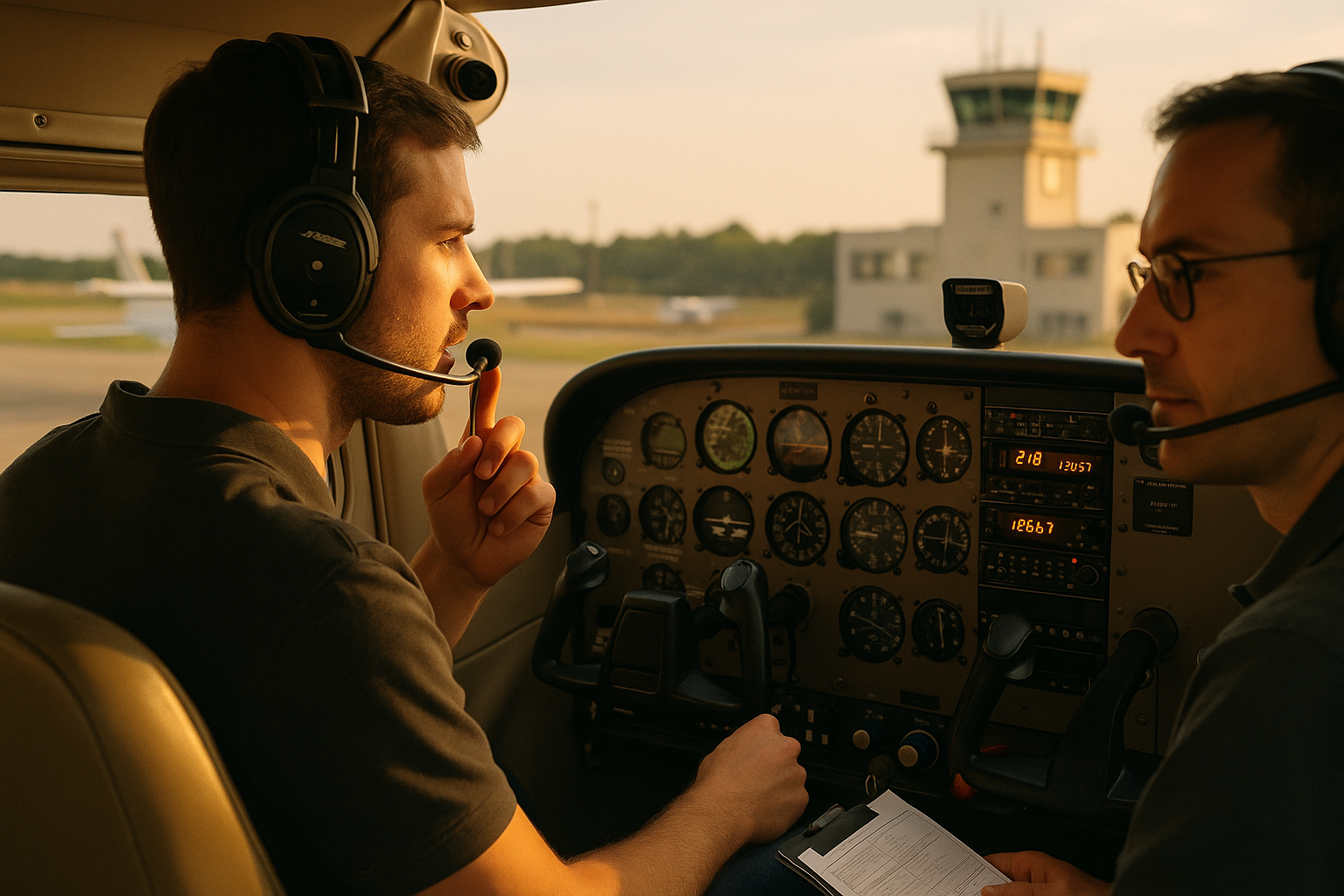
Aviation English is the language of the cockpit and the tower. For pilots, student pilots, flight instructors, and air traffic controllers, clear radio communication is not optional. It directly shapes situational awareness, crew coordination, and routine decision-making. This article explains how Aviation English improves flight safety and gives practical guidance instructors and pilots can use immediately.
Read on for an operational view of phraseology, plain-language techniques, common pitfalls, and training exercises that make radio work safer. You will find real-world examples, a sample radio exchange with analysis, and an FAQ tailored to pilots and instructors who want to translate theory into better outcomes in the cockpit.
What Aviation English Means for Pilots
At its core, Aviation English covers two related areas: standardized phraseology and effective plain-language communication when standard phraseology does not apply. Standard phraseology is a compact, predictable set of words and sentence structures designed to reduce ambiguity. Plain-language communication is clear, concise speech used when controllers or flight crews must convey information not covered by fixed phrases.
Both areas overlap with cockpit resource management, situational awareness, and decision-making. Successful radio exchanges follow a simple pattern: transmit, receive, confirm, and act. When any part of that loop fails, the odds of misunderstanding increase. Aviation English is the toolkit pilots and controllers use to keep the loop intact.
Why This Matters in Real-World Aviation
Misunderstandings on the radio can transform a normal flight into an urgent operational problem. Incorrect readbacks, missing clearances, misunderstood headings, or confusion over taxi routes can lead to runway incursions, loss of separation, or procedural deviations. Even when events do not result in an accident, they can increase workload and erode confidence in the cockpit and the tower.
Flight training, line operations, and recurrent checks are all opportunities to strengthen Aviation English skills. Instructors who integrate radio discipline into every flight lesson improve student pilots' readiness for real-world operations. Operators who emphasize clear comms in briefings and standard operating procedures reduce the probability of human error during high-workload phases such as departure, approach, and taxi.
Language proficiency also affects non-technical skills. Clear, assertive speech helps capture attention during abnormal situations. A well-phrased challenge from a first officer or a concise instruction from ATC can prevent the escalation of errors and shorten the time to a safe resolution.
How Pilots Should Understand Aviation English
Think of Aviation English as practiced behavior, not merely vocabulary. Pilots should master three practical habits: predictable phrase patterns, accurate readbacks, and proactive clarification. Predictability helps the receiver parse meaning quickly. Accurate readbacks close the loop. Proactive clarification resolves uncertainty before it becomes a problem.
Predictable phrase patterns include common elements such as callsign, clearance, numeric values, and action verbs. For example, an instruction that begins with a callsign quickly focuses attention. A concise numeric readback highlights potential mismatches. When a pilot modifies or extends a clearance, the structure should make the change obvious.
Accurate readbacks are central to safe radio work. Readbacks must capture critical elements: clearances, altitudes, headings, frequencies, and taxi instructions that affect separation or routing. When in doubt, read it back verbatim or request repetition. The discipline of readbacks reduces conversational drift - the gradual loss of precision that can occur in familiar environments.
Proactive clarification is a safety skill. If you ever hesitate about a phrase, say so. Use clear prompts such as "Confirm runway 27?" or "Say again previous message." A short, focused clarification early in a sequence is less costly than a lengthy recovery after a misunderstanding.
Common Mistakes or Misunderstandings
Pilots and instructors often assume radio competence without practicing it. Common problems include:
Overreliance on informal language. Casual phrases or regional idioms can be misinterpreted by non-native listeners.
Poor readbacks. Leaving out numbers or omitting the part of a clearance that changes the aircraft's route or altitude.
Failure to use callsigns. Messages without a clear recipient can be missed, especially on busy frequencies.
Inadequate phraseology when switching to plain language. When standard phrases do not cover a situation, pilots may use vague wording instead of structured clear language.
Assuming a lost transmission. Pilots sometimes act on an instruction they did not actually receive, instead of obtaining confirmation.
Training gaps also appear in cross-cultural contexts. Pilots with different native languages or accents may pronounce words differently or place emphasis on nonstandard syllables. That makes deliberate phrase choice and consistent readbacks more important. Instructors should include exercises with accented speakers or playback simulation to expose students to real-world variability.
Practical Example
Scenario: A single-pilot cross-country in a light twin is cleared to taxi for departure at a busy towered airport. Multiple ground instructions are issued, and the pilot must confirm a hold-short clearance before crossing an active runway.
Sample exchange and analysis:
Controller: "Cessna 123AB, taxi to runway 27 via Alpha, hold short runway 9."
Pilot: "123AB taxi to runway 27 via Alpha, hold short runway 9."
Analysis: The pilot's readback repeats the runway numbers and the route. It signals comprehension. The phrase "hold short" flags the critical action.
Later, when approaching a runway crossing, the pilot hears an ambiguous transmission on frequency and is unsure whether the instruction to cross was for another aircraft or for them.
Pilot: "Ground, 123AB, confirm hold short runway 9, say again runway crossing instruction."
Controller: "Cessna 123AB, confirm hold short runway 9. Expect departure on 27 after departure briefing, do not cross runway 9."
Analysis: The pilot's focused clarification used the callsign and repeated the critical element - hold short. That prompted the controller to specify and remove ambiguity. The outcome avoided a potential runway incursion. The exchange demonstrates the value of concise clarifications and exact readbacks when ambiguity exists.
Practical Training Exercises Instructors Can Use
Instructors should treat Aviation English as a recurring element of every lesson. Practical exercises include:
Readback drills: Give students a mix of clearances that include headings, altitudes, and frequencies. Require immediate verbatim readbacks of the critical elements.
Role play: Simulate high-workload scenarios where students must manage radio duties, checklist flows, and basic flying. Include background noise or accented voices to increase realism.
Hearback training: Have students listen to recorded ATC transmissions and transcribe the critical instructions. Debrief discrepancies and discuss likely causes.
Plain-language practice: Present non-standard situations such as equipment failures or weather deviations and require students to craft concise plain-language transmissions that convey the problem and intended action.
CRM integration: Combine crew communication drills with radios. Practice assertive challenge-response patterns for safety-critical calls.
These exercises improve both fluency and the mental habit of closing the communication loop under stress. They also give instructors objective ways to evaluate student progress beyond maneuver performance.
Best Practices for Pilots
Practice predictable habits. Here are practical behaviors to adopt and teach:
Start transmissions with the callsign and end with critical values. Keep the middle concise.
Read back critical elements verbatim: runway numbers, altitudes, headings, frequencies, and hold-short instructions.
If you do not understand, ask immediately. Use short, focused prompts to confirm the specific item, not the entire message every time.
Anticipate expected phraseology. Predict what the controller will clear you to do and listen specifically for deviations from expectation.
Use standard phrasing when available. When you must use plain language, be concise and prioritize the essential facts.
Practice night and low-visibility comms where verbal clarity becomes even more critical because visual cues are limited.
Operational habit formation is key. Repetition in training, supported by deliberate debriefs that include radio performance, will embed the behaviors so they become automatic during high workload.
When Phraseology and Plain Language Collide
There are moments when neither fixed phraseology nor routine plain language will suffice, such as an unexpected mechanical problem that requires an unconventional routing. In those cases, structure your message like a mini-briefing: identify the aircraft, state the problem in one line, state your intent in one line, then request or accept instructions.
For example: "Tower, Cessna 123AB, engine instrument abnormal, intend to return to field for landing, request vectors and priority handling." That structure quickly provides the controller the pieces they need to prioritize and coordinate resources.
Human Factors and Communication Under Stress
Stress narrows attention and reduces verbal precision. Instructors should integrate stress-exposure training so pilots practice clear radio work while managing cognitive load. Simple interventions help: slow speech slightly when workload increases, use short sentences, and prioritize the most important information first.
Crew Resource Management techniques reinforce that anyone in the cockpit may speak up and that challenge-response loops are non-punitive. Encouraging concise, direct phrasing from all crewmembers reduces the chance that a junior pilot will withhold a vital clarification.
Frequently Asked Questions
Is Aviation English required for all pilots?
Language requirements vary by country and operation type. Many international operations and air traffic services expect pilots to demonstrate operational-level proficiency. For precise regulatory requirements, consult the applicable national or international authority. In practical terms, pilots flying in controlled airspace should be able to use standardized phraseology and plain language clearly.
How can student pilots practice Aviation English effectively?
Include radio work in every lesson. Practice readbacks, role-play tower interactions, and debrief radio exchanges as part of the postflight critique. Use recorded ATC audio and simulators for exposure to accents and real-world noise. Structured repetition builds both vocabulary and the habit of closing the communication loop.
What is the difference between phraseology and plain language?
Phraseology refers to standardized, compact expressions designed to be unambiguous. Plain language is clear, concise speech used when the standardized phrase does not fit the situation. Use phraseology when it covers the situation; use plain language when you must describe a nonstandard problem or coordinate an unusual action.
How should pilots handle accents or poor audio quality on frequency?
Slow down speech, repeat critical elements, and ask for clarification. Use callsign repetition to ensure the message is addressed to you. If the audio quality makes the message unsafe to act on, request the controller to restate the critical instruction or ask for a different frequency or method of communication if available.
When is it acceptable to deviate from standard phraseology?
Deviations are acceptable when phraseology cannot convey the required information. When deviating, keep language concise, prioritize the essential facts, and include a brief intent statement. Always be prepared to repeat or clarify specific numeric values when asked.
Key Takeaways
- Practical takeaway: Treat Aviation English as a flight discipline. Practice readbacks and clarifications in every lesson to build automatic, reliable habits.
- Safety takeaway: Clear, concise communication reduces misunderstandings that can lead to runway incursions, loss of separation, or procedural deviation.
- Training and decision-making takeaway: Integrate radio proficiency into skill checks and scenario training. Evaluate radio performance alongside flying skills during debriefs.
Good radio work is a skill you can train and measure. By emphasizing predictable phrase patterns, disciplined readbacks, and timely clarifications, pilots and instructors improve safety margins across the operation. Use the exercises and practical habits in this article to embed Aviation English into routine flying and training activities.