
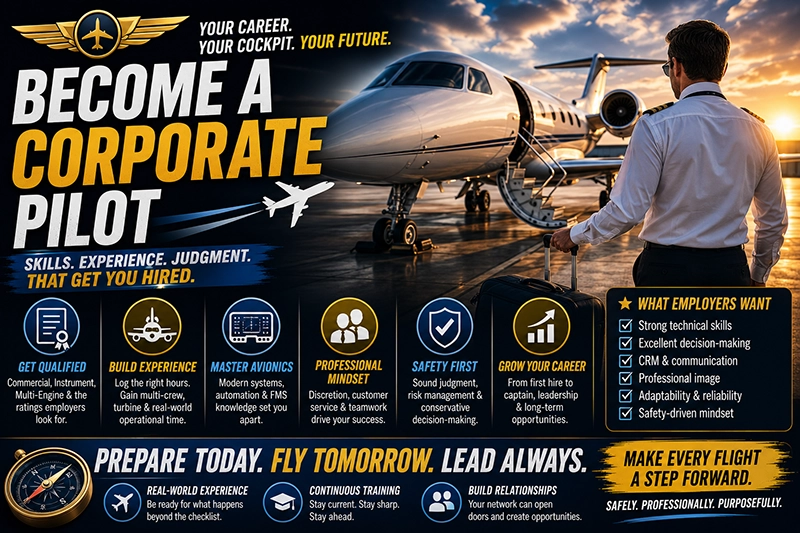
Becoming a corporate pilot is a realistic career goal for pilots who want to fly business jets, turboprops, or piston aircraft for companies, fractional operators, high-net-worth individuals, or charter firms. The term corporate pilot covers a wide range of roles and operations. This article explains practical pathways to become a corporate pilot, what employers typically look for, and how to make training, safety, and operational decisions that increase your chances of success.
If you are a student pilot, flight instructor, or an experienced aviator exploring a career change, this guide focuses on aviation realities that matter in the cockpit: certifications and ratings you will likely need, operational differences between corporate flying and airline or regional flying, training priorities, common hiring gaps, and the real-world judgment pilots must demonstrate once hired. The primary keyword corporate pilot appears early because employers and searchers are often looking for exactly this practical guidance.
What "Corporate Pilot" Means in Practice
A corporate pilot typically operates aircraft owned or leased by companies, individuals, or organizations for business or personal transportation. Corporate flying can include scheduled shuttle operations for a company, on-demand charter flights, ferry flights, or dedicated executive transport. Aircraft range from light pistons to large business jets. Corporate operations prioritize flexibility, discretion, and customer service in addition to safe aircraft operation.
Operationally, corporate flying differs from airline operations in several ways. Schedules can be less predictable, destinations may include smaller or private fields, and pilots often have more direct contact with passengers or passengers' representatives. That requires a blend of technical airmanship, strong communication and interpersonal skills, and sound judgment when making operational decisions about weather, diversion plans, and crew rest.
Why This Career Path Matters in Aviation
Corporate flying remains a meaningful segment of the aviation industry because it supports business mobility, urgent travel needs, and missions that scheduled airlines cannot serve. For pilots, the corporate sector can offer varied flying, opportunities for leadership and management, quicker progression to more complex aircraft, and exposure to multi-crew operations in a non-airline environment.
From a safety and training perspective, corporate operations require rigorous attention to risk management. Operators expect pilots to understand aircraft performance, weight and balance, company policies, and applicable operating rules. They also expect crews to manage pressure from passengers, meet confidentiality expectations, and make conservative decisions when safety margins shrink.
Core Certifications, Ratings, and Qualifications
There is no single, universal regulatory pathway to become a corporate pilot because hiring standards vary by employer and by the type of operation. However, most corporate operators look for a combination of the following qualifications and experience:
Commercial pilot certificate and instrument rating - These are basic professional credentials that demonstrate you can operate for compensation and fly in instrument meteorological conditions.
Multi-engine rating - Most corporate aircraft are multi-engine, and a multi-engine rating is essential for safe operation and to be considered for many positions.
Type ratings and high-performance endorsements - For turbine business jets and some turboprops, a specific type rating may be required by the employer before you can act as pilot-in-command. Employers may also require experience in similarly complex aircraft.
Flight hours and multi-crew experience - Employers will look at total flight time and specific experience relevant to their fleet. For multi-pilot jets, experience in multi-crew environments and understanding Crew Resource Management (CRM) are critical.
Professional attributes - Good decision-making, customer service, confidentiality, and the ability to work within company procedures are as important as technical skill.
Note: Because this article is written without a specific FAA or operator document, the exact certifications and minimums required by a particular operator may differ. See manual review items for details you should verify with specific operators or regulatory material.
How Pilots Should Understand Corporate Operations
Think of corporate flying as a hybrid of technical airmanship, discretionary judgment, and customer-focused service. Pilots are expected to be both technically competent and adaptable. Below are practical operational realities to internalize.
Flight planning and performance: Corporate flights often operate to and from smaller fields with shorter runways, unique terrain, or more limited services. Pilots must be fluent in determining runway performance with the aircraft's actual weight, runway surface, temperature, and altitude. Conservative planning and contingency fuel are essential when operating into remote or single-runway airports.
Weather assessment and go/no-go decisions: Corporate passengers may exert pressure to complete a flight. Pilots must balance customer expectations with conservative go/no-go and diversion decisions. Effective use of weather briefings, alternate planning, and timely diversion acceptance reduces risk.
Security and discretion: Corporate pilots often work closely with executives or private individuals. Maintaining operational security, passenger privacy, and professional behavior is part of the job description and can affect job retention.
Regulatory frameworks and operating rules: Corporate operations can fall under different regulatory parts depending on the mission, the operator's certificate, and whether flights are for compensation or private carriage. Pilots should understand how operational rules may affect minimum crew requirements, duty time, training, and maintenance oversight. Verify regulatory specifics with operators and official guidance.
Training, Upskilling, and How to Be Competitive
Because hiring standards for corporate pilots are competitive, pilots should plan a deliberate training progression and prioritize experience that operators value. Several practical steps will improve marketability and operational readiness.
Gain solid foundational experience: Start with a complete set of ratings that match the aircraft you want to fly. For most corporate roles this includes a commercial certificate, instrument rating, and multi-engine rating.
Build multi-crew and turbine experience: Many corporate employers prefer pilots who have experience in turbine aircraft or who have worked in structured, multi-crew environments. Consider flight instructing, charter flying, aerial surveying, or fractional operations as ways to build hours and professional experience.
Obtain relevant type ratings or endorsements strategically: If you have a target fleet in mind - for example, light jets or midsize jets - plan to obtain a relevant type rating when economically and operationally sensible. Some pilots secure type ratings through sponsored programs or industry partnerships.
Master avionics and automation: Corporate aircraft often include advanced avionics suites and automation systems. Familiarity with glass cockpits, flight management systems, and modern navigation procedures improves safety and efficiency and is a hiring differentiator.
Prioritize CRM and professional training: Crew Resource Management, threat and error management, and upset recovery training are valuable. These programs improve decision-making, communication, and safety culture - traits corporate operators seek.
Common Mistakes and Misunderstandings
Many aspiring corporate pilots make predictable errors that slow career progression. Recognizing and avoiding these mistakes accelerates advancement and reduces career risk.
Underestimating non-technical expectations: Technical ability matters, but so do soft skills. Weak interpersonal skills, poor customer service, or failure to adapt to corporate confidentiality can limit opportunities even for very competent pilots.
Neglecting aircraft systems knowledge: Operating complex turboprops and jets requires more than stick-and-rudder skills. Pilots who lack a deep understanding of systems, automation, and performance calculations risk operational errors.
Rushing type ratings without relevant preparatory experience: A type rating alone does not guarantee competency. Seek supervised line experience, mentorship, and recurrent training to convert a type rating into effective operational capability.
Ineffective networking and professional image: Corporate hiring often involves direct contact with hiring managers, chief pilots, or trusted industry contacts. A professional reputation, solid references, and a demonstrable record of safe decision-making matter.
Practical Example: Transitioning from Flight Instructor to Corporate Pilot
Scenario: You are a certificated flight instructor with 1,200 total flight hours and want to move into corporate flying. You have a commercial certificate with instrument and multi-engine ratings, but you lack turbine experience.
Step 1 - Target experience-building roles: Consider regional charter, fractional operator ferry flights, or corporate ferry legs that accept pilots with your certificate set. Alternatively, pursue opportunities as a co-pilot in a turboprop where the employer provides a type-specific conversion.
Step 2 - Professional development plan: Enroll in initial turbine transition training, focus on advanced avionics courses, and complete structured CRM training. Work with a mentor who has corporate experience and ask for supervised line experience when possible.
Step 3 - Build relevant endorsements: Add a high-performance and complex aircraft endorsement and consider an initial type rating if a target employer or mentorship opportunity makes it practical. Use simulator time to practice emergency scenarios, automation management, and non-normal procedures.
Step 4 - Prepare for interviews: Be ready to discuss real flight scenarios where you made conservative decisions, managed threats, or applied CRM to resolve an in-flight problem. Demonstrate how your instructing experience created habits of disciplined procedures and clear communication.
This transition pathway emphasizes that corporate hiring values transferable skills, deliberate experience building, and evidence of safe judgment in addition to raw flight hours.
Best Practices for Pilots Seeking Corporate Roles
Be professional - Maintain a professional appearance, strong references, and a polished resume targeted for corporate hiring managers. Emphasize reliability, confidentiality, and customer service experience.
Document experience clearly - Keep an accurate logbook and operation-specific records. Highlight experience with complex avionics, multi-crew operations, and any type ratings. Be specific about aircraft types, roles, and operational environments.
Practice conservative decision-making - Corporate operators value pilots who prioritize safety and are able to justify conservative choices with clear risk assessment. Use formal risk matrices or company checklists where available.
Invest in recurrent and scenario-based training - Realistic simulator training that includes automation management, upset recovery, and emergency procedures will increase your operational readiness and demonstrate commitment to safety.
Network within the industry - Attend industry events, join professional organizations, and build relationships with chief pilots, training providers, and operators. Reputation and referrals are powerful in corporate hiring.
How to Prepare for Real-World Operational Challenges
Flights in the corporate environment can present unique operational challenges: last-minute itinerary changes, airport constraints, variable weather conditions, and passenger needs that place pressure on the flight crew. Preparing for these realities reduces operational stress and enhances safety.
Plan alternates proactively - Because corporate flights may be to airports with limited services, always have realistic alternates and plan for fuel contingencies. Apply conservative fuel planning when passenger schedules or weather are marginal.
Maintain currency and proficiency - Currency alone is not proficiency. Engage in regular simulator practice, scenario-based flight training, and recurrent procedural checks to stay sharp in emergencies and abnormal procedures.
Communicate clearly with passengers and operations - Explain realistic limitations to passengers when safety or operational constraints exist. Clear, confident communication prevents pressure-driven decision-making and sets expectations.
Career Pathways and Progression
Career progression in corporate aviation is not strictly linear, but there are common patterns. Pilots often begin in instructing, charter, agricultural, or regional flying to build hours. From there, moving into light-business aircraft, turbine transitions, and then multi-crew corporate jets is common. Advancement to captain, chief pilot, director of operations, or training captain are potential career milestones.
Professional development beyond flying - Corporate pilots often take on responsibilities beyond the cockpit: flight department management, scheduling, maintenance liaison duties, and security coordination. Developing administrative skills, understanding maintenance practices, and learning regulatory compliance enhance long-term career prospects.
Common Safety Risks and How to Mitigate Them
Corporate flying brings distinct safety risks that pilots must recognize and manage. Typical risks include operational pressure, fatigue from irregular schedules, and complacency on familiar routes.
Operational pressure - Passengers with tight schedules may pressure crews to accept higher-risk conditions. Mitigate this by setting boundaries early, using company policies, and applying objective risk assessment methods.
Fatigue risk - Irregular schedules, overnight repositioning, and time-zone changes can degrade performance. Maintain robust fatigue risk management practices and prioritize rest over schedule pressure where safety is at stake.
Complacency - Routine routes can foster complacent behavior. Use standard operating procedures, checklists, and scenario-based recurrent training to maintain vigilance.
Frequently Asked Questions
What certifications do I absolutely need to be considered for corporate flying?
Employers typically expect a commercial pilot certificate, instrument rating, and a multi-engine rating for most corporate roles. Additional qualifications like type ratings, turbine time, or a particular number of multi-crew hours may be required depending on the operator and aircraft type.
Is flight instructing a good route to become a corporate pilot?
Yes. Flight instructing helps build hours, refines teaching and communication skills, and establishes a strong foundation in airmanship. Many pilots use instructing to reach the flight hours and experience needed to transition into charter, corporate, or fractional operations.
Do corporate pilots need an ATP certificate?
Some operators require the Airline Transport Pilot certificate for certain roles or for operations under specific regulatory frameworks, particularly for high-capacity or commercial scheduled services. Requirements vary by operator and operation type, so check with prospective employers and regulatory guidance.
How important is a type rating for corporate jets?
Type ratings are important when the aircraft requires one for legal operation. Even when not immediately required, a type rating in the target aircraft family increases employability because it reduces training burden for the employer.
How can I improve my chances of getting hired by a corporate operator?
Build relevant experience in complex aircraft, develop CRM and systems knowledge, seek mentorship, maintain an impeccable professional reputation, and prioritize recurrent and scenario-based training that demonstrates readiness for multi-crew operations.
Transitioning to the Line and Initial Operational Experience
Once hired, the initial period of operational experience - often called line indoctrination or transition - converts training into practical capability. This phase includes supervised flights, company-specific procedures, and recurrent checks. Treat this time as an apprenticeship: absorb procedures, ask experienced crewmembers for rationales behind company standards, and practice conservative decision-making until you build comfort and judgment in the specific operation.
Building a Long-Term Professional Profile
As you gain experience, cultivate skills beyond flying. Effective corporate pilots contribute to a safe, efficient flight department by participating in safety meetings, mentoring junior pilots, assisting with procedure development, and engaging with maintenance and scheduling teams. A reputation for safety, reliability, discretion, and operational competence opens opportunities to advance to leadership roles.
Key Takeaways
- Practical takeaway: Build a foundation of commercial, instrument, and multi-engine experience and prioritize turbine and multi-crew exposure where possible.
- Safety takeaway: Maintain conservative decision-making, robust preflight planning, and proactive alternate and fuel planning to manage operational risk.
- Training and career takeaway: Invest in type ratings, advanced avionics training, and CRM to improve your competitiveness and readiness for corporate operations.
Final Advice
Becoming a corporate pilot is a career that rewards technical competence, disciplined decision-making, and professional behavior. Focus on structured experience building, continuous training, and the interpersonal skills that employers value. Keep an accurate logbook, seek mentors with corporate experience, and be deliberate about the types of aircraft and operations you pursue. The combination of solid fundamentals, demonstrated judgment, and professional presence will create opportunities in corporate aviation.
If you are serious about this path, create a multi-year plan that includes targeted training, practical experience in complex aircraft, and building relationships within the industry. That plan, combined with consistent attention to safety and professionalism, will position you for success as a corporate pilot.