
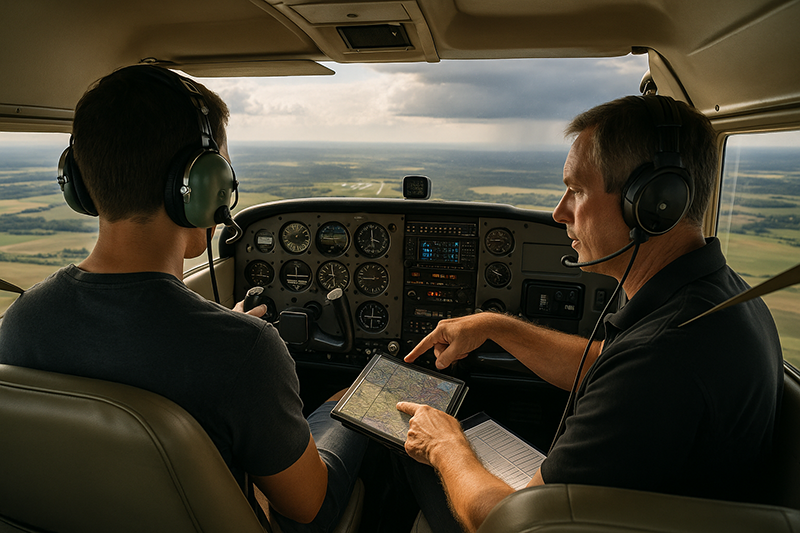
Diversion plans are one of the most useful safety tools a pilot can carry into the cockpit, yet they are often treated as a quick line on a nav log or a casual thought during preflight. A good diversion plan is not simply naming an alternate airport. It is the habit of keeping realistic options available as the flight develops, then choosing one before weather, fuel, daylight, terrain, or workload removes the pilot’s margin.
For student pilots, diversion planning builds confidence and judgment. For experienced pilots, it protects against complacency and plan continuation bias. For flight instructors and aviation professionals, it offers a practical way to teach aeronautical decision-making beyond rote navigation exercises. The best diversion planning is not dramatic. It is quiet, disciplined, and continuous. It helps a pilot answer three important questions throughout the flight: Where can I go now? What will it cost me in fuel, time, and workload? When should I stop trying to make the original destination work?
What a Better Diversion Plan Really Means
A diversion is a change from the original plan to a different airport, route, altitude, holding point, or safe outcome. In training, the word often means turning toward a nearby airport after the instructor covers the destination or announces a simulated weather problem. In real operations, a diversion may be caused by weather, deteriorating visibility, stronger-than-expected winds, passenger needs, fuel concerns, mechanical indications, airspace constraints, runway closures, delays, or the pilot’s own fatigue.
Building better diversion plans means developing options before they become urgent. The pilot does not wait until the destination is no longer usable, fuel is tight, or the cockpit is saturated. Instead, the pilot continually updates the mental picture of nearby airports, fuel remaining, weather trends, terrain, communications, and aircraft condition. That active awareness turns a diversion from a surprise into a managed decision.
A strong diversion plan has three qualities. First, it is realistic for the aircraft and pilot. An airport may look convenient on the chart but be unsuitable because of runway length, surface condition, crosswind, terrain, lighting, services, or the pilot’s proficiency. Second, it is timely. A diversion option that requires using nearly all available fuel or flying through worsening weather is not really a good option. Third, it is simple enough to execute under stress. When workload rises, the best plan is usually the one with the clearest route, the most manageable weather, and the fewest unnecessary complications.
This is why diversion planning should not be limited to emergencies. A pilot who regularly thinks about diversion options during normal flights builds the same mental muscles needed when circumstances are less forgiving. The goal is not to be fearful or overly conservative. The goal is to preserve choices.
Why Diversion Planning Matters in Real-World Aviation
Real-world flying rarely follows the exact picture built at the kitchen table or flight school briefing room. Winds aloft may differ from the forecast. Cloud bases can lower earlier than expected. Convective weather can develop along a route. Smoke, haze, turbulence, or precipitation can make a legal flight uncomfortable or unwise. A planned fuel stop may become less attractive after an unforecast headwind. An airport that looked perfect may report a runway closure, a strong crosswind, or traffic delays.
In these situations, the pilot’s safety margin depends less on memorizing a perfect plan and more on adapting early. A well-prepared pilot does not ask, “Can I still make it?” as the only question. The better question is, “Which option gives me the safest and simplest outcome from here?” That change in mindset is central to better diversion planning.
Diversion planning also matters because workload is not evenly distributed across a flight. In cruise, the cockpit may feel calm and the pilot may have time to compare airports, check frequencies, review weather, and brief an approach or traffic pattern. Near the destination, workload often increases. The pilot may be descending, talking to ATC, managing traffic, configuring the aircraft, reviewing runway information, and watching weather at the same time. If the decision to divert is delayed until that high-workload phase, the pilot may have fewer good options and less attention available to evaluate them.
For instructors, diversion training is a powerful way to teach judgment. It combines navigation, aircraft performance, weather interpretation, communication, fuel management, risk assessment, and cockpit organization. It also reveals how a student thinks. Does the pilot choose the nearest airport without checking runway suitability? Does the pilot forget fuel? Does the pilot focus on the GPS magenta line and stop looking outside? Does the pilot make a plan but fail to communicate it? These are training opportunities that directly support safer flying.
How Pilots Should Understand Diversion Plans
A diversion plan is best understood as a layered decision process rather than a single airport name. The first layer is awareness. The pilot should know the general location of usable airports along the route, especially when crossing areas with sparse landing options, changing terrain, or limited weather reporting. This does not mean memorizing every airport. It means maintaining a practical sense of what is nearby and what is suitable.
The second layer is evaluation. A suitable diversion airport is not necessarily the closest airport. Suitability depends on the situation. A short paved runway may be reasonable for one aircraft and inappropriate for another. A non-towered airport may be simple in good VFR conditions but less desirable at night if lighting, terrain, or weather is uncertain. A larger airport may offer services, weather reporting, instrument approaches, and longer runways, but it may also involve more traffic or more complex communications. The pilot must match the option to the aircraft, conditions, and pilot capability.
The third layer is timing. A diversion decision should usually be made while there is still room to choose among several acceptable outcomes. Waiting for certainty can be dangerous because aviation problems often become clearer only after the margin has already decreased. If a weather trend is moving against the route, if fuel reserves are shrinking, or if the pilot is working harder than expected, an early diversion may be the most professional decision.
The fourth layer is execution. Once the decision is made, the pilot must fly the airplane first, then navigate, communicate, and manage the cockpit. In a technologically equipped aircraft, the GPS or flight management system can reduce workload, but it can also distract the pilot if programming becomes the focus. In a basic training aircraft, pilotage, dead reckoning, VOR navigation, or a simple heading and time estimate may be more practical. The method matters less than maintaining aircraft control and situational awareness.
Preflight Work That Makes Diversions Easier
Good in-flight decisions often begin before engine start. During preflight planning, pilots should look beyond the planned destination and identify reasonable escape routes along the flight path. This is especially important on cross-country flights, night operations, flights over unfamiliar terrain, and flights near marginal weather.
A useful preflight review includes more than airport names. Pilots should consider runway length and surface, field elevation, lighting, weather reporting, fuel availability, maintenance support, terrain, communication coverage, and the general complexity of the airport environment. For instrument-capable pilots and aircraft, the availability of suitable instrument procedures may also matter. For VFR pilots, nearby weather reporting and terrain clearance may be more important than the presence of a published approach.
Fuel planning deserves special attention. A diversion is much easier when the pilot has protected fuel options from the beginning. Rather than planning fuel so tightly that only the original route makes sense, a practical pilot asks what the fuel picture looks like if the flight must deviate around weather, slow down for turbulence, hold outside airspace, climb or descend for conditions, or land short. Conservative fuel thinking is not a sign of poor planning. It is what makes flexible planning possible.
Weather review is another key element. Pilots should look for trends, not just snapshots. A METAR or forecast may show acceptable conditions, but the trend may reveal lowering ceilings, increasing winds, building precipitation, or spreading fog. Along the route, weather reporting may be widely spaced, so a pilot should avoid placing too much confidence in a single observation. The practical question is, “If this trend continues or arrives earlier than expected, where will I go?”
Finally, pilots should brief themselves on personal decision triggers. These triggers are not a substitute for judgment, but they reduce hesitation. Examples include a minimum fuel point for committing to a diversion, a personal weather minimum that is higher than the legal minimum, a maximum crosswind based on recent proficiency, or a daylight cutoff for an unfamiliar airport. Personal triggers help pilots make decisions while they still have the discipline to act on them.
In-Flight Diversion Planning: Keeping Options Alive
Once airborne, diversion planning becomes a continuous scan. The pilot is not constantly calculating full routes to every airport. Instead, the pilot keeps a rolling picture of the best nearby options. This can be as simple as periodically asking, “If I had to land in the next 20 to 30 minutes, where would I go?” The exact time frame will vary by aircraft, terrain, weather, and operation, but the habit is valuable.
Modern avionics make this easier. Many GPS units and electronic flight bags can display nearest airports, runway information, frequencies, weather products, and terrain. These tools are extremely helpful when used thoughtfully. However, they should not replace basic judgment. A nearest-airport page may rank airports by distance, but distance alone does not determine safety. A pilot still needs to evaluate the runway, winds, terrain, airspace, weather, and the aircraft’s ability to land there safely.
In less automated cockpits, pilots can still maintain excellent diversion awareness. A sectional chart, nav log, clock, compass, and outside references remain effective tools. The pilot can note airports ahead and abeam the route, estimate time and fuel to reach them, and keep a mental picture of weather and terrain. Flight following, when available and appropriate, may also help by improving communication options and giving the pilot a resource for information, but the pilot remains responsible for the decision.
The most important in-flight habit is to decide early enough that the diversion is still routine. If the pilot waits until the destination disappears in haze, the fuel plan becomes uncomfortable, or the aircraft is already close to weather, the diversion may feel like an emergency even if it began as an ordinary operational choice. A timely diversion is often calm, simple, and uneventful. That is exactly the point.
Fuel, Weather, and Workload: The Three Big Pressures
Most diversion decisions are influenced by some combination of fuel, weather, and workload. These pressures can develop separately, but they often interact. A weather deviation increases flight time, which affects fuel. A fuel concern increases stress, which raises workload. Higher workload can lead to missed radio calls, delayed navigation updates, or less effective weather monitoring. A better diversion plan addresses all three pressures together.
Fuel should be treated as decision-making margin, not just engine-running time. When fuel is abundant, the pilot can slow down, deviate, climb, descend, hold, or choose among several airports. As fuel decreases, options narrow. A pilot who protects fuel margin throughout the flight is protecting the ability to make good decisions later.
Weather requires humility. A pilot may legally depart with a reasonable forecast and still encounter conditions that are not suitable for the pilot, aircraft, or mission. Good diversion planning recognizes that weather does not need to be severe to create a problem. Lower-than-expected ceilings, reduced visibility, gusty winds, turbulence, or convective buildups can be enough to make the original plan unwise. The pilot’s job is to respond to the actual conditions, not to defend the forecast.
Workload is sometimes the most overlooked factor. A pilot may have enough fuel and acceptable weather, yet still be overloaded by unfamiliar airspace, passenger concerns, turbulence, radio congestion, equipment problems, or fatigue. When workload rises, the pilot should simplify. That may mean choosing a less complex airport, asking ATC for assistance, delaying nonessential tasks, using automation appropriately, or diverting before the situation becomes harder to manage.
Common Mistakes and Misunderstandings
One common mistake is treating the nearest airport as the automatic best choice. Nearest can be useful, especially in urgent situations, but it is not always the safest option. A slightly farther airport may offer a longer runway, better weather, lighting, services, a more favorable wind, or simpler terrain. Pilots should avoid letting one data point replace a complete decision.
Another mistake is waiting too long because the destination is “almost there.” This is plan continuation bias: the tendency to continue with the original plan even when changing conditions suggest a better option. The closer a pilot gets to the destination, the more emotionally difficult it can become to divert. The sunk cost of time, fuel, passenger expectations, or schedule pressure can distort judgment. A professional pilot recognizes that a safe landing short of the destination is a successful outcome.
A third misunderstanding is believing that a diversion must be caused by an emergency. Many diversions are normal operational decisions. Diverting for weather, fuel comfort, passenger illness, fatigue, or an unfavorable runway condition is not a failure. In many cases, it is the decision that prevents a minor problem from becoming a serious one.
Pilots also sometimes over-rely on technology during diversions. Electronic tools are valuable, but programming them at the wrong time can increase risk. If the aircraft is not well controlled, if traffic avoidance is suffering, or if the pilot is heads-down for too long, the technology has become part of the problem. A simple heading, an altitude that keeps the aircraft clear of terrain and weather, and a radio call may be the better first step.
Finally, some pilots fail to brief the arrival at the diversion airport. Once the airplane is pointed toward the new airport, the pilot still needs to think through the landing environment. That includes runway selection, wind, traffic pattern, terrain, obstacles, airport lighting if relevant, communications, and the plan after landing. The diversion is not complete until the aircraft is safely parked or otherwise stabilized on the ground.
Practical Example: A VFR Cross-Country Diversion
Consider a private pilot flying a single-engine training aircraft on a daytime VFR cross-country. The route is 180 nautical miles, with a planned fuel stop at the destination. The preflight weather looked acceptable, with scattered clouds and good visibility along most of the route. About halfway through the flight, the pilot notices that visibility ahead is not as good as expected, the horizon is becoming less distinct, and a nearby weather report shows lowering ceilings closer to the destination.
At this point, the pilot still has comfortable fuel. The aircraft is in smooth air, and there is an airport 18 miles left of course with a paved runway, fuel, and weather reporting. Another airport is 10 miles ahead, but it has a shorter runway, no fuel, and less favorable winds. The original destination is still reachable, but the trend is unfavorable.
A weak diversion plan would focus only on whether the destination is still technically possible. The pilot might continue another 30 minutes, hoping conditions improve. If the visibility continues to drop, the pilot may then be closer to marginal conditions, farther from the better airport, and more stressed.
A stronger diversion plan recognizes the decision point early. The pilot levels the workload, confirms fuel and position, compares the nearby airports, and chooses the airport 18 miles left of course because it offers better runway suitability, fuel, and weather information. The pilot turns while conditions remain manageable, communicates intentions as appropriate, briefs the runway and traffic pattern, and lands without drama. The destination was not reached, but the flight was managed professionally.
This example illustrates a key principle: the best diversion may be the one made before the pilot is forced into it. Early decisions often look conservative from the outside, but in the cockpit they preserve the calm and flexibility that safe flying depends on.
Teaching Better Diversion Decisions
Flight instructors can improve diversion training by moving beyond the classic surprise exercise. The traditional exercise has value: it tests navigation, wind correction, time, fuel, and cockpit organization. But real diversion judgment also requires scenario-based thinking. Instead of simply saying, “Your destination is closed,” an instructor can build a situation that develops over time. Weather trends downward. A passenger becomes uncomfortable. A headwind is stronger than expected. A runway report changes. The student must decide when the original plan no longer makes sense.
Instructors should also teach students to verbalize the decision process. A useful student briefing might include the reason for diverting, the selected airport, expected time and fuel, runway and wind considerations, communication plan, and any threats. This helps the instructor evaluate judgment, not just navigation technique.
Another effective teaching method is to compare two or three diversion airports and ask which one is best, not merely which one is nearest. This encourages the student to consider runway length, surface, weather, services, terrain, airspace, and workload. It also prepares the pilot for real flights where the most convenient option may not be the safest one.
After the flight, the debrief should include timing. Did the student recognize the decision point early? Did the student keep flying the airplane while solving the problem? Did the student make the cockpit simpler or more complex? Did the student communicate clearly? These questions build the habits that matter outside the training environment.
Best Practices for Pilots
Better diversion planning is built from small habits repeated consistently. The following practices are useful for training flights, personal flying, and many day-to-day aviation operations.
- Identify options before departure. Review suitable airports along the route, not just the destination and one alternate.
- Protect fuel margin. Treat fuel as decision-making flexibility, especially when weather, terrain, night, or unfamiliar airports are involved.
- Use decision triggers. Establish personal points for diverting based on weather, fuel, daylight, fatigue, or aircraft concerns.
- Keep the cockpit simple. During a diversion, fly the aircraft first and delay nonessential tasks until workload is under control.
- Evaluate suitability, not just distance. Consider runway, wind, terrain, lighting, services, weather, airspace, and pilot proficiency.
- Communicate early when helpful. ATC, flight service, company operations, or other resources may help, but the pilot must still make the decision.
- Brief the new arrival. A diversion is not finished when the aircraft turns. Prepare for the runway, pattern, approach, and landing environment.
These practices should be adapted to the aircraft and operation. A student pilot in a basic trainer, a pilot flying a high-performance single, and a crew in a turbine aircraft will use different procedures and tools. The underlying principles remain the same: maintain options, decide early, reduce workload, and choose the safest practical outcome.
Using Technology Without Becoming Dependent on It
Electronic flight bags, panel-mounted GPS units, moving maps, ADS-B weather displays, and integrated avionics have changed diversion planning for the better. They can quickly show airports, distances, runway data, frequencies, terrain, weather, and airspace. Used correctly, these tools reduce workload and improve situational awareness.
The risk is that pilots may confuse displayed information with complete understanding. Weather products may have age, limitations, or gaps. Airport data should be verified when possible. A magenta line does not account for every operational concern. The pilot still needs to look outside, listen, think, and fly.
A practical technology strategy is to use automation in layers. First, stabilize the aircraft and choose a safe general direction. Second, use the nearest or direct-to functions to support the plan. Third, verify the selected airport’s suitability. Fourth, brief the arrival. If programming takes too much attention, simplify. Ask for vectors if appropriate, use a heading, or maintain a safe orbit or hold only if conditions and fuel permit. Technology should support the pilot’s decision, not delay it.
Frequently Asked Questions
What is the difference between an alternate and a diversion airport?
An alternate is usually planned before the flight as a backup destination under certain planning assumptions. A diversion airport is selected or used when the flight changes from the original plan. In practical flying, the terms can overlap, but a diversion is the in-flight decision to go somewhere other than originally intended.
Should pilots always divert to the nearest airport?
Not always. The nearest airport may be the best choice in some urgent situations, but suitability matters. A slightly farther airport may provide a better runway, wind, weather, lighting, services, terrain environment, or communications. Pilots should choose the safest practical option for the circumstances.
When should a pilot decide to divert for weather?
A pilot should consider diverting when weather trends, actual conditions, or personal minimums indicate that continuing is no longer the safest practical choice. The best time to decide is before the aircraft is boxed in by weather, low fuel, terrain, darkness, or high workload.
How can student pilots practice diversion planning?
Student pilots can practice by identifying suitable airports during preflight, updating options during cruise, estimating time and fuel to a new airport, and briefing the arrival. Instructors can add realistic scenarios such as lowering ceilings, stronger headwinds, or a simulated runway closure.
Does using a GPS make diversion planning easy?
GPS makes diversion planning faster, but not automatic. The pilot still must evaluate runway suitability, weather, terrain, airspace, fuel, aircraft performance, and workload. A nearest-airport list is a starting point, not a complete decision.
Is diverting a sign of poor planning?
No. Diverting can be a sign of strong judgment. Good pilots adjust when conditions change or when the original plan no longer offers the safest margin. A safe landing at a suitable airport is a successful outcome, even if it is not the planned destination.
Key Takeaways
- Better diversion plans begin before departure by identifying realistic airports, fuel options, weather trends, and personal decision triggers.
- The safest diversion is often the one made early, while the pilot still has fuel, time, workload capacity, and multiple suitable choices.
- Training should emphasize judgment, timing, airport suitability, communication, and cockpit management, not just drawing a new course line.