
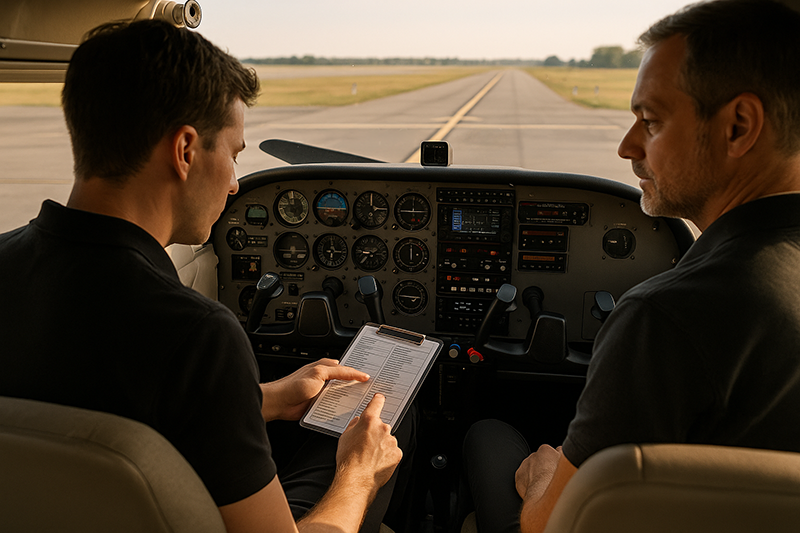
Cockpit discipline is the quiet structure behind safe, professional flying. It is not a single checklist item, a stern personality trait, or something reserved for airline crews. It is the consistent way a pilot manages attention, procedures, communication, aircraft control, and decision-making from preflight planning through shutdown. For student pilots, it creates a stable foundation for learning. For certificated pilots, it protects against complacency. For flight instructors and aviation professionals, it is one of the clearest markers of operational maturity.
Every pilot has experienced moments when the cockpit becomes busy: a radio call arrives during a configuration change, weather begins to change ahead, a passenger asks a question at the wrong time, or an unexpected aircraft appears in the traffic pattern. Cockpit discipline does not eliminate workload, but it gives the pilot a method for handling workload without surrendering aircraft control, situational awareness, or judgment. This article explains how to build consistent cockpit discipline in practical terms, with emphasis on habits that apply across training, personal flying, instructional operations, and professional aviation environments.
What Cockpit Discipline Really Means
Cockpit discipline is the practice of doing the right aviation tasks at the right time, in the right order, with the right level of attention. It includes procedural discipline, checklist discipline, communication discipline, automation discipline, and decision discipline. It also includes the restraint to avoid unnecessary conversation, distractions, shortcuts, and improvisation when the phase of flight demands focus.
Many pilots think of discipline as rigidity. In aviation, that is incomplete. A disciplined cockpit is not a cockpit where the pilot refuses to adapt. It is a cockpit where adaptation happens inside a controlled framework. The pilot still evaluates weather, traffic, aircraft performance, fuel, route options, passenger needs, and operational constraints. The difference is that a disciplined pilot does not let changing circumstances produce random behavior.
Good cockpit discipline is visible in small actions. The pilot briefs the departure before taxi, verifies the correct runway before takeoff, uses the checklist instead of relying only on memory, avoids casual conversation during high workload periods, and acknowledges when workload is rising. The pilot does not continue an unstable approach simply because the runway is in sight, does not accept a clearance that creates confusion without asking for clarification, and does not treat a familiar flight as an excuse to become casual.
It is also important to distinguish cockpit discipline from perfection. No pilot performs flawlessly on every flight. The value of discipline is that it creates recoverable margins. A missed radio call, a late checklist, or a momentary distraction becomes less likely to develop into a serious problem when the pilot has strong habits for task management, verification, and correction.
Why This Matters in Real-World Aviation
Real-world flying rarely unfolds exactly as planned. Training flights are affected by traffic, maintenance delays, weather changes, airspace constraints, and student workload. Personal flights often include passengers, schedule pressure, unfamiliar airports, and a mixture of visual and instrument references. Professional operations may add operational policies, crew coordination, dispatch considerations, company procedures, and higher levels of accountability. In every environment, cockpit discipline helps keep the flight organized when conditions become less predictable.
A disciplined cockpit supports the most basic aviation priority: aviate, navigate, communicate. That phrase is familiar because it expresses a practical hierarchy. Aircraft control comes first. Navigation and flight path management come next. Communication is important, but it should not consume the pilot’s attention at the expense of control or situational awareness. Cockpit discipline turns that priority into behavior under pressure.
Consider radio communication. A pilot with weak cockpit discipline may rush to answer every call instantly, even while turning base to final, configuring the aircraft, or correcting an altitude deviation. A more disciplined pilot understands that communication must be timely, but not at the expense of flying the airplane. If necessary, the pilot can delay a response briefly, complete the critical task, and then communicate clearly.
Checklist use is another real-world example. A checklist is not a decorative cockpit item. It is a method for confirming that important items have been completed. In training, pilots sometimes memorize flows and then stop using the printed or electronic checklist carefully. Flows are useful when taught properly, but they should lead into checklist verification rather than replace it. Cockpit discipline means the pilot knows the difference between performing a task from memory, confirming it with a checklist, and using an immediate action procedure when the aircraft or operating procedure calls for it.
Cockpit discipline also helps manage risk before the aircraft moves. A rushed preflight, vague weather review, incomplete performance consideration, or casual fuel planning mindset can create problems that appear later in flight. Disciplined pilots tend to find issues earlier because they approach planning and preflight inspection with attention rather than assumption.
The Core Elements of a Disciplined Cockpit
Building consistent cockpit discipline is easier when pilots understand its major components. These elements overlap, but each one addresses a different part of cockpit performance.
Attention Management
Attention is one of the pilot’s most limited resources. Cockpit discipline begins with deciding what deserves attention now, what can wait, and what should be eliminated. During taxi, attention should be directed toward aircraft movement, signage, markings, clearances or instructions, traffic, and checklist completion. During takeoff and initial climb, attention shifts to aircraft control, engine indications, airspeed, pitch attitude, runway alignment, obstacle clearance, and departure path. During cruise, there may be more capacity for navigation review, systems monitoring, weather updates, and passenger communication.
A disciplined pilot does not give every stimulus equal priority. A passenger question, a noncritical avionics setting, or a minor administrative issue should not interrupt a high workload phase of flight. This is where many distractions begin. The pilot thinks, “This will only take a second,” and that second occurs at the exact wrong time.
Procedural Consistency
Procedures exist to make cockpit behavior repeatable. Consistency does not mean every aircraft or operation uses the same procedure. It means that within a specific aircraft and operation, the pilot follows the appropriate procedure rather than inventing a new method each flight. This matters because inconsistent procedures increase cognitive load. If a pilot changes the order of tasks every time, the pilot must spend more mental energy remembering what has and has not been done.
For student pilots, procedural consistency helps build confidence. For instructors, it makes performance easier to evaluate. For experienced pilots, it reduces the likelihood that familiarity will become carelessness. The more routine the flight feels, the more valuable disciplined procedures become.
Communication Discipline
Communication discipline includes clear radio work, concise cockpit conversation, and honest internal communication. The pilot should use plain, professional radio technique appropriate to the environment and avoid unnecessary chatter. In a two-pilot or instructional cockpit, communication discipline also means speaking up when something is unclear, unstable, unexpected, or unsafe.
Silence is not always discipline. A student who is confused but says nothing may be increasing risk. A pilot monitoring who notices an altitude trend but hesitates to speak may allow a small deviation to grow. Good cockpit discipline encourages timely, relevant communication that supports the flight.
Checklist and Flow Discipline
Many cockpit tasks are best managed through a combination of flows and checklists. A flow is a logical movement pattern through cockpit controls and indications. A checklist verifies that required or important items have been completed. When used well, this combination improves efficiency without sacrificing confirmation.
The risk appears when flows become casual and checklists become symbolic. Reading a checklist while not actually looking at the relevant controls or indications is not meaningful verification. Skipping a checklist because the flight is familiar is not efficiency. It is erosion of discipline. The disciplined pilot treats checklist use as an active process, not a performance for appearances.
Decision Discipline
Decision discipline is the ability to make timely, conservative, and operationally sound choices without being pulled excessively by convenience, pride, or schedule pressure. It includes recognizing when a plan is no longer appropriate and changing course before options narrow.
Examples include delaying a departure for weather, discontinuing a maneuver that is not developing properly, going around from an approach that is not stable, diverting when fuel or weather margins are no longer comfortable, or asking air traffic control for clarification instead of guessing. A disciplined pilot does not wait until a situation becomes dramatic before making a professional decision.
How Pilots Should Understand Cockpit Discipline
Cockpit discipline should be understood as a habit system, not a personality type. Some pilots are naturally orderly, while others are more improvisational. Either pilot can build discipline through repeated, intentional behaviors. The goal is to make professional cockpit conduct the default, especially when the pilot is tired, distracted, rushed, or operating in a familiar environment.
A useful way to think about cockpit discipline is to divide the flight into phases and assign each phase a mental posture. Preflight is investigative. Taxi is deliberate. Takeoff is focused. Climb is structured. Cruise is monitored. Descent is planned. Approach and landing are stabilized. Shutdown is complete. These are not formal regulatory categories for every operation, but they are practical mental models that help pilots align behavior with risk.
During preflight, cockpit discipline means more than walking around the aircraft. It means reviewing the flight as a system: aircraft condition, route, weather, fuel, performance, airspace, alternates when appropriate, pilot readiness, and passenger expectations. A pilot who begins the flight with vague assumptions is already behind the aircraft.
During taxi, discipline means slow enough movement to maintain control, correct use of airport signs and markings, attention to clearances or instructions, and avoidance of unnecessary distractions. It also means resolving uncertainty before crossing or entering surfaces where aircraft movement conflict could occur. If the pilot is unsure, stopping the aircraft in a safe place and asking for clarification is usually better than continuing with uncertainty.
During takeoff, initial climb, approach, landing, and other high workload phases, discipline becomes especially important. These are not good times to reprogram avionics casually, search for loose items, conduct unrelated conversation, or troubleshoot noncritical issues that can wait. A disciplined pilot protects these segments from avoidable distraction.
In cruise, discipline does not disappear. It changes form. Cruise flight can create a false sense of completion, particularly on familiar routes in good weather. The disciplined pilot continues to monitor fuel, engine indications, position, weather trends, airspace, terrain, traffic information when available, and the next phase of flight. Cruise is also the right time to get ahead of the aircraft by preparing for descent, arrival, approach, and airport environment.
Common Mistakes and Misunderstandings
One common misunderstanding is that cockpit discipline is only important in instrument flying or complex aircraft. In reality, discipline matters in a basic training aircraft on a clear day. Many of the habits that later support instrument flying, crew coordination, and advanced aircraft operation begin with simple VFR training: trim the aircraft, maintain heading and altitude, use checklists, brief intentions, communicate clearly, and manage distractions.
Another mistake is confusing speed with skill. A fast cockpit is not necessarily a disciplined cockpit. Rushing checklist items, taxiing faster than appropriate for conditions, accepting a clearance before understanding it, or hurrying an approach to avoid inconveniencing others can all create unnecessary risk. Professional pace is not slow or fast. It is appropriate.
Pilots also sometimes believe that familiarity reduces the need for discipline. The opposite is often true. Familiarity can reduce perceived risk, which may lead to casual habits. The local practice area, the home airport traffic pattern, and the frequently flown short cross-country can all invite shortcuts. A disciplined pilot treats familiar flights with respect because the aircraft, weather, traffic, and human factors still require active management.
Overconfidence with avionics is another modern discipline challenge. Advanced displays, moving maps, traffic information, and autopilot systems can improve awareness and reduce workload when used correctly. They can also absorb attention at the wrong time. A pilot who spends too long manipulating screens while aircraft control or traffic scan deteriorates has allowed the tool to become the task. Automation discipline means knowing when to use technology, when to simplify, and when to hand-fly or revert to basic navigation and communication techniques.
In instructional flying, a frequent problem is unclear transfer of control. Both instructor and student must know who is flying the aircraft. Casual phrases, delayed responses, or assumptions can create confusion. Standardized transfer language is a simple discipline habit that prevents ambiguity. The same principle applies to any shared cockpit environment: roles and responsibilities should be clear.
Another subtle mistake is treating checklists as legal or administrative artifacts rather than operational tools. The purpose is not merely to say a checklist was used. The purpose is to catch omissions and confirm configuration. A checklist that is rushed, interrupted, or performed from memory without verification loses much of its value.
Practical Example: A Busy Pattern After a Routine Flight
Imagine a private pilot returning to a familiar non-towered airport after a short local flight. The weather is good, visibility is comfortable, and the pilot has landed at this airport many times. During the descent, the pilot begins listening to the common traffic advisory frequency and hears several aircraft in the area. One airplane is departing, another is on downwind, and a third reports a practice instrument approach nearby.
A casual cockpit might allow this situation to become disorganized. The pilot may continue descending while trying to identify every aircraft visually, respond to a passenger question, adjust avionics, and enter the traffic pattern without a clear plan. The pilot may make a late radio call, enter at an awkward angle, or become fixated on one traffic target while losing track of aircraft configuration and airspeed.
A disciplined cockpit looks different. Before entering the airport environment, the pilot slows the pace mentally and physically. The pilot confirms the runway in use based on available information, reviews the intended pattern entry, completes the appropriate checklist at a manageable distance, and gives passengers a brief instruction to hold nonessential conversation until after landing. The pilot makes concise position reports, visually scans for traffic, and remains willing to extend, re-enter, or go around if spacing does not look right.
On downwind, the pilot maintains a stable altitude and airspeed, configures the aircraft according to the aircraft’s normal procedures, and avoids unnecessary avionics tasks. If another aircraft turns base unexpectedly or spacing becomes uncertain, the disciplined pilot does not force the landing. A go-around or pattern adjustment is treated as normal airmanship, not a failure.
This example is intentionally ordinary. Cockpit discipline is not proven only during emergencies. It is built and demonstrated during ordinary flights, ordinary traffic patterns, ordinary radio calls, and ordinary decisions. Those habits become especially valuable when a flight stops being ordinary.
Building Discipline During Flight Training
Flight training is the ideal environment for building cockpit discipline because habits are still forming. Students often focus on aircraft control, maneuvers, landings, and knowledge test preparation. Those are important, but cockpit discipline should be trained alongside them from the beginning. The way a student handles checklists, radio calls, briefings, distractions, and uncertainty becomes part of that student’s future pilot identity.
Instructors play a major role. If an instructor treats checklist use casually, the student learns that checklists are optional in practice. If an instructor allows unstable approaches to continue without discussion, the student learns that salvaging a landing is normal. If an instructor speaks during every critical task, the student may never learn to protect attention during high workload moments. Conversely, when an instructor models calm, consistent, professional cockpit behavior, students learn that discipline is part of normal flying.
Students should be encouraged to verbalize plans at appropriate times. A short takeoff briefing, a maneuver entry explanation, a traffic pattern plan, or an approach review helps organize thinking. Verbalization also gives the instructor insight into what the student understands. The goal is not to create excessive talking, but to make thinking clear and deliberate.
Training should also include managed distractions. A student who can fly well only in a quiet cockpit may struggle when real-world workload appears. Instructors can introduce distractions carefully and at appropriate times, then teach the student how to prioritize. The lesson is not that distractions are harmless. The lesson is that pilots must recognize, reject, delay, or manage them while maintaining aircraft control.
Maintaining Discipline After Certification
After earning a certificate or rating, pilots often gain freedom in how they fly. That freedom is one of aviation’s rewards, but it also removes some of the external structure provided by instructors, stage checks, and formal lessons. Maintaining cockpit discipline after certification requires intentional self-standardization.
One effective practice is to create personal standard operating habits for recurring flights. These are not a substitute for aircraft manuals, regulations, or training, but they can help a pilot remain consistent. Examples include when to complete passenger briefings, when to finish programming avionics, how to brief a departure, what conditions trigger a delay or diversion, and when to discontinue an approach. The pilot should ensure these habits are compatible with the aircraft, operating environment, and applicable procedures.
Another important practice is recurrent training. A flight review, instrument proficiency work, transition training, or focused session with an instructor can reveal habits that have drifted. Pilots should not wait for a requirement or a problem to seek coaching. A disciplined pilot understands that proficiency is perishable and that outside feedback is valuable.
Self-briefing is also useful. Before a flight, a pilot can ask: What is most likely to increase workload today? What is my escape plan if weather, traffic, aircraft performance, or personal readiness becomes a concern? What tasks must be completed before takeoff? What tasks can wait until cruise? These questions encourage proactive thinking rather than reactive flying.
Cockpit Discipline and Crew Resource Management
Crew resource management is often associated with multi-pilot operations, but many of its principles apply broadly. At its core, it is about using available resources effectively. Those resources may include another pilot, an instructor, air traffic control, passengers, dispatch, maintenance personnel, weather information, avionics, checklists, and the pilot’s own judgment.
In a single-pilot cockpit, discipline includes knowing when to reduce workload by asking for help, delaying a task, using available automation appropriately, or changing the plan. A single pilot must be both pilot flying and pilot monitoring. That makes personal discipline especially important because there may be no second crewmember to catch an omission.
In a two-pilot or instructional cockpit, discipline includes defined roles, clear transfer of control, mutual monitoring, and respectful challenge when something does not look right. Authority gradient can become a problem when one person feels unable to speak up. Professional cockpit discipline encourages direct, relevant communication focused on the safety and success of the flight.
Passengers can also be part of cockpit discipline. A short passenger briefing can explain when conversation is welcome and when the pilot needs a quiet cockpit. Passengers usually respond well when they understand the reason. This is particularly important in small aircraft where passengers sit close to the pilot and may not realize that a casual question during a critical phase of flight can be distracting.
Best Practices for Pilots
The best cockpit discipline habits are simple enough to use consistently and strong enough to hold up under workload. They should not depend on mood, perfect conditions, or whether someone is watching. The following practices are broadly useful across many types of flying, provided they are applied in a way that fits the aircraft, training, and operating environment.
- Brief before workload rises. Review departures, arrivals, approaches, runway expectations, and abnormal considerations before the cockpit becomes busy.
- Use checklists as verification tools. Flows can improve efficiency, but the checklist should confirm important items rather than become a memorized ritual.
- Protect critical phases of flight. Limit nonessential conversation and noncritical tasks during taxi, takeoff, climb, approach, landing, and other high workload periods.
- Standardize your personal cockpit setup. Organize charts, tablets, avionics, kneeboards, and required items so they are accessible without creating clutter.
- Slow down when uncertain. If the situation allows, reduce speed, hold position, request clarification, enter a hold, go around, or create time before making a rushed decision.
- Verbalize important changes. State configuration changes, altitude targets, heading assignments, runway changes, and transfer of control when appropriate.
- Debrief honestly. After the flight, identify one habit that worked well and one habit that should improve next time.
These practices are not meant to create a rigid cockpit culture. They are intended to create a reliable operating rhythm. When discipline becomes normal, the pilot has more mental capacity available for judgment, traffic awareness, weather decisions, and unexpected events.
How Instructors Can Teach Cockpit Discipline
Flight instructors can teach cockpit discipline most effectively by modeling it. Students notice how instructors behave when the radio is busy, when the schedule is tight, when weather changes, or when a landing is not developing well. If the instructor remains calm, procedural, and transparent, the student learns that professionalism is not situational.
Instructors should explain why a habit matters, not just demand compliance. A student who understands that a checklist protects against interruption is more likely to use it meaningfully. A student who understands why nonessential conversation stops during takeoff and landing is more likely to protect attention later as pilot in command. A student who understands that a go-around is a normal safety maneuver is less likely to force an unstable landing.
Debriefing should include cockpit management, not just maneuver standards. Questions such as “When did workload increase?” “What distracted you?” “Did you complete the checklist actively?” and “What would you do earlier next time?” help students connect discipline to performance. This type of debriefing builds self-awareness, which is essential for long-term safety.
Frequently Asked Questions
What is cockpit discipline in aviation?
Cockpit discipline is the consistent management of aircraft control, procedures, communication, checklists, attention, and decisions. It means the pilot handles tasks in an organized way and avoids unnecessary distractions or shortcuts, especially during high workload phases of flight.
Is cockpit discipline only for professional pilots?
No. Cockpit discipline is important for student pilots, private pilots, instrument pilots, instructors, and professional crews. The aircraft and operation may differ, but the need for organized cockpit behavior applies throughout aviation.
How can a student pilot improve cockpit discipline?
A student pilot can improve by using checklists consistently, briefing each phase of flight, keeping the cockpit organized, verbalizing important actions, and learning to prioritize aircraft control before less important tasks. Working with an instructor who models disciplined habits is especially valuable.
What are signs of poor cockpit discipline?
Common signs include rushed checklists, unnecessary conversation during critical tasks, unclear transfer of control, fixation on avionics, accepting confusion instead of asking for clarification, unstable approaches, and inconsistent procedures from one flight to the next.
How does cockpit discipline help with emergencies?
Discipline helps a pilot keep priorities clear under stress. A pilot who has practiced organized task management is more likely to maintain aircraft control, use appropriate procedures, communicate effectively, and make timely decisions when an abnormal or emergency situation occurs.
Can too much discipline make a pilot inflexible?
Discipline should not mean rigidity. Good cockpit discipline creates structure while still allowing the pilot to adapt. The goal is to make changes deliberately, based on aircraft control, safety, procedures, and sound judgment rather than impulse or pressure.
Key Takeaways
- Cockpit discipline is built through repeatable habits: active checklist use, organized communication, clear priorities, and deliberate task management.
- Safety improves when pilots protect high workload phases of flight from distractions, rushed decisions, and unnecessary cockpit activity.
- Training, recurrent practice, honest debriefing, and conservative decision-making help prevent discipline from eroding after certification.