
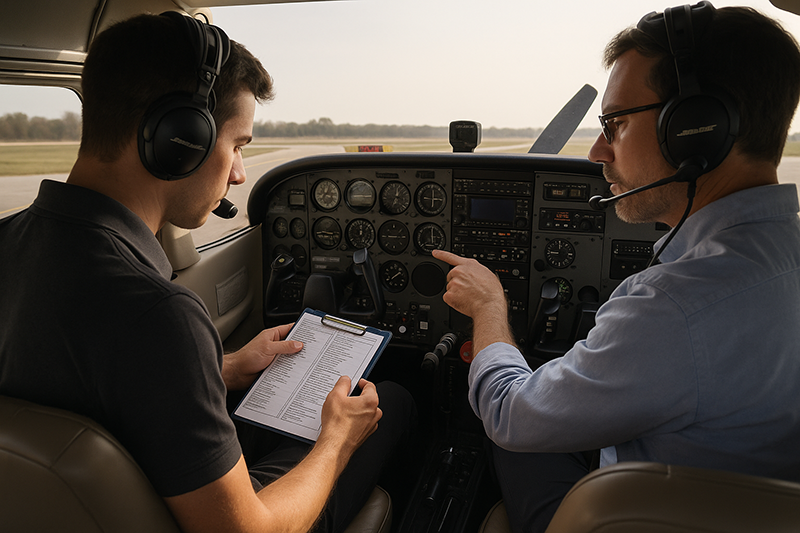
Cockpit discipline is the habit of doing the right things, in the right order, at the right time, even when the flight feels routine. It is not about being rigid or mechanical. It is about creating a cockpit environment where checklists are respected, aircraft control remains the priority, communication is deliberate, and distractions are managed before they become threats.
For student pilots, cockpit discipline turns training maneuvers into reliable operating habits. For certificated pilots, it helps keep proficiency from becoming complacency. For flight instructors and aviation professionals, it provides a practical framework for evaluating how pilots manage workload, risk, automation, and decision-making. The goal is simple: build a cockpit routine that still works when the weather changes, the radio gets busy, the aircraft does something unexpected, or the pilot feels rushed.
What Cockpit Discipline Really Means
Cockpit discipline is the consistent use of procedures, flows, checklists, communication standards, and attention management to support safe aircraft operation. It includes obvious tasks, such as completing a before-takeoff checklist, but it also includes quieter habits: setting up avionics before taxi, briefing the departure, verifying fuel selection, maintaining a sterile cockpit mindset during high-workload phases, and resisting the urge to multitask when aircraft control should be the focus.
Good cockpit discipline does not mean a pilot never adapts. Aviation requires judgment. A pilot may need to delay a checklist, discontinue an approach, ask for a radio repeat, or simplify a task to maintain control and situational awareness. Discipline is what helps the pilot make that choice deliberately instead of being pulled along by momentum.
A useful way to think about cockpit discipline is that it protects the basics. Aviate, navigate, and communicate remain central priorities, but disciplined pilots give those priorities a structure. They know which tasks must be completed before movement, before takeoff, before descent, before landing, and before shutdown. They use a repeatable flow to configure the aircraft, then use the checklist to verify that critical items were not missed. They brief what matters, monitor what is changing, and speak up early when something no longer matches the plan.
In training, cockpit discipline is sometimes misunderstood as simply memorizing procedures. Memory has a role, but disciplined flying is not built on memory alone. It is built on repeatable habits, standard callouts, sound workload management, and a willingness to slow down when conditions demand it. The disciplined pilot is not the one who appears busy. The disciplined pilot is the one who knows what deserves attention now and what can wait.
Why This Matters in Real-World Aviation
Most pilots have experienced a moment when a small distraction interrupted a normal cockpit routine. A passenger asks a question during taxi. A frequency change arrives during a checklist. A tablet battery warning appears while approaching the airport. A runway change forces a new taxi route, new departure briefing, and a new mental picture. None of these events is unusual, but each one can break the rhythm of a flight if the pilot does not have a disciplined way to recover.
Real-world flying is rarely as tidy as a lesson plan. Airports are busy, weather can be marginal, passengers may not understand timing, and avionics can invite head-down time at exactly the wrong moment. A pilot who relies only on confidence may continue working faster as workload increases. A pilot with cockpit discipline is more likely to pause, prioritize aircraft control, verify the next action, and use available resources.
Cockpit discipline also supports better decision-making because it reduces ambiguity. When a pilot briefs personal minimums, reviews runway and departure information, verifies fuel and performance considerations, and discusses abnormal plans before they are needed, the pilot is less likely to improvise under pressure. The point is not to predict every possible problem. The point is to create a cockpit where the next safe action is easier to identify.
For instructors, cockpit discipline is one of the clearest indicators of a pilot’s maturity. A student may be able to hold altitude, track a course, or make a smooth landing, yet still struggle with cockpit organization. That struggle matters because flying skills and cockpit management must work together. A technically skilled pilot who consistently rushes checklists, accepts distractions at critical times, or allows avionics programming to replace outside scanning is not yet operating with the discipline that complex flight environments require.
For experienced pilots, the challenge is different. Familiarity can make shortcuts feel harmless. The pilot has flown the route many times, knows the aircraft well, and expects the same outcome. That comfort is valuable when paired with disciplined habits, but it becomes a risk when it encourages casual procedures. Consistency is what keeps an ordinary flight from becoming vulnerable to one missed switch, one misunderstood clearance, or one late configuration change.
The Core Elements of Consistent Cockpit Discipline
Building cockpit discipline starts with understanding the major elements that support safe cockpit behavior. These elements are not separate boxes to check. They overlap throughout the flight and reinforce one another.
Procedural consistency
Procedural consistency means using the same logical flow and checklist philosophy each time you operate the aircraft. In many cockpits, a flow is used to configure systems in a physical pattern, and the checklist is then used to confirm that critical items are complete. This reduces the risk of simply reading a checklist without actually touching or verifying the required items.
Consistency does not require rushing. In fact, it often prevents rushing. When a pilot has a known sequence for preflight setup, engine start, taxi, run-up, takeoff, cruise, descent, approach, landing, and shutdown, each phase feels less improvised. The pilot can recognize interruptions more easily because the normal pattern is familiar.
Attention management
Attention is one of the most limited resources in the cockpit. A disciplined pilot protects it. That means avoiding unnecessary conversations during high-workload periods, limiting head-down tasks, managing electronic flight bag use, and setting avionics when workload is low rather than waiting until the aircraft is close to a critical point.
Attention management also includes knowing when to stop a task. If a pilot is troubleshooting a minor avionics issue while altitude, airspeed, heading, or traffic awareness is deteriorating, discipline means abandoning the secondary task and returning to aircraft control. Not every problem deserves immediate attention. Some tasks can wait until the aircraft is stable or safely on the ground.
Communication discipline
Clear communication is part of cockpit discipline whether a pilot is flying solo, with an instructor, with another pilot, or with passengers. Communication discipline includes standard radio phraseology, active listening, readback accuracy where appropriate, and clear cockpit statements about intentions and uncertainties.
In a training aircraft, a simple phrase such as “my controls” and “your controls” matters because it eliminates confusion. In a two-pilot or instructor-student environment, verbalizing configuration changes, checklist status, and concerns helps create shared awareness. In single-pilot operations, speaking key items aloud can still be useful because it forces deliberate verification.
Configuration discipline
Aircraft configuration must match the phase of flight and the pilot’s plan. Configuration discipline includes correct flap selection, trim, power setting, landing gear status where applicable, fuel system awareness, mixture or propeller control as appropriate to the aircraft, and avionics setup. It also includes recognizing when the aircraft is not configured in time.
A stable approach is one example. While exact criteria vary by operation, aircraft, and training environment, the principle is broadly useful: the aircraft should be in a controlled position, at an appropriate speed, with the required configuration and landing checklist items completed in time to make a safe landing. If the approach becomes disorganized, cockpit discipline supports the go-around decision rather than a rushed salvage attempt.
Self-monitoring
Discipline is not only about what the pilot does. It is also about how the pilot monitors personal performance. Fatigue, frustration, overconfidence, dehydration, stress, and time pressure can all change cockpit behavior. A disciplined pilot notices those influences and adjusts the plan. That might mean slowing the pace, asking for help, delaying a departure, requesting vectors, or choosing a more conservative option.
How Pilots Should Understand This Topic
Pilots should understand cockpit discipline as a skill that can be trained, evaluated, and improved. It is not a personality trait. Some pilots are naturally organized, and others are naturally relaxed, but both groups need structured cockpit habits. Discipline is built by repetition with intention.
One practical approach is to divide cockpit discipline into three time periods: before the flight, during the flight, and after the flight. Before the flight, discipline shows up in planning, weather review, aircraft documents and airworthiness awareness, weight and balance consideration when applicable, performance planning, passenger briefing, and cockpit setup. During the flight, it shows up in checklist use, situational awareness, aircraft control, radio management, and threat recognition. After the flight, it shows up in shutdown procedures, securing the aircraft, logging discrepancies when needed, and debriefing what went well or what should improve.
This structure helps pilots avoid treating discipline as something that begins at takeoff. Many cockpit problems are created before the aircraft moves. A pilot who starts taxi while still arranging charts, programming avionics, adjusting a headset, and answering passenger questions has already accepted unnecessary workload. Conversely, a pilot who completes setup before taxi has more attention available for movement area awareness, clearances, signage, traffic, and checklist compliance.
In flight, disciplined pilots continuously compare three pictures: what they expected, what the aircraft is doing, and what the environment is doing. If the airplane is not where it should be, if weather is developing differently than expected, or if the pilot is falling behind, the disciplined response is not denial. It is correction. Sometimes that correction is small, such as asking ATC to repeat an instruction. Sometimes it is significant, such as diverting, holding, delaying an approach, or returning to the departure airport.
After flight, cockpit discipline continues through honest review. Pilots who debrief only landings miss many learning opportunities. A valuable debrief includes setup quality, communication clarity, workload peaks, checklist discipline, risk decisions, automation management, and any moment when the pilot felt rushed or uncertain. This habit turns each flight into data for the next one.
Common Mistakes and Misunderstandings
One common misunderstanding is that checklist use alone equals cockpit discipline. Checklists are essential tools, but they are not a substitute for attention, aircraft knowledge, or judgment. A pilot can read a checklist while distracted and still miss the meaning of an item. Good checklist discipline requires touching, looking, verifying, and understanding.
Another frequent mistake is treating familiar flights casually. A local practice area flight, short repositioning leg, or quick pattern session can still include taxi confusion, traffic conflicts, weather changes, mechanical indications, or communication errors. Familiarity should reduce unnecessary workload, not reduce respect for procedures.
A third mistake is allowing passengers or cockpit technology to set the tempo. Passengers may not know when quiet is needed, and devices may demand attention with alerts, updates, or navigation changes. The pilot must set expectations. A short passenger briefing can explain when conversation is welcome and when the cockpit needs to remain quiet. Similarly, avionics and electronic flight bags should be configured in a way that supports the flight rather than pulling the pilot into extended head-down management.
Rushing is another major enemy of cockpit discipline. Rushing often appears when a pilot is trying to meet a schedule, keep up with radio traffic, depart ahead of weather, or avoid inconveniencing passengers. In those moments, the pilot may skip a briefing, shorten a checklist, accept an unstable setup, or continue with incomplete information. Discipline gives the pilot permission to slow down. A short delay on the ground is usually easier to manage than a confusing situation in the air.
Some pilots also confuse confidence with discipline. Confidence can help a pilot perform smoothly, but confidence without structure can hide weak habits. The most professional pilots are often not the ones who rely on memory and personality. They are the ones who use procedures consistently because they understand how human performance can degrade under pressure.
Finally, pilots sometimes believe that cockpit discipline is only important in instrument flying or advanced aircraft. That is not true. A basic training aircraft in visual conditions still requires organized procedures, traffic awareness, checklist use, runway discipline, fuel management, and sound judgment. The simpler cockpit may reduce some tasks, but it does not eliminate the need for disciplined flying.
Practical Example: A Routine Flight That Gets Busy
Consider a private pilot preparing for a short daytime cross-country flight in a familiar single-engine training aircraft. The weather is visual, the destination is familiar, and the route has been flown before. Because the flight feels simple, the pilot is tempted to start the engine while still finishing the tablet setup and discussing arrival plans with a passenger.
A disciplined version of this flight begins differently. Before engine start, the pilot completes the cockpit organization: charts are available, the route is loaded and checked, the headset is connected, the passenger understands when conversation should pause, and the expected taxi route is reviewed. After engine start, the pilot uses the checklist at a deliberate pace and delays nonessential conversation during taxi.
During run-up, ground control changes the expected departure runway. The casual pilot might accept the change and keep moving, planning to brief the new departure while approaching the hold short line. The disciplined pilot stops in an appropriate location, updates the mental picture, verifies the new runway, reviews the departure direction, checks applicable performance considerations, and completes the before-takeoff checklist without rushing.
After takeoff, the tower issues a frequency change while the aircraft is climbing through a busy traffic pattern. At the same time, the passenger points out something on the ground. The disciplined pilot maintains aircraft control, completes the radio change, continues the climb scan, and tells the passenger that conversation will resume shortly. Nothing dramatic has happened. That is the point. Cockpit discipline keeps ordinary interruptions from accumulating into a high-workload problem.
Later, approaching the destination, the pilot notices that descent planning is behind schedule because of a stronger-than-expected groundspeed. The disciplined response is to adjust early: reduce workload, obtain weather and airport information with adequate time, brief the arrival, and if needed, request additional spacing or maneuvering. The pilot does not press toward the airport while trying to descend, configure, communicate, and brief all at once.
This example is not about an emergency. It is about normal aviation. Most flights contain small changes. Disciplined pilots expect those changes and create room to handle them.
Best Practices for Building Cockpit Discipline
The best way to build cockpit discipline is to make it visible and repeatable. Pilots should not wait for a checkride, flight review, or stressful flight to discover whether their cockpit habits are reliable. The following practices help turn discipline into a normal part of flying.
- Use flows and checklists together. A flow helps configure the aircraft efficiently. The checklist verifies that critical items are complete.
- Brief before workload increases. Departure, arrival, approach, taxi, and abnormal considerations should be reviewed before the cockpit becomes busy.
- Protect critical phases of flight. Limit unnecessary conversation, device use, and nonessential tasks during taxi, takeoff, climb, approach, landing, and other high-workload periods.
- Verbalize important changes. Speaking configuration changes, transfer of controls, or uncertainty can improve awareness, especially in training or multi-pilot environments.
- Slow down when interrupted. If a checklist or flow is interrupted, return to a known point rather than guessing where you left off.
- Manage technology before it manages you. Set up avionics and electronic flight bags early, but keep aircraft control and outside awareness ahead of screen work.
- Debrief cockpit management, not only stick-and-rudder performance. Review where workload peaked, where distractions appeared, and whether procedures remained consistent.
Instructors can reinforce these habits by evaluating process as much as outcome. A landing may be acceptable, but if the student arrived there through rushed configuration, weak checklist discipline, and poor radio awareness, the lesson should address the process. Likewise, a go-around from an unstable or poorly prepared approach should be treated as disciplined decision-making, not as failure.
Experienced pilots can strengthen discipline by periodically flying with an instructor, reviewing aircraft-specific procedures, and inviting critique on cockpit organization. A pilot who has flown for years may have developed efficient habits, but may also have accumulated shortcuts. A professional review can help separate useful technique from risky drift.
Teaching Cockpit Discipline in Flight Training
Flight instructors play a major role in shaping cockpit discipline because early habits tend to last. If a student learns that checklists are optional when workload rises, that passenger conversation can continue during critical tasks, or that avionics programming is acceptable during taxi without careful attention outside, those habits can become normalized. Instructors should model the cockpit behavior they want students to adopt.
Good instruction makes discipline practical. Instead of simply saying “use the checklist,” the instructor can teach when to use a flow, when to verify with the checklist, how to recover from an interruption, and why checklist rhythm changes between ground operations and flight. Instead of saying “stay ahead of the airplane,” the instructor can show what that means: setting up radios early, briefing the next phase, thinking about wind correction before entering the pattern, and completing configuration with enough time to evaluate the result.
Scenario-based training is especially useful. An instructor might introduce a runway change, simulated passenger distraction, unexpected frequency congestion, or late weather update. The purpose is not to overload the student for entertainment. The purpose is to teach the student how disciplined cockpit behavior absorbs change. Students should learn that slowing down, asking for clarification, going around, or delaying a task can be signs of good judgment.
Instructors should also be careful about what they reward. If only smooth landings receive praise, students may learn to value the final touchdown more than the disciplined process that leads to it. A better debrief recognizes checklist recovery, timely communication, stable configuration, conservative decisions, and honest self-correction.
Cockpit Discipline and Automation
Modern avionics and autopilots can reduce workload when used correctly, but they also require disciplined management. Automation does not remove the pilot’s responsibility to understand aircraft state, flight path, mode selection, and navigation source. A pilot who is unsure what the automation is doing should simplify the situation rather than continue deeper into confusion.
Automation discipline begins before the flight. The pilot should understand how the equipment is expected to support the route, what data must be entered, and how to verify that the aircraft is navigating as intended. In flight, the pilot should monitor mode changes, maintain basic flying proficiency, and remain prepared to hand fly when appropriate. The highest value of automation is not that it allows the pilot to stop flying. Its value is that it can free attention for planning, monitoring, and decision-making when used within the pilot’s knowledge and comfort level.
One of the most common automation traps is excessive head-down time. A pilot may spend too long editing a flight plan, searching a menu, or troubleshooting a display while altitude, heading, traffic awareness, or weather avoidance receives less attention. Cockpit discipline requires a clear boundary: if the task is taking too long, stop, stabilize the aircraft, use simpler navigation if needed, ask for assistance if available, or change the plan.
Frequently Asked Questions
What is cockpit discipline in aviation?
Cockpit discipline is the consistent use of procedures, checklists, communication habits, attention management, and sound judgment to keep the flight organized and safe. It applies to every phase of flight, from preflight planning to shutdown.
How can student pilots improve cockpit discipline?
Student pilots can improve by using the same flows and checklists consistently, briefing each phase before workload increases, limiting distractions, verbalizing important actions, and debriefing cockpit organization after every lesson. The goal is to build habits that remain reliable under pressure.
Is cockpit discipline only important in complex aircraft?
No. Complex aircraft may add workload, but cockpit discipline is just as important in basic training airplanes. Taxi awareness, checklist use, communication, fuel awareness, traffic scanning, and go-around judgment matter in every cockpit.
What should a pilot do if interrupted during a checklist?
The safest habit is to return to a known point in the checklist or restart the relevant section rather than guessing what was completed. Interruptions are common, and a disciplined recovery method prevents missed items.
How does cockpit discipline help with decision-making?
Disciplined cockpit habits reduce confusion and workload, which gives the pilot more mental capacity for judgment. Briefings, stable procedures, and early recognition of threats make it easier to choose conservative options before pressure builds.
Can cockpit discipline become too rigid?
Yes, if a pilot follows a routine without thinking. Good cockpit discipline is structured but flexible. The pilot should use procedures to support safety while still adapting to weather, traffic, aircraft status, ATC instructions, and personal limitations.
Key Takeaways
- Cockpit discipline is built through consistent habits, not occasional attention during difficult flights.
- Distractions, rushing, weak checklist recovery, and excessive head-down time can erode safety even on routine flights.
- Training should evaluate cockpit organization, workload management, communication, and decision-making along with aircraft control.