
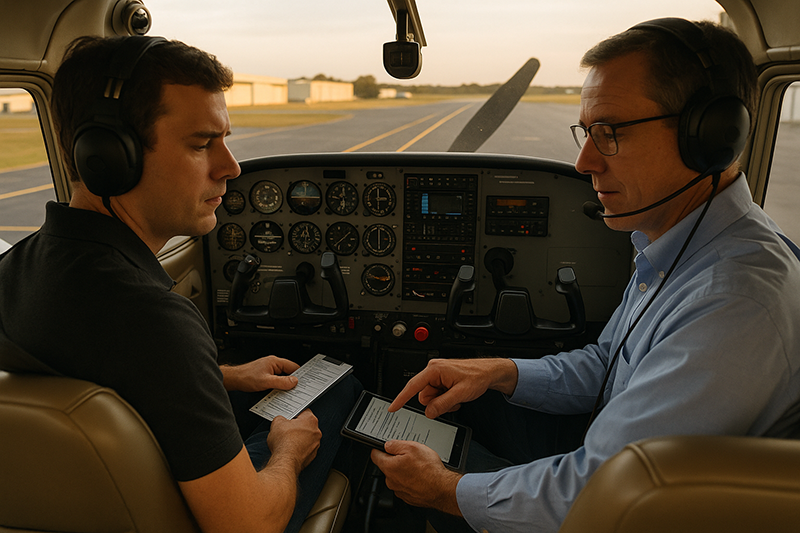
Building pilot skills when you fly infrequently is one of the most important challenges in general aviation training. Many pilots care deeply about proficiency but do not fly often enough to keep every habit, scan pattern, radio rhythm, and aircraft handling skill sharp. A student pilot may have weather delays between lessons. A private pilot may fly only a few times each month. A flight instructor may see clients who are legally current but not truly comfortable. The issue is not motivation. The issue is how to train deliberately when time, money, weather, maintenance, family, and work schedules limit flight time.
Infrequent flying does not have to mean stalled progress or declining confidence. It does mean the pilot must treat each flight hour as a high-value training opportunity. Skill retention in aviation depends on repetition, recency, quality of practice, and honest feedback. A pilot who flies rarely but prepares well, briefs carefully, practices deliberately, and reviews each flight can often make better use of limited time than a pilot who flies often without a plan. The goal is not to rush, force progress, or pretend rust is not present. The goal is to build a reliable system for keeping knowledge, aircraft control, cockpit workflow, and aeronautical decision-making active between flights.
The Core Problem: Currency Is Not the Same as Proficiency
One of the most useful distinctions for pilots is the difference between currency and proficiency. Currency is about meeting applicable requirements to act as pilot in command or carry passengers under the rules that apply to the operation. Proficiency is broader. It is the practical ability to plan, brief, fly, communicate, manage workload, recognize threats, and make conservative decisions in the aircraft and operating environment at hand.
A pilot can satisfy a minimum legal requirement and still feel behind the airplane. Another pilot may not be eligible for a specific operation until a required item is completed, yet may have strong handling skills because of recent dual instruction or simulator practice. The point is not to dismiss regulations. They matter. The point is to understand that the regulations establish required boundaries, while proficiency is developed through effective practice, sound judgment, and honest self-assessment.
For pilots who fly infrequently, the gap between legal eligibility and practical readiness can widen quietly. The pilot may remember how to perform a maneuver but take longer to set up for it. Radio calls may be technically correct but less fluid. Checklist usage may become mechanical rather than meaningful. Weather planning may feel familiar until the pilot has to make a real go or no-go decision. These are normal effects of reduced recency, and they are best managed directly rather than ignored.
Why Infrequent Flying Affects Skill Differently Than Ground Knowledge
Aviation knowledge can often be refreshed by reading, watching a lesson, reviewing a chart, or discussing a scenario. Flying skills are different because they combine knowledge with perception, timing, physical coordination, and workload management. Landing well, for example, is not only knowing the correct approach speed and flare concept. It is seeing the runway picture, sensing sink rate, maintaining alignment, managing power smoothly, correcting for wind, and deciding when to go around.
That combination is perishable. When a pilot goes weeks or months between flights, the first part to fade is often not the basic concept. It is the rhythm. The pilot may know what to do but do it later than ideal. Small delays compound: the traffic pattern entry is late, the before-landing flow is rushed, the radio call competes with descent planning, the crosswind correction is recognized after drift has already developed, and the landing becomes a recovery exercise rather than a stabilized operation.
This is why infrequent flyers should focus on systems rather than isolated memories. A good system includes preparation before the flight, a limited set of training objectives, structured cockpit flows, verbal briefings, conservative personal minimums, and post-flight review. The system reduces the amount of improvisation required when the pilot is least current.
Why This Matters in Real-World Aviation
In real-world flying, pilots rarely encounter one task at a time. A short local flight may involve airspace, weather, aircraft performance, runway selection, radio communication, traffic awareness, and passenger management. Even a simple day VFR flight can become demanding when the pilot has not flown recently. The aircraft moves at the same speed whether the pilot is sharp or rusty.
Infrequent flying also changes how a pilot should think about risk. A pilot who has not flown recently may need more time for preflight planning, more conservative weather limits, a longer runway margin, a less complex route, or a dual flight before carrying passengers. These are not signs of weakness. They are signs of professional judgment. Experienced pilots know that risk management is not about proving capability. It is about matching the flight to actual readiness on that day.
Flight instructors play a critical role here. A good instructor can help an infrequent pilot identify which skills have faded and which are still strong. That matters because rust is not uniform. One pilot may still fly smooth steep turns but struggle with radio work near a busy airport. Another may communicate well but show weak airspeed control in the pattern. Another may be technically competent but overly optimistic about weather. Effective recurrent training is targeted, not generic.
How Pilots Should Understand Skill Building With Limited Flight Time
The best way to build skills while flying infrequently is to separate aviation proficiency into four areas: knowledge, procedures, aircraft handling, and judgment. Each area can be trained, but not all require the same tool.
Knowledge includes regulations that apply to the intended flight, aircraft systems, airspace, weather interpretation, performance planning, and navigation. Much of this can be maintained between flights through study and scenario review. Procedures include flows, checklist discipline, callouts, briefings, and cockpit setup. These can be rehearsed on the ground, in a chair, in an aircraft on the ramp when appropriate, or in an approved training device if available. Aircraft handling includes takeoffs, landings, maneuvering, trim, energy management, and instrument scan. This generally requires aircraft time or appropriate simulation. Judgment includes risk management, diversion decisions, weather avoidance, passenger considerations, and recognizing when to stop, delay, or ask for help.
For the infrequent pilot, the mistake is trying to solve all four areas with one occasional flight. A better approach is to use ground time for knowledge and procedures so that actual flight time can focus on aircraft handling and decision-making. If the first twenty minutes of a lesson are spent trying to remember cockpit setup, avionics button sequences, or the basic plan, the training value of the flight is reduced. If those items are reviewed beforehand, the flight can begin at a higher level.
Build a Personal Proficiency Baseline
A personal proficiency baseline is a realistic picture of what you can do well right now and what needs attention before you accept more complexity. It is not a logbook entry or a certificate level. It is a working assessment of current capability.
Start with recent experience. How long has it been since your last flight? Was it dual or solo? Was it in the same aircraft type or a different one? Did it include takeoffs and landings, airwork, instrument procedures, cross-country operations, night operations, or busy airspace? Then consider comfort level. Which parts of the flight felt automatic, and which required extra mental effort?
Instructors can make this process more objective by using a proficiency profile. Instead of simply asking whether the pilot is rusty, review categories such as preflight planning, cockpit organization, checklist usage, taxi control, takeoff briefing, climb and cruise management, airspace awareness, approach planning, landing consistency, go-around readiness, and post-flight evaluation. The profile should guide training priorities without turning the flight into a pass or fail event.
For student pilots, the baseline is especially important because learning interruptions can create false starts. A student who flies once every few weeks may spend each lesson relearning portions of the previous lesson. That can be discouraging, but it is not a character flaw. It is a training design problem. The student and instructor should tighten the connection between lessons with assigned preparation, chair flying, clear lesson objectives, and short review notes after each flight.
Make Every Flight a Deliberate Practice Session
Deliberate practice means the flight has a purpose beyond simply logging time. It does not mean overloading the lesson with too many tasks. In fact, infrequent pilots usually benefit from fewer, better-defined objectives.
A useful proficiency flight might focus on normal and crosswind takeoffs and landings, slow flight and stall recognition, emergency procedures review, or navigation and airspace management. Another flight might focus on instrument scan and basic attitude flying with an instructor or safety pilot when appropriate. The right objective depends on the pilot’s certificate level, aircraft, environment, and upcoming flying plans.
Each objective should answer three questions: What skill are we improving? What does good performance look like? What decision point tells us to stop, repeat, or move on? For example, a landing practice session should not be defined only as doing six landings. It should include stable approaches, proper airspeed control, runway alignment, go-around decisions, and consistent post-landing review. A pilot can do many landings and still reinforce weak habits if nobody identifies what is actually happening.
For pilots flying alone, deliberate practice requires more discipline. It is easy to launch for a casual local flight and avoid the tasks that feel uncomfortable. A better plan is to brief the flight in writing, select one or two realistic objectives, and set conservative limits. If the pilot has not practiced emergency procedures recently, the safer choice may be to schedule dual instruction rather than attempt complex self-directed drills.
Use Ground Time to Protect Flight Time
Ground preparation is the infrequent pilot’s force multiplier. It costs less than aircraft time, can be done frequently, and reduces cockpit workload. Good ground preparation is not passive. It should involve active recall and scenario thinking.
Before the next flight, review the aircraft checklist, normal procedures, emergency memory items if applicable to the aircraft, cockpit flows, avionics setup, airport diagram, expected taxi route, departure plan, local airspace, weather, NOTAMs, performance considerations, and alternates. The goal is not to memorize every detail in isolation. The goal is to arrive at the aircraft with a mental picture of how the flight will unfold.
Chair flying is especially valuable. Sit in a quiet place and mentally fly the profile from preflight to shutdown. Move your hands as if reaching for switches, controls, radios, trim, fuel selector, or avionics. Say the callouts and radio calls aloud. Imagine interruptions, such as a runway change, a traffic advisory, a high oil temperature indication, or unexpected turbulence. This type of rehearsal strengthens procedural memory, which helps when real cockpit workload increases.
For instrument-rated pilots or students, ground time can also support scan discipline and procedure briefing. Reviewing approach plates, missed approach instructions, holding entries, weather minimum concepts, and avionics sequencing before a flight can prevent a training session from becoming a button-pushing exercise. Actual proficiency still requires appropriate practice, but preparation makes that practice more productive.
Common Mistakes or Misunderstandings
The first common mistake is assuming that because a pilot once performed a task well, the skill is still available at the same level. Aviation skill is not permanently stored like a certificate in a wallet. It must be refreshed. The more complex or time-sensitive the task, the more recency matters.
The second mistake is using a flight review, checkout, or single dual lesson as a complete proficiency solution. These events can be valuable, and some may be required depending on the operation, but they are not a substitute for an ongoing personal proficiency plan. A pilot should leave each training event with a clear understanding of what to practice next.
The third mistake is trying to make up for infrequent flying by planning flights that are too ambitious. A long cross-country, night arrival, unfamiliar airport, marginal weather, complex airspace, passengers, and a rusty pilot can combine into a high-workload situation. Each factor may be manageable by itself. Together, they may exceed the pilot’s current proficiency.
The fourth mistake is neglecting the go-around. Infrequent pilots may be especially reluctant to go around because they feel pressure to complete the landing. A go-around is not a failed landing. It is a normal maneuver that protects safety margins when the approach is unstable, the runway environment changes, spacing becomes uncomfortable, or the touchdown point and alignment are not acceptable.
The fifth mistake is practicing only the enjoyable skills. Many pilots like takeoffs, landings, and local sightseeing. Fewer voluntarily practice diversions, abnormal procedures, weather decision-making, or avionics failures. Yet these are the areas where a lack of recent practice can create significant workload. A good proficiency plan includes the skills that are easy to avoid.
Practical Example: Returning After a Two-Month Break
Consider a private pilot who normally flies a four-seat piston aircraft from a non-towered airport. Work and weather have kept the pilot out of the cockpit for about two months. The pilot wants to take two friends on a day VFR lunch flight to an airport 90 nautical miles away, crossing near busy airspace and arriving at an unfamiliar airport.
A poor plan would be to treat the lunch flight as the proficiency flight. The pilot may be legally eligible depending on recent experience and the specific passenger-carrying requirements that apply, but legality alone does not answer the proficiency question. The better plan is to schedule a shorter solo or dual proficiency flight before carrying passengers. If the pilot is unsure about landing consistency, radio work, airspace navigation, or emergency procedures, dual instruction is the more conservative choice.
The proficiency flight might begin with a thorough ground briefing: aircraft status, weather, performance, local NOTAMs, runway conditions, taxi plan, airspace, and personal minimums. In flight, the pilot and instructor could review normal takeoffs, pattern work, stabilized approaches, go-arounds, slow flight, stall recognition and recovery procedures appropriate to the training environment, simulated engine-out planning, and basic navigation tasks. The purpose is not to cram every possible maneuver into one hour. The purpose is to identify whether the pilot is ready for the intended passenger flight or should simplify the plan.
After the flight, the pilot might decide to change the lunch trip. Perhaps the route is simplified, the departure time is moved earlier for smoother conditions, an alternate airport is selected more carefully, or the pilot chooses to take one passenger instead of two. Perhaps the pilot schedules one more short flight before going. Each of these choices reflects sound aeronautical decision-making, not a lack of confidence.
Best Practices for Pilots Who Fly Infrequently
The most effective practice is to create a repeatable proficiency rhythm. This rhythm should include short study sessions between flights, a preflight preparation routine, a clear flight objective, and a debrief. It should also include the humility to seek instruction before the flight becomes too complex for current readiness.
Use a written personal minimums document and update it based on recent experience. Personal minimums might address wind, crosswind, visibility, ceiling, runway length, terrain, night operations, passenger carriage, and unfamiliar airports. These minimums should be more conservative when you have not flown recently. They can expand again as proficiency returns, but only after demonstrated performance supports the change.
When you do fly, protect the first portion of the flight from unnecessary complexity. A pilot returning after a break does not need the hardest route, busiest airspace, shortest runway, and most demanding weather on the first day back. Start with a manageable environment, rebuild rhythm, and then add complexity deliberately.
Use instructors strategically. Schedule dual when changing aircraft, returning after a long break, preparing for a challenging trip, restoring instrument proficiency, or addressing a specific weak area. A well-planned hour with an instructor can prevent several hours of unfocused practice.
- Brief the entire flight before engine start, including taxi, departure, abnormal situations, and return plan.
- Limit each proficiency flight to a small number of meaningful objectives.
- Practice go-arounds often enough that the decision feels normal, not dramatic.
- Debrief honestly and write down the next training priority before leaving the airport.
- Avoid carrying passengers until both legal currency and practical confidence support the flight.
Special Considerations for Student Pilots
Student pilots are often hit hardest by schedule gaps because they are still building the mental framework that certificated pilots already have. When lessons are separated by long intervals, the student may spend valuable flight time rebuilding basic comfort rather than advancing. This can increase frustration and cost.
The solution is to make the training connection stronger between lessons. The instructor should assign specific preparation, not simply tell the student to review. The student should know what the next lesson will cover, what procedures to chair fly, what radio calls to practice, and what knowledge areas to refresh. After each lesson, the student should record what improved, what needs work, and what to prepare for next time.
Students should also understand that frequent short lessons are often more effective than rare long lessons, when scheduling and finances allow. If that is not possible, the student can still make progress by using ground lessons, simulator sessions, and structured self-study to keep the training thread alive. The objective is continuity.
Special Considerations for Instrument Pilots
Instrument flying places heavy demand on scan, interpretation, procedure management, and decision-making under reduced visual references. An instrument-rated pilot who flies infrequently should be especially careful about confusing regulatory currency with actual readiness for real instrument conditions.
Maintaining instrument proficiency often requires more than flying an occasional approach. The pilot must be able to brief the procedure, manage avionics, maintain aircraft control, communicate clearly, comply with clearances, monitor weather, execute a missed approach, and manage workload when something changes. If those tasks feel slow or uncertain, practice with an instructor or appropriate training device may be the prudent next step.
Instrument pilots should also consider the difference between practicing in visual conditions and launching into actual instrument meteorological conditions. Both can be valuable, but actual conditions add workload, consequence, and fewer visual escape cues. A conservative return-to-IFR plan may begin with ground review, simulator practice, dual instruction, and then carefully selected real-world IFR flying.
How Instructors Can Help Infrequent Flyers Progress
Instructors should avoid treating every returning pilot the same way. A pilot who has not flown recently needs assessment, structure, and encouragement. The first flight should reveal current strengths and weaknesses without overwhelming the pilot or masking problems with excessive instructor intervention.
A productive instructional approach begins with questions. What flying has the pilot done recently? What flights do they want to make? What aircraft and avionics will they use? What parts of flying feel rusty? What decisions have they been avoiding? The answers help shape the training plan.
During the flight, instructors should allow the pilot to demonstrate normal workflow while preserving safety. Overprompting can make a pilot appear more proficient than they are. Underprompting can create unnecessary risk. The instructor’s job is to find the balance, then give specific feedback that the pilot can act on. Instead of saying the pattern was rough, identify whether the issue was spacing, airspeed, configuration timing, trim, descent planning, radio workload, or crosswind correction.
Frequently Asked Questions
How often should I fly to stay proficient?
There is no single frequency that fits every pilot, aircraft, mission, or environment. A pilot flying a simple local day VFR profile may need a different rhythm than a pilot flying IFR, night operations, mountain routes, or busy airspace. If you fly infrequently, use recent performance, instructor feedback, and the complexity of the next flight to decide whether you need additional practice or dual instruction.
Can simulator practice help if I cannot fly often?
Yes, when used appropriately. A simulator or training device can support procedures, instrument scan, avionics workflow, navigation, and scenario-based decision-making. It does not replace every element of aircraft handling, especially the full sensory and environmental cues of flight, but it can make the next aircraft session more efficient.
Should I take an instructor after a long break from flying?
Often, yes. If you feel rusty, plan to carry passengers, change aircraft, fly in challenging weather, operate in complex airspace, or return to instrument flying, dual instruction is a practical risk-management choice. It provides feedback, structure, and an opportunity to rebuild confidence before accepting more responsibility.
What should I practice first after not flying for a while?
Start with the skills that protect the flight from start to finish: preflight planning, checklist discipline, taxi and runway safety, normal takeoffs, pattern operations, stable approaches, landings, go-arounds, and basic abnormal procedure review. Add navigation, airspace, instrument, or cross-country complexity only when the fundamentals are returning.
Is it safe to carry passengers if I have not flown recently?
That depends on legal currency, aircraft familiarity, recent performance, weather, airport complexity, passenger workload, and your honest comfort level. If there is doubt, make a proficiency flight first, preferably with an instructor if the gap has been significant or the planned passenger flight is demanding.
Key Takeaways
- Building pilot skills with limited flight time requires deliberate practice, not just occasional flying.
- Legal currency and real proficiency are related but not identical, so match each flight to current readiness.
- Use ground preparation, personal minimums, instructor feedback, and honest debriefing to keep skills moving forward.