
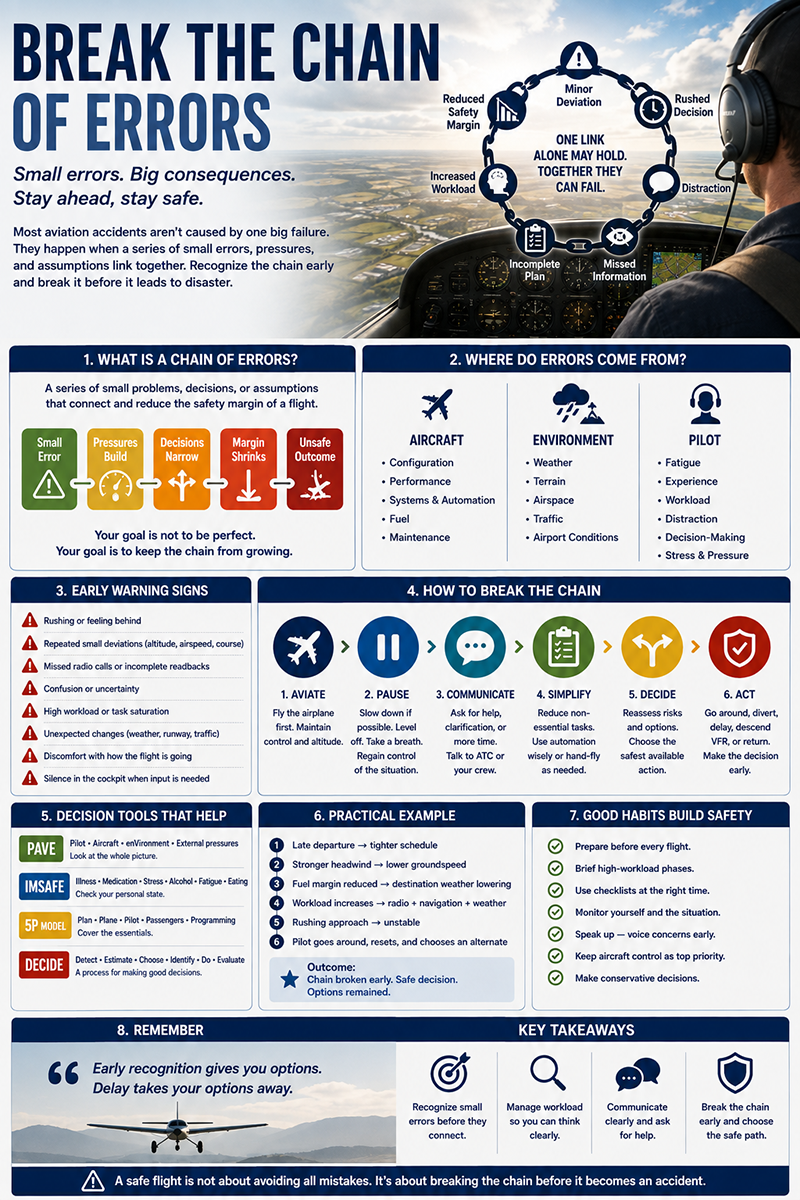
A chain of errors is one of the most important safety concepts a pilot can understand because it explains how an otherwise routine flight can drift toward an unsafe outcome. In aviation, serious problems rarely begin as one dramatic failure. More often, they start as small deviations, incomplete communications, rushed decisions, overlooked limitations, weather assumptions, fatigue, distraction, or a checklist item handled casually. Each item may seem manageable by itself. The danger grows when those items connect.
For pilots, student pilots, flight instructors, and aviation professionals, the practical skill is not simply avoiding every mistake. No pilot can guarantee that. The real skill is recognizing when normal workload has turned into an error-producing environment and then breaking the chain before it grows. That requires discipline, situational awareness, communication, and the willingness to slow down, speak up, delay, divert, discontinue an approach, or return to a known safe point.
What a Chain of Errors Means in Aviation
A chain of errors is a sequence of small problems, decisions, omissions, or assumptions that combine to reduce the safety margin of a flight. The phrase is often used in flight training and safety discussions because it gives pilots a practical way to think about accident prevention. Instead of treating safety as a single yes-or-no condition, it helps pilots see risk as something that can accumulate.
One missed radio call may not be serious. One slightly late descent planning decision may not be serious. One weather update that is not reviewed may not be serious. But if the pilot is also tired, the destination weather is lowering, the aircraft is behind profile, fuel planning is tight, and the cockpit becomes task saturated, those separate items can begin to reinforce one another. The pilot may still feel in control, but the margin for correction is shrinking.
Identifying a chain of errors means noticing patterns rather than waiting for a single obvious emergency. A pilot who says, “This flight is starting to stack up,” is using sound aeronautical decision-making. That statement recognizes that the issue is no longer one isolated problem. It is the combination of factors that matters.
The concept applies across aviation. A student pilot in the traffic pattern can experience an error chain after a high approach, a late configuration change, and a rushed landing decision. A flight instructor can see a chain forming when a student becomes overloaded and begins missing basic aircraft control cues. A professional crew can encounter one when automation surprises, weather deviations, ATC instructions, and operational pressure begin competing for attention. Maintenance, dispatch, ground handling, and flight operations all have similar patterns because aviation safety depends on connected human and technical systems.
Why This Matters in Real-World Aviation
The chain of errors matters because aircraft usually give pilots opportunities to recover before conditions become critical. Those opportunities may appear as discomfort, confusion, unstable parameters, unanswered questions, or a sense that the plan no longer fits the situation. Pilots who recognize those cues early have more options. Pilots who continue while hoping the situation will simplify often give away time, altitude, fuel, runway, weather alternatives, and mental bandwidth.
Real-world flying involves changing conditions. Weather may arrive earlier than forecast. A runway may be closed. A passenger may create pressure. A radio frequency may be congested. A training maneuver may take longer than planned. A minor aircraft discrepancy may require a decision about whether to continue. None of these automatically means a flight is unsafe, but each one requires the pilot to reassess risk.
In flight training, identifying error chains helps students move beyond rote procedures. A student can know the checklist and still miss the bigger picture. For example, a student may configure correctly for landing but fail to notice that the approach is unstable because airspeed, alignment, descent rate, or runway aiming point are not coming together. The lesson is not only “use the checklist.” It is “use the checklist while maintaining aircraft control, situational awareness, and a realistic plan.”
For certificated pilots, the chain of errors concept is equally important because experience can create confidence that is useful but occasionally misleading. Familiar routes, familiar aircraft, and familiar airports can make pilots comfortable. Comfort is not a problem by itself, but it can reduce curiosity. A pilot who has completed the same short cross-country many times may be more likely to dismiss a weather trend, accept a late departure, or minimize the significance of fatigue. Error chains often grow quietly in familiar environments.
Flight instructors and check pilots can use this concept to coach judgment. Instead of waiting until a student makes a major error, the instructor can ask, “What is beginning to change?” or “What would make this situation worse?” Those questions train pilots to see risk before the aircraft is out of position or the decision window is nearly gone.
How Pilots Should Understand This Topic
Pilots should understand a chain of errors as a warning system, not as a criticism. The goal is not to label every mistake as a failure. The goal is to see when ordinary imperfections are beginning to align. Good pilots make corrections early because they know that aviation rarely rewards delay when the safety margin is decreasing.
A useful way to think about error chains is to separate the flight into three layers: the aircraft, the environment, and the pilot. The aircraft layer includes configuration, performance, fuel, systems, automation, and maintenance status. The environment layer includes weather, terrain, airspace, traffic, airport conditions, runway length, lighting, and communications. The pilot layer includes proficiency, fatigue, workload, planning, pressure, distraction, and decision-making. An error chain often becomes significant when more than one layer begins to show weakness.
For example, a pilot who is well rested and flying in good weather may easily handle a late runway change. A tired pilot at night, arriving at an unfamiliar airport, while dealing with gusty winds and a passenger asking questions, may experience that same runway change very differently. The event is not identical because the surrounding risk picture is different.
Another key idea is that pilots should treat confusion as useful information. If a pilot is unsure of clearance, position, mode status, fuel state, weather trend, or aircraft configuration, that uncertainty should trigger a pause or clarification. Confusion is not embarrassing. Unresolved confusion is dangerous. Asking ATC to repeat an instruction, leveling off to regain control of the situation when appropriate, requesting vectors, delaying a maneuver, or going around are all examples of breaking an error chain.
Many pilots also benefit from using structured decision tools such as PAVE, IMSAFE, the 5P model, or the DECIDE model during training and recurrent review. These frameworks are not magic formulas. Their value is that they force the pilot to look beyond the immediate task and evaluate the whole situation. When used naturally, they help transform a vague feeling of concern into specific questions: What changed? What is the risk now? What options remain? What is the safest next action?
Early Warning Signs That a Chain Is Growing
A chain of errors rarely announces itself with a single alarm. It usually appears as a gradual increase in workload, uncertainty, or deviation from the plan. One of the earliest warning signs is the need to rush. If the pilot feels forced to hurry a checklist, briefing, weather review, descent, approach, or taxi instruction, the safety margin may already be narrowing.
Another warning sign is repeated small deviations. Being a little high on descent, then a little fast, then late with configuration, then uncertain about the wind correction may point to a larger workload or planning problem. The pilot may still be able to fix each item individually, but the sequence deserves attention.
Communication problems are also strong clues. Missed calls, readback uncertainty, cockpit interruptions, unresolved passenger questions, or incomplete crew coordination can all add risk. In multi-pilot or instructional environments, silence can be a warning sign too. If one person notices a concern but does not verbalize it, the opportunity to break the chain may be lost.
Automation confusion deserves special attention. Modern avionics and autopilot systems can reduce workload when the pilot understands what the system is doing. They can increase workload when the pilot is uncertain about modes, navigation sources, altitude capture, vertical guidance, or flight plan sequencing. If the aircraft is not doing what the pilot expected, the correct response is to simplify. That may mean hand flying, selecting a basic mode, rechecking the flight plan, asking for assistance, or taking another action appropriate to the aircraft and operation.
Emotional cues matter as well. Frustration, embarrassment, impatience, resignation, and get-there pressure are not aircraft instruments, but they are cockpit data. A pilot who thinks, “I just need to make this work,” should consider whether a safer option is being ignored. Good aeronautical decision-making includes recognizing when pride or pressure is influencing the plan.
Why Chains Grow: Human Factors in the Cockpit
Error chains grow because pilots are human. Human beings are capable, adaptable, and resilient, but they are also vulnerable to workload saturation, confirmation bias, habit, distraction, and fatigue. Aviation training exists partly to build procedures that protect the pilot from predictable human limitations.
Confirmation bias occurs when a pilot gives more weight to information that supports the desired plan and less weight to information that challenges it. A pilot who wants to complete a flight may focus on the part of the weather picture that looks acceptable and minimize the trend that suggests deterioration. A pilot who expects a normal landing may overlook the fact that the approach never stabilized. The risk is not dishonesty. The risk is selective attention.
Plan continuation bias is closely related. Once a pilot has invested time and effort into a plan, changing that plan can feel like failure. In reality, changing the plan is often a mark of professionalism. Diverting, delaying, canceling, requesting a different clearance, or going around may be the best evidence that the pilot is actively managing risk.
Workload saturation is another major factor. When task demand exceeds available attention, pilots tend to narrow their focus. They may fixate on one problem while missing another. A pilot troubleshooting a navigation issue may allow airspeed or altitude to drift. A student trying to correct centerline alignment may forget pitch attitude or power. The remedy is to aviate first, simplify, and restore priorities.
Fatigue and stress can make all of these issues worse. A tired pilot may still be legal and capable, but reaction time, patience, scan discipline, and judgment can suffer. Stress can make a pilot more likely to rush or cling to a plan. The chain of errors concept helps pilots identify these conditions before they become part of a larger problem.
Common Mistakes or Misunderstandings
One common misunderstanding is believing that an error chain only matters after something serious has happened. In fact, the best time to identify the chain is when the errors are still small. If the first clear sign appears during the flare, during a low-altitude maneuver, or after entering deteriorating weather, the pilot may have fewer options than were available earlier.
Another mistake is treating checklists as a substitute for judgment. Checklists are essential tools, but they do not evaluate the entire operating context by themselves. A pilot can complete the before-landing checklist and still be unstable, distracted, too close to weather, uncertain about runway conditions, or operating under pressure. Checklists support decision-making. They do not replace it.
A third misunderstanding is assuming that experience prevents error chains. Experience improves pattern recognition, but it does not eliminate human factors. Experienced pilots may be better at noticing risk, yet they may also be more vulnerable to normalization if they have previously succeeded in similar marginal situations. The statement “I have done this before” should not automatically become “therefore it is safe today.”
Some pilots also wait for permission to make conservative decisions. Student pilots may not want to disappoint an instructor. Private pilots may not want to inconvenience passengers. Professional pilots may feel operational pressure. But the pilot’s responsibility is to manage the flight as conditions actually exist. A conservative decision made early is usually easier to explain than a risky decision defended later.
Finally, pilots sometimes underestimate the value of verbalizing concerns. Saying “we are high and fast,” “I am not comfortable with this weather,” or “let’s go around and reset” can immediately change the cockpit dynamic. It turns an internal concern into a shared safety action. In single-pilot flying, speaking the concern out loud can still help by forcing the pilot to name the problem clearly.
Practical Example: A Short Cross-Country That Starts to Stack Up
Consider a private pilot planning a late afternoon VFR cross-country to an airport about 90 nautical miles away. The aircraft is familiar, the route is familiar, and the forecast appears acceptable. The pilot arrives at the airport later than planned because of traffic on the drive. That is the first pressure point, but it does not feel significant.
During preflight, the pilot notices the fuel level is adequate for the intended flight with planned reserves, but not as comfortable as originally expected because the departure is later and winds aloft are less favorable than hoped. The pilot decides to continue and plans to monitor groundspeed. That decision may be reasonable, but the margin has changed.
After departure, the frequency is busy and the pilot has difficulty obtaining flight following. The airplane climbs more slowly than expected in warm conditions and turbulence. The pilot spends extra time managing the radio and reviewing the moving map. The aircraft drifts slightly off course, and the pilot corrects. None of this is an emergency, but the workload is increasing.
Halfway to the destination, the pilot notices lowering visibility ahead and a darker area near the route. The weather still appears manageable, but the original mental picture no longer matches what the pilot sees. The pilot also realizes that arrival will be closer to sunset than planned. At this point, the chain is visible: late departure, reduced fuel comfort, headwind, workload, weather uncertainty, and decreasing daylight.
A pilot who identifies the chain early has several options. The pilot can turn back while conditions behind remain known, divert to a closer airport for fuel and weather reassessment, request updated weather information, climb or alter course if appropriate and safe, or land and wait. The key is not that one specific answer is always correct. The key is that the pilot recognizes the pattern before being forced into a narrow set of choices.
If the pilot ignores the pattern, the next links may form quickly. Visibility could continue to decline. Fuel options could become less comfortable. The pilot may become more focused on reaching the destination than evaluating alternatives. A familiar flight can become an increasingly complex decision problem. The chain was not created by one bad act. It grew because small pressures were allowed to remain connected.
Best Practices for Pilots
The most effective way to stop a chain of errors is to develop habits that reveal risk early. These habits should be simple enough to use during normal operations and strong enough to help when workload rises. Pilots should not wait for a perfect decision-making moment. The best time to reassess is often during ordinary transitions: before engine start, before taxi, before takeoff, at top of climb, before descent, before entering the traffic pattern, and any time the plan changes.
One strong habit is to maintain a “what changed?” mindset. If weather, aircraft performance, fuel state, passenger condition, runway assignment, route, traffic, or pilot workload changes, the risk assessment should change with it. A plan that was reasonable at noon may not be reasonable at 1700 after delays, fatigue, and weather movement.
Another best practice is to create personal triggers for conservative action. These triggers are not regulatory requirements unless specifically adopted by an operation, but they can be powerful personal safety tools. Examples include deciding in advance when to go around, when to divert for fuel, when to stop a training maneuver, when to discontinue a flight because of fatigue, or when to ask for help. The purpose is to reduce decision-making burden during high workload.
Pilots should also keep aircraft control at the center of every response. When a situation becomes confusing, the first priority is to fly the airplane. That includes maintaining attitude, airspeed, altitude, heading, terrain clearance, and configuration appropriate to the phase of flight. Once control is assured, the pilot can navigate, communicate, troubleshoot, and decide.
Briefings are another practical tool. A good briefing is not a speech. It is a mental rehearsal of what should happen and what will trigger a change. Before an approach or landing, for example, the pilot should know the runway, wind, expected traffic flow, aiming point, configuration plan, go-around procedure, and factors that would make the landing unacceptable. That mental preparation makes it easier to recognize deviations.
In two-pilot, instructional, or crew environments, pilots should create a cockpit culture where concerns are welcomed. A flight instructor should encourage students to call out unstable conditions or uncertainty. A safety pilot should speak up when something does not look right. A professional crew should use clear, standard communication appropriate to the operation. The chain of errors grows faster when people hesitate to communicate.
Practical techniques that help break the chain include:
- Pause and reassess when the plan changes, rather than continuing automatically.
- Use plain language to name the problem, such as “we are high, fast, and late configuring.”
- Simplify the aircraft and avionics when automation increases confusion.
- Ask for clarification, delay vectors, additional time, or assistance when appropriate.
- Go around, divert, delay, or cancel when the safest option is to reset the situation.
The value of these actions is that they preserve options. Early corrections are usually less dramatic than late recoveries. A go-around from an unstable approach is a normal maneuver. A diversion made with comfortable fuel and daylight remaining is a planning adjustment. A delay before departure is often far easier than managing deteriorating conditions in flight.
How Flight Instructors Can Teach Error Chain Recognition
Flight instructors play a major role in helping pilots recognize error chains because students often focus on immediate performance. They may know that airspeed is five knots fast or that altitude has drifted, but they may not yet understand how those deviations interact with workload, traffic, weather, and decision timing.
Instructors can teach the concept by using guided questions rather than only correcting errors. Instead of saying, “You are high,” the instructor might ask, “What is your approach picture telling you?” Instead of immediately fixing a navigation error, the instructor might ask, “What else is happening in the cockpit right now?” This helps the student build pattern recognition.
Scenario-based training is especially useful. A lesson can include a simulated late runway change, unexpected headwind, passenger distraction, or weather update. The objective is not to overwhelm the student for its own sake. The objective is to teach the student to slow the situation down, prioritize aircraft control, communicate clearly, and choose a safer option.
Debriefing should focus on decision points. After a flight, the instructor can ask when the first link appeared, what cues were available, what options existed, and what action would have broken the chain earlier. This moves the conversation beyond whether the maneuver was completed and toward how the pilot managed risk.
Instructors should also model conservative decision-making. Students learn from what instructors do, not only from what they say. When an instructor cancels for weather, discontinues a maneuver, goes around, or delays a flight because conditions do not support the lesson objective, the student sees professional judgment in action.
Using Briefings and Personal Minimums to Break the Chain
Briefings and personal minimums help pilots identify error chains before emotion and workload take over. A personal minimum is a self-imposed limit or decision point that may be more conservative than what is legally permitted or what the aircraft is capable of doing. Personal minimums should reflect pilot experience, proficiency, aircraft familiarity, environment, and mission complexity.
For a student pilot, a personal minimum might include wind conditions, ceiling, visibility, crosswind comfort, or airport familiarity appropriate to the current training stage. For an instrument-rated pilot, personal minimums may address approach conditions, recent proficiency, equipment status, alternates, or night operations. For any pilot, personal minimums should be reviewed honestly and adjusted only through training, proficiency, and experience, not convenience.
Briefings turn those decisions into actionable expectations. A departure briefing might include what to do after an engine abnormality, what runway will be used, what terrain or airspace matters, and what conditions would lead to returning or landing straight ahead as appropriate. An arrival briefing might include descent planning, traffic pattern entry, runway environment, wind, go-around plan, and expected workload.
The briefing should include a reset point. For example, a pilot might decide, “If I am not stabilized by my chosen point, I will go around,” or “If the weather does not match my plan by this checkpoint, I will divert.” These statements help break the chain because the pilot has already made the conservative decision before pressure increases.
Frequently Asked Questions
What is a chain of errors in aviation?
A chain of errors is a sequence of small mistakes, omissions, pressures, or changing conditions that combine to reduce the safety margin of a flight. Each link may appear manageable alone, but together they can create a situation that requires immediate correction or a change of plan.
How can a pilot recognize an error chain early?
Early signs include rushing, repeated small deviations, confusion, incomplete communication, unexpected workload, weather that no longer matches the plan, fuel or time pressure, and discomfort with how the flight is progressing. The key is to notice patterns, not just isolated errors.
Does using a checklist prevent a chain of errors?
Checklists are essential, but they do not prevent every error chain by themselves. A checklist confirms critical actions, while pilot judgment evaluates the larger situation. Safe operations require both disciplined checklist use and active risk management.
What is the best way to break a chain of errors?
The best response depends on the situation, but effective actions often include slowing down, flying the aircraft first, communicating clearly, simplifying automation, asking for help, going around, diverting, delaying, or canceling. The safest action is usually easier when taken early.
Why do experienced pilots still need to think about error chains?
Experience improves judgment and pattern recognition, but it does not eliminate fatigue, distraction, confirmation bias, or operational pressure. Experienced pilots can still benefit from structured risk assessment and a willingness to change the plan when conditions change.
How should instructors teach this concept to student pilots?
Instructors should use realistic scenarios, guided questions, and thoughtful debriefs. Students should learn to identify the first link, describe what is changing, and choose an action that restores safety margins before the situation becomes urgent.
Key Takeaways
- A chain of errors usually begins with small, manageable issues that become hazardous when they connect and reduce the pilot’s options.
- Early recognition is a safety skill. Rushing, confusion, repeated deviations, communication problems, and changing weather are cues to reassess.
- Pilots break the chain by flying the aircraft first, naming the problem, simplifying the situation, communicating clearly, and choosing conservative options early.
- Flight instructors can strengthen judgment by teaching students to identify risk patterns, not just correct individual maneuver errors.
- Personal minimums, briefings, and planned reset points help pilots make better decisions before workload and pressure increase.