
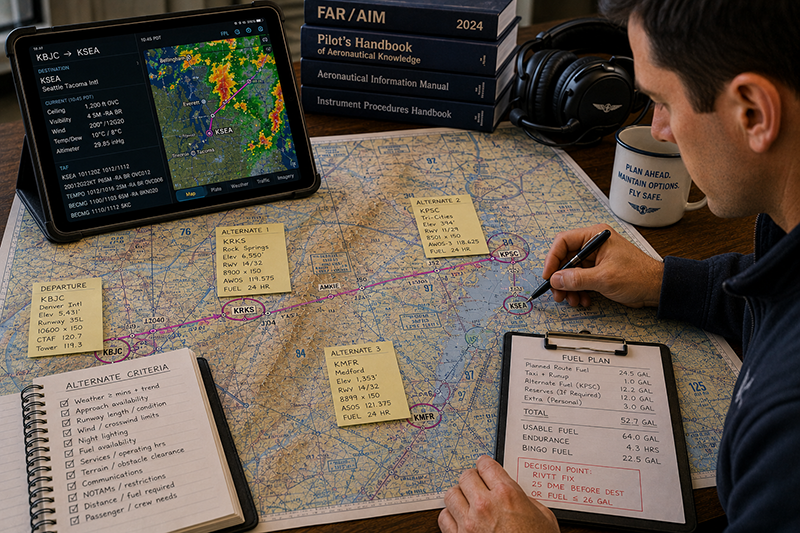
Choosing alternate airports strategically is one of the most practical risk-management skills a pilot can develop. An alternate is not just a name typed into a flight plan or a regulatory box to satisfy before departure. It is a realistic escape option when weather, traffic, aircraft performance, fuel status, passenger needs, runway conditions, or operational constraints change the plan.
For student pilots, alternate planning builds judgment beyond the mechanics of navigation. For instrument pilots, it connects weather interpretation, fuel planning, approach availability, and missed approach thinking. For flight instructors and aviation professionals, it is a direct window into aeronautical decision-making. The quality of an alternate choice often reveals whether a pilot is truly managing the flight or simply hoping the original plan works.
A strategically chosen alternate airport answers a practical question: if the destination stops being a good option, where can the aircraft safely and confidently go next? The best answer is rarely based on distance alone. A nearby airport may be a poor alternate if it shares the same weather system, has limited approaches, lacks lighting, sits behind terrain, has an unfavorable runway, or offers no practical services. A slightly farther airport may be a much better safety decision if it provides better weather, longer runways, more approach options, fuel, maintenance, and fewer operational traps.
This article explains how pilots can think about alternate airports in a disciplined, real-world way. It does not replace current regulations, approved aircraft data, company procedures, or instructor guidance. Instead, it focuses on the judgment behind the selection: how to evaluate weather, approaches, fuel, runway suitability, terrain, services, workload, and timing before the flight becomes urgent.
What Strategic Alternate Airport Planning Really Means
Strategic alternate airport planning means selecting one or more airports that are useful under realistic conditions, not merely acceptable on paper. The concept applies to VFR and IFR flying, day and night operations, training flights, cross-country trips, and commercial or business aviation. The details vary by aircraft, pilot qualification, flight rules, and operating environment, but the underlying principle is the same: an alternate must improve the outcome if the original plan deteriorates.
There are two broad categories of alternates. A planned alternate is considered before departure and may be listed in a flight plan when required or appropriate. A working alternate is the airport a pilot is actually prepared to use during the flight if conditions change. Sometimes they are the same place. Sometimes they are not. A pilot may file one airport because it meets planning criteria, then continuously update the practical diversion plan as weather, fuel, traffic, or routing changes.
The strongest alternate planning starts with a simple mindset: the destination is not guaranteed. Even on a clear day, a runway closure, disabled aircraft, mechanical indication, passenger issue, unexpected winds, smoke, haze, convective weather, or air traffic delay can make a diversion necessary. In instrument flying, a destination that looked reasonable during preflight planning may become less attractive after updated weather, pilot reports, ATC delays, or deteriorating ceiling and visibility.
A strategic alternate is evaluated as a complete operating environment. The pilot considers whether the airport is reachable with legal and practical fuel reserves, whether the weather trend supports arrival, whether the available approaches match the aircraft and pilot capability, whether the runway is suitable for the aircraft, and whether the airport can support the next steps after landing. That last point is often overlooked. Landing safely at an isolated airport may solve the immediate airborne problem, but it may create operational complications if there is no fuel, no transportation, no maintenance, no lighting after sunset, or no secure parking.
Why This Matters in Real-World Aviation
Alternate airport selection matters because diversions usually happen when workload is already increasing. A pilot who waits until the destination becomes unusable may have to evaluate weather, fuel, approaches, terrain, airport data, communications, passenger concerns, and aircraft status all at once. That is exactly when decision quality can decline.
Good alternate planning reduces the number of decisions that must be made under pressure. If the pilot has already identified a strong alternate, reviewed the approach options, checked fuel, noted runway orientation, considered terrain, and briefed the general diversion path, the decision becomes much simpler. Instead of asking, “Where can I go now?” the pilot can ask, “Has the time arrived to execute the plan?”
In training, alternate planning also develops the ability to think ahead of the aircraft. Many student pilots learn diversions as a navigation exercise: draw a line, estimate a heading, calculate time and fuel, and proceed. That skill is important, but the strategic question comes first. Why that airport? Is it safer than the other options? Does the weather support it? Does it have the runway, services, and approach capability needed? A technically accurate diversion to a poor airport is still a poor decision.
For instrument pilots, alternates are closely tied to weather, fuel, and approach planning. Regulations may determine when an alternate must be listed for certain operations, and the details depend on the type of operation and current rules. However, compliance alone does not guarantee that an alternate is operationally smart. A pilot may need to select an alternate even when not strictly required, or choose a more conservative airport than the minimum planning standard would allow. Legal planning is the floor. Strategic planning is the safety margin above it.
For operators and flight departments, alternate strategy affects dispatch reliability, passenger expectations, fuel cost, crew workload, and contingency planning. A well-chosen alternate can prevent rushed decisions and reduce the chance of pressing into deteriorating conditions. A poorly chosen alternate can produce a cascade of problems: fuel stress, missed approaches, unexpected holding, runway limitations, or a landing at an airport that cannot support the aircraft or passengers.
How Pilots Should Understand Alternate Airports
Pilots should think of alternate airports as options with different strengths and weaknesses. The goal is not to find a perfect airport. The goal is to choose the airport that provides the best combination of weather reliability, runway suitability, approach capability, fuel feasibility, terrain clearance, operational support, and workload management.
Distance is only one variable. The closest airport may be useful in an immediate emergency, but it may not be the best planned alternate. A better alternate may be located away from the same weather system, aligned with prevailing winds, equipped with more suitable approaches, served by an operating control tower or reliable weather reporting, and supported by fuel and maintenance. In some cases, the best alternate is behind the aircraft rather than ahead of it, especially when weather is moving along the route.
Weather is usually the first major filter. Pilots should evaluate the current conditions, forecasts, trends, and broader weather pattern. A destination and alternate separated by only a short distance may experience the same low ceilings, fog, thunderstorms, smoke, or freezing precipitation. A more strategic choice may be outside the influence of the same coastal layer, valley fog, convective line, upslope flow, or frontal boundary. The important question is not simply, “What is the forecast at the alternate?” It is, “Why do I believe this alternate will remain usable when I need it?”
Approach capability is another critical factor. For IFR operations, an alternate with multiple suitable instrument approaches may be more resilient than an airport with a single approach dependent on one navigation source or one runway direction. Pilots should consider whether the aircraft is properly equipped, whether the pilot is current and comfortable with the procedure, whether the approach lighting and runway environment support the expected conditions, and whether the missed approach procedure is manageable.
Runway suitability must be evaluated using approved aircraft performance information and current conditions. A runway that looks adequate in a directory may become less attractive with high density altitude, contaminated surfaces, gusty crosswinds, tailwind components, displaced thresholds, obstacles, or nighttime operations. Pilots should avoid assuming that any paved runway is suitable. The alternate must support both landing and the likely departure that follows, especially if fuel, maintenance, or repositioning will be required.
Fuel planning ties the entire strategy together. A pilot should not merely plan enough fuel to reach the destination and then think about alternatives later. The real question is whether the aircraft can proceed to the destination, experience realistic delays or approach attempts, divert to the alternate, and still land with the reserve required by regulation and good judgment. The exact fuel rules depend on the type of operation, aircraft, and flight rules, so pilots should use current regulations and approved procedures. From a practical perspective, fuel is time, and time is decision space.
Services matter as well. Fuel availability, operating hours, maintenance, ground transportation, ramp space, customs if applicable, weather reporting, communications, lighting, snow removal, and emergency services can all affect whether an alternate is truly useful. For a short training flight, a small airport with a suitable runway may be perfectly reasonable. For a night IFR trip with passengers, a larger airport with services and multiple approaches may be the more professional choice.
Regulatory Planning Versus Operational Judgment
One common misunderstanding is that alternate airport planning is only a regulatory issue. Regulations are important, and pilots must comply with the current requirements that apply to their operation. However, regulations cannot anticipate every practical variable. A flight may be legal and still poorly planned. A listed alternate may satisfy a planning requirement but still be a weak option if it shares the same weather risk, has limited facilities, or creates excessive workload.
Strategic alternate selection begins after the legal question is answered. If an alternate is required, the pilot must select one that meets the applicable criteria. If an alternate is not required, the pilot should still consider whether a prudent backup is needed. VFR pilots, especially on cross-country flights, benefit from identifying suitable airports along the route before departure. Night VFR, mountain flying, marginal weather, high traffic areas, and unfamiliar terrain all make alternate thinking more valuable.
For IFR pilots, the difference between “filed alternate” and “best available escape plan” is especially important. The alternate listed in the flight plan may be appropriate at departure, but the best real-time choice can change. Updated weather may make another airport more attractive. A route amendment may put the aircraft closer to a different option. Fuel burn may be higher or lower than expected. Air traffic delays may change the risk picture. Strategic pilots keep evaluating, not because they are indecisive, but because good decisions depend on current information.
Flight instructors can help students by separating the compliance discussion from the judgment discussion. First, identify what rules apply to the flight. Then ask which airport is actually the best place to go if the plan changes. This approach prevents students from treating alternate selection as a paperwork exercise and encourages them to build real operational judgment.
The Main Factors in Choosing a Strong Alternate
A strong alternate airport usually performs well across several categories. It does not need to be the closest airport, the largest airport, or the most convenient airport. It needs to provide a dependable and manageable option under the conditions that could reasonably exist at the time of arrival.
Weather and trends
The weather picture should be evaluated beyond a single forecast line. Pilots should consider whether conditions are improving, stable, or deteriorating; whether the alternate is affected by the same weather as the destination; and whether the ceiling, visibility, winds, convective activity, icing potential, turbulence, or precipitation type could change during the flight. Weather trends matter because an alternate is usually needed later, not at the moment the preflight briefing is completed.
Approach and navigation capability
For instrument operations, the available approaches should match the aircraft equipment, pilot proficiency, and likely weather. A precision or vertically guided approach may reduce workload compared with a nonprecision approach, but only if the aircraft and pilot are prepared to fly it correctly. GPS, ground-based navigation, approach lighting, runway lighting, and missed approach design all influence the quality of the alternate. Pilots should also think about what happens if one navigation source, one runway, or one approach becomes unavailable.
Runway, wind, and performance
Runway length, width, slope, surface, lighting, obstacles, and wind alignment should be evaluated using the aircraft’s approved performance data and the pilot’s personal or organizational minimums. A runway that is comfortable in calm daytime conditions may not be comfortable with gusty winds, wet pavement, high density altitude, or night illusions. At an alternate, the pilot may already be tired or task-saturated, so the runway environment should not add unnecessary difficulty.
Fuel, time, and decision points
Fuel planning should include clear decision points. A pilot should know when continuing toward the destination will begin to reduce flexibility. This is sometimes called a “bingo fuel” concept in practical planning: a predetermined fuel state or location at which the pilot will divert rather than continue hoping for improvement. The term and method may vary by operation, but the principle is valuable. Make the fuel decision before fuel pressure forces the decision.
Terrain and route structure
An alternate on the other side of high terrain, restricted airspace, a large body of water, or complex arrival corridors may not be as simple as it looks on a map. Terrain affects minimum altitudes, weather patterns, radio reception, glide options, and workload. Pilots should consider the diversion route, not just the destination airport. The safest alternate may be one reached by a simpler route with better terrain clearance and fewer airspace complications.
Airport services and practical support
Fuel availability, operating hours, maintenance support, deicing capability if relevant, transportation, lodging, food, security, and passenger handling can all matter. For training flights, services may be less important. For business aviation, family travel, medical concerns, or weather delays, they may be decisive. A strategic alternate should solve the aviation problem and, when practical, support the people and aircraft after landing.
Common Mistakes or Misunderstandings
The most common mistake is choosing the nearest airport without asking whether it is the best alternate. Nearness can be valuable in an emergency, but it does not automatically provide better weather, better approaches, longer runways, or more services. In marginal conditions, a nearby alternate may be affected by the same weather that made the destination unusable.
Another mistake is choosing an alternate based only on forecast numbers. Forecasts are planning tools, not guarantees. Pilots should consider weather systems, trends, terrain effects, and the time of expected arrival. Fog, convection, snow showers, wind shifts, smoke, and low clouds can vary significantly over time and distance. A good alternate strategy includes monitoring updates and being willing to change the plan.
Pilots sometimes overvalue a familiar airport. Familiarity helps, but it can also create blind spots. An airport used often in training may be a poor alternate at night, in strong crosswinds, with limited lighting, during low instrument conditions, or when services are closed. Familiarity should be balanced with current conditions and aircraft performance.
Another misunderstanding is assuming that filing an alternate completes the task. Filing is not the same as preparing. A pilot should review the airport layout, approaches, missed approach procedures, runway data, frequencies, weather reporting, and likely arrival flow. If the alternate becomes necessary, the pilot should not be seeing critical information for the first time during a high-workload diversion.
Some pilots delay diversion decisions too long. This often happens because the destination is close, passengers expect to arrive, weather might improve, or the pilot has already invested time and fuel into the plan. Strategic alternate planning helps counter that pressure by creating objective decision points before the flight. When the aircraft reaches a certain fix, fuel state, weather threshold, or time limit, the pilot already knows what action to take.
A final mistake is failing to account for pilot condition. Fatigue, night operations, single-pilot IFR, busy airspace, turbulence, passenger distractions, or an abnormal aircraft indication can reduce capacity. Under those conditions, a more capable alternate with easier approaches and better services may be worth extra fuel and distance.
Practical Example: A Cross-Country IFR Decision
Consider a pilot planning a single-engine IFR cross-country to a non-towered destination near a coastal region. The forecast suggests marginal VFR to low IFR conditions around the destination near the expected arrival time. Winds are manageable, but the ceiling may lower as moist air moves inland. The destination has one usable instrument approach for the aircraft and limited evening services.
The closest alternate is only 18 nautical miles away. It has a similar elevation, similar coastal exposure, one approach, and no fuel after normal business hours unless arranged in advance. On paper, it may look convenient. Operationally, it does not add much resilience because it is likely to experience similar weather and offers limited support if the pilot lands there after hours.
A second option is 45 nautical miles inland. It has multiple runways, more approach options, published weather reporting, fuel, lighting, and better ground transportation. The route to it avoids the lowest coastal weather and does not require crossing significant terrain. It is farther away, but it provides more reliable weather separation and better support. If fuel planning permits, this airport is a stronger strategic alternate.
During preflight, the pilot chooses the inland airport as the planned alternate and identifies a decision point 40 minutes before the destination. If updated weather at the destination drops below the pilot’s personal minimums, or if the approach becomes unavailable, the pilot will divert before beginning a low-fuel, high-workload sequence near the destination. The pilot also briefs the inland airport’s likely approach and confirms fuel availability.
In flight, the destination weather trends downward. The pilot requests updated conditions and sees that the inland alternate remains well above the pilot’s planned minimums. Rather than continuing toward a questionable destination with shrinking options, the pilot diverts early. The diversion is calm because the airport, route, fuel state, frequencies, and approach have already been considered. This is strategic alternate planning in action: not dramatic, not reactive, and not dependent on luck.
Best Practices for Pilots
Effective alternate planning is a habit, not a last-minute task. Pilots can make better choices by combining regulatory compliance, aircraft performance, weather analysis, and personal minimums into one practical decision process.
- Choose alternates for resilience, not convenience. Look for airports that remain useful if the destination fails because of weather, runway closures, traffic, or operational limits.
- Separate legal minimums from personal minimums. Current regulations and procedures must be followed, but a prudent pilot may need more margin based on proficiency, aircraft capability, and conditions.
- Evaluate the weather system, not just the airport forecast. Consider whether the alternate is far enough from the same weather risk to be meaningful.
- Review the approach before you need it. Know the available procedures, runway environment, missed approach requirements, and aircraft equipment needs.
- Set decision points in advance. Decide when fuel, weather, time, or workload will trigger a diversion.
- Account for after-landing needs. Fuel, maintenance, transportation, lighting, and operating hours may determine whether the alternate is practical.
Instructors should encourage students to explain their alternate choices out loud. A good answer should include more than “it is close” or “it has a runway.” The student should be able to describe why the airport is suitable under expected conditions, what could make it unsuitable, and when the pilot would divert. That type of discussion builds the judgment needed for real-world flying.
Experienced pilots should also remain humble about alternate planning. Familiar routes can lead to casual assumptions. Modern avionics make diversion navigation easier, but they do not replace decision-making. A moving map can show where the airports are. It cannot decide which airport gives the best safety margin under the current conditions.
Frequently Asked Questions
Is the closest airport usually the best alternate?
Not always. The closest airport may be best for an immediate emergency, but a planned alternate should be evaluated for weather, approaches, runway suitability, fuel, services, terrain, and workload. A farther airport may provide a much better operating environment.
Should VFR pilots think about alternate airports?
Yes. Even when a formal alternate is not part of the flight plan, VFR pilots benefit from identifying suitable airports along the route. Weather changes, passenger needs, mechanical concerns, darkness, fuel planning, or runway closures can make a diversion necessary.
How many alternate airports should a pilot consider?
At least one strong alternate should be considered for any meaningful cross-country flight, and more may be appropriate when weather, terrain, night operations, or long routes increase complexity. The number matters less than the quality and realism of the options.
What makes an IFR alternate strategically strong?
A strong IFR alternate generally offers reliable weather separation from the destination, suitable instrument approaches, manageable missed approach procedures, adequate runway performance, fuel feasibility, and practical services. The aircraft and pilot must also be capable of using the available procedures.
When should a pilot decide to divert?
The best time to decide is before fuel, weather, or workload removes good options. Pilots should establish decision points before departure and update them in flight. If the destination no longer fits the plan, diverting early is usually easier than waiting until the situation becomes urgent.
Key Takeaways
- Choosing alternate airports strategically means selecting a realistic backup that improves safety, not merely the nearest airport or the easiest entry on a flight plan.
- Weather trends, runway suitability, approach capability, fuel, terrain, services, and pilot workload all affect whether an alternate is truly useful.
- Regulatory compliance is essential, but strong aeronautical decision-making adds personal minimums, early decision points, and continuous in-flight reassessment.