
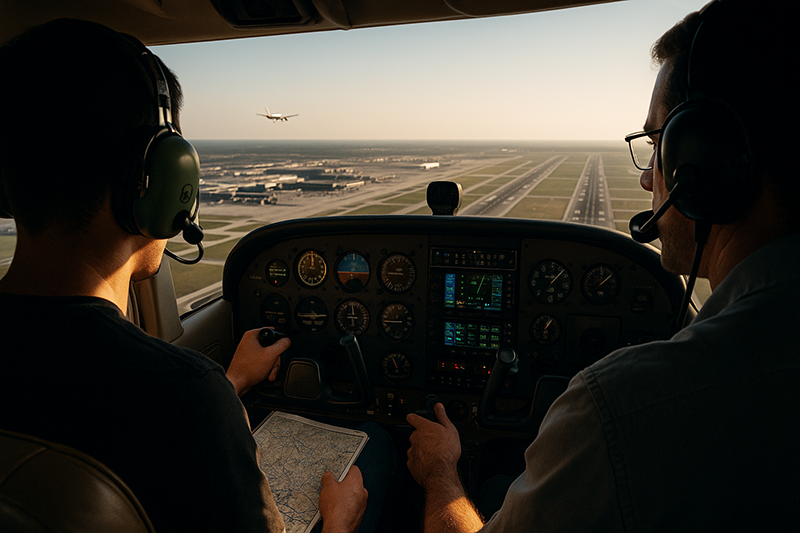
A first Class B airport flight is a milestone for many pilots. It is often the first time a student pilot, private pilot, or transitioning general aviation pilot operates in the same arrival and departure environment as airline crews, business jets, high-performance aircraft, helicopters, and sophisticated ground operations. The airspace is not designed to intimidate you, but it does demand preparation, discipline, and a clear understanding of how ATC, charted procedures, communications, and airport surface movement all fit together.
Preparing for a Class B airport flight is not just about sounding polished on the radio. It is about knowing what clearance you need, where the airspace begins, what equipment and charting requirements apply, how to brief the arrival and departure, how to manage cockpit workload, and how to keep your aircraft ahead of the operation. For pilots training toward real-world competence, a well-briefed Class B flight can build confidence in ATC communication, traffic awareness, runway assignment management, and professional cockpit habits that transfer to nearly every type of flying.
What Makes a Class B Airport Flight Different?
Class B airspace surrounds many of the busiest airports in the United States. The shape is commonly described as an upside-down wedding cake because it usually has multiple shelves with different lateral boundaries and floor altitudes. The airport at the center often supports dense airline and corporate traffic, multiple runways, parallel approach paths, complex taxi routes, and a high tempo of ATC instructions.
The most important practical difference for a VFR pilot is that entry into Class B airspace requires an explicit ATC clearance. A simple acknowledgement of your call sign is not the same as being cleared into Class B. The controller must issue words that clearly authorize entry, such as a clearance into the Bravo. If you are approaching the lateral boundary or a shelf and you have not received that clearance, you must remain outside the airspace unless otherwise authorized.
Class B airports also tend to compress workload. You may be talking to approach control, receiving traffic advisories, descending or leveling to stay within a shelf, being assigned a runway you did not expect, changing frequencies, copying taxi instructions, avoiding wake turbulence, and navigating unfamiliar airport geometry in a short period of time. None of these tasks is unusual by itself. The challenge is that they often happen close together.
A good Class B preparation strategy starts well before engine start. It includes choosing a realistic route, reviewing the sectional or terminal area chart, checking current airport information, briefing communications, understanding likely arrival and departure flows, and deciding what you will do if the workload becomes too high. A Class B flight should feel busy, but it should not feel improvised.
Regulatory Concepts Pilots Must Understand
Class B operations include several regulatory and procedural concepts that every pilot should understand in practical terms. This article is not a substitute for current regulations, chart notes, or instructor guidance, but the concepts below are central to safe and legal planning.
First, VFR pilots need an ATC clearance before entering Class B airspace. This is different from Class C or Class D communication requirements, where establishing two-way radio communication may be sufficient for entry. In Class B, listen for an actual clearance. If you hear only “stand by,” “remain outside,” or a traffic advisory without a clearance, do not enter.
Second, aircraft equipment matters. Operations in and around Class B airspace commonly require an operable transponder with altitude reporting capability and ADS-B Out where applicable under current rules. The 30-nautical-mile Mode C veil surrounding many Class B primary airports is also an important planning factor. Pilots should confirm aircraft equipment status, database currency if using panel navigation, and any applicable exceptions before the flight.
Third, VFR weather minimums in Class B are different from some surrounding airspace. A pilot operating VFR in Class B should know the applicable flight visibility and cloud clearance requirements and should not assume that conditions suitable for nearby uncontrolled airspace automatically make a Class B operation practical. Legal minimums are only the starting point. In busy terminal airspace, reduced visibility can increase workload significantly even when the operation is technically permitted.
Fourth, speed restrictions can become relevant during Class B transitions, operations below shelves, and traffic sequencing. Pilots should understand the general speed limitations that apply below 10,000 feet, near busy airports, and in certain airspace configurations. More importantly, pilots should be ready to comply with ATC instructions while staying within aircraft limitations and maintaining safe energy management.
Finally, student pilots need special attention before solo operations involving Class B airspace or a Class B airport. Instructor endorsements, training requirements, and local restrictions can apply. Any student pilot considering such an operation should review the current rules with a certificated flight instructor and verify the specific airport and airspace limitations before planning a solo flight.
Why This Matters in Real-World Aviation
A first Class B airport flight matters because it exposes a pilot to the structure and pace of high-density aviation. Even if you normally fly from a quiet non-towered airport, there may come a time when you need to land at a major airport, pick up passengers from a busy reliever, transition through terminal airspace, divert due to weather, or coordinate with approach control while navigating near a metropolitan area.
Class B proficiency also strengthens habits that are valuable everywhere. You learn to brief before you transmit. You learn to listen for your call sign, runway assignment, altitude restriction, heading, and frequency change. You learn to write down clearances instead of relying on memory. You learn to say “unable” when necessary and to ask for clarification before uncertainty becomes a safety issue.
For instructors, Class B training is a useful way to evaluate whether a pilot can manage workload without losing basic aircraft control. A pilot who becomes absorbed in the radio and altitude shelves may drift off heading, miss a descent point, or stop scanning for traffic. A pilot who over-focuses on the moving map may miss a runway assignment or taxi clearance. The lesson is not that Class B is dangerous by nature. The lesson is that high task density reveals weak cockpit habits quickly.
For aviation professionals and serious enthusiasts, Class B operations also demonstrate how airspace design supports traffic flow. Controllers are not simply granting permission to enter a busy area. They are integrating aircraft with different speeds, performance capabilities, routes, and runway needs. A well-prepared general aviation pilot makes that integration easier by being predictable, concise, and ready to comply or communicate when unable.
How to Plan the Flight Before You Call ATC
Good Class B preparation begins with a chart, not a microphone. Start by identifying the Class B boundaries, shelf altitudes, prominent visual checkpoints, nearby airports, prohibited or restricted areas if any are nearby, and likely arrival corridors. A terminal area chart is often more useful than a standard sectional near major airports because it provides additional detail in congested airspace.
Next, decide whether your goal is to land at the primary Class B airport, land at a satellite airport inside or near the airspace, or transition through the area. Each mission has different planning considerations. Landing at the primary airport requires surface movement planning and a realistic understanding of fees, parking, FBO location, taxi distance, and runway configuration. A transition may require more focus on altitude, routing, and alternate plans if ATC cannot accommodate your request.
Before departure, review current weather, NOTAMs, airport diagrams, runway lengths, field elevation, frequencies, expected taxi route, and any published VFR procedures or charted flyways. Many Class B areas have VFR flyway planning charts or commonly used routes that help VFR pilots avoid the busiest flows. These routes do not replace ATC clearance requirements when entering Class B, but they can help pilots plan predictable paths around or through terminal airspace.
It is also wise to brief a simple “no clearance” plan. If approach control is too busy to accommodate you, or if you are told to remain outside Class B, where will you go? Will you orbit over a known landmark outside the boundary? Will you remain under a shelf at a safe altitude? Will you divert to a reliever airport? The answer should be decided before you are one mile from the boundary with the airplane still pointed at the Bravo.
Finally, prepare the cockpit. Load the route, but do not let the GPS replace chart knowledge. Put the airport diagram within reach. Set up radios in a logical sequence. Have a kneeboard or tablet ready for instructions. Review expected phraseology with your instructor or safety pilot if this is a training flight. A prepared cockpit reduces the temptation to rush when ATC starts issuing instructions.
Communication: Sounding Professional Without Overcomplicating It
Many pilots worry about the radio before their first Class B airport flight. That concern is understandable, but the goal is not to sound like an airline crew. The goal is to be clear, concise, and accurate. Controllers need to know who you are, where you are, what you want, and what you can accept.
A typical initial VFR call to approach control should include the facility name, your aircraft identification, position, altitude, and request. For example, a pilot might say that they are ten miles northwest of a named checkpoint at a specific altitude, requesting landing at the Class B airport with current weather information. The exact wording will vary by location and operation, but the structure should be simple.
Once ATC responds, listen carefully. Do not assume you were cleared into Class B because the controller gave you a squawk code. A discrete transponder code is part of radar identification and traffic handling, but it is not automatically a Class B clearance. If you are approaching the airspace and the clearance has not been issued, ask for clarification before entering.
Readbacks should be complete enough to confirm the instruction. Altitudes, headings, runway assignments, hold short instructions, and Class B clearances deserve careful readback. If you miss part of a transmission, say so. Asking for a repeat is normal. Guessing is not.
Concise communication also means avoiding unnecessary storytelling. Controllers in busy terminal areas may be working many aircraft. Long explanations, uncertain position reports, and repeated nonessential questions can clog the frequency. If you need help, ask plainly. If you cannot comply, say “unable” and provide the minimum useful reason. Professional communication is not theatrical. It is disciplined and useful.
Managing Workload in the Arrival Environment
The arrival is often the busiest part of a first Class B airport flight. You may be descending, slowing, configuring the aircraft, scanning for traffic, copying a runway assignment, and preparing for a frequency change. The best way to manage that workload is to brief what you can before the aircraft reaches the terminal area.
Know the likely landing runway based on wind and airport flow, but stay flexible. Class B airports may use runway configurations that are optimized for traffic flow, noise abatement, construction, or other operational needs. Your assigned runway may not be the runway you expected. If the runway is unfamiliar, quickly identify its length, orientation, approach path, and expected taxiway exits if workload permits. If the assignment creates an operational concern, advise ATC early.
Energy management deserves attention. A light training aircraft may be sequenced with faster traffic or asked to maintain a speed that is comfortable but higher than your normal pattern speed. Do not accept an instruction that would compromise safety or exceed aircraft limitations. At the same time, be realistic about your ability to fit into the flow. If you are unable to maintain a requested speed, descend at a requested rate, or accept a short approach, tell ATC promptly.
Wake turbulence is another important consideration. Large aircraft and some helicopters can generate wake that is hazardous to smaller aircraft. Avoiding wake turbulence requires awareness of where larger aircraft touched down or lifted off, wind drift, and your own touchdown or rotation point. If spacing or wake turbulence is a concern, communicate with ATC and use appropriate avoidance techniques.
As you approach the airport, maintain basic flying discipline. Aviate first. Hold altitude accurately. Keep the aircraft trimmed. Do not let the radio distract you from airspeed, configuration, or runway alignment. A stable approach is still the goal at a Class B airport. The environment may be larger and busier, but the airplane still responds to the same fundamentals.
Surface Operations Can Be the Hardest Part
Many pilots prepare heavily for the Class B clearance and arrival, then underestimate taxi operations. At a major airport, the surface environment can be more complex than the airborne portion of the flight. Taxiways may be numerous, runway crossings may be involved, hotspots may be charted, and instructions may come quickly after landing.
Before landing, review where the FBO, ramp, or parking area is located. After touchdown, do not rush to exit at a high-speed taxiway unless you can do so safely. Once clear of the runway, stop only if appropriate and safe, clean up the aircraft methodically, and contact ground when instructed or when ready as appropriate. Have the airport diagram open before receiving taxi instructions.
Taxi instructions should be written down or displayed in a way that prevents memory errors. Read back hold short instructions carefully. If you are unsure of your position or the assigned route, stop in a safe location and ask for progressive taxi instructions. Controllers would much rather provide help than have an aircraft wander onto the wrong taxiway or approach a runway without clearance.
Night operations, rain, construction, unfamiliar signage, and bright ramp lighting can increase surface risk. A Class B airport may be designed for large aircraft, which can make distances look different from what a general aviation pilot is used to. Taxi speed should remain controlled, and the pilot should maintain a sterile cockpit when moving on the airport surface.
Common Mistakes and Misunderstandings
One of the most common misunderstandings is treating a transponder code as permission to enter Class B. A code helps ATC identify and track you, but it is not the same as an explicit Class B clearance. If the controller has not cleared you into the airspace, remain outside and ask if needed.
Another common error is poor shelf awareness. Pilots sometimes focus on the lateral boundary of the Class B area but miss the floor altitude of the shelf above them. This can lead to unintended entry from below during a climb or when terrain, weather, or traffic causes a pilot to change altitude. Good planning includes both horizontal and vertical boundaries.
Some pilots overprepare scripts and underprepare decisions. They rehearse the perfect radio call but do not decide what they will do if ATC says “remain outside Class Bravo,” assigns an unexpected runway, or asks for a speed they cannot safely maintain. Real preparation includes contingency planning, not just phraseology.
Another risk is letting cockpit technology create false confidence. Moving maps are valuable, but they can tempt pilots to fly too close to boundaries without a clearance or to rely on airspace depictions without cross-checking current charts and altitude limits. Use technology as a tool, not as legal or operational authority by itself.
Taxi confusion is also common during first visits to major airports. Pilots may relax after landing and then face a rapid sequence of ground instructions. The solution is to brief the surface environment with the same seriousness as the arrival. If uncertain, ask. If overloaded, slow down or stop where safe.
Finally, some pilots view Class B operations as a test of ego. They accept instructions they are not ready for, hesitate to ask for clarification, or continue toward the airspace without a clearance because they do not want to sound inexperienced. Safe pilots do not pretend. They communicate early, honestly, and professionally.
Practical Example: A First Training Flight to a Class B Airport
Consider a private pilot working with an instructor on a first Class B airport flight in a normally aspirated single-engine training aircraft. The plan is to depart from a non-towered airport 35 nautical miles from the Class B primary airport, request VFR flight following, enter the Bravo for a full-stop landing, taxi to the FBO, then depart back to the home airport.
During preflight planning, the pilot and instructor review the terminal area chart and identify the Class B shelves along the route. They note the frequencies for approach, tower, ground, and ATIS. They review the airport diagram, paying particular attention to the likely runway, FBO location, runway crossing points, and any charted hotspots. They also discuss the plan if approach cannot issue a Class B clearance before the boundary.
After departure, the pilot contacts approach control with position, altitude, and request. ATC assigns a transponder code and provides radar identification. The instructor asks the pilot whether that means they are cleared into Class B. The pilot correctly answers no. Several minutes later, the controller issues a clearance into Class B with an altitude restriction and a heading. The pilot reads back the clearance and verifies that the assigned altitude keeps the aircraft within the intended shelf.
As the aircraft nears the airport, ATC assigns a runway different from the one expected. The pilot has already reviewed the airport layout, so the change is manageable. The pilot asks for clarification on a traffic advisory, reports the traffic in sight only after actually identifying it, and continues the approach while maintaining airspeed and altitude discipline. When a speed request is issued, the pilot accepts only because it is safe for the aircraft and phase of flight.
After landing, the pilot exits the runway and contacts ground with the airport diagram open. Ground issues taxi instructions involving several taxiways and a hold short instruction. The pilot writes them down, reads back the hold short instruction, and taxis at a controlled speed. At one intersection, the pilot becomes uncertain and asks ground for progressive taxi. The flight continues safely because uncertainty was managed openly rather than hidden.
On the return leg, the departure clearance and frequency changes feel easier. The pilot has learned that Class B flying is not about memorizing every possible instruction. It is about preparation, controlled workload, clear communication, and the willingness to ask for help before small uncertainties become large problems.
Best Practices for Pilots Preparing for Class B
The best Class B pilots, including professional crews, do not rely on improvisation. They brief, organize, communicate, and verify. For a first Class B airport flight, those habits matter more than speed or polish.
- Brief the airspace in three dimensions. Know the lateral boundaries, floor altitudes, ceiling, and your planned crossing points.
- Listen for an actual clearance. Do not enter Class B airspace unless ATC has clearly cleared you to do so.
- Use current charts and airport diagrams. Terminal procedures, taxiway closures, runway configurations, and frequencies can change.
- Prepare concise radio calls. Know your position, altitude, request, and current weather information before transmitting.
- Have a remain-outside plan. Decide in advance how you will avoid the airspace if ATC cannot accommodate your request.
- Write down complex instructions. Taxi routes, hold short instructions, headings, altitudes, and runway assignments should not be trusted to memory under workload.
- Ask early when uncertain. Clarification is a normal part of professional aviation communication.
For pilots flying with an instructor, consider dividing the first experience into learning phases. One flight might focus on a Class B transition without landing at the primary airport. Another might include a landing at a busy satellite airport. A later flight can involve the primary airport itself. This step-by-step approach can build competence without overwhelming the pilot.
For instrument-rated pilots, Class B operations may feel more familiar because ATC communication and clearances are already part of the instrument environment. Still, VFR Class B operations require specific attention to visual navigation, cloud clearance, traffic scanning, and airspace boundaries. Do not let instrument experience create complacency about VFR entry requirements.
Instructor Tips for Teaching a First Class B Flight
Instructors should treat a first Class B airport flight as scenario-based training, not a sightseeing trip into busy airspace. The objective should be clear: develop the pilot’s ability to plan, communicate, maintain situational awareness, and make safe decisions under increased workload.
A strong preflight briefing should include the regulatory entry requirement, likely phraseology, chart review, equipment considerations, expected ATC facilities, missed communication strategies, wake turbulence awareness, and surface movement planning. The instructor should also decide in advance how much help to provide on the radios. If the instructor takes over every complex transmission, the student may complete the flight without developing the intended skill.
During the flight, instructors can ask short, timely questions that support learning without distracting from aircraft control. For example: “Have we been cleared into Bravo?” “What is the floor of the shelf ahead?” “Where will you go if they tell us to remain outside?” These questions encourage active airspace management.
After the flight, debrief more than the radio work. Discuss workload, aircraft control, chart use, runway assignment management, taxi performance, and decision-making. A pilot who sounded nervous but made safe decisions may have performed better than a pilot who sounded confident while missing important details.
Frequently Asked Questions
Do I need a clearance to enter Class B airspace VFR?
Yes. For VFR operations, you need an explicit ATC clearance before entering Class B airspace. Establishing radio contact or receiving a transponder code is not enough by itself. If you are unsure whether you have been cleared, remain outside and ask ATC for clarification.
Is a first Class B airport flight appropriate for a student pilot?
It can be appropriate as dual instruction with a qualified instructor when the flight is carefully planned and matched to the student’s readiness. Solo student pilot operations involving Class B airspace or Class B airports require careful review of current training, endorsement, and airport-specific limitations.
What should I study before flying to a Class B airport?
Review the terminal area chart, airport diagram, current weather, NOTAMs, frequencies, likely runways, taxi route to parking, Class B shelf altitudes, and any published VFR flyway or local procedures. Also brief what you will do if ATC cannot clear you into the airspace.
What if ATC tells me to remain outside Class B?
Comply and use your preplanned remain-outside option. That may mean holding over a known landmark, staying below or outside a shelf where legal and safe, requesting an alternate route, or diverting. Do not continue into Class B unless you receive a clearance.
How can I reduce radio anxiety before the flight?
Practice likely calls on the ground, listen to live or recorded ATC communications where appropriate, chair-fly the route, and keep your transmissions short. Focus on accuracy rather than style. Controllers need usable information, not a perfect performance.
What is the biggest safety risk on a first Class B flight?
The biggest risk is often workload saturation. A pilot may become so focused on radios, clearances, or navigation displays that aircraft control, traffic scanning, or surface awareness suffers. Preparation and clear task management are the best defenses.
Key Takeaways
- A Class B airport flight starts with preparation: chart study, equipment verification, airport diagram review, communication planning, and a remain-outside option.
- Do not enter Class B airspace unless ATC has issued an explicit clearance. A squawk code or radio acknowledgement alone is not enough.
- The safest first Class B experience is usually a structured training flight that emphasizes workload management, clear communication, taxi awareness, and sound pilot judgment.