
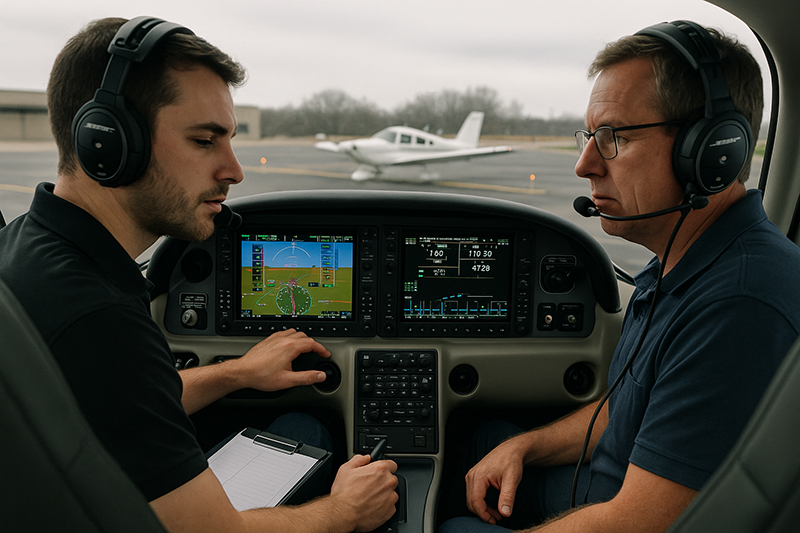
Clearance delivery mistakes are easy to make because they often happen before the airplane moves, while the cockpit is busy, the pilot is programming avionics, passengers may be talking, and the departure plan is still coming together. The clearance sounds routine until one missed altitude, one misunderstood fix, or one incomplete readback creates confusion at the worst possible time: during taxi, takeoff, or the initial climb.
For pilots, student pilots, flight instructors, and aviation professionals, clearance delivery is more than a radio call. It is the transition from planning to operating under an air traffic control authorization. A good clearance workflow helps the pilot confirm the route, understand the initial altitude, anticipate the departure frequency, and verify the transponder code before engine start or taxi workload increases. This article explains the most common clearance delivery mistakes, why they matter, and how pilots can build practical habits that reduce errors without turning the cockpit into a paperwork exercise.
What Clearance Delivery Is Really For
Clearance delivery is the air traffic control function that provides an IFR clearance, and at some airports may also provide other departure-related information or instructions depending on local procedures. In practical terms, it is the point where the pilot receives the authorized clearance limit, route, altitude information, departure frequency, and transponder code. Many pilots remember the common CRAFT memory aid: clearance limit, route, altitude, frequency, and transponder. CRAFT is not a substitute for understanding the clearance, but it is a useful structure for listening, copying, and reading back.
The clearance is not simply permission to go flying. It defines how the IFR flight begins from an ATC perspective. It may include a standard instrument departure, radar vectors, an initial assigned altitude, an expected higher altitude after a stated time, a departure control frequency, and a squawk code. At non-towered airports, clearances may be obtained by radio, telephone, remote communications outlet, or other authorized method, and may include a release time, clearance void time, or other time-sensitive instructions. The exact format depends on the airport, airspace, ATC facility, and the filed flight plan.
One of the first misunderstandings to correct is the idea that a clearance is just a string of words to repeat. It is a clearance that must be understood well enough to fly. A precise readback is important, but a readback without understanding does not help the pilot manage workload once the aircraft is rolling. The best clearance delivery technique combines disciplined listening, accurate copying, correct readback, and immediate verification against charts, avionics, and the pilot’s mental model of the departure.
Why Clearance Delivery Matters in Real-World Aviation
Clearance delivery errors tend to propagate. A pilot who copies the wrong initial altitude may set the wrong altitude preselect. A pilot who misunderstands the first fix may load the wrong route into the navigator. A pilot who misses a departure frequency may spend valuable time after takeoff searching for the correct frequency while flying close to terrain, weather, or busy traffic flows. These problems are not limited to high-performance aircraft or airline operations. They can occur in a training aircraft departing a familiar airport on a short IFR cross-country.
The departure phase already carries high workload. The pilot may be configuring the aircraft, briefing the departure, monitoring engine indications, complying with taxi instructions, avoiding runway incursions, managing wind correction, and preparing for an instrument scan after takeoff. If the IFR clearance is not properly understood before taxi or takeoff, the pilot may be forced to solve a planning problem while also controlling the aircraft. That is poor cockpit resource management, even in a single-pilot airplane.
Clearance delivery also matters because it is often the first opportunity to catch a mismatch between what the pilot filed, what the avionics contain, and what ATC is actually authorizing. A filed route is a request. The clearance is the authorization. The GPS flight plan, electronic flight bag route line, and paper nav log should be adjusted to match the clearance, not the other way around. When pilots skip that comparison, they may depart with the wrong expectation and become surprised by a heading, fix, altitude, or amended routing.
For instructors, clearance delivery is a valuable training window. It reveals whether a student is truly thinking like an IFR pilot or simply memorizing radio phraseology. Can the student identify the clearance limit? Can the student explain whether the route is filed, amended, or assigned via a procedure? Can the student describe the altitude restriction and expected altitude concept in plain language? Can the student find the departure frequency without hunting through multiple screens after takeoff? These are operational skills, not just communication skills.
How Pilots Should Understand an IFR Clearance
A useful way to understand a clearance is to separate it into meaning, not just sequence. The clearance limit tells you where the clearance currently takes you. For most routine IFR departures, that may be the destination airport, but pilots should not assume. The route tells you how ATC expects you to proceed after departure. That route may be simply “as filed,” or it may include a departure procedure, transition, radar vectors, direct fix, airway, or amended segment.
The altitude portion deserves special attention because it may contain more than one idea. A clearance may include an initial altitude to maintain and an expected altitude later. The initial altitude is what the pilot must fly unless later amended. The expected altitude is planning information that helps the pilot anticipate what may come later, but it is not the same as an immediate climb clearance. Pilots who confuse those two concepts can create altitude deviations. The safe habit is simple: set and brief the altitude you are actually cleared to maintain, then note any expected altitude separately.
The departure frequency is the frequency the pilot expects to use after takeoff or when instructed. It should be placed where it can be accessed quickly, usually in the standby window or an appropriate radio memory. The transponder code should be entered carefully and confirmed before takeoff. With modern avionics, it is tempting to assume the code is correct because it was entered once. A quick verbal confirmation during the before-takeoff flow helps prevent simple digit transposition errors.
Pilots should also understand that clearance delivery is part of a larger departure system. A standard instrument departure, obstacle departure procedure, runway assignment, takeoff minimum consideration, and ATC clearance may all interact. An ATC clearance may assign a SID or routing, but the pilot remains responsible for using current procedures, aircraft performance planning, and sound judgment. If something does not make sense, the pilot should ask before accepting or flying it.
Common Clearance Delivery Mistakes or Misunderstandings
The most common clearance delivery mistakes are not dramatic. They are ordinary human errors that occur under time pressure. The danger is that they can look harmless until they appear later as a wrong turn, wrong altitude, missed frequency change, or cockpit distraction during a high-workload phase of flight.
Calling before being ready to copy
One common mistake is calling clearance delivery while still searching for a pen, opening the flight plan, or loading the route. Pilots sometimes do this because they want to keep the operation moving, especially at a busy airport. The result is predictable: the controller issues the clearance, the pilot misses the first half, and the exchange becomes longer than it needed to be. Before calling, have a clearance form, kneeboard, or electronic scratchpad ready. Know your call sign, location on the airport, ATIS code if applicable, destination, and requested operation.
Assuming the clearance will match the filed route
Another frequent mistake is hearing the words the pilot expected instead of the words actually spoken. If the pilot filed a familiar route, it is easy to assume the clearance says “as filed” or to miss a small amendment. A single added fix, different transition, or assigned departure procedure can change the early part of the flight. The safest habit is to compare the copied clearance to the filed route immediately and highlight any difference before taxi.
Reading back correctly but programming incorrectly
A pilot can provide a perfect readback and still enter the wrong route into the navigator. This is especially common when fixes have similar names, when a procedure has multiple transitions, or when the avionics database displays several options. The readback only confirms communication. The avionics check confirms cockpit execution. After receiving the clearance, pilots should verify the loaded route from the departure runway through the first several fixes, not just glance at the magenta line.
Confusing assigned altitude with expected altitude
Altitude misunderstanding is one of the most important clearance delivery errors to prevent. If the clearance includes an initial altitude and an expected higher altitude, the aircraft should be flown according to the assigned altitude until a further clearance is received. The expected altitude should be noted for planning, not treated as a climb authorization. A disciplined altitude readback, altitude selector setting, and departure briefing can prevent this mistake.
Missing a departure procedure detail
Some pilots accept a departure procedure in the clearance without reviewing the chart closely enough. A SID may include runway-specific instructions, climb gradients, altitude restrictions, headings, transition choices, or communication notes. Not every departure is complicated, but the pilot should verify the assigned procedure and runway compatibility before takeoff. If a clearance includes a procedure the pilot cannot find, cannot load, or does not understand, the correct response is to ask for clarification or an alternative clearance if appropriate.
Using CRAFT as a script instead of a thinking tool
CRAFT is helpful, but it can become a trap if the pilot treats it as a fill-in-the-blank ritual. Some clearances do not fit neatly into a simple training example. Others include holds for release, void times, expect departure clearance times, route amendments, or special local instructions. The structure helps you listen, but judgment helps you interpret. The goal is not to fill every box. The goal is to understand the clearance you received.
Failing to ask for clarification
Some pilots hesitate to ask ATC to repeat or clarify a clearance because they do not want to sound inexperienced. That hesitation is backwards. Professional radio work includes asking when something is unclear. A concise request such as “say again route after departure,” “confirm initial altitude,” or “unable assigned departure, request vectors” is far better than guessing. Controllers would generally rather resolve confusion on the ground than discover it after takeoff.
Not briefing the clearance after receiving it
In a two-pilot crew, one pilot may copy the clearance while the other handles aircraft setup. In a single-pilot cockpit, the pilot does both. Either way, the clearance should become part of the departure briefing. The pilot should be able to verbalize the runway, departure procedure or initial heading, first altitude, expected next altitude if applicable, first frequency, transponder code, and any notable route changes. This short briefing helps catch mistakes and improves mental readiness.
Letting passengers or cockpit interruptions disrupt copying
Clearance delivery often happens during a socially busy moment, especially in general aviation. Passengers may ask questions, a line technician may approach, or a student may be halfway through a checklist. A missed word can matter. Before calling, establish a sterile cockpit expectation for that short period. In training, instructors should make this explicit: when the clearance is being copied, nonessential conversation stops.
Not updating the clearance after a runway, route, or timing change
Departures are dynamic. A runway change may affect the assigned departure procedure or initial fix. A delay may affect a release time or flow control instruction. A route amendment may require a new avionics setup. When something changes, pilots should resist the urge to patch the plan mentally. Update the written clearance, update the avionics, and re-brief the affected portion.
A Practical Clearance Delivery Example
Consider a pilot departing a towered airport in a single-engine airplane on an IFR training flight. The pilot filed a route from the departure airport to a nearby destination via a familiar fix and airway. Before engine start, the student calls clearance delivery with the ATIS code and receives a clearance that includes the destination, an assigned departure procedure, a transition, an initial altitude, an expected cruise altitude after a period of time, a departure frequency, and a transponder code.
The student copies the clearance and reads it back accurately. At first glance, everything seems fine. But during the instructor’s review, two issues appear. First, the assigned departure procedure transition is not the same as the first fix in the filed route. Second, the student has set the expected cruise altitude in the altitude preselect instead of the initial altitude. Neither error was caused by poor radio technique. The student heard and repeated the clearance. The mistakes happened during interpretation and cockpit setup.
The instructor pauses the flow and asks the student to explain the departure in plain language. The student identifies the runway, loads the correct departure and transition, verifies the first three legs on the moving map against the chart, sets the initial altitude, places the departure frequency in standby, and confirms the squawk code. The departure briefing is then revised: “After takeoff, we will fly the assigned departure procedure, maintain the initial altitude, expect higher later, and contact departure on the assigned frequency when instructed.”
This example illustrates a key lesson. Clearance delivery proficiency is not proven by sounding smooth on the radio. It is proven by converting the clearance into an accurate, briefed, flyable plan before the airplane enters the runway environment.
Best Practices for Pilots
The best clearance delivery habits are simple, repeatable, and calm. They should work in a basic trainer, a technically advanced aircraft, or a professional crew environment. The aim is not to create unnecessary ceremony. The aim is to make sure the airplane, avionics, and pilot are all aligned before departure.
Start by preparing before the call. Review the expected route, likely departure procedures, airport diagram, ATIS or current airport information, and any obvious local considerations. Have a way to copy the clearance that is reliable in the cockpit environment. Some pilots prefer paper because it is fast and resistant to screen changes. Others use an electronic flight bag scratchpad. Either can work if it is practiced and available instantly.
When calling clearance delivery, be concise. Provide the information the facility needs, then listen. If the clearance comes faster than you can copy, ask for a repeat of the missed portion. If the route is complex, it is acceptable to request clarification. Good radio technique is not about pretending to understand. It is about making the communication accurate.
After copying, read back the elements that matter. Controllers need to hear that the pilot received the clearance correctly, especially assigned headings, altitudes, routes, frequencies, and transponder codes. A rushed or partial readback can create ambiguity. At the same time, do not add unnecessary chatter. Clear, complete, and concise is the standard to aim for.
Once the readback is complete, shift from communication mode to verification mode. This is where many errors are caught. Compare the clearance to the filed route. Load or amend the avionics. Verify the departure procedure, runway, transition, and first fixes. Set the initial altitude, not merely the altitude you hope to receive later. Tune or store the departure frequency. Enter and confirm the transponder code. Then brief the departure in practical language.
A short flow can help without becoming a rigid checklist:
- Copy the clearance using a consistent structure such as CRAFT.
- Read back the clearance clearly, especially route, altitude, frequency, and code.
- Compare the clearance to the filed route and identify any changes.
- Program the avionics and verify the route against the chart or clearance.
- Set the assigned initial altitude and brief any expected altitude separately.
- Confirm the departure frequency and transponder code before takeoff.
- Ask ATC for clarification before taxi or takeoff if anything is uncertain.
For flight instructors, the most effective training technique is to make students explain the clearance in their own words. If the student can only recite the clearance but cannot describe what the airplane will do after takeoff, more instruction is needed. Scenario-based training works well here. Give the student an amended route, a departure procedure transition, or an expected altitude and ask the student to identify what must be programmed, what must be briefed, and what remains only planning information.
Special Considerations at Non-Towered Airports
Clearance delivery at non-towered airports requires careful attention because the pilot may receive an IFR clearance before entering controlled airspace, may need a release, and may be working with time-sensitive instructions. The specific method varies by airport and ATC facility. Pilots may contact ATC through a radio outlet, phone, or another published method. Because there is no local tower controller sequencing takeoffs, the clearance may include instructions that are especially important to understand before departure.
At these airports, pilots should be particularly careful with release times, void times, and any instruction that affects when the aircraft may depart under the IFR clearance. If the timing cannot be met, the pilot should contact ATC as appropriate rather than guessing. The pilot also needs to maintain normal non-towered airport vigilance, including traffic awareness, runway selection, wind assessment, and communication on the local traffic frequency. An IFR clearance does not remove the need to operate safely in the local traffic environment.
Another common issue at non-towered airports is trying to copy or negotiate a clearance while taxiing or while holding short with other traffic in the pattern. If cockpit workload becomes too high, stop in a safe location, finish the clearance work, and then continue. A departure clearance is only useful if the pilot has enough attention remaining to fly the airplane safely.
How Technology Helps and How It Can Mislead
Modern avionics and electronic flight bags can reduce clearance delivery errors, but they can also hide them. A datalinked route, stored flight plan, or recently used clearance can make setup faster. However, pilots should still verify that the displayed route matches the actual clearance. Automation can display a beautiful route line that is still wrong for the clearance received.
The most important habit is route verification by segments. Do not rely only on the destination and final magenta line. Check the departure runway if relevant, departure procedure, transition, first fix, airway or direct segment, and initial altitude constraints shown by the system. If the avionics cannot represent the clearance exactly, the pilot should understand the workaround and brief it clearly. If the pilot cannot confidently make the avionics match the clearance, asking for help or clarification on the ground is better than improvising after takeoff.
Technology also creates a distraction risk. Heads-down programming after receiving a clearance can absorb the pilot’s attention. In a single-pilot operation, the safest time to resolve route and procedure details is before taxi or while stopped in a safe area. In crew operations, one pilot should monitor the environment while the other manages avionics, consistent with the operation’s procedures.
Frequently Asked Questions
What is the most common clearance delivery mistake?
One of the most common mistakes is assuming the clearance matches the filed route. Pilots should listen for amendments, compare the copied clearance to the filed route, and update the avionics before taxi or takeoff.
Is CRAFT required for copying an IFR clearance?
CRAFT is a widely used memory aid, not a substitute for understanding. It helps pilots organize the clearance limit, route, altitude, frequency, and transponder code, but pilots must still interpret and brief the clearance correctly.
What should I do if I miss part of a clearance?
Ask ATC to repeat or clarify the missed portion. It is better to resolve uncertainty immediately than to guess. A concise request such as “say again altitude” or “confirm route after departure” is appropriate when needed.
How do I avoid confusing initial and expected altitudes?
Set the altitude you are actually cleared to maintain in the altitude selector and brief any expected altitude separately. Treat the expected altitude as planning information unless ATC later issues a clearance to climb.
Should I program the avionics before or after calling clearance delivery?
Many pilots load the filed or expected route before calling, then amend it after receiving the clearance. The critical step is verifying that the final programmed route matches the clearance before departure.
Does an IFR clearance at a non-towered airport mean I can depart whenever I want?
No. Non-towered IFR departures may involve release or timing instructions depending on the situation. Pilots should understand and comply with any time-sensitive instructions and coordinate with ATC if they cannot depart as planned.
Key Takeaways
- Clearance delivery is not just a radio exercise. It is the process of turning an ATC authorization into a flyable departure plan.
- Many clearance delivery mistakes happen after the readback, when pilots set the wrong altitude, load the wrong route, or skip the departure briefing.
- If any part of the clearance is unclear, ask for clarification before taxi or takeoff. Professional pilots resolve uncertainty early.