
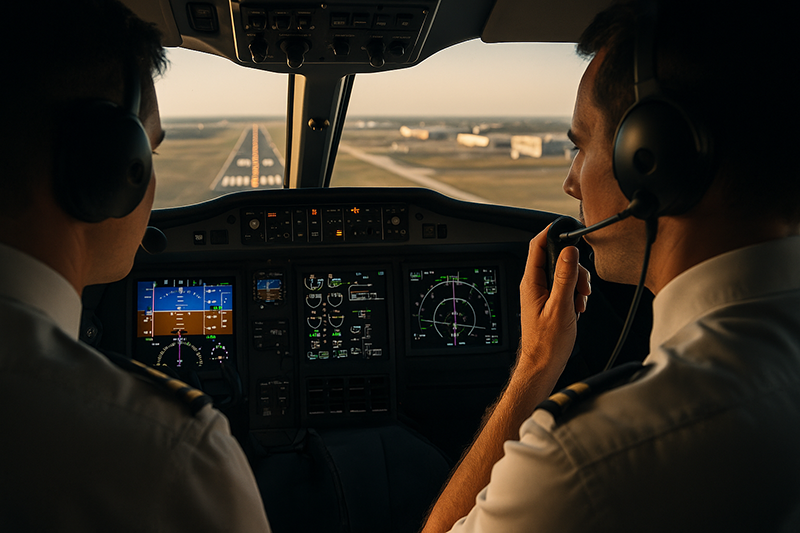
Reducing communication errors in the cockpit is one of the most practical ways pilots can improve safety, workload management, and crew coordination on every flight. Whether the aircraft is a training airplane in the traffic pattern, a business jet operating in busy Class B airspace, or a multi-crew aircraft flying an instrument arrival, communication is the system that connects intention, clearance, action, and verification.
Most cockpit communication problems are not caused by a pilot who does not care or a controller who is not paying attention. They usually come from ordinary human factors: expectation bias, high workload, poor timing, radio congestion, fatigue, ambiguous wording, incomplete readbacks, or crew members assuming they understood the same thing. This article explains how communication errors develop, why they matter, and how pilots, student pilots, instructors, and aviation professionals can build stronger communication habits without turning every flight into a scripted exercise.
What Cockpit Communication Really Means
Cockpit communication includes far more than talking on the radio. It includes air traffic control transmissions, crew briefings, callouts, checklist responses, instructor-student coordination, passenger safety communication, and the quiet but important habit of confirming what the aircraft is doing versus what the pilot intended it to do.
In single-pilot flying, communication often feels external: talking to tower, approach, center, flight service, or other aircraft. In reality, single-pilot communication also includes self-briefing. A pilot who verbalizes the next expected taxi turn, the assigned altitude, or the missed approach plan is using communication to structure attention. That can be especially valuable during training, instrument flight, and busy arrival phases.
In crewed aircraft, communication becomes a core part of crew resource management. The pilot flying, pilot monitoring, and any additional crew members need a shared mental model of the aircraft state, clearance, route, threats, and next action. A clearance that is heard but not understood by both pilots is not yet fully integrated into the operation. A callout that is made but not acknowledged may not have served its safety purpose.
Effective cockpit communication has three qualities. It is clear enough to be understood, complete enough to support the decision or action, and confirmed enough to catch errors before they affect the flight path. The goal is not to say more words. The goal is to reduce uncertainty at the moment uncertainty matters.
Why Communication Errors Happen
Communication errors often begin when the human brain fills in a gap. Pilots are trained to anticipate, and anticipation is usually useful. A pilot entering the downwind expects a landing clearance or pattern instruction. A pilot on an instrument arrival expects a descent clearance, speed assignment, or approach clearance. A pilot taxiing at a familiar airport expects the usual route. The problem begins when expectation becomes substitution. Instead of hearing exactly what was said, the pilot hears what seemed likely.
Radio communication also has built-in limitations. Transmissions are brief, non-visual, and often made under time pressure. Frequency congestion can encourage clipped speech. Similar-sounding call signs can increase the chance of responding to the wrong clearance. Accents, weak radio reception, blocked transmissions, and cockpit noise can further reduce clarity. Even a well-trained pilot can misunderstand a number, fix name, runway, heading, frequency, or altitude when workload is high.
Inside the cockpit, communication errors frequently involve assumptions. One pilot assumes the other loaded the expected approach correctly. An instructor assumes the student understood the tower instruction. A pilot monitoring assumes the pilot flying heard a mode change callout. A student assumes silence means approval. These assumptions are especially risky because they often remain invisible until the aircraft does something unexpected.
High workload makes the problem worse. During taxi, takeoff, climb, approach, landing, abnormal events, and weather deviations, the pilot has less spare attention available to detect subtle communication errors. This is why disciplined phraseology, deliberate readbacks, and assertive crew communication are not formalities. They are workload management tools.
Why This Matters in Real-World Aviation
Communication errors can affect nearly every operational area: taxi routing, runway crossings, altitude assignments, heading instructions, instrument approach clearances, traffic advisories, weather avoidance, checklist completion, and emergency coordination. A small misunderstanding can create a larger problem if it changes the aircraft’s path, delays a required action, or causes two people to believe different plans are in effect.
For student pilots, communication errors often appear as hesitation or overload. The student may understand aircraft control but become saturated by radio work. The risk is not just an awkward transmission. The risk is that attention shifts away from aircraft control, traffic scanning, navigation, or energy management. Good instruction treats communication as a flight skill, not as an accessory.
For instrument pilots, communication precision is closely tied to altitude, route, and approach management. An unclear altitude assignment, a missed frequency change, or a misunderstood approach clearance can increase workload quickly. In instrument conditions, the aircraft’s path is less forgiving because visual references may be limited or absent. Clear communication supports stable execution.
For instructors, communication quality directly affects training safety. A flight instructor must manage external radio communication, internal teaching, aircraft control transfer, traffic scanning, and student workload. Ambiguous instruction such as “watch it,” “fix that,” or “you have it” can be less effective than concise, specific language such as “maintain runway centerline,” “add right rudder,” or “my controls.” Clear cockpit language is especially important during takeoff, landing, stalls, simulated emergencies, and go-arounds.
For professional crews, communication is a defense layer. Standard callouts, briefings, challenge-and-response checklist discipline, and assertive intervention help prevent one pilot’s misunderstanding from becoming a crew error. The most effective cockpit cultures make it normal to question, confirm, and clarify without embarrassment.
How Pilots Should Understand Communication Error
A useful way to understand communication error is to separate it into four stages: transmission, reception, interpretation, and action. An error can occur at any stage.
Transmission is what was actually said. A pilot may transmit too quickly, omit a key element, use nonstandard wording, or key the microphone before forming the message. Reception is what the other person physically heard. Reception can be degraded by radio interference, blocked transmissions, cockpit noise, or overlapping calls. Interpretation is what the listener believes the message means. This is where expectation bias, unfamiliar airport names, similar call signs, and incomplete phraseology can create trouble. Action is what the pilot or crew does next. A correct transmission can still lead to an incorrect action if the clearance is entered incorrectly, briefed poorly, or not cross-checked.
This model helps pilots avoid the trap of saying, “I heard it,” as if hearing alone were enough. The real question is whether the message was heard accurately, interpreted correctly, and acted on as intended. In aviation, confirmation matters because the consequences of a wrong assumption may not appear immediately.
Readbacks are one of the most powerful tools for closing the loop. A readback gives the sender an opportunity to detect a mismatch between what was intended and what the receiver understood. For pilots, the most important readbacks are those that affect separation, runway use, terrain clearance, route, altitude, and aircraft configuration. If a clearance or instruction is safety-critical, it deserves a deliberate readback rather than a rushed acknowledgment.
Clarification is equally important. Asking “confirm altitude,” “say again heading,” or “verify cleared for the approach” is not a sign of weakness. It is a normal professional response to uncertainty. The best pilots do not rely on confidence alone. They use confirmation to protect the flight.
Common Mistakes or Misunderstandings
One common mistake is treating radio work as a performance skill rather than a safety skill. Student pilots often worry about sounding polished, while experienced pilots may rush because they are comfortable. The objective is not to impress anyone on the frequency. The objective is to communicate accurately at the speed the operation allows.
Another common misunderstanding is believing that a short acknowledgment is always sufficient. “Roger” may indicate that a transmission was received, but it does not confirm the critical details of a clearance or instruction. When a message includes an altitude, heading, runway, route, frequency, or hold-short instruction, the safer habit is to read back the essential elements clearly and in the correct order.
Pilots also make errors when they begin speaking before they know what they intend to say. This often produces rambling calls, missing information, or corrections mid-transmission. A brief pause before keying the microphone can prevent many poor transmissions. Think first, then transmit. On a busy frequency, concise preparation is more helpful than speed without structure.
Call sign confusion is another practical risk. Similar call signs, partial call signs, or a pilot answering a call intended for another aircraft can create confusion. Pilots should listen for their complete call sign and remain alert when another aircraft on frequency has a similar identifier. If there is any doubt, clarify before acting.
Inside the cockpit, one of the most serious communication weaknesses is an authority gradient. This occurs when one crew member, student, passenger, or instructor feels reluctant to speak up because of perceived experience, rank, confidence, or personality. A junior pilot may notice a discrepancy but hesitate to challenge. A student may recognize a traffic conflict but assume the instructor already sees it. A healthy cockpit environment makes it explicit that safety concerns must be voiced clearly and promptly.
Another frequent issue is checklist communication that becomes mechanical. Challenge-and-response procedures are meant to confirm aircraft configuration and system status, not simply to complete a ritual. If a response is given from memory without looking, touching, or verifying as appropriate, the communication loses much of its value. Checklist discipline depends on the connection between the spoken item and the verified aircraft condition.
The Role of Standard Phraseology
Standard phraseology reduces ambiguity because it gives pilots and controllers a shared language. The words are not decorative. They are designed to make instructions, clearances, and reports easier to understand quickly and consistently. When pilots replace standard wording with casual language, they may increase the chance of misunderstanding, especially in complex airspace or busy traffic environments.
This does not mean every transmission must sound robotic. It means the critical information should be structured and recognizable. Who you are calling, who you are, where you are, and what you want remains a useful framework in many VFR communications. In IFR operations, the structure may be driven by the clearance, procedure, or controller instruction, but the principle remains the same: make the essential information easy to hear and easy to verify.
Numbers deserve special attention. Altitudes, headings, speeds, runway numbers, frequencies, transponder codes, and distances can be misheard or transposed. A pilot should slow down slightly for numbers and avoid burying them in unnecessary words. If a number does not make operational sense, the pilot should verify it rather than rationalize it.
Good phraseology also supports cockpit coordination. Clear terms such as “my controls” and “your controls” reduce ambiguity during transfer of control. Specific callouts such as “airspeed alive,” “positive rate,” “gear up,” “localizer alive,” or “runway in sight” may be appropriate depending on aircraft type, operation, and training environment. The key is that the cockpit team agrees on what the callout means and what action, if any, follows it.
Managing Workload Before It Affects Communication
Communication quality often deteriorates after workload has already risen. Pilots can reduce that risk by completing predictable tasks early. Before taxi, review the airport diagram, expected taxi route, likely departure runway, hotspot areas if applicable, and any complex intersections. Before arrival, brief the weather, runway, approach, missed approach, expected taxi route, and possible changes. The more predictable the next communication is, the easier it is to detect when the actual instruction differs from the expected one.
In training aircraft, this preparation can be simple. Before calling ground control, a student can write down the ATIS information, parking location, destination on the airport, and likely request. Before calling tower, the student can know the runway environment, pattern direction, and current position. That preparation reduces filler words and helps keep eyes outside when appropriate.
In instrument operations, writing down clearances remains valuable. Even pilots using advanced avionics should avoid relying entirely on short-term memory for complex route amendments or holding instructions. A clearance that is written, read back, entered, and cross-checked has passed through several defenses. A clearance that is remembered briefly and entered under pressure has fewer protections.
Automation can help, but it can also hide communication errors. A pilot may hear a clearance correctly but enter the wrong altitude preselect, select the wrong fix, or activate an unexpected leg in the navigator. Good communication includes verifying the aircraft’s automation modes and flight management inputs against the clearance. The spoken clearance and the displayed plan must agree.
Practical Example: A Busy Training Flight
Consider a student pilot and instructor returning to a towered airport after practicing maneuvers. The weather is VFR, the frequency is busy, and several aircraft are in the pattern. The student calls tower and reports ten miles west with the current weather information. Tower responds with instructions to enter a right downwind for Runway 18 and report midfield.
The student expected a left downwind because that was used earlier in the day. While descending and configuring the aircraft, the student reads back “left downwind” without noticing the mismatch. The instructor catches it and says, “Confirm right downwind for Runway 18.” Tower confirms right downwind. The student corrects the readback and adjusts the entry.
This is a simple example, but it illustrates several important defenses. The instructor was listening actively rather than assuming the student handled the radio correctly. The student’s readback gave tower and the instructor an opportunity to catch the error. The clarification was brief, professional, and immediate. No one needed to assign blame. The communication loop worked because someone noticed a mismatch before the aircraft entered the wrong side of the pattern.
Now consider how the same event could deteriorate. If the student had acknowledged only “roger,” the mismatch might not have been noticed. If the instructor was focused inside the cockpit, the incorrect pattern entry might continue. If another aircraft was already established on the correct downwind, the situation could become more complicated. The safety lesson is not that pilots must be perfect. The lesson is that communication systems should catch predictable human errors early.
Best Practices for Pilots
Reducing communication errors is not about memorizing more scripts. It is about building habits that keep meaning intact from the first transmission to the final action. These practices apply across many types of flying, though pilots should always follow the procedures, phraseology, and standard operating practices appropriate to their aircraft, operation, and airspace.
- Prepare before keying the microphone. Know who you are calling, who you are, where you are, and what you need before you transmit.
- Use standard phraseology for critical information. Keep headings, altitudes, runways, frequencies, clearances, and instructions easy to hear and verify.
- Read back safety-critical items deliberately. Treat runway assignments, hold-short instructions, altitude assignments, headings, routes, and approach clearances as information that deserves confirmation.
- Write down complex clearances. Do not make short-term memory carry more than it should during high workload phases.
- Ask for clarification early. A short request to repeat or verify is better than acting on uncertainty.
- Monitor the aircraft after the communication. Confirm that the heading, altitude, route, mode selection, and configuration match the intended clearance or plan.
- Create a speak-up cockpit culture. Students, instructors, passengers, and crew members should know that safety concerns are welcome and expected.
Instructors can strengthen these habits by teaching communication in context rather than as a separate memorization exercise. For example, a student practicing traffic pattern work should learn not only what to say to tower, but also how to listen for runway changes, sequencing instructions, traffic advisories, and clearance limits. A student learning IFR should practice copying, reading back, entering, and cross-checking clearances as one connected skill.
Professional pilots can apply the same principles through disciplined briefings, mode awareness, standard callouts, and mutual monitoring. The most effective crews are not silent crews. They are crews that communicate the right information at the right time, with enough clarity to support safe action.
Communication During Abnormal and Emergency Situations
Abnormal and emergency situations place special demands on communication. The pilot must aviate, navigate, communicate, manage the aircraft, and make decisions under pressure. In these moments, communication should become simpler, not more complicated.
The first priority is maintaining aircraft control and an appropriate flight path. Communication should support that priority rather than compete with it. A pilot dealing with an engine issue, smoke, electrical failure, medical concern, or unexpected weather encounter may need to delay nonessential communication until the aircraft is under control and a safe plan is forming.
When communicating an abnormal situation, clarity is more valuable than polish. State the nature of the problem, intentions, assistance needed, aircraft position or altitude if relevant, and any operational limitations that affect the plan. Controllers can often provide useful assistance, but they need enough information to understand the pilot’s situation and intentions.
Inside the cockpit, abnormal events require deliberate task sharing. In a crewed aircraft, one pilot should normally remain focused on flying while the other handles checklists, radios, and coordination as appropriate to the operation. In a training aircraft, an instructor may need to take control temporarily or assign the student a clear role. Ambiguous cockpit language during abnormal events can increase workload quickly, so instructions should be direct and confirmed.
Teaching Better Communication to Student Pilots
Student pilots often learn radio communication in fragments: a call to ground, a call to tower, a position report, or a request for flight following. That is necessary, but it is not sufficient. The deeper skill is understanding what each communication is meant to accomplish operationally.
A good training approach begins with expectation management. Before the student transmits, ask what response they expect and what alternatives might occur. If tower assigns a different runway, what will change? If approach gives a new heading, what heading bug action follows? If the controller issues a traffic advisory, where should the student look? This turns communication into decision support rather than rote speech.
Instructors should also model calm clarification. Students sometimes hesitate to ask a controller to repeat a transmission because they do not want to sound inexperienced. An instructor who routinely says “say again” or “confirm” when appropriate teaches that clarification is normal professionalism. That lesson may be more important than any single script.
Debriefing communication after the flight is equally valuable. Instead of simply saying “your radios were good” or “your radios need work,” identify the pattern. Did the student rush? Miss call signs? Forget location? Fail to read back instructions? Stop flying the airplane while transmitting? Specific feedback turns communication from a confidence issue into a trainable skill.
Using Briefings to Prevent Misunderstandings
A briefing is a communication tool that prepares the cockpit for what should happen and what might change. A useful briefing is not a speech. It is a shared mental model. Before takeoff, the crew or single pilot should understand the runway, departure plan, initial altitude or route expectations, emergency considerations, and any threats such as crosswind, traffic, terrain, or complex taxi geometry. Before approach, the pilot should understand the procedure, runway, minima or visual references as applicable, missed approach plan, aircraft configuration plan, and likely ATC communications.
The best briefings are short enough to be used and specific enough to matter. A vague briefing such as “standard departure” may not help much if the airport has complex terrain, intersecting runways, or unusual taxi instructions. On the other hand, a long briefing filled with unnecessary detail can cause pilots to tune out. The right briefing gives the pilot or crew the information needed to catch deviations.
Briefings also create permission to speak up. When a pilot says, “If we do not have the runway environment by the planned point, we will go around,” the cockpit now has a shared trigger. When an instructor says, “If I say ‘my controls,’ release the controls and acknowledge,” the student knows exactly what to do. Clear briefings reduce hesitation at critical moments.
Technology, Headsets, and Avionics
Modern cockpit technology can improve communication, but it does not replace disciplined listening and verification. Good headsets reduce fatigue and improve audio clarity. Audio panels allow better management of radios and intercom. Avionics can display frequencies, clearances in some equipped environments, traffic information, terrain information, and route data. These tools can help pilots understand and confirm what they hear.
Technology can also introduce new errors. A pilot may monitor the wrong frequency, transmit on the wrong radio, enter a clearance into the wrong field, or assume a displayed route is correct without cross-checking it. Audio panel setup should be part of cockpit discipline. Before making a call, confirm the selected transmitter and monitored receiver. Before accepting an automation change, confirm that it matches the clearance or intended flight path.
Electronic flight bags and moving maps can support communication by improving situational awareness, especially during taxi and instrument operations. However, they should not encourage heads-down behavior when visual scanning or aircraft control needs priority. Communication improves when technology supports the pilot’s mental model without capturing all of the pilot’s attention.
Building a Cockpit Culture That Catches Errors
The strongest defense against communication error is a cockpit culture that expects confirmation. In that culture, pilots do not take clarification personally. Instructors do not treat student questions as interruptions. Captains do not treat challenges as disrespect. Students do not remain silent when something seems wrong. Everyone understands that communication errors are normal human threats and that catching them early is a sign of professionalism.
This culture can be built in small ways. A pilot can verbalize uncertainty instead of hiding it. An instructor can praise a student for asking for clarification. A crew can brief that either pilot may call for a go-around if safety margins are not satisfactory. A pilot can invite passengers to point out traffic or concerns while making clear that the pilot will decide how to use that information.
Good communication is not constant talking. It is timely, relevant, and connected to aircraft control. Silence can be appropriate during high-workload moments when everyone understands the plan. But silence becomes dangerous when it hides uncertainty, confusion, or disagreement. The difference is whether the cockpit has already established a clear shared understanding.
Frequently Asked Questions
What is the most common cause of cockpit communication errors?
Many communication errors come from expectation bias, workload, incomplete readbacks, ambiguous wording, or assumptions between pilots. Rather than looking for a single cause, pilots should build habits that catch errors at several points: listening carefully, reading back critical items, writing down complex clearances, and confirming actions against the clearance or plan.
Should pilots ask ATC to repeat a transmission if they are unsure?
Yes. If a pilot is unsure about a clearance, instruction, frequency, altitude, heading, runway, or route, the professional response is to ask for clarification before acting. A short “say again” or “confirm” is far safer than guessing. Pilots should use the procedures and phraseology appropriate to their operation and airspace.
How can student pilots get better at radio communication?
Student pilots improve faster when they prepare each call before transmitting, listen to real traffic, practice expected responses, and connect radio calls to aircraft actions. Instructors should debrief specific patterns such as rushing, missing call signs, weak position reports, or incomplete readbacks rather than giving only general feedback.
Is cockpit communication only important in multi-crew aircraft?
No. Single-pilot aircraft need strong communication as well. A single pilot must communicate with ATC and other aircraft, manage passengers, brief procedures, and confirm personal decisions. Self-briefing and verbal callouts can help a single pilot maintain structure during busy phases of flight.
How do readbacks reduce communication errors?
A readback closes the communication loop. It allows the pilot to confirm what was heard and gives the controller or other crew member an opportunity to catch a mismatch. Readbacks are especially valuable for clearances and instructions involving runway use, altitude, heading, route, frequency, and approach operations.
What should a pilot do if another crew member does not respond to a concern?
The pilot should restate the concern more clearly and directly, especially if flight safety may be affected. Effective cockpit communication requires assertiveness when needed. A concern about aircraft control, traffic, terrain, configuration, runway alignment, altitude, or clearance compliance should not be left unresolved.
Key Takeaways
- Reducing communication errors in the cockpit starts with clear transmissions, deliberate listening, accurate readbacks, and early clarification.
- Communication is a safety system that supports aircraft control, ATC coordination, crew resource management, and workload management.
- Pilots and instructors should train communication as an operational skill, not merely as radio phraseology or cockpit etiquette.