
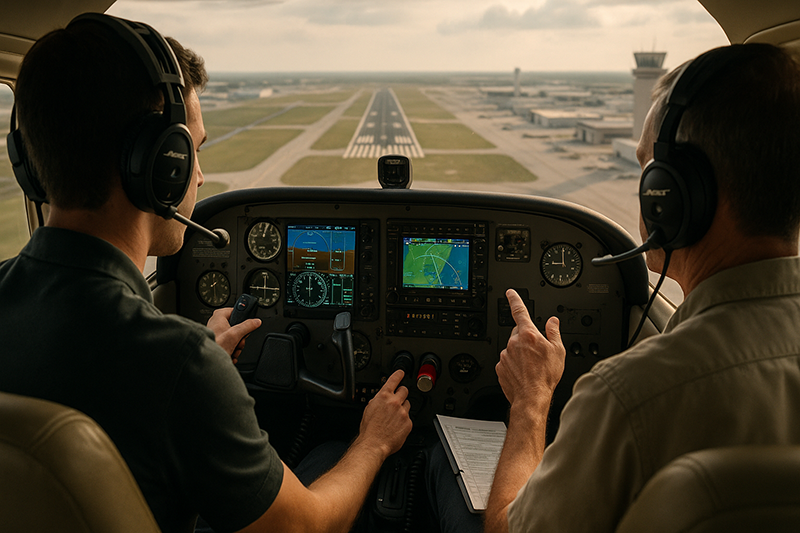
Cognitive overload in pilots is one of the quietest threats in aviation because it rarely announces itself as a single obvious emergency. More often, it shows up as a missed radio call, a late checklist item, a fixation on one instrument, or the uneasy feeling that the cockpit is moving faster than the pilot can process. By the time the situation feels clearly dangerous, the pilot may already be behind the aircraft.
For student pilots, cognitive overload can appear during a first busy pattern, a gusty landing lesson, or a cross-country diversion. For experienced pilots, it can emerge during an equipment abnormality, a complex clearance, deteriorating weather, high-density traffic, unfamiliar avionics, or a time-critical operational decision. The skill is not to prove that you can absorb unlimited workload. The skill is to recognize when your mental capacity is being consumed faster than you can replenish it, then take deliberate action before judgment, aircraft control, and situational awareness degrade.
What Cognitive Overload Means in the Cockpit
Cognitive overload occurs when the demands placed on a pilot’s attention, memory, decision-making, and motor coordination exceed the pilot’s available mental resources. In simple terms, the airplane, environment, radios, navigation, passengers, automation, weather, and internal stress are collectively asking for more processing than the pilot can provide at that moment.
This does not mean the pilot is unskilled or unprepared. Every pilot has a finite amount of working memory and attention. Working memory is the short-term mental workspace used to hold information such as an altitude assignment, a frequency, a runway number, a checklist step, or a mental picture of traffic and terrain. When that workspace becomes crowded, items begin to fall out. The result may be confusion, missed details, delayed responses, or task fixation.
In aviation, workload is not constant. It rises and falls throughout a flight. A calm cruise segment in smooth air may require relatively little mental effort. The same flight can become demanding within minutes if weather changes, ATC issues an unexpected reroute, a passenger becomes airsick, or the aircraft develops an abnormal indication. Cognitive overload is most dangerous when it develops during a transition, such as departure, arrival, approach, landing, or a change from normal to abnormal operations.
It is useful to separate workload from overload. Workload is expected. Training exists partly to help pilots handle workload efficiently. Overload begins when performance starts to decline because the pilot’s mental system is saturated. That decline may be subtle at first. The pilot may still be flying the airplane, but scan discipline weakens, communication becomes clipped or delayed, and the ability to think ahead decreases.
Why This Matters in Real-World Aviation
Aviation places pilots in a high-consequence environment where small errors can compound quickly. Cognitive overload matters because it affects the very skills pilots rely on to stay safe: aircraft control, situational awareness, judgment, communication, and risk management. When overload increases, pilots may become reactive instead of proactive. They may respond to the loudest or most immediate stimulus while missing the most important one.
Consider a pilot on arrival to an unfamiliar airport. The aircraft is descending, the pilot is configuring, ATC is issuing traffic advisories, the GPS is displaying a sequence the pilot did not expect, and the wind favors a different runway than planned. None of those items is necessarily an emergency. Together, they can create a cockpit environment where the pilot’s attention becomes fragmented. If the pilot continues without recognizing the overload, a stabilized approach can become unstable, a checklist can be missed, or a runway alignment error can go unnoticed.
Flight instructors see early signs of overload frequently. A student who normally holds altitude well may suddenly wander 200 feet while trying to tune a radio. A pilot who understands pattern procedures during a briefing may forget a downwind call when traffic, wind correction, and landing configuration all arrive at once. These moments are not simply lapses in effort. They show how human performance changes under pressure.
For professional crews, cognitive overload can be influenced by operational tempo, automation management, weather deviations, fatigue, dispatch pressures, or complex procedures. Crew resource management helps distribute workload, but it does not eliminate the human limits of attention. A two-pilot cockpit can still become overloaded if both pilots become absorbed in the same problem or if communication breaks down.
For single-pilot operations, recognizing overload is even more important because there may be no other crewmember to catch the early signs. The single pilot must serve as aircraft commander, navigator, communicator, systems manager, and safety monitor. That does not mean single-pilot flying is unsafe. It means workload management must be treated as a core flying skill, not as an afterthought.
Early Warning Signs Pilots Should Not Ignore
Cognitive overload usually leaves clues before it becomes hazardous. The challenge is that the clues often feel ordinary in the moment. A pilot may explain them away as being busy, slightly rusty, or temporarily distracted. The earlier these signs are recognized, the easier they are to correct.
One common warning sign is a narrowing of attention. The pilot becomes locked onto one task, such as entering a flight plan, troubleshooting a radio, finding traffic, or correcting an altitude deviation. While attention is fixed on that one item, other essential tasks fade into the background. The aircraft may continue flying, but the pilot is no longer maintaining a full mental picture of airspeed, altitude, heading, traffic, terrain, weather, and next actions.
Another sign is degraded communication. The pilot may miss a call, read back incorrectly, hesitate before answering, or feel irritated by radio traffic. Instructors often notice that overloaded students stop talking. They may become quiet not because they are calm, but because they are using all available mental capacity just to keep up. In crew operations, overloaded pilots may give shorter, less precise statements or fail to verbalize important changes.
Physical cues can also be important. A pilot may grip the controls tightly, stop scanning smoothly, breathe shallowly, lean forward, or become unusually tense. These signs are not diagnostic by themselves, but they can indicate rising stress and reduced spare capacity. A pilot who notices these cues early can use them as a prompt to simplify the situation.
Performance cues are often the clearest evidence. If altitude control, airspeed control, heading, configuration timing, checklist use, or radio accuracy begin to degrade, workload may already be exceeding capacity. A single small deviation is not automatically overload, but a pattern of small errors is worth attention. In many flights, the first meaningful clue is not one large mistake. It is a cluster of minor items that do not match the pilot’s normal performance.
Emotional cues matter as well. Overload can feel like frustration, embarrassment, tunnel vision, hurry, or a desire to make the situation end quickly. That last feeling deserves particular respect. When a pilot starts thinking, “I just need to get this on the ground,” or “I do not have time to sort this out,” decision quality may be under pressure. The correct response may be to slow the operation down, not to force the original plan to continue.
How Pilots Should Understand Mental Capacity
Pilots often think of capability in terms of knowledge and skill: Can I fly the approach? Can I land in this crosswind? Can I program this navigator? Those questions are important, but they are incomplete. A better question is, “Can I perform this task safely with the workload I have right now?”
A pilot may be fully capable of flying an instrument approach in training conditions, yet become overloaded if the same approach is flown after a long day, in turbulence, with unfamiliar avionics, while managing a passenger concern and a late runway change. The task did not change dramatically on paper, but the total workload did.
Mental capacity is affected by fatigue, proficiency, stress, recency of experience, environmental conditions, aircraft familiarity, and the amount of time available to think. A procedure that feels routine in a familiar training aircraft may feel demanding in a different cockpit layout. A radio call that is easy in a quiet practice area may become difficult near a busy Class C airport. This is why good pilots brief, plan, and simplify. They are not trying to avoid work. They are preserving attention for the moment when something unexpected occurs.
Automation can reduce workload when it is understood, configured correctly, and monitored. It can also increase workload when the pilot does not understand what it is doing or spends too much time trying to make it do something. A basic autopilot, GPS navigator, or flight management system should not become the center of attention at the expense of aircraft control. If automation confusion begins to consume the cockpit, reverting to a simpler mode, hand flying if appropriate, or using basic navigation can be safer than continuing to wrestle with a system.
Checklist discipline also interacts with workload. Checklists are designed to support memory, but they still require time and attention. During high workload, pilots may skip them because they feel too busy. That is precisely when structured flows, callouts, and checklists become valuable. The key is to use them at appropriate times while maintaining control of the aircraft. If the airplane is not under control, the first task is to restore control and create enough margin to use the checklist properly.
The Difference Between Being Busy and Being Saturated
Busy pilots can still prioritize. Saturated pilots struggle to prioritize at all. That difference is critical. A busy pilot may have many tasks but can still decide what matters most. A saturated pilot may treat all tasks as equally urgent or become stuck on the task directly in front of them.
In a busy but manageable cockpit, a pilot can say, “I will fly the airplane, level at this altitude, ask ATC for delay vectors, then sort out the navigation.” In an overloaded cockpit, the pilot may continue twisting knobs, miss an altitude assignment, and fail to recognize that a simple request for time would reduce the risk. The difference is not intelligence. It is available mental bandwidth.
One of the most useful aviation principles during overload is to return to the hierarchy of priorities: control the aircraft, maintain a safe flight path, communicate as needed, and solve the problem in an orderly manner. The exact words vary among training environments, but the practical meaning is consistent. Do not allow a secondary task to displace aircraft control and flight path management.
Time pressure intensifies overload. When pilots feel rushed, they may compress decisions that deserve more space. A rushed approach briefing, a hurried descent, or a late configuration change can produce avoidable workload. Creating time is often a safety action. Requesting vectors, delaying a descent, going around, entering a hold when appropriate, diverting, or simply telling ATC you need a moment can turn an overloaded situation into a manageable one.
Common Mistakes and Misunderstandings
One common misunderstanding is the belief that cognitive overload is a beginner problem. Student pilots experience it often because many tasks are new, but experienced pilots are not immune. Experience reduces workload for familiar tasks, but it can also create confidence that delays recognition when conditions become abnormal or unfamiliar. A high-time pilot in a new avionics suite, a new operating environment, or an unexpected weather situation can become overloaded just as surely as a student in the traffic pattern.
Another mistake is trying to solve everything at once. When workload rises, pilots may attempt to update the navigation, brief the approach, answer ATC, manage passengers, review weather, and configure the aircraft in the same short window. Multitasking often feels efficient, but in the cockpit it can become rapid task switching with degraded performance. The safer method is disciplined sequencing: fly the airplane, stabilize the flight path, then work the next most important problem.
A third mistake is allowing embarrassment to prevent a request for help or delay. Pilots sometimes hesitate to ask ATC to repeat a clearance, provide a vector, slow the operation down, or allow time to rebrief. They may worry about sounding inexperienced. In reality, clear communication about workload is a professional behavior. Controllers cannot fly the airplane for you, but they can often provide time, spacing, clarification, or simpler instructions when they understand what you need.
Automation misunderstanding is another frequent contributor. Pilots may assume automation is reducing workload while it is actually creating mode confusion. If the aircraft does not appear to be doing what the pilot expects, attention can become absorbed in diagnosing the automation. The pilot may stop monitoring raw aircraft performance. The solution is not to reject automation, but to remain proficient in simpler modes and to know when to reduce complexity.
Some pilots also underestimate the effect of small stressors. A minor passenger issue, a late start, a hot cockpit, a frequency congestion problem, or a small equipment inconvenience may seem insignificant alone. Combined with weather, traffic, and procedural workload, those factors can erode spare capacity. Good risk management accounts for accumulation. The question is not whether each factor is acceptable in isolation. The question is whether the combined picture leaves enough margin.
Finally, pilots may mistake persistence for good decision-making. Continuing an unstable approach, pushing into deteriorating conditions, or pressing on with an overloaded cockpit can feel like determination. In aviation, disciplined discontinuation is often the more professional choice. A go-around, diversion, delay, or reset is not a failure. It is a tool for restoring margins.
Practical Example: A Manageable Flight Becoming Overloaded
Imagine a private pilot flying a familiar single-engine airplane on a VFR cross-country to an airport near a busy metropolitan area. The weather is legal and generally good, but visibility is reduced by haze and the afternoon sun is low. The pilot has flown the route before, but not recently. A passenger in the right seat is nervous and asks frequent questions.
During cruise, the workload is comfortable. The pilot has the airport weather, the GPS is set, and fuel is adequate. As the aircraft approaches the terminal area, the radio becomes busy. The controller issues a traffic advisory and a heading change. The pilot begins looking outside for traffic while also checking the moving map. At the same time, the passenger points out an aircraft that is not the reported traffic. The pilot acknowledges the passenger, continues scanning, and misses part of the next radio call.
The controller repeats the instruction, this time with a runway assignment the pilot did not expect. The pilot starts rethinking the traffic pattern entry and reaches for the airport diagram. While looking down, the aircraft begins to drift from altitude. The pilot corrects, but now the airspeed is higher than planned for the descent. The passenger asks whether everything is okay. The pilot says yes, but feels rushed.
This is the point where cognitive overload is becoming visible. Nothing dramatic has happened. The aircraft is still flying, the weather is still VFR, and the pilot is not in an emergency. But several warning signs have appeared: missed communication, attention narrowing, altitude deviation, speed management issues, passenger distraction, and a feeling of hurry.
A good response would be to simplify immediately. The pilot could level the aircraft, reduce speed if appropriate, tell the passenger to remain quiet for a few minutes, and ask ATC for the runway assignment again or request a vector to allow time to get organized. If the approach becomes unstable or the pilot is not confident about the pattern entry, the pilot can go around or request resequencing. The safest outcome may be achieved not by working faster, but by reducing task demand.
In a training environment, this scenario is valuable because it shows overload before an accident chain becomes obvious. The instructor can pause after the flight and ask when the first signs appeared, what the pilot felt physically, and which action would have created the most time. That kind of debrief builds recognition, not just technique.
Best Practices for Recognizing Overload Early
The most effective overload defenses begin before the flight. Preflight planning is not merely a paperwork exercise. It is a workload management tool. Reviewing the route, airport layout, expected frequencies, likely runways, terrain, airspace, weather, and alternates reduces the amount of new information that must be processed under time pressure. A pilot who has already considered the likely complications has more mental capacity available when one of them occurs.
Briefings are equally important. A departure briefing, approach briefing, passenger briefing, or crew briefing creates a shared plan and reduces improvisation. In single-pilot flying, a spoken self-brief can be useful. Saying the plan out loud helps organize the next phase of flight and makes deviations easier to detect.
During flight, pilots should monitor their own performance as carefully as they monitor the aircraft. Ask practical questions: Am I staying ahead of the airplane? Did I just miss a call? Am I fixating on one problem? Is my scan slowing down? Am I rushing a decision that could be delayed? These questions are not signs of weakness. They are signs of professional self-monitoring.
Instructors can help students by teaching overload recognition explicitly. Instead of only correcting altitude or radio errors, instructors can point out the workload condition that produced them. For example, “Notice what happened when you started programming the GPS during the descent. Your scan stopped and the airplane began to accelerate.” That teaches the student to connect workload, attention, and aircraft performance.
Useful habits include building quiet periods before high-workload phases, setting avionics before departure or descent when possible, using standard callouts, and avoiding unnecessary cockpit conversation during critical phases of flight. Passengers should be briefed that there may be times when the pilot needs a sterile cockpit, meaning no nonessential conversation. This is especially useful in single-pilot general aviation, where passenger distraction can be a real workload factor.
When overload is suspected, pilots should take actions that increase time, reduce complexity, and restore aircraft control margins. Depending on the situation, appropriate actions may include:
- Leveling off or slowing down when safe and appropriate.
- Using trim and, if proficient and appropriate, automation to reduce physical workload.
- Asking ATC to repeat, clarify, delay, or provide vectors.
- Going around from an unstabilized or rushed approach.
- Returning to basic navigation and simpler automation modes.
- Delegating tasks in a crew environment or with a qualified pilot passenger.
- Postponing nonessential tasks until the aircraft is stable.
The best practice is not to wait until the situation becomes severe. If you think you might be overloaded, assume that you need to simplify. Early action is almost always easier than late recovery.
Training Cognitive Capacity Without Creating Unsafe Workload
Training can improve a pilot’s ability to manage workload, but it should be done deliberately. The goal is not to overwhelm the learner for its own sake. The goal is to build capacity, prioritization, and recognition in a controlled environment. Scenario-based training is useful because it exposes pilots to realistic combinations of tasks: weather changes, runway changes, passenger distractions, abnormal indications, or navigation revisions.
For student pilots, instructors should introduce complexity progressively. A lesson that combines steep turns, radio work, diversion planning, and simulated abnormal procedures before the student has basic control proficiency may produce frustration rather than learning. Once the foundation is stable, carefully layered workload can teach prioritization.
For instrument pilots, workload training should include avionics management, missed approach preparation, holds, reroutes, approach changes, and partial-panel or abnormal scenarios appropriate to the training environment. The emphasis should remain on flight path control, communication discipline, and decision-making. If the pilot becomes consumed by button pushing, the training point should be brought back to aircraft control and simplification.
For flight reviews and recurrent training, cognitive overload should be discussed directly. Pilots benefit from identifying their personal overload signatures. One pilot may stop talking. Another may rush. Another may fixate on the GPS. Another may become overly confident and press forward. Recognizing your own pattern gives you an early warning system.
Decision-Making Tools That Help Reduce Overload
Structured decision-making models are useful because they reduce the mental burden of inventing a process under pressure. In practical terms, a pilot needs a simple way to identify the problem, consider options, choose an action, and evaluate whether it is working. The exact model is less important than actually using a structured thought process when workload rises.
Risk management tools also help before the flight begins. Personal minimums, weather gates, fuel planning, alternate planning, and passenger briefings are not just conservative habits. They reduce the number of decisions that must be made in a compressed time window. If a pilot has already decided what conditions will trigger a diversion, the in-flight decision becomes clearer and less emotionally loaded.
Another useful concept is the planned escape route. Before entering a demanding phase, ask, “What will I do if this stops working?” Before an approach, the answer may be a go-around or missed approach. Before entering a mountain valley, it may be a turn-around point. Before continuing VFR toward lowering ceilings, it may be a predetermined diversion airport. Having an escape plan reduces overload because the pilot is not inventing the exit while already under stress.
Frequently Asked Questions
What is cognitive overload in aviation?
Cognitive overload in aviation is the condition where cockpit demands exceed a pilot’s available mental capacity. It can affect attention, memory, communication, aircraft control, and decision-making. It often develops gradually as tasks, distractions, and pressure accumulate.
How can a pilot tell the difference between normal workload and overload?
Normal workload can be high while still remaining organized. Overload begins when performance degrades. Warning signs include missed radio calls, fixation, altitude or airspeed deviations, confusion about priorities, delayed responses, checklist errors, and a strong feeling of being rushed.
Is cognitive overload mainly a student pilot problem?
No. Student pilots may experience it more visibly because many tasks are new, but experienced pilots can also become overloaded. Unfamiliar avionics, weather changes, abnormal indications, fatigue, complex airspace, or time pressure can affect pilots at any certificate level.
What should I do first if I realize I am overloaded?
First, restore and maintain aircraft control and a safe flight path. Then reduce task demand. That may mean leveling off, slowing down if appropriate, asking ATC for clarification or delay, simplifying automation, using a checklist at the right time, or going around if the approach is not stable.
Can automation prevent cognitive overload?
Automation can reduce workload when the pilot understands it and monitors it properly. It can also increase workload if it creates confusion or distracts from basic aircraft control. Pilots should remain proficient in simpler modes and be willing to reduce automation complexity when necessary.
How should flight instructors teach overload recognition?
Instructors should connect performance errors to workload conditions during debriefing. Instead of only correcting the missed altitude or radio call, discuss what task saturated the student, what early cues appeared, and what action would have simplified the situation sooner.
Key Takeaways
- Cognitive overload often appears first as small performance changes, such as missed calls, fixation, checklist delays, or altitude and airspeed deviations.
- The safest response is usually to simplify the cockpit, create time, and restore a stable flight path before solving lower-priority problems.
- Pilots and instructors should treat workload recognition as a trainable aeronautical decision-making skill, not as a personality trait or a sign of weakness.