
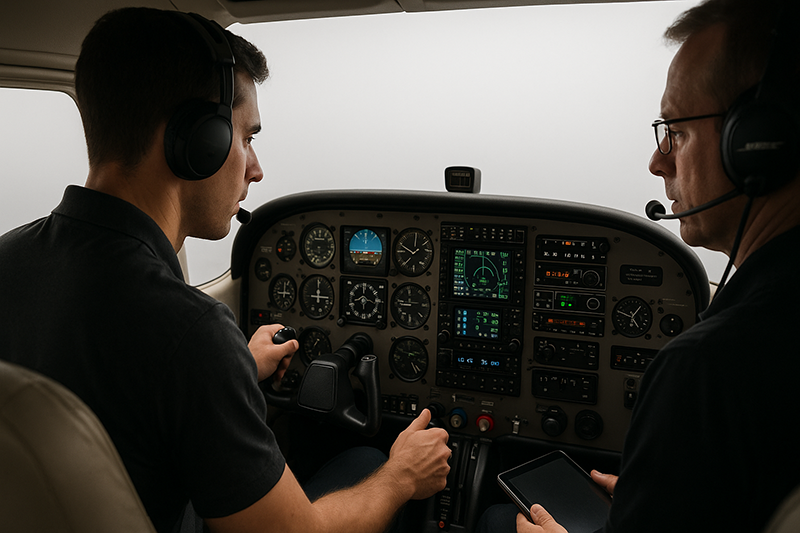
Instrument scan problems show up early in instrument training, but they are not limited to student pilots. Experienced pilots, flight instructors, and professional crews can all experience scan breakdowns when workload rises, weather changes, automation surprises them, or attention becomes fixed on one problem. A good instrument scan is not just a mechanical eye movement pattern. It is a disciplined way of gathering cockpit information, interpreting aircraft performance, and making timely control inputs before small deviations become large ones.
For pilots training toward an instrument rating, returning to proficiency, or teaching instrument procedures, understanding common instrument scan problems is essential. The goal is not to stare faster or memorize a rigid pattern. The goal is to build an organized cross-check that keeps attitude, altitude, airspeed, heading, vertical speed, navigation, engine indications, and automation status in context. This article explains why scans fail, how to recognize the early signs, and how to correct the habits that lead to altitude excursions, heading drift, unstable approaches, and loss of situational awareness.
What an Effective Instrument Scan Really Does
An effective instrument scan answers three questions continuously: What is the aircraft doing, is that what I want, and what correction is needed? The pilot gathers information from the attitude indicator, airspeed indicator, altimeter, vertical speed indicator, heading indicator, turn coordinator or turn rate information, navigation displays, engine instruments, and flight director or autopilot modes when installed. No single instrument tells the whole story. The scan is the pilot’s method for combining partial information into a usable mental picture.
In visual flight, outside references make attitude and trend information immediate. In instrument conditions or while wearing a view-limiting device, the pilot must replace that outside picture with instrument interpretation. The attitude indicator often becomes a central reference because it gives direct pitch and bank information, but it should not become the only reference. Airspeed, altitude, vertical speed, heading, and navigation indications confirm whether the aircraft is actually performing as expected.
A healthy scan is both regular and selective. It is regular because the pilot returns frequently to essential flight instruments. It is selective because not every instrument deserves the same attention at every moment. During a constant airspeed climb, airspeed and attitude may need more attention. During level cruise, altitude, heading, and power setting may become more prominent. During an instrument approach, lateral and vertical guidance, trend, configuration, power, and missed approach readiness become more important. The pilot’s eyes move with purpose because the pilot’s mind knows what information is needed next.
Many pilots think of scan as an eye technique, but it is also a thinking technique. The pilot observes, interprets, decides, and acts. A weak scan often begins when one of those steps is skipped. The pilot sees a deviation but does not interpret the trend. The pilot notices a course needle move but delays a correction. The pilot changes pitch but forgets to verify airspeed or vertical speed. The result is not usually one dramatic failure. It is more often a chain of small missed cues.
Why Instrument Scan Problems Matter in Real-World Aviation
Instrument flying compresses time. A five-degree heading error, a small pitch change, or an unnoticed descent rate may be manageable if detected early. If the same deviation is allowed to continue, it can create a higher workload at exactly the wrong time. The pilot may then overcorrect, chase indications, or lose the broader picture of the flight. That is why scan quality affects nearly every phase of instrument flight, from basic attitude instrument flying to holds, approaches, missed approaches, and abnormal situations.
Scan problems also matter because instrument flight rarely happens in a quiet classroom environment. Pilots must communicate with air traffic control, manage avionics, brief procedures, monitor weather, configure the aircraft, calculate performance, and make decisions. Any of these tasks can interrupt the scan. The interruption itself is not always the problem. The problem occurs when the pilot does not deliberately return to the primary flight task after the interruption.
Modern cockpits create additional scan challenges. Glass panels, moving maps, flight directors, autopilots, and GPS navigators provide excellent information, but they can also attract attention away from basic aircraft control. A pilot may spend too much time programming a procedure, verifying a route, or watching a magenta line while pitch, bank, altitude, or airspeed changes unnoticed. In aircraft with autopilot, scan discipline remains important because the pilot must monitor aircraft performance and automation status, not assume that the system is doing what was intended.
For instructors, scan problems are training opportunities because they reveal how a pilot manages attention. A student who repeatedly loses altitude while changing frequencies may not have an altitude control problem alone. The underlying issue may be task prioritization. A pilot who overcorrects localizer deviations may not need more aggressive control inputs. The pilot may need earlier detection, smaller corrections, and better trend awareness. Good instruction identifies the real source of the problem instead of treating every deviation as a simple control error.
How Pilots Should Understand the Instrument Scan
The instrument scan should be understood as a flexible cross-check, not a fixed route around the panel. Early in training, a structured pattern helps develop discipline. As skill improves, the scan becomes more responsive to the aircraft’s phase of flight, the procedure being flown, and the deviations that need attention. The pilot should know which instruments are most important for the current task and should still return often enough to the others to detect unwanted changes.
One useful way to think about instrument flying is the relationship between control instruments and performance instruments. Control instruments show what the pilot has commanded, such as attitude and power. Performance instruments show what the aircraft is actually doing, such as airspeed, altitude, vertical speed, heading, and course tracking. If the pilot sets a pitch attitude and power setting for level flight, the performance instruments should confirm that the aircraft is maintaining altitude, heading, and airspeed within acceptable tolerances for that operation. If they do not, the pilot adjusts and verifies again.
Trend matters as much as the present indication. An altimeter shows altitude, but the vertical speed indicator and the movement of the altimeter show whether that altitude is changing. A heading indicator shows direction, but bank angle and turn rate show whether the heading is about to change. A course deviation indicator shows position relative to course, but its rate of movement helps the pilot judge whether the aircraft is converging, diverging, or correcting appropriately. Good scan technique is built around detecting trends early.
The scan should also be tied to aircraft control priorities. Aviate, navigate, and communicate remains a practical cockpit concept because aircraft control comes first. In instrument flying, aviate means maintain attitude, airspeed, altitude, heading, and configuration appropriate to the phase of flight. Navigate means remain aware of route, course, clearance, terrain considerations, and procedure requirements. Communicate means exchange necessary information with ATC or other parties without allowing the communication task to displace aircraft control.
Common Instrument Scan Problems and Their Solutions
Most instrument scan problems fall into recognizable patterns. The names may vary among instructors, but the underlying behaviors are familiar: fixation, omission, emphasis, chasing, delayed interpretation, overcontrol, and automation distraction. Each one has a different cause and a different correction strategy.
Fixation on One Instrument
Fixation occurs when the pilot stares at one instrument or display while other important information changes. A common example is watching the localizer needle during an approach while altitude begins to drift. Another is staring at the attitude indicator after turbulence while airspeed and altitude trends are ignored. Fixation often happens when the pilot is anxious about a specific parameter or when a deviation has already developed and seems urgent.
The solution is to make the correction, then return immediately to the cross-check. If the localizer moves, apply an appropriate heading correction and then verify pitch, altitude, airspeed, and vertical guidance. If altitude drifts, correct pitch and power as needed, then verify heading and navigation. The pilot should avoid trying to solve the entire problem by staring harder at the same indication. Instruments are connected through aircraft performance, so the scan must reconnect them.
Omission of Critical Instruments
Omission means an instrument is unintentionally left out of the scan. A pilot may monitor attitude, altitude, and heading but forget airspeed during a climb. Another pilot may watch airspeed and vertical speed during descent but fail to monitor heading. In glass cockpits, omission can also mean failing to notice annunciations, mode changes, or standby instrument information when it is relevant.
The solution begins with awareness of what the current phase of flight demands. During climbs and descents, airspeed, vertical speed, altitude, attitude, power, and navigation all deserve attention. During approaches, lateral and vertical path, airspeed, configuration, altitude constraints, and missed approach planning must be integrated. Instructors can help by asking the pilot what instrument has not been checked recently. The pilot should learn to recognize gaps before the instructor points them out.
Overemphasis on a Favorite Instrument
Overemphasis is similar to fixation but more subtle. The pilot keeps returning too often to a preferred instrument, even when other indications deserve equal or greater attention. Some pilots overuse the attitude indicator. Others overuse the moving map or course display. In aircraft with a flight director, pilots may focus so heavily on command bars that they stop cross-checking raw performance.
The correction is to rebuild the scan around the task rather than comfort. If the task is maintaining level flight, the pilot should verify attitude, altitude, heading, airspeed, power, and trend. If the task is intercepting a course, the pilot should include heading, course deviation, groundspeed awareness when available, and attitude control. The preferred instrument remains useful, but it should not dominate the cockpit picture.
Chasing Needles and Indications
Chasing occurs when the pilot reacts to every small movement with abrupt or excessive control inputs. This is common during early instrument approach training. The pilot sees a localizer or glidepath deviation, makes a large correction, then reverses the correction when the indication moves back. The aircraft weaves around the desired path rather than settling onto it.
The solution is earlier detection and smaller, smoother corrections. Instrument flying rewards anticipation. A small deviation caught early usually needs a small correction. A large correction made late often creates a second problem. Pilots should learn to think in terms of attitude, power, and trend rather than needle position alone. The question is not only where the needle is, but where it is going and whether the current correction is working.
Slow Interpretation
Sometimes the pilot’s eyes are moving, but the mind is behind. The scan may look active from the instructor’s seat, yet the pilot is not interpreting the information fast enough to control the aircraft precisely. The pilot sees the airspeed decreasing, altitude changing, or course needle drifting but does not connect the indications to a timely control input.
The solution is to verbalize trends during training and use known pitch and power references. Saying, “airspeed decreasing,” “altitude trending low,” or “localizer moving right,” can help the pilot connect observation to interpretation. Known configurations also reduce mental workload. If a pilot knows the approximate pitch and power needed for level flight, a standard-rate turn, or a stabilized descent in that aircraft, the scan becomes a verification process rather than a guessing process.
Overcontrol and Control Pressure Problems
Overcontrol is often blamed on poor stick-and-rudder skill, but in instrument flying it is frequently a scan problem. If the pilot detects deviations late, the correction tends to be large. If the pilot does not verify the result promptly, the large correction continues too long. The aircraft passes through the desired performance state, and the pilot must correct again in the opposite direction.
The solution is to reduce the size of corrections and improve trim discipline. Smooth pitch and bank changes, coordinated control use, and timely trim reduce workload. The pilot should make a small correction, pause long enough for the aircraft to respond, and verify the trend. This is especially important in aircraft that respond slowly or in turbulence, where rapid control movements can make the scan less stable.
Automation and Avionics Distraction
Automation can reduce workload when used properly, but it can also create scan traps. A pilot may assume the autopilot captured an altitude, armed an approach mode, or is tracking the intended source without verifying the annunciations and aircraft performance. Another pilot may spend too much time entering flight plan changes while basic instrument references go unattended.
The solution is active monitoring. When using automation, the scan should include mode awareness, flight path verification, and basic aircraft performance. The pilot should be able to answer: What mode is active, what mode is armed, what is the aircraft doing, and does that match the clearance or plan? If the answer is uncertain, simplify. That may mean using a more basic mode, delaying a nonessential programming task, asking for a vector or delay when appropriate, or hand-flying if that improves control and understanding.
The Role of Attitude, Power, and Trim
A reliable instrument scan is easier when the aircraft is properly configured and trimmed. Pilots who fight the airplane tend to narrow their attention. If pitch pressure is high, the pilot may spend too much time correcting altitude. If power is not set appropriately, airspeed and vertical speed may wander. If trim is neglected, workload rises and the scan becomes less effective.
Attitude and power are practical starting points because they produce predictable performance in a given aircraft configuration. The exact numbers depend on the aircraft, weight, configuration, and conditions, so pilots should use aircraft-specific training and approved operating information rather than universal values. The principle is what matters: set a reasonable attitude and power for the desired performance, trim to relieve pressure, then scan to confirm the result.
Trim should not be used as a primary flight control, but it is essential for reducing workload. A well-trimmed aircraft lets the pilot use light control pressures and devote attention to interpretation. Poor trim makes instrument flying feel busier than it needs to be and can contribute to altitude deviations during frequency changes, approach briefings, and checklist use.
How Workload Breaks the Scan
Scan failures often occur during workload transitions. A pilot may be stable in cruise but lose the scan during descent planning. Another may fly basic attitudes well but become saturated during an approach briefing. Workload rises when the pilot must perform several tasks at once, especially if those tasks involve head-down avionics work, radio communication, weather evaluation, or configuration changes.
One of the most useful training habits is to separate tasks when possible. Brief the approach before the workload peaks. Set up radios and navigation sources early when appropriate. Use checklists deliberately rather than rushing through them. If hand-flying in instrument conditions or simulated instrument conditions, avoid unnecessary head-down time. If a task must interrupt the scan, make the interruption short and return to aircraft control before continuing.
Instructors can teach this by allowing students to experience controlled workload, not by overwhelming them. The point is not to create stress for its own sake. The point is to teach the pilot to protect the scan while managing realistic cockpit duties. A well-timed question, frequency change, or simulated reroute can reveal whether the student truly has a sustainable scan or only performs well when nothing else is happening.
Instrument Scan in Glass Cockpits and Round-Dial Panels
The principles of scan do not change just because the display changes, but the pilot’s eye movement and information management do. In a traditional round-dial panel, information is physically separated. The pilot must move among individual instruments and compare them. In a glass cockpit, much of the primary flight information may be integrated into one display, while navigation, engine, traffic, terrain, and weather information may appear nearby or on a multifunction display.
Glass displays can make trends easier to see, especially with tapes, trend vectors, and integrated flight director cues. They can also encourage pilots to stare at one screen and miss mode changes, standby references, or raw data. Round-dial panels can encourage a more distributed scan, but they also require disciplined cross-checking because no single instrument offers the whole picture.
Pilots transitioning between panel types should not assume that instrument proficiency automatically transfers without adjustment. A pilot used to round dials may initially spend extra time searching a glass display for information. A pilot used to glass may need practice interpreting separate analog instruments efficiently. The safe approach is to train deliberately in the actual cockpit layout, avionics suite, and operating procedures used for flight.
Common Mistakes or Misunderstandings
One common misunderstanding is that a faster scan is always a better scan. Speed helps only if the pilot is interpreting correctly. Rapid eye movement without understanding can produce the illusion of proficiency. A good scan is timely, but it is also purposeful. The pilot should know what each glance is meant to confirm.
Another mistake is treating scan errors as isolated technical flaws rather than symptoms of workload, weak aircraft control references, or poor task management. If a pilot repeatedly loses altitude during radio calls, the fix is not simply “look at the altimeter more.” The pilot may need better trim, a more stable attitude reference, shorter communication technique, or a habit of checking altitude immediately before and after the call.
A third mistake is relying too heavily on the vertical speed indicator for pitch control. The vertical speed indicator is useful for trend and rate information, but it may not provide the most immediate pitch reference in all aircraft or situations. Pilots should understand instrument characteristics and avoid making abrupt pitch corrections based solely on one indication. The attitude indicator, altimeter trend, airspeed, power setting, and vertical speed information should be interpreted together.
Another common error is forgetting that navigation displays do not fly the airplane. A moving map can be excellent for situational awareness, but it should not replace primary flight instruments. During an approach, the pilot must maintain aircraft control, comply with procedure requirements and clearances, and monitor appropriate course guidance. The map supports that work. It does not substitute for a disciplined scan.
Pilots may also misunderstand the role of the autopilot. Autopilot use does not eliminate the need for an instrument scan. It changes the nature of the scan. The pilot becomes a systems manager and monitor, but still must verify attitude, altitude, airspeed, navigation tracking, mode status, and aircraft response. If automation does something unexpected, a pilot with an active scan will detect it earlier.
Practical Example: Scan Breakdown on an Instrument Approach
Consider a pilot flying a practice instrument approach in a light training aircraft. The aircraft is established on final approach course in simulated instrument conditions. The pilot is slightly right of course and notices the needle moving toward center. Wanting to correct quickly, the pilot turns left more than needed and keeps watching the course deviation indicator. During those few seconds, pitch lowers slightly, airspeed increases, and the aircraft begins descending faster than intended.
Now the pilot notices altitude trending low and pulls back abruptly. The localizer needle continues moving, so the pilot adds another heading correction. Airspeed begins to decay, the descent rate changes, and the instructor sees the pilot’s scan narrow further. Nothing dramatic happened all at once. The problem began with fixation, then turned into chasing, then became overcontrol.
A better response would begin with a small heading correction, followed immediately by a return to attitude, altitude, airspeed, and vertical path. The pilot would verify that the correction is working rather than stare at the needle. If altitude begins to trend low, the pilot would make a measured pitch or power correction appropriate to the aircraft and approach segment, then return to lateral guidance. The scan would remain broad enough to keep the airplane stable while correcting course.
This example also illustrates why instructors emphasize stabilized habits. A pilot who has memorized the approach but cannot maintain a balanced scan will struggle when conditions become busy. A pilot who can detect small trends early, correct smoothly, and keep the procedure in context is more likely to remain ahead of the airplane.
Best Practices for Building a Stronger Instrument Scan
Improving instrument scan requires deliberate practice. Simply flying more approaches may reinforce bad habits if the pilot does not know what to change. The best practice is to isolate the weakness, train it in manageable conditions, then integrate it back into realistic flight tasks.
Start with basic attitude instrument flying. Straight-and-level flight, climbs, descents, turns, and constant airspeed changes are not just beginner exercises. They are the foundation of every instrument procedure. If a pilot cannot smoothly transition from level flight to a descent while maintaining heading and airspeed, an approach will magnify the problem.
Use known pitch and power references. Pilots should learn the approximate settings and attitudes that produce common performance profiles in the aircraft they fly. These references do not replace the scan, but they reduce guesswork. The pilot sets a reasonable baseline, trims, and then uses instruments to verify and refine.
Practice verbal callouts during training. The purpose is not to create cockpit chatter in normal operations. The purpose is to train the brain to interpret trends. A student who says, “altitude high, correcting,” or “airspeed increasing, reducing pitch change,” is learning to connect information to action. Over time, much of that interpretation becomes internal.
Protect the scan during interruptions. Before changing frequencies, programming avionics, or reviewing a chart, stabilize the aircraft. Make the task brief. Return to the primary flight instruments. If the aircraft is not stable, delay nonessential tasks until control is restored. If workload exceeds capacity, use available resources and make conservative decisions.
Train with realistic distractions, but do it progressively. Once basic control is reliable, add radio calls, amended clearances, holds, partial-panel references as appropriate to the training environment, and automation management. The objective is to maintain scan integrity under realistic workload, not to overload the pilot beyond learning value.
- Make small corrections early instead of large corrections late.
- Scan for trend, not just present position.
- Use attitude and power references, then verify with performance instruments.
- Trim carefully to reduce workload and prevent control pressure from narrowing attention.
- Monitor automation actively, including active and armed modes when applicable.
- Return to basic aircraft control after every interruption.
How Flight Instructors Can Diagnose Scan Problems
Flight instructors should look beyond the visible deviation and identify the behavior that caused it. If a student loses altitude during a turn, the cause may be fixation on bank, poor pitch reference, trim neglect, or late detection. If a student cannot maintain a localizer, the cause may be overcontrolling, failure to bracket wind correction, or spending too much time inside one display. The instructor’s diagnosis determines the quality of the correction.
One effective teaching method is to ask timely questions rather than immediately provide answers. “What is your altitude doing?” “What is the trend?” “Which instrument have you not checked?” These questions help the student build self-monitoring. However, instructors must balance questioning with safety and workload. If the aircraft is becoming unstable, the instructor should intervene appropriately and then debrief the scan failure afterward.
Instructors can also use short, focused exercises. For example, have the student fly level turns while making small heading changes and verbalizing altitude trend. Then add a radio call. Then add a navigation intercept. By layering tasks, the instructor can see when the scan begins to degrade and teach strategies before the student becomes saturated.
Partial-Panel and Failure Considerations
Instrument scan training should include the idea that instruments can fail or provide misleading information. The specific procedures and required equipment considerations depend on the aircraft, operation, and training scenario, so pilots should follow approved guidance and instructor direction. From a scan perspective, the important habit is cross-checking. When one indication does not agree with the others, the pilot should question it and use reliable supporting information.
For example, if the attitude indication appears inconsistent with airspeed, altitude trend, turn information, and outside conditions when available, the pilot should not blindly trust the conflicting indication. The correct response depends on the aircraft and situation, but the mental habit is universal: compare, verify, and maintain control using dependable references. Partial-panel training develops this discipline by teaching pilots not to become dependent on one instrument alone.
Modern aircraft may include standby instruments, electronic backups, or redundant systems. These are valuable only if the pilot knows where they are, how they are powered, and how to include them in the scan when needed. Familiarity with the installed equipment is part of instrument proficiency.
Frequently Asked Questions
What is the most common instrument scan problem?
Fixation is one of the most common problems. The pilot becomes absorbed in one instrument, such as the attitude indicator, localizer, glidepath, or moving map, and fails to notice changes in altitude, airspeed, heading, or configuration. The correction is to make a measured input, then immediately return to a broader cross-check.
Should student pilots use a fixed instrument scan pattern?
A structured pattern can help early in training because it builds discipline and prevents random eye movement. As proficiency improves, the scan should become more selective and task-based. The pilot still checks the essential instruments, but attention shifts depending on phase of flight, aircraft performance, and procedure demands.
How can I stop chasing needles on instrument approaches?
Catch deviations earlier, use smaller corrections, and monitor trend rather than reacting to needle position alone. After making a correction, return to attitude, altitude, airspeed, and vertical path. If you stare at the needle until it centers, you may miss the next aircraft control problem.
Does an autopilot reduce the need for an instrument scan?
No. Autopilot use changes the scan, but it does not remove the pilot’s monitoring responsibility. The pilot should verify active and armed modes when applicable, confirm aircraft performance, and be prepared to intervene if the automation does not match the clearance, procedure, or intended flight path.
How often should I look at each instrument?
There is no universal timing rule that fits every aircraft and phase of flight. The better question is whether you are checking each instrument often enough to detect meaningful trends before they become large deviations. Workload, aircraft response, weather, and procedure complexity all affect scan timing.
Can glass cockpit pilots develop weak scan habits?
Yes. Glass panels can improve information access, but they can also encourage pilots to stare at one display or rely too heavily on automation cues. Glass cockpit pilots should still cross-check attitude, airspeed, altitude, heading, navigation guidance, power, configuration, and automation status.
Key Takeaways
- A strong instrument scan is a purposeful cross-check that connects attitude, power, performance, navigation, and trend information.
- Most scan failures begin with fixation, omission, overemphasis, chasing, slow interpretation, overcontrol, or automation distraction.
- Pilots improve scan quality by using known aircraft references, trimming properly, making small corrections early, and protecting aircraft control during high-workload tasks.