
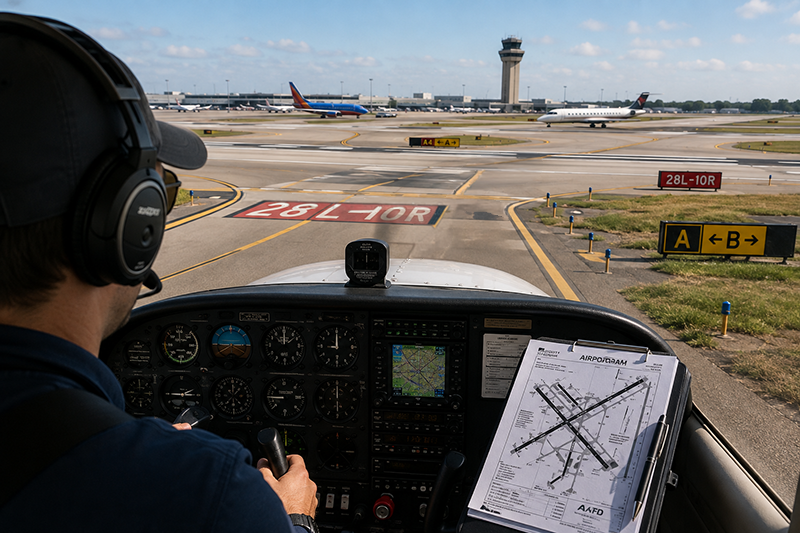
Navigating complex airport layouts is a core pilot skill, not just a ground operations task. A flight can be well planned, the weather can be favorable, and the aircraft can be performing normally, yet risk can increase quickly if the pilot becomes uncertain on the airport surface. Large airports, unfamiliar airports, construction areas, closely spaced taxiways, confusing ramp exits, and multiple runway crossings all demand the same disciplined mindset pilots use in the air.
For student pilots, the airport surface is often where radio communication, aircraft control, chart interpretation, traffic awareness, and time pressure collide for the first time. For experienced pilots, complacency can become the bigger threat. A pilot who has landed at the same airport many times may still be surprised by a changed taxi route, a temporarily closed taxiway, a night operation, a low-visibility surface environment, or a clearance that sounds simple until the aircraft is moving. This article explains how pilots can understand complex airport layouts, brief them effectively, use airport diagrams intelligently, and maintain situational awareness from engine start to shutdown.
What Makes an Airport Layout Complex?
An airport does not have to be large to be complex. Complexity comes from the relationship between runways, taxiways, ramps, hold short lines, intersections, traffic flow, lighting, signage, and pilot workload. Some major airline airports are logically organized and well marked, while some smaller airports can be surprisingly demanding because of unusual geometry, nonstandard ramp access, confusing runway crossings, or closely spaced pavement areas.
Several features tend to increase pilot workload on the ground. Parallel runways can create multiple hold short points and runway crossing opportunities. Intersecting runways require careful attention to which runway is active, which runway you are cleared to cross, and where the holding position markings are located. Taxiway networks with many branches can lead to route confusion, especially when taxiway identifiers sound similar or are located near each other. Large ramp areas may lack the same level of directional clarity as movement areas controlled by air traffic control. Construction areas can change normal routes and introduce temporary markings or barricades. At night, in rain, or in low visibility, visual cues may be harder to distinguish.
The movement area is the portion of the airport surface where aircraft and vehicles are normally under air traffic control direction. The non-movement area typically includes ramps and aprons where pilots may still need clearance or instructions depending on local procedures, but where tower control may not provide the same routing detail. Understanding that distinction matters because pilots sometimes relax once they leave a runway or movement area, even though collision avoidance, taxi discipline, and aircraft control remain essential.
Complexity also changes with direction of operation. A taxi route that is simple after landing on one runway may be much more difficult when the airport is using another runway configuration. A departure from a familiar FBO can become challenging if the active runway is on the far side of the field and requires multiple runway crossings. Pilots should treat every airport surface operation as a new operation, not simply a repeat of the last visit.
Why This Matters in Real-World Aviation
Surface navigation is directly connected to runway safety. The runway environment is where aircraft are landing, taking off, accelerating, decelerating, and sometimes operating with limited ability to maneuver. Any misunderstanding about runway entry, runway crossing, taxi clearance, or holding position can create immediate risk. Even when an error does not lead to a conflict, it can increase workload for the pilot, air traffic control, and other airport users.
For flight training, airport layout awareness is one of the best ways to teach practical aeronautical decision-making. Students learn that safety is not limited to stick-and-rudder skills. It includes preparation, communication, verification, and the willingness to stop the aircraft when something is unclear. Instructors can use taxi operations to build habits that carry into instrument flying, crew resource management, and professional operations. Reading an airport diagram, briefing a taxi route, confirming clearances, and maintaining a sterile cockpit are all examples of disciplined aviation behavior.
For professional pilots and aviation operators, surface operations involve additional layers of coordination. Crew members may divide responsibilities between taxiing, radio communication, checklist management, and monitoring. Operators may have standard operating procedures that define how taxi clearances are read back, how runway crossings are confirmed, and when heads-down tasks are permitted. Even in a single-pilot cockpit, the principle is the same: the aircraft must be navigated deliberately, and the pilot must avoid becoming absorbed in tasks that do not support safe movement.
Complex airport layouts also affect flight planning and time management. A pilot departing from a major airport may need more taxi time than expected. A pilot arriving at an unfamiliar airport may need to brief likely runway exits and ramp routing before landing. A fuel stop at a busy airport can become stressful if the pilot has not reviewed the diagram, does not know where the FBO is located, or accepts a clearance without understanding the route. Good surface planning reduces last-minute decision-making and helps the pilot stay ahead of the aircraft.
How Pilots Should Read an Airport Diagram
An airport diagram is not just a picture of pavement. It is a working navigation chart for ground movement. Pilots should use it before engine start, during taxi when safe to do so, after landing, and anytime there is uncertainty. Whether displayed on paper, a tablet, installed avionics, or another approved chart source, the diagram should be oriented and reviewed in a way that supports the pilot’s expected route.
The first step is to identify the runways and their orientation. Runway numbers provide a general magnetic direction, but pilots should avoid relying only on memory. On a complex field, the same runway system may have parallel designations, crossing runways, displaced thresholds, or closed sections. Next, identify the parking location, ramp exit, likely departure runway, and likely taxiways. If arriving, identify probable runway exits and the destination ramp before touchdown. This does not mean guessing what air traffic control will assign. It means building a mental map so the clearance makes sense when received.
Taxiway identifiers deserve careful attention. Similar-sounding taxiways, short connector taxiways, and multiple branches can confuse pilots who are moving quickly. A route such as “Taxi via Alpha, Charlie, hold short Runway Two Seven” sounds straightforward only if the pilot has already located Alpha, Charlie, and the runway hold short point. If the pilot must search for each element while moving, workload rises sharply.
Hot spots, when depicted on airport diagrams, are areas with a history or potential for increased risk due to confusing geometry, intersecting traffic flows, or other surface navigation challenges. Pilots should review any depicted hot spots during preflight planning and again during the taxi briefing. The practical point is simple: if the chart highlights an area as requiring extra attention, slow down mentally and physically before reaching it.
Airport diagrams may also show runway holding position markings, instrument landing system critical areas, ramp boundaries, deicing areas, and other operational features. Pilots should interpret these elements in the context of the actual clearance. A diagram helps the pilot understand where the aircraft is, but it does not replace listening carefully, reading back clearances properly, and complying with current instructions.
Taxi Clearances and Route Discipline
A taxi clearance is a navigation instruction, and pilots should treat it with the same seriousness as an IFR route clearance or an approach clearance. Before moving, the pilot should understand the route, identify any runway hold short points, and know what instruction requires further clearance. If any part of the clearance is unclear, the safest response is to ask for clarification before the aircraft begins moving or before reaching the uncertain point.
Readbacks are especially important when a clearance includes runway assignments, runway crossings, hold short instructions, or intersecting taxiways. Pilots should use standard phraseology to the extent practical and avoid casual language that could hide misunderstanding. The goal is not to sound polished. The goal is to confirm that the pilot and controller have the same expectation for the aircraft’s movement.
Route discipline means following the assigned taxi route, not improvising because another route looks shorter or more familiar. If the pilot misses a turn, becomes uncertain, or is unable to comply, the correct response is to stop where safe and advise ground control. Continuing while trying to solve the problem can lead to crossing a hold short line, entering the wrong taxiway, or moving into an area not intended for that aircraft.
In a single-pilot cockpit, taxiing while programming avionics, briefing passengers, adjusting charts, or troubleshooting equipment can create unnecessary risk. The aircraft may be moving slowly, but it is still moving. A pilot who looks down for several seconds can miss signage, taxiway centerline changes, other aircraft, vehicles, or a hold short marking. When workload increases, slowing down or stopping is often the best risk control available.
Signage, Markings, and Lighting on the Airport Surface
Airport signs, markings, and lights are the pilot’s outside references for surface navigation. They confirm what the diagram shows and help the pilot detect when something is wrong. On complex airports, pilots should cross-check the assigned route using both the chart and the view outside. Neither should be used in isolation.
Runway holding position markings are among the most important surface markings a pilot will encounter. They identify the point at which an aircraft must stop unless cleared to enter or cross the runway. Pilots should approach these markings with the expectation that stopping may be required, especially when the clearance includes a hold short instruction or when the pilot has not received a specific runway crossing or entry clearance.
Taxiway location signs identify the taxiway the aircraft is on. Direction signs point toward intersecting taxiways or destinations. Runway holding position signs use runway designations and are placed near runway hold points. At night or in reduced visibility, these signs may be easier or harder to interpret depending on lighting, weather, cockpit workload, and viewing angle. Pilots should not wait until reaching an intersection to begin looking for the next sign. The earlier the pilot anticipates the next cue, the less rushed the decision will be.
Taxiway centerline markings and edge markings help keep the aircraft on intended pavement, but pilots must still consider wingtip clearance, propeller blast, jet blast, and nearby vehicles or aircraft. At unfamiliar airports, the visual impression of pavement width and available clearance can be misleading. Large paved areas, closed taxiways, and ramp markings may not provide the same guidance as active taxiways. When in doubt, slow down, ask for progressive taxi instructions if available, or request assistance from airport personnel as appropriate.
Lighting can either help or complicate the picture. Blue taxiway edge lights, green centerline lights where installed, runway edge lights, runway guard lights, and stop bar systems at certain airports all contribute to surface awareness. However, pilots should avoid making assumptions based only on lighting color or pattern without confirming the clearance and markings. A bright, well-lit path is not automatically the assigned path.
Building a Taxi Briefing That Actually Works
A useful taxi briefing is short, specific, and tied to the airport diagram. It should not be a ritual recitation that the pilot performs without thinking. The purpose is to create a shared mental model before the aircraft moves. In a training aircraft, the instructor and student can brief the route together. In a crewed cockpit, one pilot can taxi while the other monitors. In single-pilot operations, the pilot can brief aloud or silently, but the content should be just as deliberate.
A good briefing identifies the starting point, expected runway or parking destination, likely taxi route, runway crossings, hot spots, hold short points, and any anticipated complexity. It should also include a simple lost-or-uncertain plan: stop the aircraft, set the brake if appropriate, and ask for clarification. This may sound basic, but it is one of the strongest habits a pilot can build. The pilot who has already decided to stop when uncertain is less likely to continue into a developing error.
Before departure, the taxi briefing can be combined with other ground planning. The pilot can review the ATIS or airport information, identify the active runway, compare expected taxi routes, and check NOTAMs or airport notices for closures and construction information. After landing, a brief pause clear of the runway, when appropriate and not interfering with traffic, allows the pilot to clean up the aircraft, contact ground if required, and review the taxi route to parking. The key is to avoid rolling into a complex taxi environment while still mentally finishing the landing.
Instructors should teach taxi briefings early, not wait until students visit large towered airports. A small non-towered airport can still be used to practice diagram orientation, runway incursion avoidance, hold short discipline, and route planning. By the time a student operates at a busier airport, the briefing process should already feel familiar.
Managing Workload at Busy and Unfamiliar Airports
Workload management begins before the aircraft moves. Pilots should gather needed information early, arrange charts and devices so they are accessible, and minimize distractions during taxi. If using an electronic flight bag, the airport diagram should be loaded before taxi begins. If using paper charts, the correct page should be visible and secured. If passengers are on board, they should understand when conversation needs to pause.
The sterile cockpit concept is especially valuable on the ground. While the exact application may vary by operation, the practical idea is straightforward: during taxi, takeoff, landing, and other high-workload phases, conversations and tasks should support the safe operation of the aircraft. A passenger question, a phone notification, a checklist item, or a tablet issue can wait if the aircraft is approaching an intersection or hold short line.
Speed control is another major factor. Taxiing too fast reduces the pilot’s time to read signs, verify clearances, identify turns, and stop smoothly. Appropriate taxi speed depends on aircraft type, surface conditions, visibility, ramp congestion, and company or training procedures. Rather than relying on a single number, pilots should use the principle that taxi speed must allow positive control, safe stopping, and accurate navigation.
Unfamiliar airports require extra humility. Pilots should not hesitate to request progressive taxi instructions when needed. Progressive taxi guidance can help when the pilot is uncertain about the route, but it does not remove the pilot’s responsibility to see and avoid, comply with clearances, and stop if confused. It is a tool, not a substitute for situational awareness.
Common Mistakes and Misunderstandings
One common mistake is assuming that taxi is the low-risk part of the flight. Because the aircraft is on the ground and moving slowly, pilots may allow attention to drift. In reality, surface operations combine navigation, communication, aircraft control, traffic awareness, and compliance with clearances. That makes taxi a high-attention phase, particularly at complex airports.
Another misunderstanding is believing that the airport diagram alone prevents errors. A diagram is valuable, but it must be actively used. A pilot who glances at the chart before startup and then never cross-checks the route may still miss a turn or approach the wrong hold short line. The diagram should support a continuous question: “Does what I see outside match where I think I am?”
Pilots also get into trouble when they accept clearances they do not fully understand. This can happen because the frequency is busy, the pilot does not want to sound inexperienced, or the route seems simple at first. Professionalism means asking for clarification when needed. Air traffic controllers would rather repeat or amend an instruction than have an aircraft proceed uncertainly.
Expectation bias is another hazard. If a pilot expects a familiar taxi route, the mind may try to fit the clearance and visual cues into that expectation, even when something has changed. Construction, runway configuration, traffic sequencing, or controller preference may produce a different route than usual. Pilots should listen to the actual clearance rather than the clearance they expected to hear.
After landing, pilots can become vulnerable to task saturation. The aircraft is decelerating, the pilot may be exiting the runway, flaps and lights may need attention, radio frequency changes may occur, and passengers may begin talking. This is a prime moment to maintain discipline. Clear the runway, comply with instructions, and avoid rushing into the next task before the aircraft is fully under control and the route is understood.
Practical Example: Arriving at an Unfamiliar Busy Airport
Consider a private pilot arriving in a single-engine aircraft at an unfamiliar towered airport with parallel runways, several FBOs, and ongoing taxiway construction. Before descent, the pilot reviews the airport diagram and identifies the likely landing runway based on current airport information. The pilot also locates the intended FBO and notices that reaching it may require crossing another runway or using a specific taxiway around a closed area.
On final approach, the pilot focuses on flying the aircraft and does not attempt to solve the entire taxi route in the flare or rollout. After landing, tower instructs the pilot to exit at a named taxiway and hold short of a parallel runway. Because the pilot reviewed the diagram earlier, the instruction makes sense. The pilot slows the aircraft, exits at the assigned taxiway, stops at the hold short line as instructed, and reads back the hold short clearance accurately.
Once cleared to cross, the pilot crosses the runway without delay and continues only after confirming the next taxi instruction. Ground control then provides a route to parking that includes a taxiway the pilot did not expect. Instead of guessing, the pilot stops clear of conflicts, advises ground that they are unfamiliar, and requests clarification. The controller restates the route in smaller segments. The pilot follows the route by matching signs outside to the airport diagram and arrives at the ramp without rushing.
This scenario is ordinary, which is why it is useful. Nothing dramatic happened. The safety margin came from preparation, a clear mental model, disciplined readbacks, willingness to stop, and refusal to guess. Those same behaviors apply whether the aircraft is a trainer, business aircraft, airline transport, helicopter, or light sport aircraft operating on a complex airport surface.
Best Practices for Pilots Navigating Complex Airport Layouts
The best surface navigation habits are simple but must be applied consistently. Pilots should brief the airport diagram before taxi and before landing, especially at unfamiliar or complex airports. The briefing should focus on where the aircraft is, where it is going, what runways or hot spots are involved, and what points require special attention.
When operating on the ground, pilots should keep their eyes outside as much as possible and use charts to confirm, not replace, visual navigation. If heads-down time is required, stop the aircraft when safe before reprogramming avionics, studying a chart, or resolving a route question. A stopped aircraft is easier to manage than a moving aircraft with an uncertain pilot.
Clear communication is equally important. Pilots should read back runway-related instructions carefully, question any clearance that does not make sense, and avoid moving beyond a clearance limit. If the pilot is unsure whether they are cleared to cross, enter, or line up on a runway, they should ask. There is no penalty for verifying a safety-critical instruction.
Several practical habits support safer ground operations:
- Review the airport diagram, hot spots, closures, and likely taxi route before engine start or before arrival.
- Write down or display the taxi clearance when workload permits, especially if the route is long or includes runway crossings.
- Verbalize hold short points and runway crossings so they stand out from ordinary taxiway turns.
- Use a sterile cockpit during taxi, takeoff, landing, and other high-workload phases.
- Slow down or stop when uncertain, confused, distracted, or unable to verify the route.
- Ask for progressive taxi instructions or clarification when needed.
Technology can help, but it should not create complacency. Moving-map airport displays, own-ship position on approved charting applications where available, and surface awareness systems can improve orientation. However, batteries fail, screens can be misread, databases require currency, and GPS position may not be suitable as the only source of surface navigation. The pilot should still navigate by clearance, signage, markings, lighting, and outside awareness.
Training Strategies for Students and Instructors
Instructors can make airport surface navigation a deliberate part of every lesson. Instead of treating taxi as dead time between checklist items and takeoff, use it to teach chart orientation, communication discipline, and risk management. Ask the student to brief the taxi route before calling ground. Have the student identify the next sign, the next hold short line, and the current position on the diagram. Encourage the student to speak up early when something does not match expectations.
Scenario-based training is especially effective. An instructor can ask, “What will you do if ground gives us a different route?” or “Where would you stop if you became uncertain?” These questions build decision-making habits before the student is under pressure. On a dual cross-country, the instructor can assign the student to review the destination airport diagram in cruise and brief the likely route from runway exit to parking.
Training should also include night operations and operations at towered airports when appropriate for the student’s stage. Night taxi introduces a different visual environment. Signs, lights, reflections, and pavement markings may appear different than they do during the day. Towered airport operations add radio workload and clearances that must be understood and followed precisely. Non-towered operations still require careful runway environment awareness, traffic scanning, and communication with other aircraft.
For advanced students and certificated pilots, recurrent training should include surface operations at airports with more complex layouts. A pilot who flies primarily from a familiar home airport may benefit from practicing at a larger airport with parallel taxiways, runway crossings, and more demanding communication. The goal is not to make taxi difficult. The goal is to normalize preparation and disciplined behavior before the pilot encounters complexity alone.
Frequently Asked Questions
What should I do if I get confused while taxiing?
Stop the aircraft in a safe location if able, hold position, and ask air traffic control or the appropriate airport authority for clarification. Do not continue taxiing while trying to guess the route. If you are on a non-towered airport, stop clear of runways and traffic flow, reassess the diagram, and communicate your intentions as appropriate.
Is it acceptable to ask for progressive taxi instructions?
Yes. If you are unfamiliar with the airport or uncertain about a route, asking for progressive taxi instructions is a practical way to reduce confusion. You should still monitor signs, markings, lighting, traffic, and clearance limits. Progressive instructions assist situational awareness; they do not replace pilot responsibility.
How should student pilots prepare for a complex airport?
Student pilots should review the airport diagram before the flight, identify likely runways and taxi routes, study any depicted hot spots, and practice reading back taxi and runway-related instructions. With an instructor, they should brief what they will do if the clearance is unexpected or unclear.
Should I use a tablet moving map while taxiing?
A tablet or installed display can be helpful if it shows current airport information and is used appropriately, but it should not distract from looking outside. Load the airport diagram before taxi, glance only when workload permits, and stop the aircraft if you need more time to study the route.
What is the biggest risk at a complex airport layout?
The biggest practical risk is losing situational awareness while the aircraft is moving, especially near runway hold short points, intersections, or construction areas. This can happen through distraction, expectation bias, unclear clearances, excessive taxi speed, or failure to verify the route.
How can instructors teach better airport surface awareness?
Instructors can require a taxi briefing, ask students to point out signs and hold short points, create realistic route changes, and reinforce the habit of stopping when uncertain. Surface navigation should be treated as an active flight skill, not an administrative task.
Key Takeaways
- Brief complex airport layouts before taxi and before arrival so taxi clearances, runway crossings, and ramp routes make sense before workload rises.
- Use airport diagrams, signs, markings, lighting, and clear communication together. No single cue should replace active situational awareness.
- If you are uncertain, slow down or stop where safe and ask for clarification. Guessing on the airport surface is never a sound operating technique.