
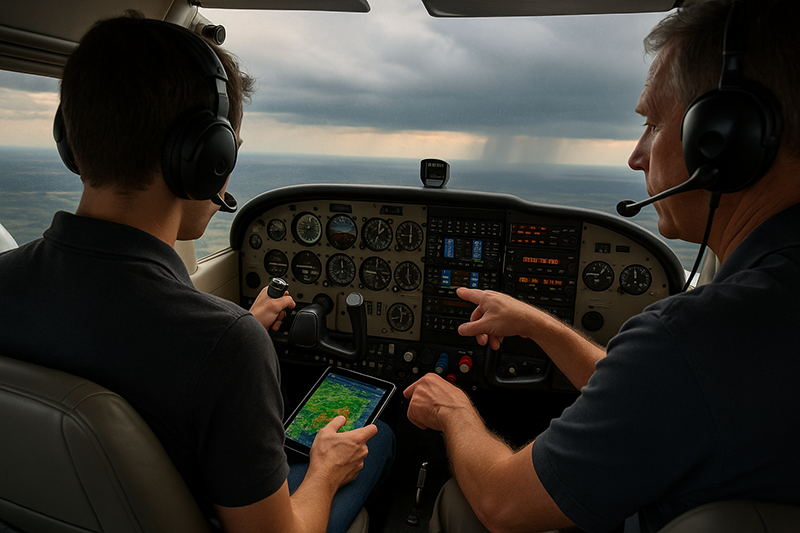
Confirmation bias in aviation is one of the most important human factors for pilots to understand because it affects how we interpret information when the stakes are high. A pilot who already believes the weather will improve, the engine is running normally, the runway is correct, or the destination is still reachable may unconsciously give more weight to evidence that supports that belief and discount evidence that points the other way. The result is not usually a dramatic lapse in intelligence. It is a normal human tendency operating inside a complex, time-sensitive flight environment.
For student pilots, flight instructors, professional crews, dispatchers, maintenance personnel, and aviation managers, the practical value of understanding confirmation bias is simple: better decisions come from better questioning. Aircraft, weather, air traffic control, checklists, performance data, and crew input all provide information. Confirmation bias becomes dangerous when the pilot filters that information through the answer they already want. This article explains how confirmation bias shows up in flight operations, why it matters to aviation safety, and how pilots can build habits that challenge assumptions before they become errors.
What Confirmation Bias Means in Aviation
Confirmation bias is the tendency to notice, interpret, and remember information in a way that confirms an existing belief or expectation. In aviation, that belief may be as simple as, “This is probably just a minor indication,” or as operationally significant as, “We can still make it through before the weather gets worse.” The pilot may not consciously ignore contrary information. More often, the mind simply treats confirming information as more persuasive and conflicting information as less important.
This matters because flying requires continuous interpretation. A pilot rarely receives one perfect, unmistakable answer. Weather reports may be changing, cockpit indications may be subtle, radio calls may be busy, and visual cues may be incomplete. The brain tries to organize these inputs quickly. That speed is useful, but it can also lead the pilot to lock onto the first plausible explanation.
In training, confirmation bias is closely related to aeronautical decision-making, risk management, situational awareness, and crew resource management. It can appear in single-pilot operations just as easily as in airline or corporate crew environments. In a two-pilot cockpit, one pilot’s expectation can influence the other. In a single-pilot cockpit, there may be no second crewmember to challenge the story the pilot has already built.
Aviation professionals should not think of confirmation bias as a character flaw. It is a predictable human limitation. The professional response is not to assume, “It will not happen to me.” The professional response is to design cockpit habits, training scenarios, callouts, and decision gates that make it harder for bias to go unchallenged.
Why This Matters in Real-World Aviation
Real-world flying rarely unfolds exactly as planned. A cross-country flight may begin with acceptable weather and later encounter lowering ceilings. A training flight may begin with a normal engine start and later produce an unusual vibration. A crew may expect a certain runway and then receive a late change. A pilot may believe a traffic advisory refers to one aircraft while another aircraft is the actual conflict. In each case, the pilot must update the mental picture as new information arrives.
Confirmation bias interferes with that updating process. Instead of asking, “What does this new information mean?” the pilot may ask, often unconsciously, “How does this fit what I already believe?” That subtle shift can delay corrective action. A pilot who expects the destination weather to remain usable may interpret a marginal report as temporary. A pilot who expects a rough magneto check to be caused by plug fouling may be slower to consider a deeper maintenance issue. A pilot who expects to be lined up with the assigned runway may overlook a heading, runway marking, or navigation cue that deserves attention.
The risk increases under workload. Fatigue, time pressure, passenger expectations, airspace complexity, training pressure, and concern about completing the mission can all make the brain prefer a simple, reassuring answer. Confirmation bias often works together with plan continuation bias, which is the tendency to continue with an original plan despite cues that suggest a change is needed. The two are not identical, but they often reinforce each other. Confirmation bias supports the belief that the plan is still sound. Plan continuation bias keeps the aircraft moving along that plan.
Instructors see this in training when a learner becomes attached to an answer. For example, a student practicing landings may decide the approach is stable because the airspeed is close to target, while overlooking that the aircraft is high and drifting. A more experienced pilot may do the same thing in a different form, focusing on one reassuring instrument while ignoring the wider pattern. Skill and experience help, but they do not eliminate bias. In some cases, experience can make a pilot more confident in an initial interpretation, which makes deliberate cross-checking even more important.
How Pilots Should Understand This Topic
The most useful way to understand confirmation bias is to see it as a threat to the cross-check. Pilots are trained to compare sources of information: attitude indicator with outside horizon, heading with navigation course, fuel remaining with time en route, weather forecast with observed conditions, and checklist action with aircraft response. Confirmation bias weakens that comparison by making the pilot favor the evidence that matches the expected picture.
A good aviation mindset treats the first explanation as a hypothesis, not a conclusion. If the aircraft is not climbing as expected, “high density altitude,” “improper configuration,” “engine performance,” “wind,” and “pilot technique” may all be possible considerations depending on the situation. The pilot does not need to panic or jump to the worst explanation. But the pilot does need to avoid selecting the most comfortable explanation too early.
Another practical concept is disconfirming evidence. This means deliberately looking for information that would prove your current belief wrong. If you believe the weather ahead is acceptable, what observation would make you turn around or divert? If you believe the aircraft is configured correctly, what indicator or checklist item would challenge that belief? If you believe you are cleared for a certain action, what exact clearance, readback, or chart information supports that belief?
Disconfirming evidence is not negativity. It is disciplined verification. A pilot who asks, “What am I missing?” is not being indecisive. The pilot is protecting situational awareness. In crew operations, this often appears as challenge and response, briefings, callouts, and cross-verification. In single-pilot operations, it may appear as verbal self-briefing, written personal minimums, conservative go/no-go criteria, and a willingness to pause before accepting a convenient conclusion.
Confirmation bias also affects memory. After a flight, a pilot may remember the cues that supported the decision and forget the cues that made the decision questionable. This is one reason debriefing is valuable. A good debrief reconstructs what was known at the time, what was assumed, what was verified, and what was missed. Instructors can help students learn not just what decision was made, but how the decision was reached.
Where Confirmation Bias Commonly Appears
Confirmation bias can appear in almost any aviation task, but several areas deserve special attention because they combine incomplete information with meaningful consequences.
Weather Decisions
Weather is a natural setting for confirmation bias because pilots often begin with a desired outcome. They want the training flight to happen, the trip to continue, or the arrival to be completed. Forecasts, observations, radar depictions, pilot reports, and visual conditions may not all tell the same story. A biased pilot may focus on the most favorable report and minimize signs of deterioration.
One common trap is treating an improving forecast as if improvement has already occurred. Another is using good weather at the departure airport to emotionally discount poorer conditions along the route or near the destination. The safer habit is to identify specific decision points before takeoff and update the plan using actual conditions, not just expectations.
Mechanical and Systems Interpretation
When an aircraft indication is unusual, pilots naturally search for familiar explanations. Familiarity is helpful, but it can become limiting. A rough engine, abnormal electrical indication, unexpected annunciator, or unusual vibration should be evaluated with the appropriate checklist, aircraft documentation, training, and maintenance support as applicable. Confirmation bias can lead a pilot to decide too quickly that the issue is minor because a similar event once had a simple explanation.
In aviation, “probably” is not the same as “verified.” If the aircraft does not respond as expected, or if the pilot cannot confidently determine the condition of the system, the decision should become more conservative. That does not mean every abnormal indication requires the same response in every aircraft or operation. It means the pilot should resist the urge to make the indication fit the desired narrative.
Navigation and Runway Identification
Runway and taxiway identification require careful attention to charts, clearances, signage, markings, lighting, headings, and outside visual references. Confirmation bias can cause a pilot to see the runway they expect rather than the runway that is actually aligned ahead. During taxi, it can cause a crew to interpret airport signage in a way that supports the expected route. During approach, it can cause the pilot to underweight a mismatch between the runway heading, instrument guidance, and visual picture.
The practical defense is verification using multiple independent cues. If the assigned runway, heading, navigation source, and outside picture do not agree, the mismatch should be resolved before continuing. A moment of clarification is far preferable to continuing with uncertainty.
Instruction and Evaluation
Instructors and evaluators are not immune. A flight instructor who believes a student is strong may overlook small but important errors. An instructor who expects a student to struggle may interpret normal learning behavior too negatively. In scenario-based training, a learner may try to satisfy what they think the instructor wants instead of evaluating the scenario independently.
Good instruction uses objective standards, clear debriefing, and open-ended questions. Instead of asking only, “Why did you do that?” an instructor might ask, “What information supported your decision, and what information argued against it?” That approach teaches decision-making rather than simple answer matching.
Common Mistakes or Misunderstandings
A common misunderstanding is that confirmation bias only affects careless pilots. In reality, it can affect conscientious pilots precisely because they are trying to make sense of a demanding environment. A pilot who studies the weather carefully may still become attached to the interpretation that supports the planned flight. A pilot who knows the aircraft well may still be slow to accept that today’s abnormal indication does not match the usual explanation.
Another mistake is confusing confidence with confirmation. Confidence is valuable when it is built on current evidence, sound training, and proper procedures. Confirmation bias feels like confidence, but it is often based on selective attention. The difference can be difficult to detect from inside the cockpit. That is why external tools such as checklists, briefings, standard operating procedures, and second opinions are so useful.
Pilots also sometimes believe that more information automatically fixes bias. More information helps only if the pilot is willing to consider information that conflicts with the current belief. A pilot can look at multiple weather products and still select only the most favorable interpretation. A crew can discuss an abnormal situation and still steer the conversation toward the answer that allows the flight to continue unchanged. The quality of the question matters as much as the quantity of information.
Another hazard is delaying a decision while searching for reassuring evidence. A pilot who is uncomfortable with deteriorating conditions may keep looking for a better report instead of acting on the trend already visible. A pilot who suspects a system problem may continue troubleshooting beyond what is appropriate for the phase of flight. There is a point where the safest decision is not to gather endless confirmation. It is to choose the more conservative option while options remain available.
Finally, some pilots treat bias management as a personality exercise rather than an operational discipline. Saying “be careful about bias” is not enough. The cockpit needs specific behaviors: verify, brief, cross-check, ask for help, use checklists, set decision gates, and be willing to discontinue an approach, divert, delay, return, or cancel when the evidence supports that choice.
Practical Example: A VFR Cross-Country Decision
Consider a private pilot planning a daytime VFR cross-country flight to meet friends for lunch. The forecast shows generally acceptable conditions, but there are indications that ceilings may lower near the destination later in the day. The pilot has made the trip before, the airplane is fueled, and passengers are already at the airport. Before departure, the pilot focuses on the favorable reports and tells the passengers, “It should be fine.”
En route, the visibility remains acceptable, but the ceiling ahead appears lower than expected. The destination weather report is still technically usable for the pilot’s intended operation, but nearby stations are trending downward. The pilot notices that the horizon is becoming less distinct. A conservative alternate airport is available behind and to the side, but continuing still feels easier. The pilot thinks, “It is probably just a local layer near that reporting station.”
This is the moment confirmation bias can become operationally significant. The pilot’s original belief was that the flight would be completed. Evidence supporting that belief includes acceptable departure weather, prior experience with the route, and the fact that conditions are not yet below the pilot’s comfort level. Evidence challenging that belief includes lowering ceilings, worsening nearby reports, reduced visual definition, and the availability of a safer alternate if the decision is made early.
A bias-resistant pilot would pause and reframe the question. Instead of asking, “Can I still make it?” the pilot asks, “What evidence would tell me that continuing is no longer the best option?” The pilot might decide that if the next weather update shows continued lowering, if visual reference becomes less comfortable, or if the route ahead appears worse than expected, the flight will divert. Better yet, the pilot may have established those decision points before takeoff.
The key lesson is not that every marginal-looking flight must result in the same decision. The lesson is that the pilot must be careful about which question is being answered. “Can I justify continuing?” is a very different question from “What is the safest practical option now?” Confirmation bias pushes toward justification. Professional decision-making pushes toward current evidence and available options.
Best Practices for Pilots
The best defense against confirmation bias is not a single technique. It is a set of habits that make honest reassessment normal. These habits should be practiced in training, used in routine flights, and reinforced during debriefing.
First, brief the conditions that would change the plan. Before departure, approach, or any demanding phase of flight, identify what would cause a delay, diversion, go-around, rejected takeoff decision, return to the airport, or request for clarification. A decision made calmly before the pressure increases is usually more reliable than a decision made while trying to preserve a plan.
Second, use checklists and published procedures as bias interrupters. A checklist is not just a memory aid. It is a structured way to prevent the pilot from skipping items that do not fit the expected picture. When pilots rush or perform a checklist from memory without verification, they remove one of the cockpit’s strongest defenses against assumption.
Third, ask disconfirming questions. Good examples include: “What evidence says I am wrong?” “What would I do if I were not trying to complete this flight?” “Which instrument, report, or visual cue does not fit?” “If another pilot described this situation to me, what would I advise?” These questions create mental distance from the preferred answer.
Fourth, encourage challenge in crew and training environments. A cockpit culture that punishes questions makes confirmation bias stronger. A cockpit culture that welcomes respectful challenge makes it weaker. Instructors should model this by thanking learners for raising concerns and by explaining how conflicting information is evaluated.
Fifth, slow down when practical. Not every flight situation allows extended analysis, but many allow a short pause, a hold, a request for vectors, a climb to a safer altitude, a diversion discussion, or a return to a known safe condition. Creating time and space improves judgment.
Sixth, debrief decisions, not just maneuvers. After a flight, review what assumptions were made, what information supported them, what information challenged them, and whether the plan changed appropriately. This builds a pilot’s ability to recognize bias before it becomes embedded in the next flight.
- Use personal minimums as decision aids, not as flexible targets to negotiate under pressure.
- Seek independent information when the current picture feels uncertain, such as updated weather, ATC assistance, instructor input, maintenance guidance, or another qualified pilot’s perspective.
- Treat unexpected information as meaningful until it is resolved, especially when it affects aircraft control, terrain clearance, weather avoidance, fuel planning, or runway identification.
- Practice verbalizing uncertainty. Saying “I am not sure this matches the plan” can be the first step toward a safer decision.
How Flight Instructors Can Teach Confirmation Bias
Flight instructors have a powerful role in making confirmation bias visible. Many learners do not recognize bias because it feels like ordinary reasoning. Scenario-based training can help when it requires students to explain their assumptions, identify conflicting cues, and make decisions with incomplete information.
An instructor might present a weather scenario where one report looks favorable but the broader trend is less comfortable. The goal is not to trick the learner. The goal is to see whether the learner can avoid anchoring on the most convenient data point. Another scenario might involve a simulated abnormal indication where the student must use the checklist, communicate, and decide whether to continue, return, or land as soon as practical based on the situation and aircraft guidance.
During debriefing, instructors should avoid making the discussion only about the final answer. Two students can make the same final decision for different reasons. One may have used a sound process. The other may have guessed correctly while ignoring contrary information. The instructor’s job is to develop the process.
Useful debriefing questions include: “What did you expect to happen?” “What was the first cue that did not match your expectation?” “Which information did you trust most, and why?” “Did any information make you uncomfortable?” “At what point would you have changed the plan?” These questions help the student build self-monitoring skills that transfer beyond the lesson.
Using Crew Resource Management and Single-Pilot Resource Management
Crew resource management and single-pilot resource management both offer practical defenses against confirmation bias. In a crew aircraft, the defense comes from defined roles, mutual monitoring, standard callouts, briefings, and an environment where either pilot can question an assumption. When used well, CRM turns two pilots into a decision-making system rather than two people silently sharing the same assumption.
Single-pilot operations require a different approach because the pilot must create structure without another crewmember. That structure may include conservative personal minimums, autopilot use when appropriate and properly monitored, organized cockpit flows, written notes, ATC communication, and preplanned diversion points. A single pilot can also use passengers wisely by asking them not to pressure the schedule and by explaining in advance that delays or diversions are normal safety decisions.
Technology can help, but it does not remove the bias problem. Weather displays, moving maps, traffic systems, engine monitors, and electronic flight bags provide valuable information, but the pilot must still interpret it correctly. A pilot can become biased toward the display that supports the desired answer or misunderstand the age, limitations, or context of the information. The disciplined question remains: “Does the total picture support my decision?”
Frequently Asked Questions
What is confirmation bias in aviation?
Confirmation bias in aviation is the tendency for pilots or aviation professionals to favor information that supports an existing belief while discounting information that challenges it. It can affect weather decisions, system troubleshooting, navigation, training evaluations, and go/no-go judgment.
Is confirmation bias the same as plan continuation bias?
No. Confirmation bias is about how a person filters and interprets information. Plan continuation bias is the tendency to keep following the original plan even when conditions suggest changing it. They often work together because selective interpretation can make continuing the plan seem more reasonable than it is.
Can experienced pilots still be affected by confirmation bias?
Yes. Experience improves pattern recognition and judgment, but it does not eliminate human bias. Experienced pilots may sometimes be especially confident in an initial interpretation, which makes deliberate cross-checking and openness to challenge important.
How can a student pilot recognize confirmation bias?
A student pilot can look for moments when they are trying to prove a desired answer rather than evaluate the situation. Warning signs include ignoring uncomfortable cues, relying on one favorable piece of information, resisting a go-around or diversion, or feeling pressure to continue because the lesson or trip was planned.
What is the best cockpit habit for reducing confirmation bias?
One of the best habits is to ask, “What evidence would prove my current assumption wrong?” This encourages the pilot to search for disconfirming information and compare multiple cues before committing to a decision.
How should instructors address confirmation bias during training?
Instructors should use realistic scenarios, require learners to explain their assumptions, and debrief the decision process. The goal is to teach students how to recognize conflicting information and update the plan, not merely to memorize a preferred answer.
Key Takeaways
- Confirmation bias in aviation is a normal human tendency, but it becomes a safety risk when pilots accept only the information that supports the plan they already prefer.
- Weather decisions, abnormal indications, runway identification, navigation, and training evaluations all benefit from deliberate cross-checking and disconfirming questions.
- Professional pilot judgment improves when checklists, briefings, personal minimums, CRM, SRM, and honest debriefing are used to challenge assumptions before they become errors.