
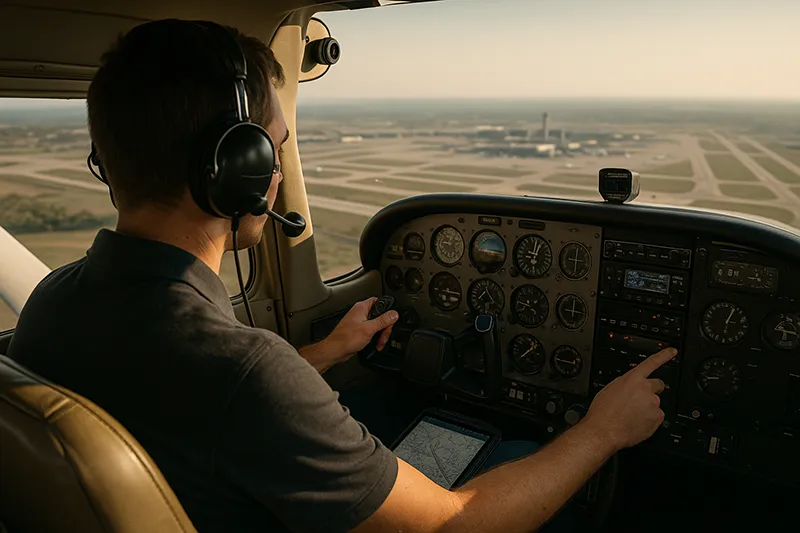
Controlled airspace is one of the most important topics a pilot learns, and understanding it well can substantially reduce in-flight stress. Pilots who can identify controlled airspace, anticipate how air traffic control (ATC) will interact with them, and integrate airspace information into preflight and in-flight decision making operate more confidently and safely.
This article explains controlled airspace in practical terms for pilots, student pilots, flight instructors, and aviation professionals. It focuses on how knowledge, preparation, and simple cockpit procedures reduce workload and anxiety when transitioning through controlled airspace or flying in busy terminal areas. Throughout the article you will find operational takeaways, a realistic scenario, common pilot mistakes, and an FAQ to sharpen your situational judgment.
What Controlled Airspace Is and How It Affects Pilots
Controlled airspace describes areas of the flight environment where ATC services are provided and where flight operations must conform to specified rules. The goal is to protect aircraft from collisions and to manage traffic flow around airports and in busy routes. For pilots, the presence of controlled airspace affects flight planning, communications, required equipment, authorization, and the level of ATC interaction during a flight.
Controlled airspace comes in different types and configurations. In practical flying terms, the key points are: know where the boundaries are, know whether you need to obtain clearance before entering, and know what level of ATC service to expect. This knowledge shortens decision time, reduces radio uncertainty, and reduces stress when ATC asks for intentions or issues instructions.
Why This Matters in Real-World Aviation
Understanding controlled airspace matters because most operational errors and conflicts near airports occur when pilots are uncertain about their rights and responsibilities relative to ATC. Stress and surprise degrade pilot performance. When a pilot is unsure whether they need a clearance, what frequencies to monitor, or how to set up navigation and radios, workload increases and attention shifts away from flying the airplane.
From a training perspective, controlled airspace is where student pilots gain critical skills: communication discipline, scanning while talking to ATC, anticipating vectoring or instructions, and managing cross-cockpit duties. For instructors and examiners, controlled airspace is a reliable environment to observe CRM, radio technique, and decision making under gradually increasing complexity.
Operationally, commercial operators and instrument pilots routinely rely on a predictable ATC environment to meet schedules and comply with procedures. General aviation pilots can use that same predictability with proper preparation: having the right frequencies set, understanding arrival and departure flows, and knowing options for rerouting or holding if needed.
How Pilots Should Understand This Topic
Move beyond memorizing airspace maps. Convert airspace knowledge into operational habits that reduce stress. These habits include preflight airspace review, setting up radios and navigation before entering busy airspace, and rehearsing short phraseology for common situations. Think of controlled airspace as a cooperative environment: ATC manages flows and provides separation within the system, but you must provide timely, accurate information and maintain basic airmanship.
When planning, identify the controlled segments of your route. Note where you will contact ATC or where you will enter terminal control areas. Add those frequencies and expected points of contact to your kneeboard or electronic flight bag. Anticipate calls you might receive and craft concise responses. For example, be ready to state your call sign, aircraft type, position, altitude, and intentions in short, clear phrases. This minimizes radio time and reduces cognitive load while communicating.
Inside controlled airspace, manage your workload with small, repeatable tasks. Complete one cockpit action before handling the next radio call when possible. Use simple readbacks to ensure mutual understanding with ATC. If you need time to comply with a request, tell ATC you need a minute and then execute. These small behaviors keep you in command and reduce stress when traffic or ATC instructions become complex.
Common Mistakes or Misunderstandings
Pilots often make similar errors around controlled airspace that increase stress and risk. Recognizing these common mistakes helps you avoid them.
- Poor preflight airspace review. Many pilots focus on weather and performance but underprepare for the airspace environment. Missing a frequency change or an airspace boundary creates scrambling and rushed radio calls.
- Assuming ATC will provide everything. Controlled airspace brings services, but ATC does not relieve you of basic navigation, collision avoidance, or planning responsibilities. Expect assistance, but carry situational awareness.
- Poor radio technique. Long, rambling transmissions cause confusion. Not listening for instructions while transmitting leads to missed clearances.
- Failure to configure avionics early. Waiting until after a clearance to set frequencies or approach plates forces multitasking during high workload phases.
- Not having contingency plans. Pilots without clear diversion or missed approach plans can become fixated when ATC vectors them away from familiar landmarks.
- Overreliance on automation without monitoring. Autopilot or route guidance can mask position errors. Always cross-check navigation fixes and altitudes against raw data.
Practical Example
Scenario: A VFR cross-country flight approaches a busy terminal area. The pilot must transit controlled airspace to reach an uncontrolled field on the other side. Before departure, the pilot reviews sectional charts, notes the Class C and Class D airspaces along the route, and programs the GPS with a waypoint to the airport. The pilot adds the tower and approach frequencies to the kneeboard and sets the transponder to the required code for flight following.
Fifteen minutes out, the pilot requests flight following on the common frequency and is given a squawk code and an advisory frequency. The controller provides traffic advisories and a heading to avoid final approach to the primary airport. The pilot repeats the readback succinctly, makes the required power and avionics changes, and sets up for the transition. Because the radios and plates were preloaded and the pilot anticipated a possible vector, handling the transition is calm and methodical.
When the controller later issues an unexpected reroute to avoid a temporary flight restriction, the pilot acknowledges and confirms a brief delay to reprogram the GPS. The pilot advises the controller that they need one minute to reconfigure. ATC approves the delay. Because the pilot communicated clearly, the reroute is executed without confusion, and the pilot maintains control of the airplane throughout.
Best Practices for Pilots
Adopt these habits to lower stress and improve performance in controlled airspace.
- Preflight airspace scan. Before engine start, review the route for controlled airspace, identify the segments where contact with ATC is required, and note alternate options if you cannot comply with an instruction.
- Set radios and navigation early. Tune the frequency you will use to contact ATC before you reach the boundary, and preload approach or arrival charts when practical.
- Use simple, standardized phraseology. Short, direct transmissions are easier for ATC to process and reduce the need for clarification.
- Establish task flow in the cockpit. Break actions into small steps such as fly, trim, brief, then communicate. This sequence prevents being overwhelmed during handoffs and vectors.
- Confirm clearances with readbacks. Read back numbers and headings precisely to confirm mutual understanding. If an instruction seems unsafe or unclear, ask for clarification immediately.
- Plan contingencies. Know nearby airports and potential altitudes to maintain VFR if communications fail or if ATC cannot accommodate your request.
- Practice phraseology on the ground. Run quick radio rehearsals with an instructor or partner so that typical exchanges become second nature.
- Use ATC services proactively. Request flight following, VFR advisories, or traffic information when available. These services reduce the mental load of scanning for traffic alone.
How Controlled Airspace Interacts with Instruments and Technology
Modern avionics and traffic information systems make controlled airspace easier to navigate, but they require correct setup and active monitoring. ADS-B traffic displays, moving maps, and synthetic vision contribute to situational awareness when used properly. However, technology can also increase complacency. A traffic advisory without verification of relative position still requires a visual scan and cross-checking against raw navigation sources.
Before entering controlled airspace, verify that your equipment meets the requirements for the airspace you expect to fly through. Ensure transponder operation, ADS-B status, and GPS integrity. If a required piece of equipment is inoperative, brief a plan for communicating that to ATC and for complying with any restrictions that might apply.
Training Recommendations for Instructors and Students
Flight instructors should incorporate controlled airspace scenarios progressively. Begin with low-complexity transits and build toward busy terminal approaches. Use realistic radio sessions where the student practices short, accurate transmissions, listens for instructions while flying, and performs simple reroutes. Introduce distractions that simulate real-world pressure, then debrief the student on decision making and stress management.
Students should log airspace transits and review each flight to identify stress points and communication gaps. Repetition reduces cognitive load. Pairing live practice with simulator or desktop exercises for complex procedures helps students rehearse without the time pressure of real flights.
Common Misunderstandings About ATC Responsibilities
Some pilots expect ATC to fully protect their flight without pilot contribution. In controlled airspace, ATC provides separation services appropriate to the class of airspace and the traffic situation. Pilots must still navigate accurately, comply with minimum safe altitudes, and remain alert to traffic. If ATC issues an instruction that would compromise safety, it is the pilot's responsibility to refuse or request an alternative. Clear, timely communication resolves most of these conflicts.
Another misunderstanding is that a clearance relieves a pilot of all situational responsibility. A clearance defines what is authorized but does not remove the pilot's duty to maintain aircraft control or to advise ATC if unable to comply.
Dealing with Unexpected ATC Instructions
Controllers sometimes issue unexpected headings, altitude changes, or reroutes to manage traffic. Your response keeps the situation calm. If you receive an unexpected instruction, quickly evaluate whether you can comply safely. If you can, acknowledge and execute. If you cannot, state your limitation succinctly and offer an alternative. For example, say, "Unable at present, request 2-minute delay to reconfigure." Controllers are used to short, precise statements and will work with you.
If ATC provides a rapid sequence of instructions, use concise readbacks and prioritize flying the airplane. If necessary, tell ATC you are unable to comply immediately and then complete the necessary cockpit tasks. It is better to gain a momentary delay than to accept an instruction and then become overloaded.
When to Ask for Help or Decline an Instruction
Request assistance or clarification whenever an instruction is unclear, conflicts with terrain or performance limits, or would place the aircraft in an unsafe configuration. Declining an instruction is a judgment call, but controllers expect pilots to speak up about safety. Use plain language when safety is at risk. Offer a concise explanation and a reasonable alternative. Typically, controllers will adjust to maintain safety and traffic flow.
Frequently Asked Questions
Do I always need ATC clearance to enter controlled airspace?
Requirements vary with the type of controlled airspace and your flight rules. In many terminal areas, ATC must authorize entry. As a pilot, identify the airspace boundaries and the expected communication point before you reach them. If in doubt, contact the controlling facility for instructions well before the boundary.
How can I reduce radio workload while flying in controlled airspace?
Prepare by setting frequencies and loading approaches in advance. Use short, structured transmissions and practice standard readbacks. If you need time to comply, tell ATC you need a brief moment. Use onboard autopilot and trim to reduce manual workload while you converse with ATC.
What should I do if I lose communications in controlled airspace?
Follow the lost communications procedures that match your flight rules and airspace. Squawk the appropriate transponder code if available, and continue to the nearest safe landing option if necessary. Also consult facility-specific guidance and be prepared to execute a published procedure if one applies to your situation.
Is flight following the same as clearance into controlled airspace?
Flight following provides traffic advisories and basic traffic information in many situations, but it is not the same as being cleared into certain controlled zones or special use areas. Always verify whether you need a specific clearance for the airspace you intend to enter and request it before crossing the boundary.
How do I practice radio calls and airspace transits without a busy field?
Use a simulator, a desktop flight planning app, or a flight instructor to role play ATC exchanges. Practice readbacks, radio discipline, and contingency statements. Rehearsal makes real-world communications simpler and reduces anxiety.
Key Takeaways
- Practical takeaway: Preflight airspace review and early radio setup transform unknowns into predictable actions.
- Safety takeaway: Maintain situational awareness and be ready to decline or clarify instructions that compromise safety.
- Training takeaway: Practice radio technique, short readbacks, and contingency planning until they become procedural memory.
Controlled airspace does not need to be a source of stress. Treat it as an operational environment with predictable rules and services. By shifting preparation earlier, managing cockpit task flow, rehearsing communications, and maintaining situational awareness, pilots shorten decision times and reduce the mental load when ATC interactions intensify.
If you are a flight instructor, integrate controlled airspace maneuvers progressively and emphasize decision making as well as radio discipline. If you are a student pilot, prioritize small wins: set frequencies early, practice concise transmissions, and review controlled airspace diagrams before every flight. Over time these habits build confidence and reduce stress around controlled airspace operations.