
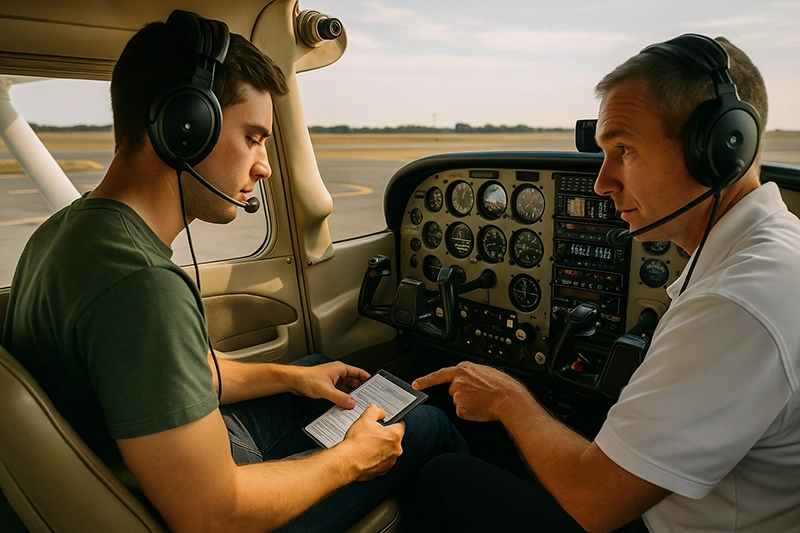
Crew resource management, or CRM for student pilots, is more than a set of procedures. It is a mindset and a collection of practical skills that reduce pilot stress, improve decision-making, and build safer flying habits from the earliest stages of training. For student pilots and instructors, treating CRM as an operational skill rather than an abstract concept shortens the learning curve for handling workload, unexpected events, and interpersonal pressures in the cockpit.
This article explains how CRM principles apply specifically to student pilots, why CRM matters in real flight training, and how instructors can structure lessons to reduce stress while building competence. Throughout the article you will find practical examples, common misunderstandings, training-focused best practices, and a set of frequently asked questions tailored to trainees, instructors, and flight schools.
What CRM Means for Student Pilots
CRM began as a human factors program for multi-crew operations, but the core ideas translate directly to single-pilot and student environments. At its heart, CRM is about using all available resources to maintain safety and accomplish the mission. Resources include personal skills like situational awareness and stress management, equipment and automation, external resources such as ATC and instructors, and standard operating procedures.
For student pilots, CRM focuses on five practical areas: situational awareness, task and workload management, communication, decision-making, and personal readiness. Developing these areas early reduces cognitive overload and the stress response when things do not go exactly as planned. Student-level CRM is not about formal checklists only. It is about shaping habits and attitudes that scale as a pilot progresses from solo training to cross-country flights and eventually to complex or multi-crew environments.
Why This Matters in Real-World Aviation
Training environments present unique stressors. Students are learning new procedures, controlling aircraft for the first time, and often coping with performance anxiety. When stress rises, attention narrows and errors increase. Integrating CRM into training reduces those risks by giving trainees structured ways to manage attention, ask for help, and use tools effectively.
Operationally, CRM for student pilots improves outcomes in several ways. It reduces task saturation during takeoff, pattern work, and emergency practice by promoting pre-entry briefings and clear role expectations. It encourages proactive communication with instructors and ATC, preventing misunderstandings. And it helps students practice decision-making under pressure, making them less likely to become immobilized when unplanned situations occur.
How Pilots Should Understand and Apply CRM
Translate CRM into training by teaching simple, repeatable actions that fit naturally into every flight. Situational awareness is more than knowing the airplane's position. It is actively monitoring the flight path, weather, traffic, and the airplane's performance trends. Workload management means sequencing tasks and using callouts, not attempting everything at once. Communication includes precise radio technique and clear briefings between student and instructor.
Start with preflight routines that build habits. A concise preflight briefing should cover the lesson objectives, roles during the flight, likely challenges, and a go/no-go decision point. That briefing sets expectations and reduces uncertainty. During the flight, short, structured callouts keep both pilot and instructor aligned. After the flight, prompt debriefs focusing on decisions and mental states help students reflect and learn faster.
Practical CRM Elements for Early Training
Preflight intent brief: Student states the lesson objective, planned route, and personal concerns.
Task sequencing: Break maneuvers into phases and verbalize next steps.
Simple cross-checks: Establish routine instrument and outside scans that become automatic.
Decision points: Define explicit points for continuation or termination of a maneuver or flight.
After-action debrief: Focus on one or two decisions and how stress affected performance.
Common Mistakes and Misunderstandings
Many trainers assume CRM belongs only in airline or multi-crew contexts. That misconception delays exposing students to vital human factors skills. Another common mistake is teaching CRM as a long lecture rather than integrating it into normal flying. Without practical repetition, CRM concepts remain theoretical and are unlikely to influence behavior under stress.
Students and instructors also often underestimate the role of personal readiness. Fatigue, poor nutrition, or emotional distraction degrade cognitive performance. Treating CRM as purely procedural misses the opportunity to teach students how to recognize and mitigate personal limitations before flight.
Finally, there is a tendency to overload students with too many CRM techniques at once. Introducing one or two CRM skills per lesson and reinforcing them through repetition and debriefs is a more effective strategy.
Practical Training Example: Crosswind Pattern with an Unexpected Radio Failure
Scenario: A student is practicing a crosswind landing pattern at a training airport with their instructor on board. During downwind, the student notices increasing crosswind and a momentary loss of radio transmit audio. The student feels tense and unsure whether to continue the pattern or conduct a precautionary action.
How CRM reduces stress and improves the outcome:
Preflight and pre-leg brief: Before the flight, the student and instructor discussed personal limits for crosswind and a clear plan if the radio failed. This set a decision point at 10 knots crosswind and assigned roles for monitoring and communicating since the instructor may need to take more control.
Recognition and communication: On downwind, the student recognizes the radio anomaly and announces the problem out loud to the instructor. Early verbalization reduces stress by externalizing the issue and invites quick input from the instructor.
Task management: The student applies task sequencing: fly stabilized approach first, then address radio at a lower workload phase. The instructor takes a position to assist with aircraft control, allowing the student to maintain aircraft state while troubleshooting.
Back-up resources: Using the prebriefed decision point, the student chooses to accept a longer downwind to stabilize the approach and request a frequency change using the alternate radio or a handheld. If workload becomes unsustainable, the instructor is prepared to take control for a safe landing.
Debrief: After the flight, the instructor leads a short debrief focusing on the student's decision-making and stress awareness. The debrief reinforces the correct use of CRM tools and identifies one specific behavior to practice on the next sortie.
Best Practices for Instructors and Students
Instructors set the tone for CRM by modeling calm, structured behavior and by using short, focused coaching moments rather than long lectures. Create a training environment where asking for help is normal and expected. Explicitly teach students how to monitor their mental state and when to call for a pause or landing.
For students, build a small toolkit of CRM habits:
Use a two-minute preflight briefing template that covers objectives, weather, radios, personal limits, and a single safety decision point.
Practice concise callouts in the cockpit to share intent and status with the instructor.
Adopt a scan routine that balances instrument and outside references based on the phase of flight.
Learn simple verbal anchors for stress: short phrases that refocus attention, such as "Aviate, Navigate, Communicate" in the order appropriate to the flight context.
After each flight, perform a two-minute structured debrief: one strength, one improvement, and one action item.
Training Curriculum Suggestions
Rather than a single CRM module, integrate CRM across the curriculum. Begin with preflight and basic pattern work, adding complexity as students demonstrate competence. Use simulated stressors, such as time pressure or minor equipment anomalies, in a controlled way so students can practice CRM responses without real risk.
Scenario-based training works well. Design lessons where the primary objective is decision-making, communication, or workload management rather than perfecting a single maneuver. This approach helps students transfer CRM skills to real flying where conditions rarely follow a script.
Measuring Progress Without Complex Metrics
Objective measurement in early training does not require advanced data systems. Simple indicators provide useful feedback: consistent preflight briefings, fewer instructor interventions during maneuvers, timely and clear callouts, and concise debrief reflections. Track these behaviors through a training log or short instructor notes to monitor improvement.
Common Misunderstandings About Automation and CRM
Students may view automation as a stress reliever, which is sometimes true, but it can also introduce new demands. Overreliance on automation can degrade basic flying skills and situational awareness. Teach students to use automation deliberately with clear mental models of what it is doing and how to revert to manual control smoothly.
Another misunderstanding is that CRM is only about other people. CRM includes managing automation, checklists, and personal factors. For a student pilot, these non-human resources are often the most immediate and useful tools for reducing stress.
How to Integrate Stress Management into CRM Training
Stress management techniques do not need to be complicated to be effective. Teach students how to recognize signs of acute stress: rapid breathing, tunnel vision, or indecision. Simple breathing control and brief self-talk can stabilize the physiological response and restore cognitive function.
Pair stress-recognition training with decision rules. If the student notices warning signs, a pre-agreed rule can call for a safe, conservative action such as requesting the instructor to take controls, entering a holding pattern, or performing an instrument scan to reset focus. Combining a behavioral plan with stress-awareness makes responses automatic rather than improvised.
Common Mistakes or Misunderstandings
1. Treating CRM as optional. CRM skills are critical safety tools. Waiting until advanced training leaves students unprepared for stress-related errors.
2. Overloading students with too many concepts at once. Introduce CRM incrementally and reinforce through repetition.
3. Neglecting personal readiness. Students sometimes assume skills alone are enough. Teach self-assessment for fitness to fly.
4. Relying solely on technology. Automation aids are valuable, but pilots must maintain basic manual flying and decision-making skills.
Frequently Asked Questions
How early should CRM be introduced in pilot training?
Introduce CRM from the first lessons in a lightweight, practical form. Simple preflight briefings and clear callouts can be taught immediately. More advanced CRM topics can be layered in as the student progresses.
Can CRM be taught in a single ground school class?
Conceptual classes help, but CRM must be practiced in flight to be effective. Combine brief ground lessons with in-flight reinforcement and focused debriefs.
Are CRM techniques different for single-pilot and multi-crew operations?
The underlying principles are the same: use all available resources, communicate clearly, and manage workload. The specific tactics differ. Single-pilot CRM emphasizes automation management, task sequencing, and use of external resources such as ATC or instructors.
How can an instructor assess a student's CRM skills objectively?
Use observable behaviors: consistent preflight briefings, timely callouts, appropriate decision points, and the ability to manage workload without repeated instructor intervention. Short instructor notes or a training card can track these behaviors over time.
What role does personal fitness play in CRM?
Personal fitness is foundational. Fatigue, illness, emotional stress, and medications affect cognition and should be assessed before flight. Teach students simple self-check routines to determine fitness to fly.
How should students practice CRM between lessons?
Encourage mental rehearsal and written briefings before flights. Use simulation or desktop scenarios to talk through decision-making and communication steps, and keep a short debrief log after each flight focusing on one CRM skill.
Key Takeaways
- Practical takeaway: Integrate CRM early through concise preflight briefings, structured callouts, and brief debriefs so skills become habits.
- Safety takeaway: CRM reduces stress-driven errors by giving students repeatable ways to manage workload, communicate, and use resources.
- Training takeaway: Teach CRM incrementally, reinforce it during flight, and use scenario-based lessons to measure behavioral improvement.
CRM for student pilots is an investment in habit formation. When instructors intentionally build CRM into everyday training, students learn to manage stress, maintain situational awareness, and make better decisions. These skills pay dividends throughout a pilot's career, improving safety and reducing the likelihood of error under pressure.