
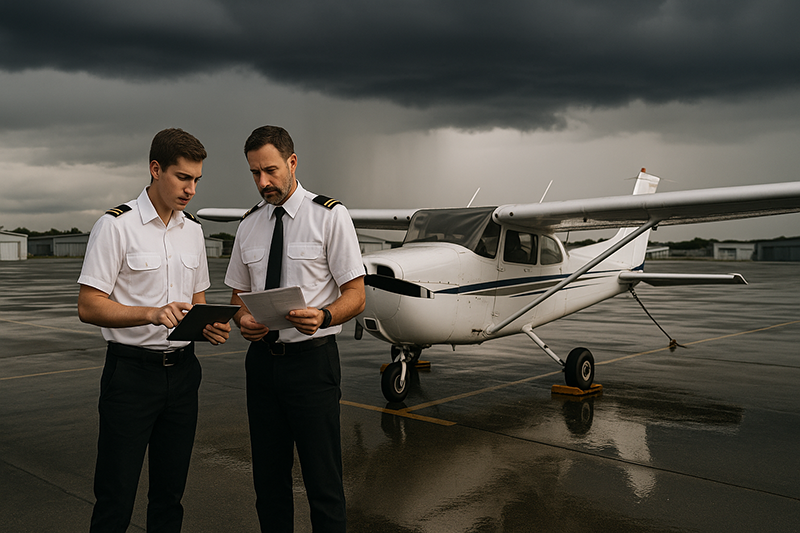
Delaying a flight is one of the most important safety decisions a pilot can make, yet it is also one of the easiest decisions to rationalize away. Pilots are trained to complete flights, manage changing conditions, and solve problems, but good aeronautical decision-making also means recognizing when the safest action is to wait. A delay is not a failure of planning. In many cases, it is the visible result of disciplined planning.
For student pilots, flight instructors, private pilots, commercial pilots, and aviation professionals, the question is rarely as simple as “Can we go?” A better question is “Can we go with a comfortable safety margin, a realistic plan, and a workable alternative if conditions deteriorate?” This article explains how pilots should think about delay decisions, why they matter in real-world operations, and how to recognize the difference between manageable inconvenience and unacceptable risk.
Why Delaying a Flight Is a Safety Decision
Aviation rewards preparation, but it also punishes stubbornness. A pilot may complete the preflight planning perfectly and still face a valid reason to delay. Weather may move faster than forecast. A maintenance concern may appear during preflight. A passenger may become ill. A runway closure may change the departure plan. The aircraft may be legal, the pilot may be current, and the route may be familiar, yet the combination of conditions may still make waiting the better choice.
Delaying a flight is a form of risk control. It reduces exposure to conditions that are beyond the pilot’s current capability, outside the aircraft’s practical performance margin, or inconsistent with the operation’s safety goals. It can also preserve options. A pilot who delays before departure still has access to the ramp, maintenance support, weather briefings, fuel services, rest, instructors, dispatchers, and other resources. A pilot who launches into a deteriorating situation may have fewer choices and less time.
There is an important mindset shift here. A delay is not simply an administrative inconvenience. It is an operational decision. It deserves the same seriousness as a go-around, rejected takeoff, diversion, or missed approach. In each case, the pilot is choosing a safer path when the original plan no longer provides enough margin.
The strongest pilots are not the ones who never delay. They are the ones who delay early enough that the decision remains calm, deliberate, and controllable.
Why This Matters in Real-World Aviation
In the training environment, delay decisions teach students how to manage risk before the airplane ever moves. A student who learns to delay because of marginal weather, fatigue, aircraft discrepancies, or weak personal readiness is learning the same judgment that will later apply to more complex aircraft and missions. Flight instructors should treat these decisions as teachable moments, not schedule interruptions.
In personal flying, delay decisions often involve social pressure. A family event, hotel reservation, business meeting, or passenger expectation can make a pilot feel obligated to depart. This is where external pressure becomes one of the most powerful hazards in aviation. The aircraft does not know that the pilot promised to arrive by dinner. The weather does not improve because the passengers are waiting. The runway does not become longer because the calendar is full.
In professional aviation, delay decisions may involve dispatch coordination, maintenance control, crew duty considerations, passenger expectations, company procedures, and operational control. Professional pilots often have more resources than a solo private pilot, but they may also face stronger production pressure. A mature safety culture recognizes that delaying a flight can be the most professional decision available.
Delays also matter because many unsafe outcomes are not caused by one dramatic error. They develop from a chain of small concessions. The pilot accepts a slightly lower ceiling than expected. Then a headwind reduces fuel flexibility. Then a passenger becomes anxious. Then a destination airport reports a runway condition change. Each factor may be manageable alone, but together they can reduce the pilot’s options. Delaying before the chain develops is often easier than recovering after several margins have already eroded.
How Pilots Should Understand the Delay Decision
A practical delay decision begins with margins. Pilots already think in margins when calculating fuel, runway distance, climb performance, weight and balance, weather minimums, alternates, daylight, and personal readiness. The real question is whether those margins are generous enough for the flight actually being attempted, not merely whether the plan appears possible on paper.
Legal minimums are not the same as personal or operational minimums. A flight may comply with applicable rules and still be a poor choice for a particular pilot, aircraft, passenger load, route, or time of day. A newly certificated private pilot, a rusty instrument pilot, and a highly experienced flight instructor may reasonably make different delay decisions under the same conditions. That does not mean the safest pilot is always the most conservative. It means the safest pilot is the one who honestly matches the plan to the risk.
Weather is the most obvious reason to delay, but it is not the only one. Pilots should also consider aircraft condition, pilot condition, airport conditions, route complexity, airspace requirements, passenger factors, and time pressure. A safe delay decision often comes from seeing how those categories interact. For example, a crosswind that is normally acceptable may be less acceptable at night, on a wet runway, after a long duty day, with an unfamiliar aircraft, or with a student pilot who has not recently practiced crosswind landings.
Risk management tools can help structure the thinking. Many pilots use simple models such as pilot, aircraft, environment, and external pressures. Others use personal minimums, preflight risk assessment forms, or a “what would make me stop?” discussion before departure. The tool matters less than the discipline behind it. If a pilot fills out a risk assessment and then ignores the result because the airplane is already fueled, the tool has failed its purpose.
The best time to decide on delay criteria is before the flight becomes emotionally loaded. Pilots can ask: What ceiling or visibility would cause me to wait? What crosswind would make me change runways, delay, or cancel? What fatigue level is unacceptable? What maintenance finding requires a mechanic’s review? What fuel reserve makes me uncomfortable for this route? These questions are easier to answer at home or in the briefing room than on a ramp with passengers watching.
Weather Delays: More Than Ceiling and Visibility
Weather delays are not only about whether the reported conditions meet a published minimum or a personal minimum. The trend matters. The route matters. The terrain matters. The aircraft equipment matters. The pilot’s recent experience matters. A flight in improving weather can be a very different risk from a flight in deteriorating weather, even if the current observation looks similar.
For VFR pilots, marginal visibility and low ceilings can reduce options quickly. A route that looks possible at departure may become difficult if ceilings lower over rising terrain or visibility decreases in precipitation, haze, smoke, or darkness. Delaying a VFR flight may be the safest choice when the pilot cannot maintain comfortable terrain clearance, visual reference, and route flexibility without pressing into conditions that demand instrument proficiency.
For IFR pilots, delay decisions may involve convective weather, icing potential, turbulence, low instrument approach conditions, alternate planning, fuel strategy, aircraft capability, and crew proficiency. Instrument training can give pilots more tools, but it does not eliminate weather risk. A capable instrument pilot still needs to consider whether the aircraft is suitable for the forecast conditions and whether the available alternates are realistic.
Thunderstorms deserve special respect. They can change rapidly and affect wide areas with turbulence, lightning, heavy precipitation, hail, wind shear, and outflow boundaries. A pilot who delays for convective weather may avoid being forced into a choice between an uncomfortable deviation and an unsafe penetration. Waiting for a line of storms to pass, delaying until a more stable weather pattern develops, or choosing a different route may be far safer than trying to “thread the needle.”
Wind is another common reason to delay. Crosswind, gust spread, mechanical turbulence, and wind shear can all raise workload and reduce landing margin. A student training flight may be delayed because the wind exceeds the lesson objective, while the same wind might be useful for dual instruction with an experienced instructor. Context matters. The delay decision should fit the pilot’s proficiency, the aircraft, the runway environment, and the purpose of the flight.
Aircraft Condition and Maintenance Concerns
Not every aircraft issue is a grounding item, but every aircraft concern deserves disciplined evaluation. Pilots should avoid the temptation to normalize small discrepancies simply because the aircraft flew recently or because the schedule is tight. A fluid leak, unusual vibration, abnormal engine indication, questionable tire condition, damaged component, avionics problem, or uncertain logbook status may justify a delay until the issue is understood.
One of the most hazardous phrases in preflight decision-making is “It’s probably fine.” Sometimes it is fine. Sometimes it is a clue that the pilot lacks enough information. A delay allows time to consult maintenance personnel, review aircraft documents, check the minimum equipment provisions that apply to the operation if any, or select another aircraft. The goal is not to overreact to every minor item. The goal is to avoid launching with unresolved doubt about airworthiness or reliability.
Training aircraft present their own challenges. They fly frequently, are handled by many students, and may have minor wear that becomes familiar to local pilots. Familiarity can be useful, but it can also make pilots less sensitive to changes. If something looks, smells, sounds, or feels different, a delay is often appropriate until the difference is explained.
Aircraft performance concerns also belong in the delay conversation. High density altitude, short runways, contaminated surfaces, heavy loading, or obstacles may turn a routine departure into a marginal one. Pilots should not treat performance charts as paperwork. They are part of the safety margin. If the numbers are close, the conditions are changing, or the pilot is uncertain about the assumptions, delaying for cooler temperatures, less weight, more favorable wind, or a different runway may be the prudent choice.
Pilot Readiness: Fatigue, Stress, and Proficiency
Pilot readiness is often the hardest delay factor to admit because it feels personal. Weather and maintenance are external. Fatigue, stress, distraction, illness, and proficiency are internal. Yet they can be just as important as any aircraft or environmental factor.
Fatigue affects attention, memory, communication, and decision-making. A tired pilot may still feel capable, especially when motivated to complete the flight. That is what makes fatigue so insidious. The pilot’s ability to judge personal performance may be degraded at the same time performance is degraded. Delaying for rest is not weakness. It is a recognition that flying requires mental capacity as much as stick-and-rudder skill.
Stress and distraction matter as well. A pilot dealing with family issues, financial pressure, workplace conflict, or time stress may bring those distractions into the cockpit. The aircraft may be airworthy and the weather may be favorable, but the pilot may not be in a condition to manage abnormal events well. A delay creates space to reset, brief, delegate, or decide that today is not the right day to fly.
Proficiency is different from currency. A pilot may meet recent experience requirements and still be uncomfortable in a specific condition, such as night cross-country flying, instrument approaches to minimums, gusty crosswinds, complex airspace, or mountain operations. A delay may be appropriate if the flight demands skills that the pilot has not practiced recently. Better still, the pilot might convert the situation into a training opportunity with an instructor on another day.
External Pressure and the Psychology of Waiting
External pressure is a central reason pilots continue flights or depart when delaying would be safer. It can come from passengers, employers, customers, instructors, aircraft rental schedules, financial cost, reputation, or the pilot’s own desire to complete the mission. The pressure may be subtle. No passenger has to say “You must go” for a pilot to feel obligated.
One effective technique is to brief passengers before the day of departure that delays are a normal part of safe aviation. A pilot can say, “We will go if the weather, aircraft, and schedule give us enough margin. If not, we will wait or make another plan.” This sets the expectation that safety decisions are part of the operation, not surprises or excuses.
Instructors can help by praising good delay decisions. Students quickly learn what an organization truly values. If a student delays for low ceilings and the instructor responds with frustration, the lesson is damaging. If the instructor reviews the decision and explains why waiting was appropriate, the student learns professional judgment.
Professional crews and aviation managers should also recognize that production pressure can shape decisions. A system that says safety comes first but punishes every delay creates mixed signals. Good organizations make delay decisions reviewable, explainable, and supported when they are based on sound risk management.
Common Mistakes or Misunderstandings
One common mistake is waiting too long to delay. Pilots sometimes treat delay as a last resort after every other plan has become difficult. A better approach is to identify triggers early. If the weather trend does not improve by a certain time, delay. If the aircraft discrepancy cannot be resolved before a reasonable cutoff, delay. If the pilot cannot get adequate rest, delay. Early decision points reduce stress and prevent rushed departures.
Another mistake is confusing inconvenience with risk. A delay may cost money, disrupt plans, or disappoint passengers. Those consequences are real, but they are not the same category of consequence as launching into a flight with inadequate safety margin. Pilots should acknowledge inconvenience honestly while keeping it separate from the flight safety decision.
A third misunderstanding is believing that experience eliminates the need to delay. Experience should improve judgment, not replace it. Experienced pilots may have more capability, but they also may be exposed to more complex missions and stronger pressure. A pilot with thousands of hours can still make a poor decision if the risk is normalized or the mission becomes too important.
Pilots also sometimes rely too heavily on a single favorable factor. Clear skies at departure do not eliminate concerns about destination weather. A long runway does not eliminate performance concerns if the aircraft is heavy and the density altitude is high. An instrument rating does not make all weather acceptable. A familiar route does not remove the need to evaluate current conditions. Risk is cumulative.
Finally, some pilots treat cancellation and delay as the same thing. They are different. A delay keeps options open. It may mean waiting two hours for fog to lift, departing after a frontal passage, taking a later route around weather, resting overnight, or changing aircraft. Framing the decision as “delay and reassess” can make it easier to choose safety without feeling that the entire mission has failed.
Practical Example: A Cross-Country That Should Wait
Consider a private pilot planning a Saturday morning VFR cross-country in a normally aspirated single-engine training aircraft. The route is familiar, the passengers are excited, and the destination airport is near a family event. The original plan called for an early departure, smooth air, and a comfortable arrival before midday.
During the morning briefing, the pilot notices several concerns. Ceilings along the first half of the route are lower than expected, visibility is reduced in areas of mist, and the destination forecast suggests gusty crosswinds later in the day. The aircraft is near its planned loading limit with passengers and baggage, and the temperature is forecast to rise. None of these factors alone automatically means the flight cannot be completed. Together, they reduce margin.
The pilot has several choices. Depart immediately and hope the ceiling improves en route. Change the route to remain over lower terrain but add time and fuel burn. Leave baggage behind and reduce weight. Wait for updated observations. Call an instructor or more experienced pilot to discuss the plan. Consider driving instead.
A disciplined pilot chooses to delay and reassess. After two hours, the mist improves but the crosswind at the destination has increased. The pilot decides the flight is no longer appropriate for the passengers, the loading, and the expected landing conditions. The family event is inconveniently missed, but the pilot’s decision is sound. The airplane remains on the ramp, the passengers are safe, and the pilot has reinforced a habit that will matter on future flights.
The important point is that the pilot did not need an emergency, a regulation violation, or a dramatic weather report to justify waiting. The risk picture simply did not provide enough margin for that pilot, aircraft, mission, and day.
Best Practices for Pilots
The best delay decisions are made before pressure becomes intense. Pilots should build delay thinking into normal preflight planning. This does not require a complicated system. It requires honest thresholds, realistic alternatives, and a willingness to act on the information available.
Personal minimums are especially useful when they are specific and current. A vague statement such as “I won’t fly in bad weather” is not very helpful. A more useful approach identifies the conditions that would cause a delay for a particular type of flight, aircraft, and pilot. Those minimums should evolve with training, proficiency, and experience, but they should not be casually adjusted on the ramp to fit a desired departure.
Pilots should also brief alternatives early. If the plan depends on perfect timing, perfect weather, and perfect aircraft availability, the plan is fragile. A stronger plan includes options: a later departure time, a fuel stop, a different route, a different aircraft, a training delay, an overnight stop, or a decision to drive. Alternatives reduce the emotional cost of waiting.
A simple set of best practices can help:
- Set delay triggers before departure, including weather, wind, fuel, fatigue, maintenance, and passenger factors.
- Separate legal minimums from personal minimums and operational comfort.
- Reassess the whole risk picture when one factor changes, not just the changed item.
- Use instructors, dispatchers, maintenance personnel, and experienced pilots as resources when appropriate.
- Brief passengers that waiting, diverting, or canceling are normal aviation safety choices.
- Document lessons learned after significant delay decisions so future planning improves.
Instructors should teach delay decisions deliberately. Instead of only asking students to determine whether a flight is legal, ask whether it is wise. Ask what would make the student wait. Ask how the plan changes if the wind increases, the ceiling drops, the passenger is late, or the aircraft has an unresolved discrepancy. These questions develop the judgment that cannot be learned from maneuvers alone.
How Flight Instructors Can Teach Delay Judgment
Flight instructors influence how new pilots define professionalism. If every weather delay is treated as lost revenue or lost progress, students may learn that the schedule matters more than risk management. If delay decisions are reviewed as part of training, students learn that conservative judgment and mission discipline are normal parts of flying.
A useful teaching technique is to compare three decisions: go, delay, and cancel. Students often think in binary terms, but aviation decisions are rarely that simple. A delay may allow the weather to improve, maintenance to inspect a concern, the pilot to rest, or the lesson objective to be changed. For example, a day that is unsuitable for a solo cross-country may still be useful for dual ground training, simulator work, flight planning practice, or a local dual lesson in appropriate conditions.
Instructors should also avoid using personal experience as the only standard. Saying “I would go” may not help a student understand why. Better instruction explains the factors: ceiling, visibility, wind, terrain, alternates, student proficiency, aircraft capability, lesson objective, and escape options. The goal is not to make students fearful. The goal is to teach them how to build and protect margins.
Professional Operations and Delay Decisions
In professional aviation, the decision to delay may involve more people, but the safety principle remains the same. Crews may coordinate with dispatch, maintenance control, ramp personnel, air traffic control, and management. The process may be formal, but the operational question is familiar: does the flight have enough safety margin to proceed as planned?
Professional pilots should be alert to subtle normalization. If a route is flown every day, unusual risk factors can appear routine. If delays are common during certain seasons, crews may feel pressure to accept marginal conditions because “that’s just how it is.” Standard operating procedures, crew resource management, and dispatch support are designed to help, but they work only when pilots speak up early and clearly.
A good delay decision in professional operations is specific. Instead of saying “I don’t like it,” the crew can identify the controlling concerns: convective weather along the route, destination braking action reports, aircraft equipment status, crew fatigue, fuel planning limitations, or a maintenance item requiring review. Specific concerns are easier for the operation to evaluate and support.
Frequently Asked Questions
Is delaying a flight the same as canceling it?
No. A delay means the pilot is waiting and reassessing before deciding whether the flight can be conducted safely. Cancellation ends the plan for that flight. Delaying can preserve options, reduce pressure, and allow better information to develop.
What are the most common reasons pilots should delay a flight?
Common reasons include deteriorating or uncertain weather, strong or gusty winds, unresolved aircraft discrepancies, inadequate fuel flexibility, pilot fatigue, lack of recent proficiency for the conditions, passenger concerns, and external pressure that is affecting judgment.
Can a flight be legal but still worth delaying?
Yes. Legal compliance is a baseline, not a complete risk assessment. A flight may meet applicable requirements and still be unwise for a specific pilot, aircraft, route, passenger load, time of day, or weather trend.
How should student pilots handle pressure to continue with a planned flight?
Student pilots should discuss concerns with their instructor and use the decision as a learning opportunity. If conditions exceed the student’s solo limitations, personal minimums, training objectives, or comfort level, delaying is appropriate. Good instructors should support sound risk management.
What should pilots tell passengers when a flight is delayed for safety?
Use clear, calm language. Explain that aviation decisions depend on weather, aircraft condition, pilot readiness, and safety margin. Passengers do not need technical detail, but they do need confidence that waiting is a normal and responsible part of flying.
How can pilots get better at making delay decisions?
Pilots improve by setting personal minimums, reviewing flights afterward, training with instructors in varied conditions, studying weather and performance planning, and being honest about fatigue, proficiency, and external pressure. Judgment improves when pilots practice decision-making before the situation becomes urgent.
Key Takeaways
- Delaying a flight is an active safety decision that protects margin before the pilot runs out of options.
- Weather, maintenance, pilot readiness, aircraft performance, passenger pressure, and operational timing should be evaluated together, not in isolation.
- Good pilots set delay triggers early, separate legal minimums from personal minimums, and treat waiting as a normal part of professional aeronautical decision-making.