
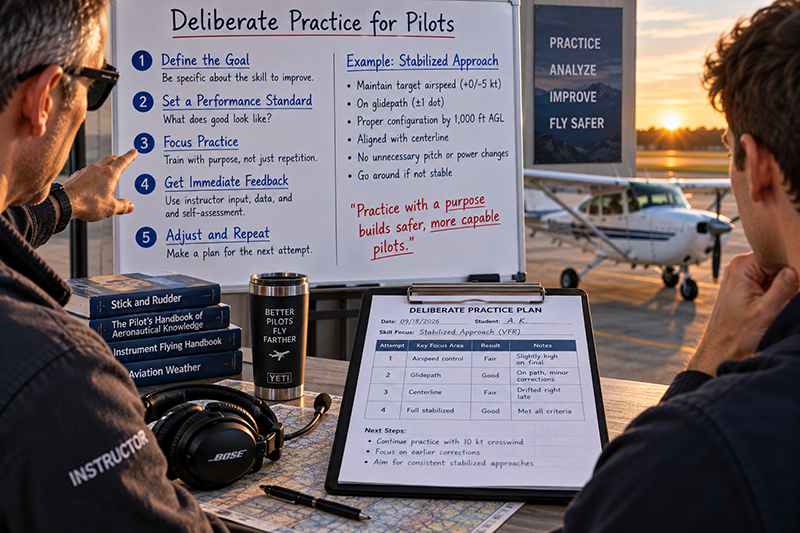
Deliberate practice for pilots is the difference between simply logging another hour and using that hour to make a measurable improvement. Aviation rewards repetition, but repetition alone does not guarantee progress. A pilot can fly the same traffic pattern, practice the same approach, or repeat the same maneuver for years and still carry the same small errors forward. Deliberate practice changes that pattern by giving each training event a clear objective, a defined performance target, immediate feedback, and a way to verify whether the next attempt was better than the last.
This matters because pilot skill is not one single ability. It is a blend of aircraft control, procedural discipline, aeronautical decision-making, communication, workload management, situational awareness, and judgment under changing conditions. Each of those areas can improve, but only if training is structured in a way that exposes weaknesses honestly and turns them into focused work. For student pilots, deliberate practice can shorten the distance between instruction and proficiency. For certificated pilots, it can make recurrent training more meaningful. For instructors, it provides a practical way to turn ordinary lessons into measurable skill development rather than a loose series of repetitions.
What Deliberate Practice Means in Aviation Training
Deliberate practice is focused, feedback-driven training designed to improve a specific skill. It is not casual repetition, and it is not simply flying more often. In aviation, deliberate practice means deciding exactly what skill needs improvement, defining what good performance looks like, practicing under appropriate conditions, receiving feedback, and adjusting the next attempt based on that feedback.
A pilot who says, “I need to work on landings,” has identified a broad topic. A pilot using deliberate practice might say, “Today I am going to improve my stabilized final approach in crosswind conditions, with special attention to airspeed control, runway alignment, and timely correction before touchdown.” That second statement gives the flight a purpose. It identifies the skill, the cues to monitor, and the behaviors that will show progress.
Deliberate practice also recognizes that flying is a performance activity. Like instrument flying, radio communication, emergency procedures, and energy management, performance improves when the pilot can compare an actual outcome to an intended outcome. The comparison must be specific enough to be useful. “That was good” is encouraging, but it rarely tells the pilot what to repeat. “Your base-to-final turn was well coordinated, but you let the airspeed decay below the target range during the last 200 feet” gives the pilot something concrete to correct.
Instructors often use deliberate practice intuitively, but the value increases when the process is made explicit. Before the maneuver, the pilot knows the objective. During the maneuver, the instructor watches for the planned cues. After the maneuver, the debrief connects observations to performance. Then the next repetition is not just another try. It is a revised attempt based on evidence.
Why This Matters in Real-World Aviation
Real-world aviation does not give pilots unlimited time to diagnose and correct weak habits. Workload can rise quickly during weather changes, abnormal indications, unfamiliar airspace, busy radio environments, or approach and landing phases. A pilot who has practiced deliberately is more likely to recognize deviations early because training has taught the pilot what to monitor and how to correct before small errors grow.
Consider approach stabilization. Many pilots understand the concept in theory. The aircraft should be properly configured, aligned, on an appropriate descent path, and within a planned speed range before continuing to landing. But understanding the concept is not the same as consistently producing it. Deliberate practice helps pilots move from knowing the words to flying the standard. It encourages the pilot to identify the first signs of instability, such as chasing pitch and power late on final, drifting off centerline without timely correction, or accepting a rushed configuration change. The goal is not perfection for its own sake. The goal is earlier recognition and better decisions.
The same principle applies to instrument training. Repeating approaches can build familiarity, but deliberate practice asks a sharper question: what specifically is improving? Is the pilot maintaining a more stable scan? Briefing more effectively? Intercepting courses with less overshoot? Managing avionics without losing aircraft control? Recognizing when workload is exceeding capacity? Each approach becomes more valuable when it is tied to a defined learning target.
For commercial, professional, and mission-oriented pilots, deliberate practice supports consistency. Professional flying depends on repeatable behaviors, not occasional good outcomes. A pilot may be capable of an excellent steep turn, short-field landing, or nonprecision approach on a good day, but deliberate practice aims for reliable performance across normal variation: different winds, different weights, different runways, different instructors, different avionics, and different levels of fatigue or workload. Training should build skill that transfers beyond the exact conditions of the lesson.
How Pilots Should Understand This Topic
Pilots should think of deliberate practice as a cycle rather than a single technique. The cycle begins with diagnosis. What is the real problem? A landing issue may look like a touchdown problem, but the root cause may be unstable airspeed on final, late flare timing, poor sight picture, inadequate crosswind correction, or inconsistent power reduction. If the diagnosis is wrong, the practice may reinforce the wrong habit.
The next step is goal setting. A useful training goal is narrow enough to guide attention in flight. “Improve crosswind landings” may be too broad for one session. “Maintain runway alignment with coordinated rudder and appropriate aileron input from final through rollout” is more useful. It tells the pilot where to look, what control relationship matters, and when the skill begins and ends.
After goal setting comes structured repetition. Repetition is still necessary. The difference is that each repetition has a purpose. The pilot should know what to attempt, what to observe, and what to change. One landing may emphasize the transition from crab to sideslip. Another may emphasize drift correction during the flare. Another may emphasize maintaining directional control after touchdown. These are related skills, but separating them can make learning clearer.
Feedback is the heart of the process. Feedback can come from an instructor, a safety pilot when appropriate, personal notes, aircraft data when available, simulator replay, or a structured self-debrief. The most useful feedback is timely, specific, and behavior-based. It should identify what happened, why it mattered, and what to do differently. Instructors should be careful not to overload the student with every imperfection. Pilots learn better when feedback is connected to the objective of the exercise.
The final step is measurement. Measurement does not always mean numbers, although numbers can help. A pilot may measure airspeed control, heading control, altitude deviation, touchdown zone consistency, checklist discipline, radio clarity, or time required to complete a flow. Some skills are measured by decision quality rather than a simple numeric tolerance. For example, a go-around decision may be evaluated by whether the pilot recognized an unstable condition early and executed the maneuver promptly and correctly. The important point is that progress should be visible in some form.
Repetition Versus Deliberate Practice
Repetition is often comfortable because it feels productive. A pilot completes ten takeoffs and landings, flies several instrument approaches, or performs multiple stalls and steep turns. The logbook shows activity. The question is whether the pilot improved. If each attempt looks similar, with the same strengths and the same flaws, the pilot may be practicing the error as much as the skill.
Deliberate practice is less comfortable because it brings weak areas into focus. It asks the pilot to slow down the learning process, isolate the problem, and accept feedback. That can be humbling, especially for experienced pilots. A pilot with many hours may still discover that a long-standing habit is inefficient or imprecise. The benefit is that deliberate practice turns that discovery into an action plan rather than a vague criticism.
There is also a fatigue element. Deliberate practice requires attention. A training session filled with high-quality attempts may be more valuable than a longer session where concentration fades. Pilots and instructors should watch for diminishing returns. If a pilot is no longer processing feedback, making the same mistake repeatedly, or becoming saturated, continuing to repeat the maneuver may not be productive. A better choice may be to pause, debrief, simplify the task, or return to the skill in a later session.
Building Measurable Improvement Into a Flight Lesson
A deliberate practice lesson should begin before engine start. The preflight briefing is where the instructor and pilot agree on the training target. This does not need to be complicated. A simple statement such as, “Today we are focusing on holding a stabilized descent profile from abeam the touchdown point through final,” can shape the entire lesson. The pilot now knows that every pattern will be evaluated against that objective.
The briefing should also identify the key cues. In a traffic pattern lesson, those cues may include power setting, pitch attitude, airspeed trend, descent rate, runway position, wind correction, and configuration timing. In an instrument lesson, they may include scan discipline, course intercept planning, approach briefing, missed approach readiness, and workload management. The pilot should not be asked to monitor everything equally. Deliberate practice works best when attention is directed.
During the flight, the instructor can protect the learning objective by keeping tasks aligned with the plan. If the lesson goal is airspeed control on final, the instructor should avoid turning the session into a general critique of every radio call, every taxi technique, and every minor procedural issue unless safety requires it. Those items may matter, but too many simultaneous corrections can dilute the learning. Aviation training is already complex. Deliberate practice reduces unnecessary noise.
The postflight debrief should close the loop. A productive debrief compares the plan to the performance. What improved? What remained inconsistent? What cue helped? What cue was missed? What will the pilot do on the next flight? The debrief should produce a short, specific takeaway. If the pilot leaves with only a broad impression, the next lesson may start from scratch. If the pilot leaves with a clear next action, learning continues between flights.
Using Metrics Without Turning Flying Into a Spreadsheet
Measurement is valuable, but pilots should not confuse measurement with judgment. Not every important aviation skill fits neatly into a number. A pilot can meet a numeric target and still be behind the airplane. A pilot can also make a conservative decision that looks less impressive on paper but reflects excellent judgment. Deliberate practice uses metrics to sharpen awareness, not to replace pilot decision-making.
Useful measures are tied to the skill being trained. For aircraft control, the pilot might track altitude, heading, airspeed, bank angle, descent planning, or touchdown consistency within the expectations of the training program. For instrument proficiency, the pilot might track localizer and glideslope corrections, approach briefing quality, missed approach setup, or deviations from assigned clearances. For communication, the pilot might evaluate accuracy, brevity, readback discipline, and timing. For decision-making, the pilot might evaluate whether risk factors were identified early and whether the chosen action matched the conditions.
Aviation metrics should also be realistic. A student pilot early in training should not be judged by the same expectations as a proficient certificated pilot preparing for advanced operations. A pilot returning after a long break may need to rebuild basic flow and scan before chasing tight tolerances. A deliberate practice plan should meet the pilot where they are, then raise expectations as performance stabilizes.
One practical method is to keep a short training notebook. After each lesson or proficiency flight, the pilot records the objective, two observations, and one next action. For example: “Objective: stabilized approaches. Observation: good configuration timing on downwind. Observation: airspeed increased when attention shifted to traffic. Next action: verbalize airspeed target before base turn and confirm trend on final.” This kind of record is simple enough to maintain and specific enough to guide the next flight.
Common Mistakes or Misunderstandings
One common mistake is confusing volume with quality. More flight time can build experience, but experience is not automatically the same as improvement. If a pilot repeats a maneuver without feedback, the strongest habit may become the most repeated habit, even if it is not the best habit. Deliberate practice protects against this by making each repetition purposeful.
Another misunderstanding is believing that deliberate practice is only for student pilots. In reality, experienced pilots may benefit even more because small habits can become deeply ingrained. A pilot who has flown for years may be smooth and confident, yet still have weak spots in avionics management, crosswind technique, checklist discipline, weather decision-making, or abnormal procedure review. Deliberate practice gives experienced pilots a professional way to improve without treating recurrent training as a formality.
A third mistake is practicing too many skills at once. Aviation tasks are integrated, but learning often improves when a complex skill is broken into parts. A pilot struggling with landings may need separate attention on final approach stability, aiming point control, flare sight picture, crosswind control, and rollout alignment. Trying to fix all of those at the same time can create frustration. Focused practice does not ignore the whole maneuver. It improves the parts that make the whole maneuver work.
Some pilots also misunderstand feedback. Feedback is not a personal judgment. It is information that helps adjust performance. A good instructor can deliver feedback in a way that is direct, respectful, and useful. A good pilot receives feedback with curiosity rather than defensiveness. The cockpit is not the place for pride to outrank learning.
Another safety risk is practicing demanding skills without the right supervision, environment, or preparation. Deliberate practice should be challenging, but it should not be reckless. Maneuvers, abnormal procedures, and emergency scenarios should be practiced in a manner appropriate to the aircraft, operating environment, pilot qualifications, and instructor guidance. Simulation can be especially useful for scenarios that are impractical or unsafe to recreate in flight.
Practical Example: Turning Pattern Work Into Skill Development
Imagine a private pilot who feels inconsistent during landings after several weeks away from flying. The pilot schedules a proficiency flight with an instructor. A repetition-based session might involve flying eight or ten patterns and hoping the landings improve. Some probably will. Some may not. The pilot may leave with a general impression of being “rusty” but without a clear path forward.
A deliberate practice session begins differently. During the briefing, the instructor asks what feels inconsistent. The pilot says the airplane often arrives high on final, then the last part of the approach becomes rushed. Together they define the objective: improve energy management from downwind to short final so the airplane is configured, aligned, and descending at a stable rate before continuing to landing.
On the first pattern, the instructor observes rather than immediately correcting every detail. The pilot extends downwind slightly while dealing with radio traffic, turns base later than intended, and then reduces power aggressively to regain the desired path. The touchdown is acceptable, but the approach was not stable enough to be a model for future performance.
In the debrief during the climbout, the instructor keeps the feedback narrow. The issue was not the flare. The issue began on downwind when the pilot did not adjust the pattern for spacing and wind. The next attempt focuses on choosing the base turn point earlier, confirming configuration before the turn, and verbalizing whether the aircraft is high, low, fast, slow, or on profile.
By the fourth pattern, the pilot is making earlier corrections. The landings improve because the approach improves. The instructor then adds a crosswind component or changes the runway environment only if appropriate, keeping the difficulty within the pilot’s capacity. At the end of the flight, the pilot’s takeaway is specific: “My landings become rushed when I delay energy decisions. I need to manage spacing and configuration earlier, then evaluate stability before committing to land.” That is measurable improvement, not just more landings.
Applying Deliberate Practice to Instrument Flying
Instrument flying is well suited to deliberate practice because deviations are often visible and correctable. However, instrument training can become repetitive if the pilot simply flies one approach after another. The better question is what each approach is intended to improve.
One session may focus on the instrument scan. The instructor might watch whether the pilot recognizes altitude, heading, and course trends early or waits until deviations are large. Another session may focus on approach briefings and cockpit setup. Another may focus on missed approach readiness, including mental rehearsal and task sequencing. Another may focus on automation management, including when to use automation, when to reduce automation, and how to maintain mode awareness.
Deliberate practice is especially helpful when a pilot becomes task saturated. Instead of labeling the problem as simply “falling behind,” the instructor can identify where workload exceeded the pilot’s capacity. Was the chart briefing incomplete? Was the avionics setup delayed? Was the pilot hand-flying during a time when workload management would have benefited from an available tool? Was radio communication allowed to interrupt aircraft control? Each diagnosis leads to a different training solution.
For instrument pilots, the goal is not just to keep needles centered in smooth air. The goal is to maintain control, procedure discipline, and decision quality while workload changes. Deliberate practice helps pilots build that resilience by training one layer at a time, then recombining the layers into realistic scenarios.
The Instructor’s Role in Deliberate Practice
Flight instructors play a central role because they help pilots see what they cannot yet see. A student may feel that a maneuver “went badly” without understanding why. An instructor can identify the first observable error, not just the final result. That distinction is essential. Correcting the first error often prevents the chain of corrections that follows.
Instructors should frame lessons around observable behaviors. Instead of saying, “Be smoother,” an instructor might say, “Begin the pitch change before adding the final trim adjustment, then pause long enough to see the airspeed trend.” Instead of saying, “Stay ahead of the airplane,” the instructor might say, “Complete the approach briefing before the initial descent so the next phase does not compete with chart interpretation.” Specific language gives the learner a path.
Instructors should also manage challenge level. If the task is too easy, the pilot may not grow. If it is too difficult, the pilot may become saturated and stop learning. Effective deliberate practice sits near the edge of current ability. The pilot should need effort, but the task should remain achievable with coaching and repetition. This balance is one of the marks of quality instruction.
Finally, instructors should teach pilots how to self-debrief. The long-term goal is not dependence on an instructor for every improvement. The goal is a pilot who can identify performance gaps, seek appropriate instruction when needed, and maintain a disciplined improvement process throughout a flying career.
Best Practices for Pilots
Pilots can make deliberate practice part of ordinary flying without turning every flight into a formal lesson. The key is to choose one or two meaningful objectives and evaluate them honestly. Even a routine local flight can include a focused communication goal, a checklist discipline goal, or a stabilized approach goal. The pilot should still prioritize safety, traffic awareness, and compliance with all applicable procedures, but focused attention can make normal operations more educational.
Before a training flight, write down the objective in one sentence. During the flight, keep the objective visible in your mind but do not let it distract from aviate, navigate, and communicate priorities. After the flight, record what changed. If nothing changed, ask why. Was the goal too broad? Was feedback too vague? Was the scenario too difficult? Was fatigue a factor?
- Practice one primary skill at a time, especially when rebuilding proficiency or learning a new maneuver.
- Define success before the flight using the syllabus, instructor expectations, aircraft procedures, or applicable standards.
- Use feedback quickly, then apply it on the next repetition while the lesson is still fresh.
- Track trends over several flights rather than judging improvement from one good or bad attempt.
- Use simulation, chair flying, and briefing practice for tasks that do not require aircraft time.
- Stop or simplify the exercise when fatigue, frustration, or task saturation begins to reduce learning quality.
Deliberate practice also works well between flights. Chair flying a checklist flow, rehearsing radio calls, reviewing an approach briefing, or mentally walking through an emergency procedure can build familiarity before the aircraft is moving. These activities are not substitutes for flight instruction, but they can make flight time more efficient because the pilot arrives prepared to work on execution rather than basic recall.
How to Keep Training Safe While Raising the Challenge
Good training should stretch the pilot, but it must remain controlled. Pilots should choose practice areas, altitudes, weather conditions, and scenarios appropriate to the training objective and their qualifications. When the objective involves maneuvers, abnormal situations, instrument procedures, or high workload, an appropriately qualified instructor can provide structure, supervision, and safety margin.
Scenario-based training can add realism without unnecessary risk. For example, rather than surprising a pilot with an unrealistic emergency at a poor moment, an instructor can brief the general category of the scenario and then evaluate how the pilot manages priorities. In a simulator or aviation training device, the instructor may be able to explore more complex failures, weather decisions, or avionics issues than would be appropriate in the airplane. The deliberate practice principle is the same: define the objective, create useful challenge, observe performance, and debrief clearly.
Pilots should also be cautious about practicing only in comfortable conditions. If training always occurs in calm wind, familiar airspace, and low workload, improvement may not transfer well to more demanding operations. At the same time, adding difficulty should be gradual. A pilot does not need to combine night, unfamiliar airport, gusty crosswind, high traffic, and new avionics into one training event to prove seriousness. Deliberate practice adds challenge in a way that still supports learning.
Frequently Asked Questions
Is deliberate practice for pilots different from simply flying more?
Yes. Flying more can build familiarity, but deliberate practice is structured around a specific skill, defined performance expectations, feedback, and measurable improvement. It turns flight time into targeted training rather than general repetition.
Can experienced pilots benefit from deliberate practice?
Absolutely. Experienced pilots often have strong habits, but not all habits are equally effective. Deliberate practice helps identify small weaknesses in technique, procedures, decision-making, or workload management and correct them before they become accepted as normal.
What is a good skill to practice deliberately?
Good candidates include stabilized approaches, crosswind control, checklist discipline, instrument scan, radio communication, short-field technique, emergency procedure flow, avionics management, and go-around decision-making. The best choice is the skill that most affects your current safety, proficiency, or training goal.
How should a pilot measure improvement?
Use measures that match the skill. Some may be numerical, such as altitude, heading, airspeed, or touchdown consistency. Others may be qualitative, such as earlier recognition of instability, better task sequencing, clearer radio calls, or more disciplined decision-making.
Does deliberate practice require a flight instructor?
Not always, but an instructor is highly valuable when diagnosing errors, practicing demanding skills, rebuilding proficiency, or preparing for evaluations. Self-briefing and self-debriefing can support improvement, but outside feedback often reveals issues the pilot may miss.
How long should a deliberate practice session be?
The best length depends on the pilot, aircraft, environment, and task. A shorter session with clear focus and high-quality feedback may be more productive than a long session with fading attention. When learning quality drops, it is often better to pause, debrief, or simplify the task.
Key Takeaways
- Deliberate practice for pilots turns repetition into improvement by pairing each training event with a specific objective, feedback, and a way to measure progress.
- Safety improves when pilots learn to recognize deviations early, correct them promptly, and make conservative decisions when performance or conditions are not acceptable.
- Effective training should be challenging but controlled, aligned with applicable standards and aircraft procedures, and supported by honest debriefing from instructors or other qualified resources.