
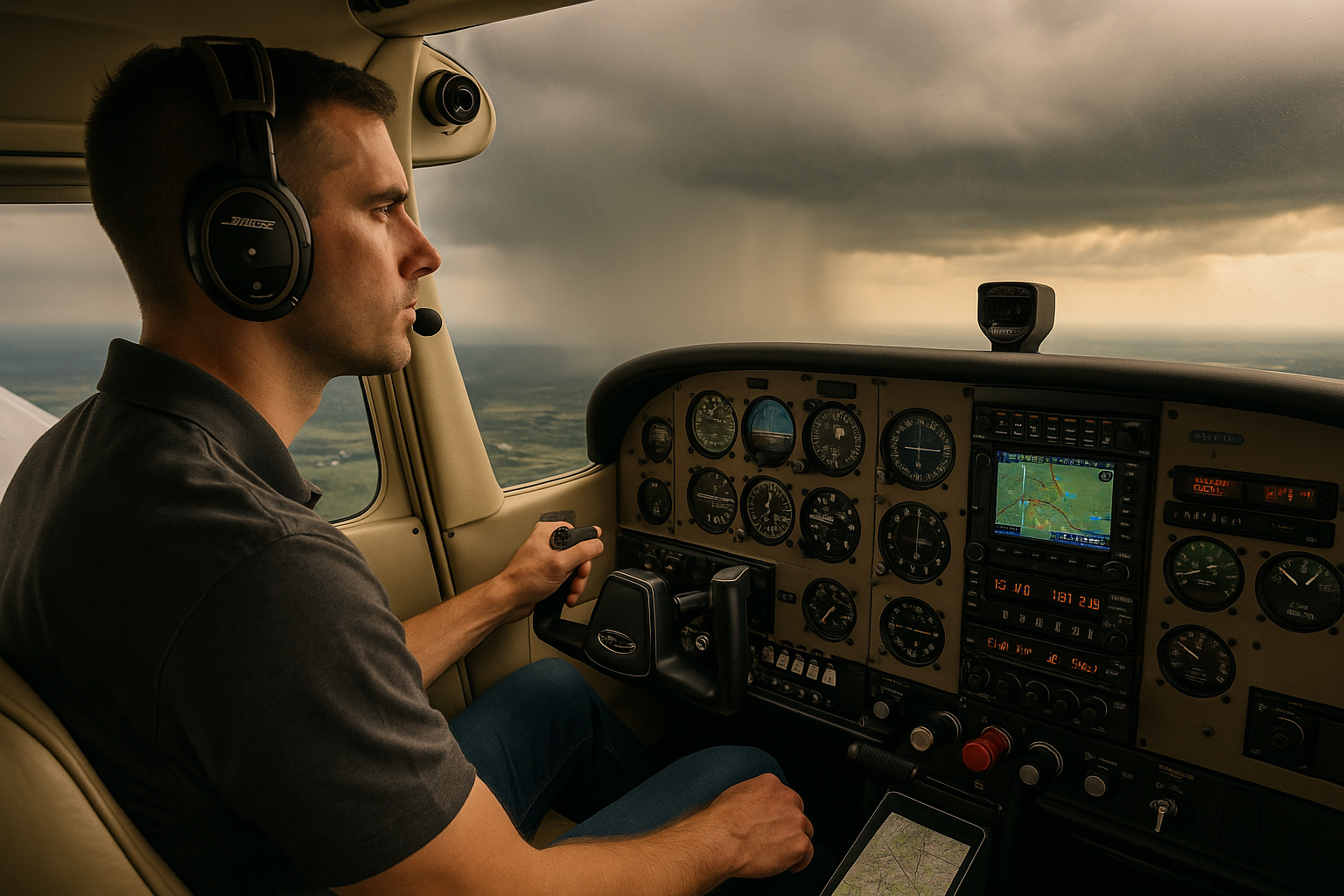
A deteriorating flight situation rarely begins as a dramatic emergency. More often, it starts as a small mismatch between the plan and reality: a headwind stronger than expected, a ceiling lowering faster than forecast, a fuel stop delayed by optimism, a radio call missed during a busy phase of flight, or a pilot who feels slightly behind the airplane but continues anyway. Learning to recognize a deteriorating flight situation early is one of the most valuable safety skills a pilot can develop.
For student pilots, this skill builds judgment before experience has had time to accumulate. For certificated pilots, it prevents routine flights from quietly drifting into high-workload, low-margin operations. For instructors and aviation professionals, it provides a practical framework for teaching decision-making before the aircraft, weather, fuel state, or crew workload forces the decision. The goal is not to make pilots fearful. The goal is to make them alert to change, honest about risk, and willing to act while good options still exist.
What a Deteriorating Situation Looks Like in Aviation
A deteriorating situation is any flight condition in which the margin between the aircraft, pilot, environment, and mission is shrinking. It may involve weather, aircraft performance, navigation, fuel, system status, terrain, traffic, passenger pressure, fatigue, or a combination of factors. The defining feature is not that something has already failed. The defining feature is that the flight is moving away from the assumptions used to launch or continue.
Pilots often brief a flight based on expected conditions. They review weather, aircraft status, route, fuel, alternates, airspace, and operational constraints. Once airborne, those assumptions must be continuously tested. If the actual flight begins to diverge from the expected flight, the pilot needs to notice the trend before it becomes urgent.
Many emergencies are obvious: smoke in the cockpit, engine roughness, electrical failure, loss of oil pressure, or an immediate flight control problem. Deterioration is more subtle. It may feel like inconvenience, workload, uncertainty, or delay. A pilot might think, “This is not ideal, but it is still manageable.” That thought deserves attention. Manageable can be acceptable, but it can also be the first sign that the pilot is normalizing an increasingly unfavorable situation.
One useful way to think about deterioration is to ask whether the flight still has time, altitude, fuel, daylight, weather margin, aircraft capability, pilot capacity, and escape options. If one of those margins is decreasing, the pilot should be curious. If several are decreasing at once, the flight is no longer simply inconvenient. It is developing risk.
Why This Matters in Real-World Aviation
Real-world flying is dynamic. Weather changes, traffic patterns become congested, passengers ask questions, aircraft systems behave unexpectedly, and airports that looked convenient during planning may not remain convenient in flight. A safe pilot is not just someone who can fly a maneuver to standards. A safe pilot is someone who notices when the original plan is no longer the best plan.
This matters because emergencies are easier to manage before they fully form. A pilot with fuel, altitude, visibility, daylight, and several suitable airports nearby has choices. A pilot who delays action until fuel is low, weather is below personal comfort, fatigue is high, and the nearest suitable airport is behind the aircraft has fewer choices. Early recognition preserves options.
In training, pilots spend considerable time practicing responses to defined problems. Engine failure after takeoff, simulated instrument failure, diversion planning, short-field operations, and abnormal procedures all have value. Yet many flights do not announce their risk with a clean training scenario. Instead, risk accumulates. The pilot becomes task saturated. A small navigation error combines with a weather concern. A radio issue combines with airspace complexity. A passenger concern combines with fuel uncertainty. The event becomes difficult not because any single factor was catastrophic, but because the pilot allowed multiple manageable issues to stack.
For instructors, this is an important teaching point. Students should not only be evaluated on whether they can solve a simulated emergency. They should also be coached to identify the early indicators that a normal lesson or cross-country is becoming less stable. That includes teaching them to verbalize uncertainty, slow the operation down when possible, use all available resources, and choose conservative alternatives without embarrassment.
The Early Warning Signs Pilots Should Notice
The earliest signs of deterioration are often operational rather than mechanical. They show up as changes in workload, uncertainty, margins, and decision quality. A pilot who can identify those signs can intervene before the situation becomes time-critical.
Workload is increasing faster than expected
Workload is one of the most reliable signals that a flight is becoming less stable. A pilot may notice that radio calls are being missed, checklists are rushed, headings or altitudes require repeated correction, or basic tasks take longer than normal. This does not mean the pilot is incapable. It means the flight is demanding more attention than planned.
When workload rises, the pilot’s ability to process new information decreases. A busy pilot may continue flying accurately but stop thinking strategically. That is a dangerous trade. The aircraft may be under control, but the flight may not be under control in a broader decision-making sense.
The plan depends on everything going right
A healthy flight plan has flexibility. It allows for unexpected wind, a delay, a runway change, a missed approach, a diversion, or slower-than-expected progress. A deteriorating plan has little tolerance left. If the pilot finds that the flight can continue only if the weather holds, the fuel burn stays exactly as planned, the destination remains available, and no further delays occur, the situation deserves immediate reevaluation.
Good aviation decisions are not built on perfect assumptions. They are built on margins that absorb ordinary variation. When the plan becomes fragile, the risk is increasing even if nothing has technically gone wrong yet.
Information is incomplete or conflicting
Uncertainty is not the same as danger, but it is a signal to slow down and gather more information. Examples include unclear weather trends, uncertain aircraft indications, conflicting navigation information, or an ambiguous clearance. The mistake is not having uncertainty. The mistake is continuing as if uncertainty does not matter.
When information is incomplete, pilots should avoid filling gaps with optimism. A better response is to seek clarification, compare available sources, ask ATC for assistance when appropriate, use onboard resources, and choose options that remain safe even if the missing information turns out to be unfavorable.
Margins are shrinking in more than one area
A single shrinking margin may be manageable. Several shrinking margins deserve stronger action. For example, a lower ceiling may be acceptable if fuel is ample, alternates are excellent, and the pilot is proficient in the conditions. A lower ceiling combined with rising terrain, passenger pressure, fading daylight, and fuel anxiety is a different situation entirely.
Pilots should look for clusters of risk. Weather, fuel, fatigue, terrain, airspace, aircraft status, and proficiency do not operate independently. They interact. A factor that is acceptable alone can become unacceptable when combined with others.
The pilot is rationalizing continuation
Internal dialogue matters. Thoughts such as “we are almost there,” “it should be fine,” “I do not want to disappoint them,” or “turning around would be embarrassing” are not automatically wrong, but they are warning signs when they replace objective analysis. A pilot who is justifying a decision instead of evaluating it may already be under the influence of plan continuation bias.
Plan continuation bias is the tendency to continue with an original plan even when changing conditions suggest that a different plan would be safer. The practical antidote is to ask, “If I were making this decision for the first time right now, with the information I currently have, would I still choose this plan?”
How Pilots Should Understand This Topic
Identifying deterioration is not a special skill reserved for high-time pilots. It is a disciplined habit. The pilot continuously compares three things: what was expected, what is actually happening, and what options remain available. When those three elements begin to separate, the pilot should respond deliberately.
A useful mental model is to divide the flight into three questions. First, is the aircraft performing normally? Second, is the environment still within safe and legal operating limits for this flight and this pilot? Third, does the pilot still have enough capacity and margin to manage the next phase? These questions are simple, but they force attention away from wishful thinking and back toward operational reality.
The aircraft question includes engine indications, flight controls, electrical status, fuel quantity and fuel management, avionics behavior, pressurization where applicable, and any abnormal sound, smell, vibration, or performance. The environment question includes weather, visibility, ceilings, wind, turbulence, icing potential when applicable, terrain, airspace, runway conditions, traffic, and daylight. The pilot capacity question includes proficiency, fatigue, stress, workload, distraction, and confidence in the current plan.
Another practical approach is to set decision points before and during the flight. A decision point is a condition that triggers reassessment. It might be a minimum fuel quantity at a checkpoint, a weather condition that requires diverting, a maximum acceptable crosswind based on proficiency and aircraft guidance, or a time by which the flight must be on the ground. The value of decision points is that they are easier to honor before pressure builds.
Decision points should not be treated as a sign of weakness. They are professional planning tools. Airlines, corporate operators, military aviation, and well-run training organizations all rely on structured decisions because human judgment is more reliable when thresholds are considered in advance.
Common Mistakes or Misunderstandings
One common mistake is waiting for a clear emergency before acting. Pilots may believe that diverting, returning, delaying, or asking for help is unnecessary unless something is officially wrong. That mindset gives away the most valuable resource in aviation decision-making: time. The earlier a pilot acts, the more ordinary the solution may be.
Another misunderstanding is assuming that legal automatically means wise. A flight can satisfy applicable rules and still be a poor choice for a particular pilot, aircraft, passenger load, terrain environment, or weather trend. Personal minimums, proficiency, recent experience, and operational context matter. The regulations establish legal boundaries, but good judgment often requires more conservative choices.
Pilots also sometimes confuse confidence with competence. Confidence is useful when it is based on preparation, proficiency, and accurate situational awareness. It becomes hazardous when it suppresses doubt or discourages a conservative decision. A pilot who says, “I can probably make this work,” should pause and ask whether making it work is the safest objective.
Another common mistake is treating passenger expectations as operational requirements. Passengers may have important schedules, but they usually do not understand the full meaning of weather margins, aircraft performance, fuel planning, or pilot workload. The pilot in command must be willing to make an unpopular decision when safety requires it. A delay, diversion, or cancellation is not a failure of skill. It is often evidence of sound command judgment.
Finally, pilots can become overly focused on one problem while missing the broader deterioration. For example, a pilot troubleshooting a navigation issue may stop monitoring weather trends. A pilot focused on reaching the destination may underappreciate fuel status. A pilot dealing with turbulence may stop thinking ahead to the arrival. Good cockpit management requires solving the immediate issue while still maintaining the big picture.
Practical Example: A VFR Cross-Country That Starts to Tighten
Consider a private pilot flying a daytime VFR cross-country in a single-engine training aircraft. The preflight weather briefing suggested scattered clouds, good visibility, and a moderate headwind. The aircraft is in good condition, fuel planning appears comfortable, and the destination is familiar. The pilot launches with a passenger for a planned weekend trip.
After departure, the headwind is stronger than expected. The first checkpoint arrives several minutes late. That alone is not an emergency. The pilot updates the groundspeed estimate and realizes the flight will take longer than planned. A better pilot response at this point is not panic, but recalculation. What is the new estimated time en route? What is the current fuel state? What airports are available along the route? What weather is ahead?
Thirty minutes later, the cloud bases appear lower than expected along the route. Visibility remains acceptable, but the pilot begins descending slightly to maintain cloud clearance. The terrain ahead rises gradually. Again, there is still no emergency. But the flight has now changed in two important ways: fuel margin is less comfortable due to the headwind, and altitude flexibility is reduced by clouds and terrain.
The passenger asks whether they will still arrive on time. The pilot feels pressure to continue. The destination is not far away, and turning toward a fuel stop would be inconvenient. This is the moment when deterioration is most important to recognize. The problem is not simply weather, fuel, terrain, or passenger pressure. The problem is the combination.
A disciplined pilot might level off at a safe altitude while conditions allow, contact flight service or ATC for updated information if available, identify the nearest suitable airports, and choose a conservative diversion before the route narrows further. The diversion may feel unnecessary if the flight could possibly continue. But that is precisely the point. The safest decisions are often made while options still look plentiful.
In this example, the pilot does not need to wait for marginal visibility, low fuel, or rising terrain to force the decision. The deteriorating trend is enough. Stronger headwind plus lowering clouds plus terrain plus schedule pressure equals a clear reason to change the plan. The pilot who diverts early turns a developing risk into a routine landing, a fuel stop, and a better conversation with the passenger.
Best Practices for Pilots
The best defense against a deteriorating flight situation is not a single checklist item. It is a pattern of professional behavior before and during the flight. Pilots should plan with margins, monitor trends, speak honestly about uncertainty, and act early enough that the action remains simple.
Before flight, develop a plan that includes realistic alternates, fuel strategy, weather escape routes, and personal limits. Personal limits should be specific enough to guide action. A vague statement such as “I will not push the weather” is less useful than a clear decision point that identifies what will trigger a delay, diversion, or return.
During flight, periodically step back from the immediate task and reassess the whole operation. Ask whether the flight still matches the plan, whether the next phase is becoming harder, and whether a safer option is available now. This habit is especially important before entering weather, crossing inhospitable terrain, continuing at night, descending below comfortable altitude options, or passing a good diversion airport.
- Use conservative decision points for fuel, weather, daylight, and workload.
- Update the plan when actual groundspeed, fuel burn, or weather differs from expectations.
- Say the concern out loud, even when flying alone, to interrupt automatic continuation.
- Use ATC, onboard systems, other pilots, dispatch, or instructors as resources when appropriate.
- Divert, delay, return, or land before the situation requires an emergency response.
Communication is also a best practice. Pilots sometimes hesitate to tell ATC they are uncertain, overloaded, or considering a diversion. Clear communication can reduce workload and improve options. A pilot does not need to wait until a situation is dire to request assistance, vectors, weather information, priority handling when appropriate, or time to sort out a problem.
Instructors should teach deterioration recognition intentionally. During scenario-based training, the instructor can introduce realistic changes such as stronger winds, a runway closure, a simulated passenger distraction, unexpected weather, or a navigation ambiguity. The learning objective should not be to trap the student. It should be to help the student identify changing risk and make a timely, defensible decision.
The Role of Personal Minimums and Decision Triggers
Personal minimums help pilots turn judgment into action. They are self-imposed limits based on experience, proficiency, aircraft capability, environment, and operational context. They do not replace regulations, aircraft limitations, or sound preflight planning. They help the pilot decide when the legal option is still not the best option.
Personal minimums are most useful when they are written, reviewed, and adjusted with experience. A new private pilot may use more conservative weather and wind limits than a highly experienced pilot who flies frequently in similar conditions. A pilot returning after a long break may temporarily tighten personal minimums. A pilot flying an unfamiliar aircraft, at night, over mountainous terrain, or with passengers may also choose more conservative limits.
Decision triggers are closely related. A trigger is a preplanned condition that requires action or reassessment. Examples might include reaching a checkpoint with less fuel margin than planned, encountering weather below the pilot’s comfort level, being unable to maintain situational awareness in complex airspace, or feeling task saturated during an approach or arrival. The key is to decide in advance what the trigger means. Does it require diverting? Slowing down? Holding? Climbing? Returning? Asking for help? Briefing the passenger?
The more specific the trigger, the less room there is for rationalization. A pilot who decides, “If I am not comfortable by this point, I will turn around,” may still negotiate with that standard under pressure. A pilot who decides, “If I cannot maintain my planned altitude with safe cloud clearance before reaching this valley, I will turn toward the airport behind me,” has a more actionable plan.
Recognizing Deterioration in Instrument Operations
Instrument flying adds another layer to deterioration recognition. The aircraft may be under precise control while the overall flight is still becoming less safe. Weather, approach availability, fuel, missed approach options, automation mode awareness, icing potential when applicable, and pilot workload all matter.
One common instrument-flight warning sign is an approach that begins to feel rushed. If the pilot is still programming avionics, briefing the procedure, configuring the aircraft, or correcting a navigation setup close to the final approach segment, the situation may be deteriorating. Going missed, asking for delay vectors, requesting a hold, or choosing another approach can be safer than forcing an unstable setup to continue.
Another sign is automation confusion. Modern avionics and autopilots are valuable tools, but they can increase workload when the pilot is uncertain about what mode is active or what the aircraft will do next. If automation is not reducing workload, the pilot should be prepared to simplify. That may mean reverting to basic modes, hand flying if appropriate, asking for vectors, or taking time to reestablish situational awareness.
Instrument pilots should also monitor the cumulative effect of repeated approaches, holding, weather deviations, and changing clearances. Each may be manageable alone, but together they can consume fuel and attention. The safest time to choose a better alternate is before fuel or fatigue forces the issue.
Recognizing Deterioration in Training Flights
Training flights are valuable precisely because they expose pilots to workload, uncertainty, and changing conditions in a supervised environment. However, training flights can also deteriorate if the instructor and student become too focused on completing the lesson plan. A lesson objective should never outrank aircraft control, weather judgment, traffic awareness, fuel management, or student capacity.
For student pilots, early warning signs include falling behind radio communications, becoming unsure of position, repeatedly missing altitude or airspeed targets, or feeling overwhelmed by simultaneous tasks. These are not character flaws. They are training data. A good instructor uses them to teach prioritization, workload management, and timely communication.
For instructors, deterioration can appear as student fatigue, weather changes, airport congestion, or a lesson that is no longer producing learning. Continuing to add tasks after the student is saturated may reduce safety and learning quality. Sometimes the best instructional decision is to pause, demonstrate, return to a simpler maneuver, or end the lesson with a productive debrief.
Frequently Asked Questions
What is the first sign that a flight situation is deteriorating?
The first sign is often a change in workload or margin rather than a dramatic aircraft problem. If tasks feel rushed, the plan depends on perfect conditions, or actual weather, fuel, or timing differs meaningfully from the plan, the pilot should reassess early.
Is diverting early an overreaction?
Not usually. Diverting early is often a sign of strong judgment because it preserves choices. A diversion made with adequate fuel, daylight, weather margin, and suitable airports available is far easier than a diversion forced by urgency.
How can student pilots practice recognizing deterioration?
Student pilots can practice by verbalizing changes during training flights: weather trends, workload, fuel status, navigation confidence, and comfort level. Instructors can use scenario-based training to help students identify risk trends and make timely decisions.
What should a pilot do when unsure whether the situation is serious?
Uncertainty itself is a reason to slow down the decision process when possible. Maintain aircraft control, gather information, use available resources, consider conservative alternatives, and avoid continuing solely because the original plan is familiar.
Does asking ATC for help mean the pilot has failed?
No. Asking for assistance is a normal and professional use of available resources. ATC may be able to provide vectors, traffic information, weather updates, airport options, or workload relief depending on the situation and service available.
How do personal minimums help prevent emergencies?
Personal minimums help pilots make decisions before pressure increases. By defining conservative limits for weather, wind, fuel, daylight, proficiency, and workload, pilots reduce the temptation to negotiate with risk in flight.
Key Takeaways
- A deteriorating flight situation often begins as shrinking margin, rising workload, or uncertainty rather than an obvious emergency.
- Early action preserves options. Diverting, delaying, returning, or asking for help is easier before fuel, weather, altitude, or pilot capacity becomes critical.
- Personal minimums, decision triggers, and honest in-flight reassessment help pilots make safer decisions before plan continuation bias takes over.