
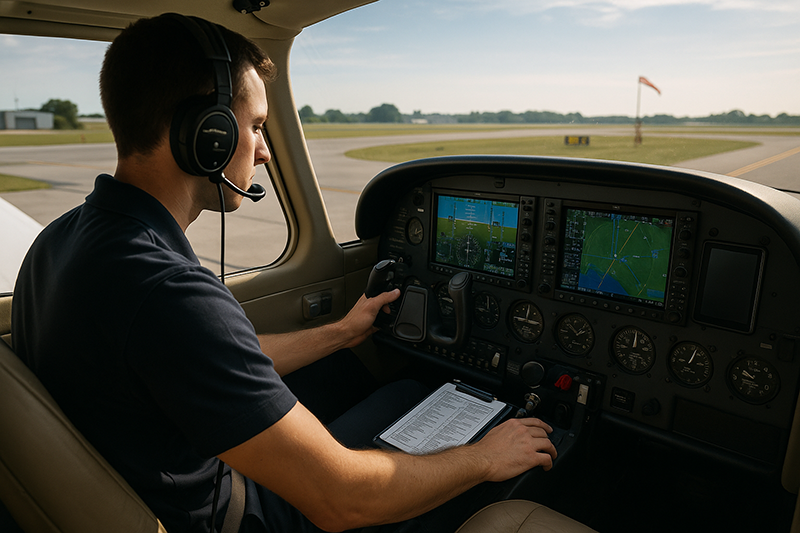
Personal SOPs give individual pilots a practical way to bring more consistency, discipline, and predictability into everyday flying. SOP stands for standard operating procedure, a term most often associated with airline, corporate, and military flight operations. Yet the underlying idea is valuable for every pilot: decide in advance how you will handle normal tasks, abnormal situations, cockpit workload, and go/no-go decisions so you are not inventing your process while the airplane is moving.
For student pilots, personal SOPs can reduce confusion by turning training concepts into repeatable habits. For certificated pilots, they can strengthen aeronautical decision-making, improve cockpit flow, and help prevent small distractions from becoming larger safety problems. For flight instructors, they provide a structured way to teach consistency without turning every flight into a rigid script. The goal is not to replace judgment. The goal is to support judgment with a reliable operating framework.
What Personal SOPs Are and What They Are Not
A personal SOP is a written or clearly defined procedure a pilot uses consistently for a recurring aviation task. It may cover how the pilot briefs a departure, configures avionics before taxi, decides when to discontinue an approach, organizes cockpit items, manages fuel planning, or handles passenger distractions. In simple terms, it is your personal operating standard for situations you expect to encounter.
Personal SOPs are not a substitute for the aircraft flight manual, pilot operating handbook, aircraft limitations, checklists, regulations, air traffic control instructions, or instructor guidance. They must fit inside those higher authorities. If a personal habit conflicts with an aircraft checklist, approved procedure, limitation, or clearance, the personal habit is wrong and should be changed.
Good personal SOPs are also not meant to make flying mechanical. Aviation always requires judgment because weather, traffic, aircraft condition, pilot condition, and mission pressures change. A strong personal SOP does not remove flexibility. It defines the normal way you operate so that any deviation is deliberate, recognized, and managed.
The best personal SOPs are short, specific, and usable in the cockpit. A 40-page personal manual may look impressive, but it is unlikely to influence behavior unless it is distilled into practical habits. A useful personal SOP answers questions such as: When do I brief? What do I say? What triggers a no-go decision? When do I slow down? When do I ask for help? When do I stop troubleshooting and fly the airplane?
Why Personal SOPs Matter in Real-World Aviation
Aviation rewards preparation and punishes improvisation at the wrong time. Many routine flights become demanding not because the pilot lacks knowledge, but because too many decisions arrive at once. Weather changes, radios get busy, passengers ask questions, avionics behave differently than expected, and the airplane still requires precise control. Personal SOPs reduce the number of new decisions required during high workload phases of flight.
In training, students often focus on performing each task correctly. That is necessary, but it is only part of becoming a safe pilot. The next step is learning when and how to perform tasks in a consistent order. A student who has a repeatable before-takeoff flow, departure briefing, climb scan, and traffic pattern setup is better prepared to identify when something is out of place.
For experienced pilots, personal SOPs help guard against complacency. Familiar airplanes and familiar airports can make pilots less deliberate. A routine local flight can still include a runway change, unexpected crosswind, passenger illness, engine roughness, or radio failure. A personal SOP keeps the pilot anchored to disciplined habits even when the flight seems simple.
For instructors, personal SOPs are useful teaching tools because they make expectations visible. Instead of telling a student to “stay ahead of the airplane,” the instructor can teach specific behaviors: brief the taxi route before brake release, verify runway and departure plan before entering the runway, complete the descent setup before the terminal area becomes busy, and conduct a short stabilized approach self-check on final.
How Pilots Should Understand Personal SOPs
Pilots should think of personal SOPs as a bridge between formal checklists and real-time decision-making. A checklist verifies required items. A personal SOP describes how the pilot organizes the overall operation around those items. For example, the aircraft checklist may tell the pilot to check fuel selector position, flaps, trim, and controls. The personal SOP may say the pilot will complete a pre-takeoff flow, run the checklist aloud, conduct a departure briefing, and pause if interrupted before taking the runway.
This distinction matters. Checklists are essential, but they do not cover every cockpit behavior. They usually do not tell a pilot exactly how to manage passenger conversation, when to re-brief after a runway change, how to decide whether the workload is too high to continue an approach, or how to organize a tablet, charts, and avionics for a night cross-country. Those areas are well suited for personal SOPs.
A practical way to build personal SOPs is to divide flying into phases: preflight planning, aircraft inspection, cockpit setup, taxi, takeoff, climb, cruise, descent, approach, landing, shutdown, and post-flight review. Then ask what behaviors would make each phase safer and more consistent. The answer should not be a long list of preferences. It should be a small set of standards that prevent common errors and reduce workload.
Personal SOPs should also include decision gates. A decision gate is a point where the pilot intentionally asks whether conditions still support continuing. Common examples include preflight weather review, fuel planning before departure, a final runway verification before takeoff, a top-of-descent review, and an approach continuation decision. These moments are valuable because they interrupt momentum. They give the pilot permission to stop, delay, divert, go around, or ask for assistance before the situation becomes urgent.
Building Personal SOPs Around Pilot Workload
Workload management is one of the strongest reasons to develop personal SOPs. A pilot who waits until short final to configure, brief, find a frequency, silence a passenger, and correct altitude is placing too many tasks into a narrow time window. A personal SOP moves work earlier whenever possible.
Before taxi, that might mean setting radios, checking the taxi diagram, briefing hotspots or complex intersections, and placing nonessential items where they will not interfere with controls. Before descent, it might mean reviewing destination weather, runway options, approach or pattern plan, terrain considerations, fuel status, and missed approach or go-around expectations. Before entering the traffic pattern, it might mean having the correct frequency, altimeter setting, runway information, and landing configuration plan already in mind.
The principle is simple: do low-priority tasks during low-workload periods so high-workload periods are reserved for aircraft control, navigation, communication, and decision-making. This is especially important in single-pilot operations, where there is no second crewmember to back up the pilot, catch errors, or handle radios while the pilot reprograms equipment.
Personal SOPs can also define when the pilot will stop doing something. For example, a pilot might decide that if a tablet app, GPS entry, or radio issue becomes distracting during a critical phase of flight, the immediate standard is to maintain aircraft control, use the simplest available navigation method, and delay troubleshooting until workload decreases. That type of standard protects the most important task: flying the airplane.
Core Areas to Include in a Personal SOP
Every pilot’s personal SOP should reflect their certificate level, aircraft, avionics, operating environment, and training. A new private pilot flying a basic trainer from a nontowered airport will not need the same procedures as an instrument-rated pilot flying cross-country through busy airspace. Still, several categories apply broadly.
Preflight Planning Standards
Preflight planning SOPs should define how the pilot evaluates weather, fuel, route, alternates when appropriate, aircraft performance, airport information, and personal readiness. The value is not in creating a rigid formula for every flight. The value is in having a consistent review process that makes it harder to overlook something important.
A strong personal standard might include a dedicated weather review before leaving for the airport and another update before departure if conditions are changing. It might include a defined fuel reserve planning habit that is more conservative than the minimum a pilot is willing to accept. It might also include a requirement to identify realistic diversion options on cross-country flights rather than assuming the original destination will remain suitable.
Cockpit Setup and Briefing Habits
Cockpit setup SOPs help prevent last-minute scrambling. They can include where the pilot places charts, tablets, kneeboards, sunglasses, flashlights, water, and backup equipment. They can also define when avionics are configured and verified. In technically advanced aircraft, this matters because flight plans, altitude preselects, navigation sources, and autopilot modes can create confusion if the pilot assumes everything is set correctly without verification.
Briefings do not need to be long to be effective. A personal departure briefing can cover runway, initial heading or departure path, first altitude, emergency plan after takeoff, and any relevant traffic or terrain considerations. An arrival briefing can cover airport layout, expected runway, pattern or approach plan, winds, taxi expectations, and go-around plan. The purpose is to create a shared mental model, even when flying alone.
Automation and Avionics Use
Modern avionics can reduce workload, but they can also create new traps when pilots become heads-down or mode-confused. A personal SOP should define how the pilot verifies automation. That may include verbalizing the active navigation source, confirming the flight director or autopilot mode when used, and deciding when hand-flying is the better choice.
A useful automation standard is to avoid programming complex changes during high workload moments unless necessary for safety. If a clearance, reroute, or approach change creates confusion, the pilot can ask for clarification, request delay vectors when available, or revert to basic aircraft control and navigation while sorting out the next step. The specific action depends on the operation, but the mindset should be built before the flight.
Passenger and Distraction Management
Many personal flights include passengers who do not understand cockpit workload. A personal SOP can make passenger management easier by setting expectations before engine start. The pilot can explain sterile cockpit expectations for taxi, takeoff, approach, and landing, using plain language rather than airline terminology if passengers are unfamiliar with it. For example: “During taxi, takeoff, and landing I need to focus on flying and radios, so please hold questions unless something is urgent.”
Distraction management also includes phones, cameras, food, pets, loose items, and cockpit conversations. A personal standard should make it clear that the pilot will not allow convenience or entertainment to interfere with aircraft control, checklist discipline, traffic scanning, or radio communication.
Abnormal and Emergency Priorities
Personal SOPs should not replace emergency checklists or aircraft-specific procedures. However, they can reinforce priorities that apply across many situations: maintain aircraft control, analyze the situation, use the appropriate checklist, communicate when able, and choose the safest available outcome. The exact sequence and actions depend on the aircraft and situation, but the pilot’s mental model should be established before an abnormal event occurs.
One of the most useful personal standards is deciding that troubleshooting has limits. If the airplane is close to the ground, in weather, near terrain, or in busy airspace, the pilot may not have time to explore every possible cause of a problem. The personal SOP should support timely decision-making instead of allowing uncertainty to consume attention.
Common Mistakes and Misunderstandings
One common mistake is confusing personal SOPs with personal preferences. A preference is something a pilot likes. An SOP is something the pilot has chosen because it improves safety, consistency, or workload management. “I like to tune this radio first” is a preference unless it supports a deliberate operating standard. “I verify the active frequency before crossing a runway or taking the runway” is closer to an SOP because it is tied to a specific risk.
Another mistake is making the SOP too complex. If the procedure is hard to remember, awkward to use, or unrealistic in the airplane, it will not survive contact with normal flying. Personal SOPs should be simple enough to use on a busy day, not just impressive on paper.
Pilots also sometimes create standards but fail to define triggers. “I will go around if the approach is unstable” is a good idea, but it becomes more useful when the pilot defines what unstable means in that aircraft and operation. Examples might include being too fast, not configured, not aligned, descending at an uncomfortable rate, or not in a position to make a normal landing. The exact criteria should be appropriate for the aircraft and training environment, but the pilot should decide before reaching short final.
A fourth mistake is allowing personal SOPs to drift. Pilots develop shortcuts over time, often for understandable reasons. Maybe the airport is familiar, the weather is good, or the flight is short. Gradual erosion is dangerous because it can make weak habits feel normal. Periodic review with an instructor, safety pilot, or trusted mentor can help identify where standards have slipped.
Finally, some pilots worry that personal SOPs will make them less flexible. In reality, a well-built SOP makes flexibility safer because it establishes a baseline. When circumstances require a change, the pilot can recognize that they are deviating from the normal plan and can manage that deviation intentionally.
Practical Example: A Personal SOP for a Cross-Country Flight
Consider a private pilot planning a daytime VFR cross-country to an unfamiliar airport in a single-engine training aircraft. The weather appears suitable, but winds are increasing during the afternoon and the destination has multiple runways, nearby airspace, and a mix of training and transient traffic.
Without a personal SOP, the pilot might complete the required planning, depart, and handle tasks as they arise. That may work, but it leaves more room for workload to pile up near the destination. The pilot may be checking weather, searching for the airport diagram, switching frequencies, briefing the runway, and descending all at once while traffic calls become more frequent.
With a personal SOP, the pilot creates structure earlier. During preflight, the pilot reviews weather trends, identifies practical diversion airports, calculates fuel with a conservative margin, and studies the destination layout. Before engine start, the pilot organizes the cockpit so charts and backup items are reachable. Before takeoff, the pilot briefs the departure path and the plan for an abnormality after liftoff.
In cruise, well before descent, the pilot updates destination weather if available, reviews the airport diagram, identifies likely runways, notes pattern altitude or approach expectations as applicable, and sets up radios. The pilot also briefs a simple plan: “If I am not comfortable with the runway, spacing, wind, or configuration, I will go around or depart the pattern and reset.” That statement is not dramatic. It is a decision made before workload peaks.
Approaching the destination, the pilot is not trying to learn the airport for the first time. The radios are ready, the chart is open, the descent is planned, and the go-around mindset is already established. If traffic becomes confusing or the wind favors a different runway, the pilot can slow down, hold outside the busiest area if appropriate, ask for clarification when talking to ATC, or choose another safe course of action. The SOP did not fly the airplane. It gave the pilot more mental capacity to fly it well.
Best Practices for Developing Personal SOPs
The most effective personal SOPs are developed gradually and tested in real flying. Start with the areas that create the most workload or have the greatest safety consequence. For many pilots, that means takeoff briefing, approach and landing criteria, weather decision-making, fuel planning, automation use, and distraction management.
Write your personal SOPs in plain language. Avoid vague phrases such as “be careful,” “watch the weather,” or “use good judgment.” Those are intentions, not procedures. Better wording describes a specific behavior: “Review destination weather before top of descent,” “brief the go-around plan before entering the pattern,” or “stop nonessential cockpit conversation during taxi, takeoff, approach, and landing.”
Keep the SOP aligned with your aircraft. A procedure that works well in a simple trainer may not fit a high-performance aircraft, and a turbine or crewed cockpit procedure may be inappropriate for a light piston single. Personal SOPs should support the airplane you actually fly, the avionics you actually use, and the environment where you operate.
Review your SOPs after training flights, flight reviews, instrument proficiency work, or flights that felt rushed. Ask what caused workload, confusion, or delay. Then decide whether a better pre-brief, earlier setup, clearer trigger, or stronger personal minimum would have helped. This turns experience into a better operating system.
- Start small with a few high-value standards rather than a long personal manual.
- Use aircraft checklists exactly as intended and build personal SOPs around them, not over them.
- Define decision points before takeoff, before descent, and before landing.
- Include passenger briefings and distraction control in your normal process.
- Periodically fly with an instructor to evaluate whether your habits match your written standards.
Personal Minimums and Personal SOPs
Personal minimums and personal SOPs are related, but they are not identical. Personal minimums define the conditions under which a pilot is willing to fly. They may address weather, visibility, ceilings, wind, crosswind, runway length, fuel margin, night operations, terrain, recent experience, or aircraft equipment. Personal SOPs define how the pilot operates before and during the flight.
A pilot might have a personal minimum for maximum demonstrated crosswind they are comfortable accepting based on training and proficiency, while the personal SOP says when that wind assessment is reviewed and what the pilot will do if winds exceed comfort level during arrival. The minimum sets the boundary. The SOP creates the process for recognizing and respecting that boundary.
Both should evolve with training and proficiency. A newly certificated pilot may choose conservative personal minimums and simple SOPs. As experience grows, the pilot may adjust standards with instructor input and demonstrated proficiency. The key is to avoid changing minimums in the heat of the moment because of schedule pressure, passenger expectations, or a desire to complete the trip.
Using Instructors and Mentors to Strengthen SOPs
Personal SOPs should not be built in isolation if good guidance is available. Flight instructors, experienced pilots, and safety-focused mentors can help identify weak spots the pilot may not see. An instructor can also distinguish between a useful personal standard and a habit that conflicts with better technique or aircraft guidance.
For student pilots, the instructor’s procedures and school policies may already define many expected behaviors. In that case, the student’s personal SOP should reinforce the training environment rather than compete with it. As the student gains experience, they can begin to understand why each procedure exists and how to carry disciplined habits into future aircraft and operations.
For certificated pilots, recurrent training is an excellent time to review personal SOPs. Bring a short written list to a flight review or proficiency session and ask the instructor to evaluate whether the standards are practical. The conversation can reveal gaps in weather planning, avionics management, abnormal procedures, or approach discipline.
How to Keep Personal SOPs Practical Over Time
A personal SOP is only valuable if it changes cockpit behavior. To keep it practical, use a short written document, not a complex manual. Many pilots can capture their most important standards in a few pages organized by phase of flight. Others may prefer a kneeboard card with key callouts, decision gates, and briefing prompts.
After each meaningful flight, take two minutes to ask three questions: What worked well? What felt rushed or unclear? What should I standardize before the next flight? This brief review is one of the simplest ways to improve. It also helps prevent the SOP from becoming stale.
When changing aircraft or avionics, revisit the SOP. Differences in cockpit layout, checklist flow, automation capability, performance, and emergency procedures can make an old habit inappropriate. Even moving between two similar training aircraft can introduce differences worth briefing, especially if avionics, fuel systems, flap systems, or performance characteristics differ.
Finally, keep humility in the process. Personal SOPs are not proof that a pilot is immune from error. They are a defense against error. The more honestly a pilot reviews weak points, the more useful the SOP becomes.
Frequently Asked Questions
Do private pilots really need personal SOPs?
Private pilots are not operating like an airline crew, but they still benefit from consistent procedures. Personal SOPs help organize cockpit tasks, reduce distractions, and make decision-making more deliberate. They are especially helpful for pilots who fly single-pilot, visit unfamiliar airports, carry passengers, or fly with modern avionics.
How are personal SOPs different from aircraft checklists?
Aircraft checklists verify required aircraft configuration and procedural items. Personal SOPs describe how the pilot manages the broader operation around those checklists, such as briefings, timing, workload management, passenger expectations, and decision gates. A personal SOP should support the checklist, never replace it.
Should student pilots write their own SOPs?
Student pilots should follow their instructor’s guidance, aircraft checklists, and any flight school procedures. However, they can still begin developing personal habits such as consistent briefings, organized cockpit setup, and disciplined go-around thinking. Any written personal SOP should be reviewed with the instructor to ensure it supports training.
What should be included first in a personal SOP?
Start with areas that affect safety and workload the most: preflight planning, takeoff briefing, cockpit setup, weather decision-making, fuel planning, approach and landing criteria, go-around mindset, automation use, and distraction management. Keep the first version short and improve it through experience.
Can personal SOPs be too rigid?
Yes. A personal SOP becomes a problem if it prevents sound judgment or conflicts with aircraft guidance, regulations, ATC instructions, or changing conditions. The best SOPs create a normal operating baseline while still allowing the pilot to adapt deliberately when the situation requires it.
How often should pilots review personal SOPs?
Review them whenever you change aircraft, avionics, mission type, or operating environment. It is also wise to review them after recurrent training, a flight review, an instrument proficiency session, or any flight that felt rushed, confusing, or poorly organized.
Key Takeaways
- Personal SOPs help pilots turn good intentions into repeatable cockpit behaviors that support safer, more consistent flying.
- The strongest SOPs reduce workload before critical phases of flight and establish clear decision gates for stopping, delaying, diverting, or going around.
- Personal procedures must always fit within aircraft checklists, operating limitations, regulations, ATC instructions, and sound instructor guidance.