
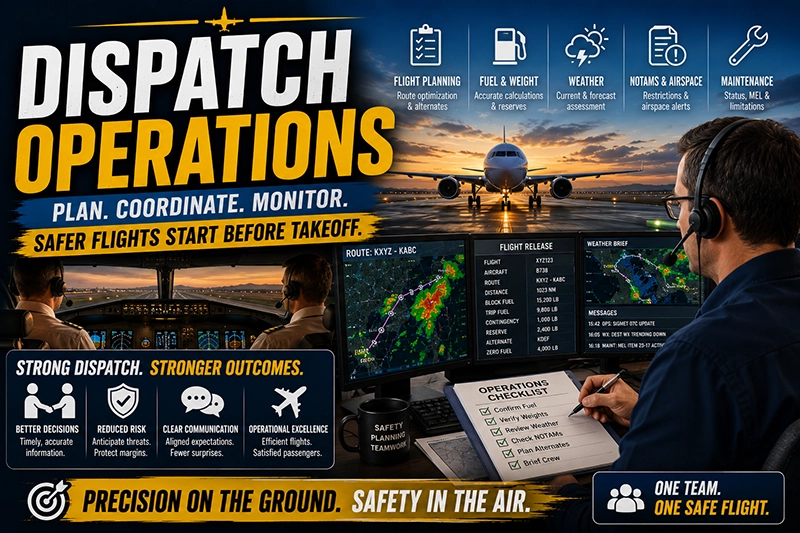
Dispatch operations shape nearly every flight decision before the nose leaves the ramp. Whether you fly single-pilot flights, train in a flight school, instruct aspiring pilots, or operate for a charter or airline, understanding dispatch operations improves safety, sharpens judgment, and helps you anticipate operational risk. In this article I use the phrase dispatch operations to mean the planning, monitoring, and communication processes operators use to translate a proposed flight into an executable, safe operation.
From fuel and weight planning to weather assessment and abnormal-event coordination, dispatch operations are where intent meets reality. Pilots who understand how dispatch works gain practical advantages: faster, clearer communication with operations personnel; better cross-checking of performance data; and improved ability to manage changes en route. The primary keyword dispatch operations appears throughout this article because it describes the operational processes pilots encounter across civil aviation.
What Are Dispatch Operations?
Dispatch operations encompass the set of activities that prepare, approve, and monitor a flight from an operational control perspective. Components commonly include flight planning, fuel calculations, weight and balance, route optimization, weather evaluation, NOTAM and airspace briefings, coordination for maintenance or special handling, and continuous monitoring of the flight while airborne. Dispatch operations create actionable information pilots use during preflight briefing, taxi, and the entire flight.
In practice, dispatch is a function performed by individuals, teams, or automated systems depending on the operator. The output of dispatch activity is operational guidance and communications for the flight crew. That guidance may take the form of a flight release, operational flight plan, or real-time messages from operations control.
Why Dispatch Operations Matter in Real-World Aviation
Dispatch operations matter because they shape the flow of information and decisions that directly affect safety and efficiency. Good dispatch work gives pilots accurate performance numbers, realistic fuel planning, and clear contingency planning. It also helps crews anticipate weather threats, airspace constraints, and maintenance restrictions that could influence a go/no-go decision or an in-flight diversion.
Poor dispatch practices increase the likelihood of surprises during flight. Examples of operational consequences include running low on usable fuel, discovering weight and balance problems late in the ground phase, encountering unanticipated weather along the planned route, or facing unclear instructions when an abnormal event occurs. In each of these situations pilots must adapt quickly. Understanding dispatch operations reduces uncertainty and streamlines that adaptation.
Dispatch activities also influence crew resource management. Clear, documented decisions coming from operations create a shared mental model between dispatchers and flight crews. Shared mental models reduce ambiguity when time-critical choices arise, such as whether to accept a reroute, divert, or return to the departure airport.
How Pilots Should Understand Dispatch Operations
Pilots should treat dispatch operations as a partner, not a substitute, for sound airmanship. Dispatch provides inputs and recommendations. The flight crew integrates that information into their preflight planning, performance calculations, and inflight decision loop. Understanding dispatch involves four practical perspectives:
Inputs: Know what information dispatch uses. This includes observed and forecast weather, runway conditions, aircraft performance data, weight and balance figures, NOTAMs, and any maintenance limitations. If you understand the inputs, you can identify gaps or mismatches before departure.
Outputs: Recognize the products of dispatch such as the operational flight plan, fuel figures, preferred routes, and contingency options. Read these outputs critically and confirm they align with your cockpit performance planning and fuel requirements.
Communication: Use clear, unambiguous language with operations. Confirm critical items aloud when handing over control at dispatch points, and restate expectations when conditions change. Keep communications concise and decision-focused.
Exception management: Understand how dispatch handles deviations. Know the expectations for who will coordinate reroutes, diversions, or MEL issues while airborne. If that expectation is unclear, establish it before departure.
For student pilots and instructors, discussing dispatch during training flights enhances realism. Simulating operations-control communications, fuel re-calculations, or sudden weather changes forces trainees to practice decision-making under realistic constraints.
Key Elements of Dispatch Operations Explained
Here are the core elements pilots will encounter in dispatch operations, explained in practical terms.
Flight Planning and Route Selection
Flight planning establishes the intended route and alternates. Dispatchers weigh route efficiency against weather forecasts, airspace constraints, and known traffic flows. For the pilot, route planning produces waypoints that affect fuel burn, top-of-descent planning, and contingency options. If dispatch uses preferred airways or user-preferred routes, verify those routes against your fuel and timing expectations.
Fuel Planning and Reserves
Fuel planning in dispatch includes the anticipated trip fuel, reserves for unforeseen holds, contingencies for reroutes, and fuel for an alternate or diversion if required. Pilots should understand the assumptions behind fuel numbers. Ask what reserves were used in the calculations and whether fuel planning accounts for expected taxi delays, anticipated holds, or the operator's fuel policy.
Weight and Balance and Performance Data
Dispatch operations often receive load information from ground handling or flight release systems. That information feeds takeoff performance numbers. Pilots must cross-check dispatch weight and balance values against actual loading to confirm takeoff speed calculations, climb gradients, and runway length requirements. Discrepancies are much easier to resolve before the aircraft pushes than during a late takeoff attempt.
Weather Evaluation
Dispatch typically aggregates weather data including current observations, terminal forecasts, SIGMETs, and en route weather trends. Pilots should compare dispatch weather summaries with the official sources the crew uses and resolve significant differences. Pay attention to timing: forecasted weather three hours from now may differ materially from conditions at the planned time of arrival.
NOTAMs and Airspace Constraints
Dispatchers incorporate NOTAMs and temporary airspace restrictions into route planning. Pilots must verify NOTAM content and applicability, especially when restrictions affect arrival paths or alternate airports. If a NOTAM introduces complexity to the arrival or departure, discuss mitigation actions with dispatch before pushback.
Maintenance Status and MEL Considerations
Dispatchers and maintenance often coordinate so the flight crew has advance notice of deferred items, limitations, or special procedures tied to a Minimum Equipment List. Pilots should confirm any remaining limitations and understand how they affect operational decisions, including whether an alternate or different routing is necessary.
Common Mistakes and Misunderstandings
Poor outcomes from dispatch-related issues usually stem from miscommunication, incorrect assumptions, or late information. Common mistakes include:
Accepting dispatch numbers without verification. Pilots should cross-check weight, balance, and fuel against actual aircraft state.
Assuming dispatch has a complete picture. Dispatch may lack last-minute changes on the apron, such as late passenger loads, catering, or de-icing delays.
Over-reliance on automated dispatch outputs. Automated planning tools are helpful but can produce unrealistic routings or optimistic fuel forecasts when inputs are incorrect.
Poor handover between operations and flight crew. Incomplete briefings leave crews vulnerable when weather deteriorates or when a diversion is required.
Failing to clarify responsibilities during abnormal events. When a diversion or long delay occurs, crews and dispatch must have a shared plan for who coordinates ground handling, passenger communications, and maintenance actions.
Understanding these pitfalls helps crews build robust habits that catch problems before they escalate.
Practical Example: Weather-Driven Diversion Scenario
Imagine you are PIC of a small charter turboprop flying a two-hour route. Dispatch provided an operational plan with fuel figures based on clear-weather expectations and a suggested alternate 30 minutes from the destination. En route, convective activity rapidly develops near the destination, and ATC issues a reroute that increases time en route by 20 minutes. Simultaneously, the suggested alternate reports broken ceilings limiting visual approaches.
How dispatch operations and crew interaction determine the outcome:
Early detection. Dispatch monitoring tools flag worsening weather at the destination. They proactively message the crew with updated fuel projections and alternate options.
Decision alignment. The flight crew compares the updated fuel picture with onboard fuel quantity and determines whether the planned fuel remains adequate. If margins are tight, the PIC and dispatcher agree on a diversion plan or a decision to hold and reassess.
Coordinated execution. If diversion is necessary, dispatch coordinates the destination's handling arrangements and notifies the operator's ground teams while the flight crew focuses on safe flight path management and ATC coordination.
In this example, timely communication and aligned expectations prevent rushed decision-making and reduce the risk of fuel exhaustion or an unprepared diversion.
Best Practices for Pilots Working with Dispatch Operations
Adopt these practical behaviors to get the most value from dispatch operations and reduce operational risk.
Start with a preflight cross-check. Compare dispatch inputs with your own performance calculations. Resolve any differences before pushback.
Know the assumptions. Ask which taxi time, fuel burn rates, or alternate airports dispatch used in the plan. When assumptions differ from reality, update the plan.
Keep communication concise and precise. Use plain language for critical items such as fuel state, weather impact, and required support on diversion.
Establish contingency roles. Brief who will coordinate ground services, passenger communications, and post-flight actions in case of diversion or long delay.
Practice scenario-based training. Simulate dispatch communications during training flights and instructor debriefs, including fuel re-planning and MEL constraints.
Use digital tools thoughtfully. Electronic flight bags and dispatch systems increase accuracy but can give a false sense of completeness. Verify outputs when conditions are dynamic.
Training Recommendations
Integrate dispatch concepts into standard pilot training. Useful training modules include joint dispatcher-pilot briefings, scenario-based fuel and diversion exercises, and cockpit drills that incorporate late information. Instructors should emphasize the reasoning behind operational decisions and teach students to question assumptions that underpin dispatch outputs.
For flight instructors, use real-world case studies without assigning regulatory causation. Focus training on decision-making, cross-checks, and communication skills. Encourage trainees to practice asking dispatch clarifying questions and to document agreed contingency plans.
Technology and Automation in Dispatch Operations
Modern dispatch systems incorporate automated weather aggregation, performance calculators, and route optimization algorithms. These tools reduce workload and provide consistent outputs. Pilots should understand what the automation does and its limits. Common limitations include outdated inputs, simplified fuel-burn models, and an inability to capture complex human factors such as airport congestion or local ground delays.
When automation suggests an efficient but marginal plan, pilots should re-run manual checks or ask for human verification. Automation aids decision-making but does not replace situational judgment.
Human Factors: Communication, Authority, and Shared Mental Models
Dispatch operations are a human-centered function. Effective human factors mitigate errors. Shared mental models are particularly important. When pilot and dispatcher share the same expectations about fuel, route, and alternates, both parties can act quickly and consistently under stress.
Authority gradients matter too. A strong safety culture enables pilots to challenge dispatch recommendations when they conflict with in-cockpit observations. Conversely, dispatchers should be empowered to recommend conservative actions when data indicates increased risk.
Common Scenarios Where Dispatch and Crew Interaction Is Critical
Dispatch coordination becomes decisive in several scenarios:
Significant en route weather changes requiring reroute or diversion.
Unplanned maintenance discoveries that affect dispatch assumptions.
Fuel or payload miscalculations identified after loading.
Airspace restrictions or NOTAMs that force route changes near departure or arrival.
Ground delays leading to extended taxi or re-dispatch decisions.
In each scenario, timely exchange of accurate information is the key to preserving safety margins.
Frequently Asked Questions
What is the difference between dispatch and pilot-in-command responsibilities?
Dispatch operations provide planning, monitoring, and operational guidance, while the pilot-in-command remains responsible for the safe operation of the aircraft in real time. Pilots should use dispatch information as an input to their judgment and confirm that plans are consistent with cockpit observations and performance calculations.
How should a pilot respond if dispatch fuel numbers differ from the crew's calculations?
Raise the discrepancy immediately with operations, explain your assumptions, and resolve the difference before departure if possible. If the difference cannot be reconciled on the ground, document the agreed plan and ensure fuel margins meet safe operating practices for the route, anticipated delays, and contingencies.
Can dispatch change a flight plan while the aircraft is airborne?
Yes. Dispatch and ATC frequently coordinate reroutes and other changes during flight. Pilots should confirm any operational changes with dispatch, understand the rationale, and ensure fuel and performance remain adequate for the new plan.
What should a pilot check on an operational release or flight plan from dispatch?
Verify fuel figures, planned route and alternates, weight and balance values, and any operational remarks such as MEL items or special procedures. Ensure that the release aligns with what you see on the aircraft and that assumptions about taxi time, engine bleed usage, or performance are realistic.
How can instructors incorporate dispatch operations into training?
Include scenario-based exercises that require students to interact with a simulated dispatcher. Practice preflight reconciliations of fuel, weight, and weather assumptions and simulate in-flight updates that require diversion or reroute decisions. Debrief focusing on communication clarity and decision logic.
Common Mistakes or Misunderstandings
Operators and crews sometimes misunderstand the limits of dispatch operations. Typical misunderstandings include assuming dispatch sees everything on the ground, assuming automation is infallible, or failing to clarify who handles passenger communications during disruptions. Correct these misunderstandings through standard operating procedures and preflight briefings.
Key Takeaways
- Practical takeaway: Treat dispatch outputs as well-crafted inputs, not final decisions. Cross-check fuel, weight, and weather before pushback.
- Safety takeaway: Clear, timely communication between crew and dispatch reduces surprises and preserves safety margins during diversions or reroutes.
- Training takeway: Include dispatch scenario training to strengthen decision-making, communication, and coordination in realistic operational contexts.
Dispatch operations are part of the operational ecosystem that supports safe flights. By understanding what dispatch does, how it arrives at recommendations, and where its limits lie, pilots can make better-informed decisions, reduce surprises, and protect margins when conditions change. Build habits of verification, clear communication, and contingency thinking. Those habits add resilience to everyday operations and are the mark of professional airmanship.