
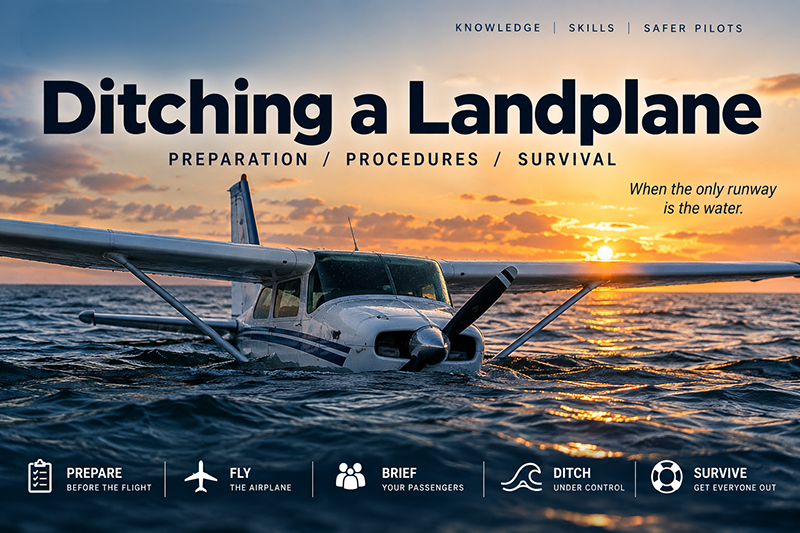
Ditching a landplane is one of the least comfortable topics in flight training, but it deserves clear, practical attention. A water landing in an aircraft not designed for routine water operations is a time-compressed emergency that requires disciplined priorities: fly the airplane, prepare the cabin, choose the best available touchdown area, and get everyone out. The goal is not to make ditching sound routine. The goal is to help pilots understand what decisions may matter when the shoreline, airport, or suitable forced landing field is no longer reachable.
For student pilots, instructors, and experienced aviators alike, the value of studying ditching is not limited to overwater flying. The same mindset applies to any forced landing: aircraft control comes first, passengers need simple instructions, loose objects become hazards, and survival depends on actions taken before impact as much as after it. This article focuses on ditching a landplane from a pilot training perspective, including cabin preparation, approach planning, touchdown technique, and evacuation considerations. Aircraft-specific procedures always come from the approved flight manual, pilot operating handbook, checklist, and operator procedures for the aircraft being flown.
What Ditching a Landplane Really Means
Ditching is an intentional emergency landing on water. A landplane is an aircraft designed primarily for takeoff and landing on land rather than water. That combination creates unique problems. The aircraft may float only briefly, doors may be difficult to open after structural distortion or water pressure develops, occupants may be disoriented, and the survival environment begins immediately after touchdown.
The pilot's first job is still aircraft control. A ditching accident can become unsurvivable if the airplane stalls, impacts at an excessive descent rate, or contacts the water in a bank or yaw. A controlled touchdown at the lowest safe speed, with the aircraft aligned as well as conditions allow, is far preferable to a rushed maneuver that sacrifices control. In an emergency, the temptation is to spend too much attention on radios, checklists, or passenger management. Those tasks matter, but they must support the central objective: arrive at the water under control.
Ditching planning also begins long before an engine failure or other emergency. Pilots who routinely cross water should brief equipment location, passenger roles, life vest use, exits, and communication plans before departure. A pilot who has already thought through those items will make better decisions during an actual emergency, when workload, noise, vibration, and stress may make even simple tasks harder.
Why This Matters in Real-World Aviation
Many pilots fly landplanes near water without thinking of themselves as overwater pilots. Coastal routes, island destinations, large lakes, wide rivers, offshore practice areas, and night flights over sparsely lit shoreline regions can all create scenarios where a runway or field is not available. Even a short water crossing can become significant if altitude, glide performance, wind, terrain, or traffic limits the options.
The real-world challenge is that ditching is both a flight maneuver and a survival event. The approach must protect the occupants from high deceleration and impact injury, while the cabin preparation must make evacuation possible. A beautiful touchdown is not enough if passengers cannot release belts, find exits, or get flotation after impact. Likewise, a well-briefed cabin cannot overcome a loss of aircraft control close to the surface.
Instructors should treat ditching as a decision-making and systems-management topic, not as a dramatic edge case. Students can learn how to evaluate glide range, manage forced landing priorities, brief passengers in plain language, and understand why survival equipment is only useful if it is reachable and familiar. Commercial operators, flight schools, and aircraft owners can use the same discussion to refine passenger briefings and equipment placement for routes that include meaningful water exposure.
Preparing Before the Flight
Good ditching preparation starts before the engine starts. The pilot should know the aircraft's published emergency procedures, including recommended configuration for forced landings and any specific water landing guidance. Some aircraft manuals include explicit ditching procedures. Others provide only general forced landing guidance. Where the manual is silent, pilots should avoid inventing technique and instead rely on conservative principles taught by qualified instructors and supported by sound aeronautical judgment.
Route planning is the first layer of prevention. A direct line across open water may be legal and efficient, but the safest route may keep the aircraft within gliding distance of land or suitable landing areas for a larger portion of the flight. Altitude is also a survival tool. More altitude increases time to troubleshoot, communicate, brief passengers, configure the airplane, and select a touchdown area. It may also improve radio and transponder coverage. Weather, sea state, daylight, water temperature, and rescue accessibility should all influence the go/no-go decision and the chosen route.
Survival equipment must be more than present. It must be accessible. A life vest in the baggage compartment may be of little value if the cabin is inverted, dark, or filling with water. A raft that cannot be reached quickly may not function as a practical survival resource. Pilots should understand how life vests are donned, when they should be inflated, how a raft is deployed, and where signaling devices are stored. As a general safety principle, inflatable life vests should not be inflated inside the aircraft because inflation can trap the occupant or restrict movement during evacuation.
Passenger briefing is equally important. A normal passenger briefing often covers seat belts, exits, and sterile cockpit expectations. For meaningful overwater flight, the briefing should also address flotation, exit operation, what to do after landing, and the importance of following pilot instructions. The wording should be simple. Passengers under stress may not process technical explanations. A clear instruction such as keep your belt fastened until the airplane stops, then release it, move to the assigned exit, and do not inflate your vest until you are outside is more useful than a long lecture.
Cabin Preparation During the Emergency
Once ditching becomes likely, cabin preparation should be direct and purposeful. The pilot may have only a few minutes or less, depending on altitude and the nature of the emergency. The cabin should be prepared to reduce injury, prevent entrapment, and support a fast evacuation.
Seat belts and shoulder harnesses should be secured tightly. Shoulder restraints, where installed, are important because water impact can produce rapid deceleration. Loose objects should be secured or discarded if time and aircraft configuration allow. Bags, headsets, tablets, cameras, and unsecured survival equipment can injure occupants or block exits. Passengers should remove sharp objects from pockets if practical and should avoid holding heavy items during touchdown.
Doors and exits deserve special attention. In many light aircraft, pilots are taught to unlatch or crack doors before touchdown during certain forced landing scenarios so the structure is less likely to jam the exit closed. However, the correct action depends on aircraft design and published procedures. Some aircraft have doors, windows, or canopies with specific limitations or operating methods. Pilots should know the normal and emergency exit operation before flight, not discover it during the descent toward water.
Passenger position matters. Occupants should be braced in a position appropriate for the seat, restraint system, and aircraft configuration. The pilot should assign exit responsibilities only if a passenger is capable and briefed. In a small aircraft, the front-seat passenger may be asked to help open a door after the aircraft stops. In a larger cabin, a capable passenger may be directed to lead others to a specific exit. The best assignments are simple and made early enough to be understood.
Electrical and fuel system actions should follow the aircraft checklist when time allows. The pilot may need to secure fuel, mixture, magnetos or ignition, master switch, and other systems before impact, but timing matters. Shutting down critical electrical power too early could eliminate radios, lights, flaps, trim, or other equipment still needed for control or communication. The published emergency checklist should guide those decisions.
Choosing the Ditching Area
Water is not a uniform landing surface. Wind, waves, swell, current, floating debris, vessels, shoreline obstacles, and lighting all affect the touchdown decision. A pilot should choose the best available area while preserving a stable approach. Last-second maneuvering close to the surface can be more dangerous than accepting an imperfect touchdown zone under control.
In light wind and significant swell, aligning generally parallel to the swell may reduce the chance of striking the face of a wave. In stronger wind, landing into the wind may reduce groundspeed and touchdown energy, but it may also put the aircraft across or into the wave pattern. The best alignment depends on the actual conditions. Pilots should avoid rigid rules that ignore what the water is doing. The practical aim is to minimize relative speed, avoid steep wave faces when possible, and keep the wings level at touchdown.
Near shore, the pilot must consider additional hazards. Surf zones can be violent and unpredictable. Shallow water may contain rocks, sandbars, reefs, pilings, or submerged debris. Boats may offer rescue potential, but they also introduce collision hazards and wake turbulence near the surface. If communicating with rescue services or nearby vessels is possible, the pilot should do so, but the approach must remain the priority.
Daylight and visibility make a major difference. At night, water can be difficult to judge, especially in dark, glassy, or featureless conditions. Reflections may mislead depth perception. If ditching at night cannot be avoided, maintaining aircraft attitude, airspeed discipline, and instrument cross-check becomes especially important. A pilot should resist diving toward lights or maneuvering aggressively toward uncertain visual references.
Approach Priorities for a Water Landing
The approach to ditching a landplane is a forced landing approach with a survival objective. The pilot wants a controlled descent, a suitable touchdown attitude, minimum safe speed, and a configuration consistent with the aircraft's procedures. A stabilized approach is not just an airline concept. In a small aircraft emergency, it means the airplane is pointed where the pilot intends, at a manageable speed, in a reasonable descent, with no need for abrupt corrections near the surface.
Airspeed control is central. Too fast increases impact forces and the possibility of structural failure. Too slow risks a stall, wing drop, or hard impact. The correct target speed is aircraft-specific and may depend on flap setting, weight, wind, and the emergency condition. If the engine is still producing power, the pilot may be able to control the descent more precisely. If power is unavailable, glide planning becomes more critical and the pilot must avoid stretching the glide with excessive pitch.
Flap use should follow the aircraft manual. In general training terms, flaps can reduce stall speed and touchdown speed, but they can also affect glide distance, pitch, visibility, and aircraft handling. A pilot should not delay critical configuration decisions until the final seconds. If flaps are electrically operated, the pilot should consider whether electrical power will remain available and whether the selected setting is appropriate before securing the electrical system.
Landing gear position is another aircraft-specific issue. In many retractable-gear landplanes, water landing guidance often favors gear retracted to reduce the chance of the aircraft digging in or flipping. That statement should never replace the aircraft's published procedure. Fixed-gear aircraft obviously do not offer a gear-up option, and some aircraft designs may have unique guidance. Pilots should know their aircraft, not rely on generic hangar talk.
Touchdown should occur with the wings level and the nose attitude appropriate for the aircraft. A yawed or banked touchdown can produce violent side loads. A nose-low impact can lead to rapid deceleration or pitching forces. Excessive flare can produce a stall and hard drop. The pilot's last few seconds should be simple: maintain control, hold the selected attitude, avoid drift or yaw as much as conditions allow, and keep flying the aircraft until it stops moving.
Evacuation After Touchdown
After water contact, the situation may change quickly. The aircraft may remain upright, pitch forward, turn, partially submerge, or invert. Occupants may be startled, injured, or disoriented. The pilot's job is to transition from flying to evacuation leadership as soon as the aircraft has stopped or slowed enough that releasing restraints and opening exits is the safer action.
A useful mental sequence is stop, orient, release, exit, inflate, and group. First, occupants wait until the major motion stops. Then they orient themselves to the nearest usable exit. They release restraints only when ready to move. They exit without taking baggage. They inflate flotation after leaving the aircraft. Then they group together, account for everyone, and move away from hazards such as fuel, debris, or sinking structure.
Underwater disorientation is a known risk in any water evacuation. If the aircraft inverts or the cabin fills, the simple act of finding a door handle can become difficult. Pilots and passengers should use fixed reference points. For example, keep one hand on the seat belt buckle or seat frame until the exit path is identified. This reduces the chance of floating away from the seat and losing orientation before releasing the belt.
Door operation may be harder after impact. Water pressure, structural deformation, or occupant panic can interfere. If an exit will not open immediately, try the alternate exit if available. This is why preflight briefing matters. Passengers who know there is more than one exit and who have seen the handle before impact are better prepared to act.
Once outside, survival priorities continue. Stay with flotation, conserve energy, assist injured occupants, and use signaling equipment when safe. If a raft is available, board it according to its design and the conditions. In cold water, reducing heat loss becomes urgent. In warm water, dehydration, sun exposure, and fatigue can still become serious concerns. The ditching event does not end at the shoreline of the cockpit. It ends when occupants are rescued and medically assessed.
Communication, Signaling, and Rescue Considerations
If time permits before ditching, the pilot should transmit a distress call on the appropriate frequency, squawk the emergency transponder code if able, and provide position, altitude, persons on board, fuel remaining if relevant, and intentions. A concise call is better than a perfect call that never gets transmitted. GPS position, nearest landmark, distance from shore, and heading can all help rescuers.
Modern aircraft and portable devices may provide additional tools, including emergency locator transmitters, personal locator beacons, satellite communicators, ADS-B tracking, and handheld radios. Each has limitations. An emergency locator transmitter may not perform as hoped if the antenna is submerged or the unit is damaged. A handheld radio is useful only if charged, accessible, and protected from water. A personal locator beacon is most valuable when the pilot or passenger knows how to activate it.
Before overwater flight, pilots should think about what they can reach while seated and what will remain attached during impact. A signaling device buried under baggage is not truly available. A waterproof pouch, tether, or vest pocket may be more practical for essential items such as a beacon, whistle, signal mirror, compact light, or waterproof radio. Equipment choices should be appropriate for the route, water temperature, distance from shore, and expected rescue environment.
How Pilots Should Understand This Topic
Ditching is best understood as a sequence of priorities, not a single maneuver. First, prevent the emergency where possible through planning, maintenance awareness, fuel management, weather judgment, and conservative routing. Second, if the emergency occurs, maintain aircraft control and diagnose only to the extent time allows. Third, communicate and prepare the cabin without losing the airplane. Fourth, fly a controlled approach to the best available water surface. Fifth, evacuate decisively and use survival equipment properly.
This sequence helps pilots avoid a common trap: focusing on one task at the expense of the others. A pilot who spends too long troubleshooting may arrive low and fast with an unprepared cabin. A pilot who briefs passengers extensively may forget to establish best glide or select a reachable touchdown zone. A pilot who fixates on a perfect water surface may maneuver aggressively and lose control. The emergency requires disciplined task management.
In training, instructors can make ditching realistic without making it sensational. A ground lesson can include route planning over a lake or coastal area, equipment placement, passenger briefing practice, and a discussion of aircraft-specific emergency procedures. In flight, simulated engine-out exercises should remain within safe training limitations and should not involve unsafe low-altitude maneuvering. The objective is judgment, not theatrical realism.
Common Mistakes or Misunderstandings
One common misunderstanding is the belief that ditching technique can be reduced to one universal rule. Pilots may hear simplified advice such as always land into the wind, always land parallel to swells, or always use a particular flap setting. Real conditions are more complex. Wind, swell, aircraft configuration, altitude, visibility, and aircraft-specific procedures all matter. A pilot needs principles, not slogans.
Another mistake is treating flotation equipment as cargo rather than survival equipment. Life vests worn or immediately reachable are different from life vests packed behind baggage. A raft secured in a way that cannot be accessed after impact is not a practical tool. Survival gear should be placed and briefed so it can be used under stress.
Inflating a life vest inside the aircraft is a serious hazard. An inflated vest can make it difficult to move through the cabin or exit opening. If the aircraft submerges or inverts, it can press the occupant against the ceiling or structure. Passengers should be briefed to inflate only after exiting unless an aircraft-specific procedure or survival equipment instruction provides different guidance.
Taking baggage during evacuation is another avoidable risk. Personal items slow egress, block exits, and can injure others. The pilot's briefing should make clear that bags stay behind. Documents, phones, and equipment are not worth delaying evacuation from a sinking or unstable aircraft.
Finally, some pilots underestimate the value of a short, calm passenger briefing. Passengers do not need to understand aerodynamics or emergency checklists. They need to know how to tighten belts, brace, open an exit if assigned, leave baggage, exit promptly, and use flotation. Clear instructions before impact can reduce confusion after impact.
Practical Example
Consider a single-engine landplane flying a coastal route on a clear afternoon. The aircraft is cruising high enough to glide several miles, but a portion of the route crosses water beyond comfortable gliding distance from shore. Before departure, the pilot briefs the front-seat passenger on the door latch, life vest location, and the instruction not to inflate the vest until outside. A handheld radio and personal locator beacon are secured within reach rather than packed in the baggage area.
During cruise, the engine begins running rough and then loses power. The pilot establishes the recommended glide speed, turns toward the nearest shoreline, and attempts the appropriate restart items while maintaining aircraft control. After determining that land is unlikely to be reached, the pilot transmits a distress call with position and intentions. The passengers are told to tighten belts, secure loose items, put on life vests without inflating them, and prepare to brace.
The pilot evaluates the water surface. The wind favors one direction, while the swell suggests a slightly different alignment. Rather than making a steep last-minute turn toward a boat or shoreline, the pilot chooses a stable path that avoids the steepest wave faces and allows a wings-level touchdown. The cabin door is handled according to the aircraft procedure. Flaps are set in accordance with the aircraft manual and available energy. The pilot holds the aircraft off as speed decreases, avoids a stall, and touches down under control.
After the aircraft stops moving, the pilot directs evacuation. The passengers release belts, move to the briefed exits, leave baggage, and inflate flotation only after clearing the aircraft. Once outside, the group stays together and activates signaling equipment. This example is intentionally ordinary. The successful elements are not heroics. They are preparation, altitude, communication, aircraft control, clear passenger instructions, and disciplined evacuation.
Best Practices for Pilots
The most useful ditching practices are habits that can be built into normal flying. Pilots should review aircraft-specific emergency procedures periodically, especially before routes involving water. They should know how each exit operates, how seats and restraints work, and where survival equipment is located. They should brief passengers in language that can be remembered under stress.
For overwater planning, consider the full survival environment rather than only the distance across the water. Water temperature, daylight, wind, sea state, traffic density, rescue availability, and communication coverage may matter as much as mileage. A route that is acceptable on a warm daylight afternoon may be a poor choice at night or in cold water.
Practical habits include:
- Review the aircraft's ditching or forced landing procedure before flights with meaningful water exposure.
- Keep flotation and signaling equipment accessible to the people who may need it.
- Brief passengers on exits, belts, brace position, flotation, and leaving baggage behind.
- Maintain altitude and routing options that preserve time for troubleshooting and preparation.
- Practice concise emergency communication during training scenarios.
- Use aircraft control and stabilized approach discipline as the foundation of every forced landing plan.
Flight instructors can strengthen this training by asking scenario-based questions. What would you do differently over cold water? Which exit would your passenger use if the left door jammed? Where is the beacon? Can you reach it while strapped in? What would you say in a ten-second passenger briefing? These questions build practical readiness without implying that every ditching scenario can be scripted.
Frequently Asked Questions
Should a pilot always land into the wind when ditching?
Not always. Landing into the wind can reduce groundspeed, but wave and swell direction may make another alignment safer. The pilot should consider wind, swell, sea state, visibility, and aircraft control. The best choice is the one that allows a controlled touchdown while avoiding the most hazardous water conditions available.
Should landing gear be up or down during a water landing?
The answer is aircraft-specific. Many retractable-gear landplanes use gear-up guidance for ditching, but pilots should follow the aircraft's approved manual and checklist. Fixed-gear aircraft do not provide a gear-up option, and some designs may have unique considerations.
When should passengers inflate life vests?
As a general safety practice, inflatable life vests should be inflated after exiting the aircraft. Inflating inside the cabin can restrict movement, block escape, or trap an occupant if the aircraft submerges or inverts. Passengers should be briefed on this point before overwater flight.
Is ditching training something pilots should practice in flight?
Pilots can practice the decision-making, communication, glide management, and passenger briefing elements of ditching during safe forced landing training. Actual low-altitude water approach practice in a landplane is not appropriate unless conducted under a specific authorized training environment with qualified oversight. Most ditching readiness is built through ground briefing, aircraft procedure knowledge, and safe simulated emergencies.
What is the most important action during a ditching emergency?
Aircraft control remains the most important action. Cabin preparation, radio calls, and troubleshooting are valuable, but they must not distract the pilot from maintaining proper airspeed, attitude, and approach control. A controlled touchdown gives occupants the best chance to evacuate.
What should pilots carry for overwater flights?
Equipment depends on the route and operating environment, but commonly considered items include accessible life vests, a raft when appropriate, signaling devices, a waterproof light, a whistle, a personal locator beacon, and a handheld radio or satellite communication device. Pilots should verify applicable regulations, aircraft limitations, and operator requirements for the specific flight.
Key Takeaways
- Ditching a landplane requires aircraft control first, followed by concise cabin preparation, a disciplined approach, and decisive evacuation.
- Survival equipment must be accessible and understood before takeoff. A life vest or beacon that cannot be reached after impact may not help.
- Aircraft-specific procedures matter. Gear, flap, door, and shutdown actions should come from the approved manual, checklist, and qualified training.