
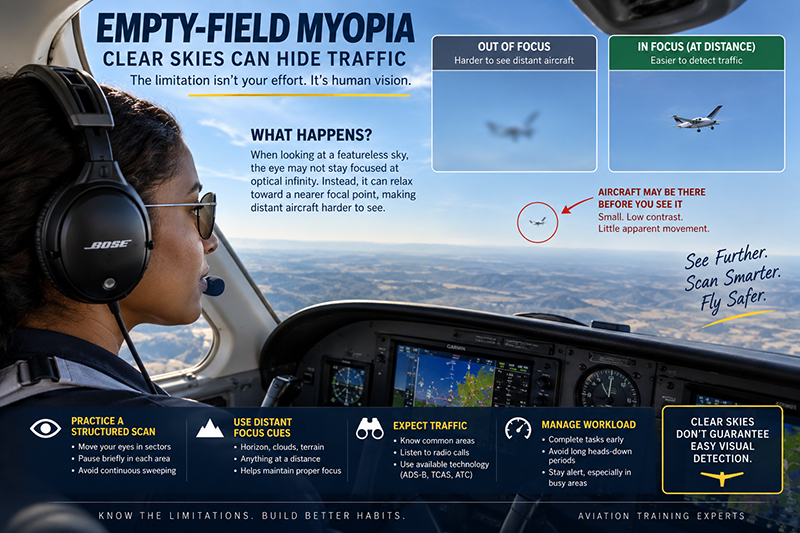
Empty-field myopia is one of those aviation human factors that sounds academic until it affects a pilot at the worst possible time. A pilot can be looking outside on a clear day, actively trying to find traffic, and still fail to see an aircraft that is there to be seen. The problem is not laziness or poor eyesight. It is a predictable limitation of the human visual system when the eye has little useful detail to focus on.
For pilots, student pilots, flight instructors, and aviation professionals, this matters because visual separation is still a core layer of collision avoidance. Radios, transponders, traffic displays, ADS-B, ATC services, and operating procedures all help, but they do not replace the pilot’s responsibility to maintain an effective visual scan when conditions allow. Understanding empty-field myopia helps pilots make better use of their eyes, their cockpit technology, and their training habits.
This article explains what empty-field myopia is, why it can occur in a clear sky, how it affects traffic detection, and what pilots can do about it in practical cockpit terms. The goal is not to make pilots distrust their vision. The goal is to make visual scanning more deliberate, more realistic, and more effective.
What Empty-Field Myopia Means for Pilots
Empty-field myopia is a visual focusing tendency that can occur when the eye is looking into a field with little or no distinct detail. In aviation, the classic example is a pilot looking into a bright, clear, cloudless sky. With no strong visual reference at a meaningful distance, the eye may not remain focused at optical infinity. Instead, it may relax toward a nearer focal point.
That matters because distant traffic may be small, low contrast, and nearly motionless on the windscreen. If the eye is not properly focused for distance, the target may not form a sharp enough image to attract attention. The pilot may feel that they are scanning outside, but the visual system is not optimized to detect small aircraft at range.
The term can be misleading if it is interpreted too narrowly. Empty-field myopia is not simply a problem for pilots with nearsightedness, and it is not limited to students. It is a human visual behavior that can affect pilots with otherwise normal or corrected vision. The issue is not only whether the pilot can pass a vision test. It is whether the pilot’s eyes are focused, moving, and attending in a way that supports traffic detection in the flight environment.
In practical terms, a clear sky can be visually deceptive. Pilots often assume that clear weather means traffic should be easy to see. In reality, a clear sky can remove the contrast cues that help the eye focus and detect distant objects. A small aircraft against a uniform blue background may be difficult to notice until it becomes larger, closer, or more angularly displaced.
Why Clear Skies Can Make Traffic Hard to See
Visual detection in aviation is not just a matter of looking in the right direction. The eye and brain must detect contrast, resolve shape, identify motion, and decide that the object is important. A traffic target may be physically present in the pilot’s field of view long before the pilot consciously notices it.
Several characteristics of aircraft traffic make this difficult. At a distance, another aircraft may occupy only a tiny portion of the visual field. Its color may blend into the background. Sun angle, haze, windshield distortion, reflections, and cockpit structure can further reduce visibility. If the target is on a collision course, it may show little relative movement across the windscreen. That lack of apparent motion is dangerous because moving objects tend to attract attention more readily than stationary ones.
Empty-field myopia adds another layer to the problem. When the eye lacks a defined distant object to focus on, the pilot may be looking outward without truly focusing at the distance where traffic exists. The result can be a subtle form of visual inefficiency. The pilot is not blind, and the pilot is not ignoring the outside environment, but the scan is less effective than it feels.
This is one reason flight instructors emphasize scanning technique rather than simply telling students to “look outside.” The instruction is not just about attitude flying or avoiding fixation on instruments. It is also about teaching the eyes and brain to search the outside environment in a structured way.
How the Eye Searches for Traffic
The human eye does not see the entire outside scene with equal clarity. The sharpest central vision occurs in a small area, while peripheral vision is better at detecting movement and changes. To find traffic, a pilot must move the eyes through a series of intentional fixations. During each pause, the eye has time to focus and the brain has time to process what is in that small sector.
A fast, sweeping glance across the windscreen may feel thorough, but it can be ineffective. If the eyes move continuously, small targets can be missed because the image does not remain stable long enough for recognition. A better scan usually involves dividing the outside view into sectors, pausing briefly in each area, and then moving to the next. The exact pattern may vary by aircraft, phase of flight, traffic environment, and pilot technique, but the principle is consistent: the scan must include purposeful eye movement and momentary fixation.
Focusing cues also matter. A pilot can help the eyes focus at distance by periodically looking at a defined object far away, such as a cloud edge, horizon feature, distant terrain, ridgeline, shoreline, or another aircraft if already identified. In a truly featureless sky, this may be more difficult, which is why the pilot’s scan discipline becomes more important.
Visual scanning is also affected by workload. When a pilot is busy with navigation, configuration, radio calls, checklists, traffic pattern procedures, or passenger communication, the quality of the outside scan can degrade. The pilot may look outside often enough to feel comfortable, but the glances may be too short or unfocused to detect traffic.
Why This Matters in Real-World Aviation
Empty-field myopia is relevant anywhere pilots rely on see-and-avoid practices. It is especially important in visual meteorological conditions, near airports, in practice areas, along common training routes, in uncontrolled airspace, during VFR-on-top operations, and in busy terminal environments where aircraft may converge from different directions.
In training aircraft, the issue can be amplified by cockpit layout and instructional workload. A student may be concentrating on altitude, heading, airspeed, trim, radio calls, and instructor feedback while also trying to scan for traffic. The student may understand the concept of see-and-avoid but still lack the visual habits needed to apply it effectively.
In faster aircraft, closure rates can reduce the time available to detect, assess, and avoid traffic. Even when both aircraft are operating legally and responsibly, the visual task may be demanding. Pilots who transition into faster airplanes should recognize that a scan technique that felt adequate at lower speeds may need refinement.
In glass cockpit aircraft, traffic displays can improve situational awareness, but they can also create a new form of fixation if used poorly. A pilot who spends too much time looking inside at traffic symbology may reduce the very outside scan needed to visually acquire the aircraft. The display should help direct the scan, not replace it.
Flight instructors play a significant role here. Good instruction connects the physiology to the cockpit behavior. Instead of treating traffic scanning as a vague reminder, instructors can teach students why a structured scan works, why continuous windshield sweeping is weak, and why clear weather does not guarantee easy traffic detection.
How Pilots Should Understand This Topic
Pilots should think of empty-field myopia as a normal human limitation that requires an operational countermeasure. It is similar in that sense to spatial disorientation, visual illusions, fatigue, or expectation bias. Knowing about the limitation does not eliminate it, but it allows pilots to build habits that reduce its effect.
The first practical point is that seeing is active, not passive. A pilot cannot simply point the face outside and expect the brain to capture every traffic conflict. Effective visual detection requires a deliberate scan, a brief pause in each search area, and attention to likely traffic sources.
The second point is that focus matters. Looking at a blank sky may not provide enough information for the eyes to maintain an ideal distance focus. Pilots should use available distant references to help maintain focus and should avoid long periods of staring into featureless space without a scan pattern.
The third point is that traffic detection is a team process between eyes, ears, and avionics. Radio position reports, ATC traffic advisories when available, onboard traffic information, airport traffic patterns, charted procedures, and knowledge of local training areas can all help the pilot know where to search. None of these tools is perfect alone. Together, they improve the odds that the pilot will look in the right place at the right time.
The fourth point is that expectation can help or hurt. If a pilot expects traffic to be on a downwind, base, final, practice area boundary, airway-like route, or common reporting point, the scan can be more focused. But if the pilot assumes traffic will always be where expected, unexpected aircraft may be missed. Good scanning balances directed search with broad situational awareness.
Common Mistakes or Misunderstandings
One common mistake is believing that excellent visibility automatically means traffic will be easy to see. Visibility reports describe the ability to see large objects or landmarks at a distance under prevailing conditions. They do not mean that a small aircraft with limited contrast will be easy to acquire visually.
Another mistake is assuming that a traffic display proves the outside environment is clear. Traffic systems are valuable, but they have limitations related to equipage, signal availability, display settings, latency, relative altitude interpretation, pilot workload, and cockpit attention. A traffic display can tell a pilot where to look, but the pilot still needs to look outside, confirm what can be confirmed, and maneuver appropriately when necessary.
A third misunderstanding is treating the scan as a rapid windshield sweep. A quick sweep may cover a large angle, but it may not create enough time for the eye to focus and the brain to recognize a small target. This is especially relevant when a pilot is anxious about missing traffic and responds by scanning faster. Faster is not always better. Methodical is usually better.
Pilots can also become overly dependent on the instructor, the other pilot, or air traffic services. In a two-pilot training environment, it is easy for each person to assume the other is watching a particular sector. In single-pilot operations, it is easy to assume that a traffic advisory service will catch every conflict. Neither assumption is reliable enough to replace disciplined see-and-avoid behavior.
Finally, pilots sometimes confuse looking outside for attitude control with scanning for traffic. These are related but not identical tasks. A pilot may be using outside references to hold pitch and bank while still not searching the sky systematically for aircraft. Traffic scanning requires its own attention, especially in busy airspace.
Practical Example
Consider a student pilot and instructor returning to a non-towered airport on a clear afternoon. The airport is easy to see, the horizon is sharp, and the weather appears ideal for VFR training. The student is preparing to enter the traffic pattern while listening to position reports. Another aircraft reports midfield downwind, but the student does not see it.
The student looks outside, then inside at the altimeter and airspeed, then outside again. The instructor asks where the traffic is. The student scans quickly across the windscreen and says, “I don’t have it.” The instructor points to an area slightly above the horizon and off the left side of the nose. After a moment, the student finally sees a small, steady speck that slowly grows into the shape of an airplane.
Several factors may be at work. The target may have been small and low contrast. It may have had little apparent motion because of the geometry. The student’s attention may have been divided among aircraft control, radio listening, pattern entry planning, and cockpit checks. If the surrounding sky offered few focus cues, empty-field myopia could have further reduced the effectiveness of the scan.
A good instructor would not simply say, “Look harder.” A more useful teaching moment would be to slow the process, point out the likely traffic sector based on the radio call, encourage the student to focus at distance, and demonstrate a sector scan with brief pauses. The instructor could then discuss why the aircraft was difficult to see even in excellent VFR conditions.
This kind of training example is valuable because it turns a missed traffic sighting into a skill-building event. The lesson is not that the student failed. The lesson is that seeing traffic requires technique, patience, and an understanding of human visual limits.
Best Practices for Pilots
The best defense against empty-field myopia is not one single trick. It is a combination of scan discipline, cockpit management, visual focus, and situational awareness. Pilots should build these habits early and continue refining them throughout their flying careers.
- Use a structured visual scan. Divide the outside view into manageable sectors and pause briefly in each area rather than sweeping continuously.
- Focus at distance when possible. Use clouds, terrain, the horizon, or other distant visual references to help the eyes maintain an appropriate focal distance.
- Search where traffic is most likely. Give extra attention to traffic pattern legs, runway extensions, practice areas, common reporting points, and areas identified by radio or traffic displays.
- Do not let avionics replace the window. Use traffic information to cue the outside scan, then return attention outside to acquire and avoid traffic when conditions allow.
- Manage cockpit workload. Complete tasks early when possible, brief expected traffic areas, and avoid long heads-down periods in high-density environments.
- Verbalize traffic responsibilities in crew or training operations. Clear communication helps prevent both pilots from assuming the other person is covering the same threat area.
These habits work best when practiced deliberately. A student who hears “keep your eyes outside” on every lesson may not improve much unless the instructor also teaches how to look outside. A pilot who practices sector scanning, traffic correlation, and focus discipline is more likely to build a durable safety habit.
Using Technology Without Losing the Visual Scan
Modern cockpit technology can be a major asset in traffic awareness. ADS-B traffic, active traffic systems, moving maps, audio alerts, and ATC advisories can all help pilots develop a mental picture of nearby aircraft. Used properly, these tools can reduce uncertainty and help direct the pilot’s eyes to the correct sector.
The key phrase is “used properly.” A traffic display is not the sky. It is a representation of information that may be limited by system design, aircraft equipage, update timing, altitude filtering, display range, or pilot interpretation. Pilots should avoid the trap of staring at the display while the actual aircraft remains outside and unseen.
A useful technique is to translate traffic information into an outside search plan. If traffic appears two miles ahead and slightly right, near the same altitude, the pilot should not merely watch the symbol. The pilot should look outside in that direction, scan the appropriate vertical area, and continue to update the search as the relative position changes.
Technology also helps when used before workload peaks. For example, reviewing nearby traffic before entering a practice area or approaching a busy airport can prepare the pilot for where to look. This reduces the chance of surprise and supports a more intelligent visual scan.
Instructor Techniques for Teaching Empty-Field Myopia
Flight instructors can make this topic more memorable by connecting it to actual cockpit experience. Rather than waiting for a close traffic encounter, instructors can introduce the concept during preflight briefing and then reinforce it during normal flight operations.
One effective approach is to ask the learner to describe where traffic is most likely before taxi, before takeoff, before entering the practice area, and before returning to the airport. This builds the habit of predictive scanning. The student learns that traffic search is not random. It is guided by position, procedure, radio calls, airport layout, and aircraft performance.
In flight, an instructor can demonstrate how quickly a target can disappear into the background when the student looks down and back up. The instructor can also point out how a stationary speck may represent a greater threat than a target moving rapidly across the windscreen, depending on geometry. Care should be taken not to overstate this as a universal rule, but the concept is important: lack of apparent movement does not mean lack of risk.
Debriefing is equally important. If a student missed traffic, the discussion should include where the student was looking, how long each fixation lasted, what cockpit tasks competed for attention, what cues were available, and how the scan could improve next time. That type of debrief builds skill without creating unnecessary fear.
Operational Takeaways for Different Flight Environments
In the traffic pattern, pilots should expect aircraft from predictable but not perfectly predictable locations. A scan should include runway final, base-to-final areas, crosswind, downwind, extended centerlines, and possible straight-in or nonstandard arrivals. At non-towered airports, radio calls help, but not every aircraft may transmit or be heard. At towered airports, clearances and advisories help sequence traffic, but pilots still need to maintain vigilance when operating visually.
In practice areas, pilots should be especially cautious near common maneuvering locations, prominent landmarks, and boundaries used for training. Aircraft performing maneuvers may change heading, altitude, and speed more frequently than en route traffic. Before steep turns, stalls, slow flight, or other training maneuvers, clearing turns and visual scanning should be treated as meaningful risk controls, not as ceremonial habits.
During cruise flight, the scan may feel less urgent, but traffic conflicts can still develop. Pilots should maintain an outside scan, particularly near airways, VFR corridors, mountain passes, river valleys, coastlines, and other routes that tend to attract traffic. Terrain and haze can also make aircraft detection harder, even when flight visibility is acceptable.
During climb and descent, visibility over the nose, aircraft attitude, sun angle, and workload can affect traffic detection. Pilots should use small heading changes when appropriate, crew coordination when available, and all available information to compensate for blind spots and task saturation.
Frequently Asked Questions
Is empty-field myopia the same as ordinary nearsightedness?
No. Ordinary nearsightedness is a refractive vision condition that affects how the eye focuses. Empty-field myopia is a focusing tendency that can occur when the eye looks into a visually empty field with few distance cues. A pilot with normal or corrected vision can still be affected by it.
Can empty-field myopia happen on a clear VFR day?
Yes. A clear, cloudless sky can provide fewer visual focus cues than a sky with clouds, terrain contrast, or other distant references. Clear weather improves many aspects of flight visibility, but it does not guarantee that small traffic targets will be easy to detect.
Does ADS-B traffic eliminate the risk?
No. ADS-B and other traffic systems can be very useful, but they do not replace the outside visual scan. Pilots should use traffic information to guide where they look, while recognizing that cockpit displays and traffic data have operational limitations.
What is the best scan technique for avoiding empty-field myopia?
A practical technique is to divide the outside view into sectors, pause briefly in each sector, and focus at distance using available visual references. The scan should be adjusted for the phase of flight, traffic environment, aircraft blind spots, and available traffic information.
Why is traffic sometimes hardest to see when it is most important?
An aircraft on a potential collision path may show little relative motion on the windscreen. It may remain a small, steady target until it gets closer. That makes a disciplined scan and prompt attention to traffic cues especially important.
How should instructors teach this to student pilots?
Instructors should explain the visual limitation, demonstrate sector scanning, use traffic calls and avionics to cue outside searches, and debrief missed sightings constructively. The goal is to build repeatable visual habits rather than simply telling students to look harder.
Key Takeaways
- Empty-field myopia can reduce traffic detection when pilots look into a featureless sky without strong distance focus cues.
- Effective see-and-avoid technique requires a structured visual scan with brief pauses, not a rapid sweep across the windshield.
- Traffic displays, radio calls, and ATC services should cue and support the outside scan, not replace pilot visual vigilance.
- Flight instructors should teach scanning as a skill that includes focus, attention, workload management, and practical traffic prediction.