
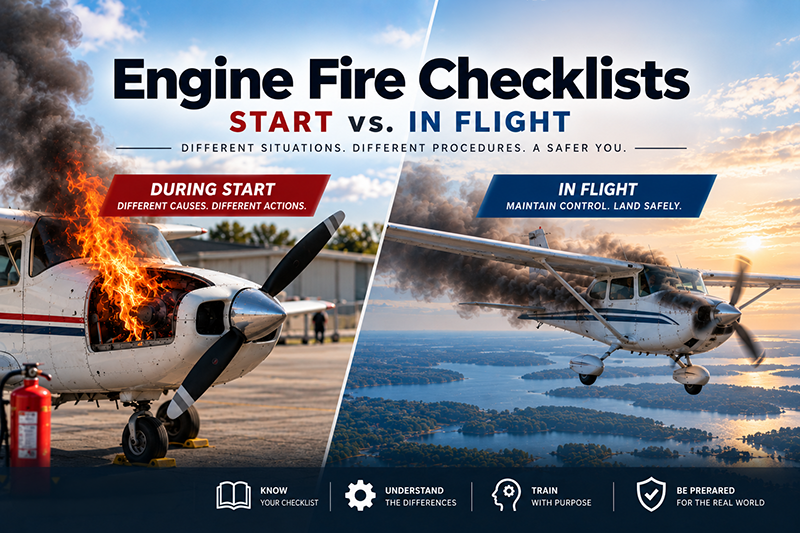
An engine fire checklist can look surprisingly different depending on whether the fire occurs during engine start or while the aircraft is already airborne. That difference is not arbitrary. It reflects two very different operating problems: on the ground, the airplane is stationary or nearly stationary, people can evacuate, and the fire may be related to fuel introduced during starting. In flight, the pilot must manage the fire while also keeping the airplane under control, preserving survivable landing options, and preventing smoke, heat, or structural damage from worsening the emergency.
For pilots, student pilots, instructors, and aircraft operators, the important lesson is not to memorize a generic fire procedure from memory and assume it applies everywhere. The aircraft-specific Pilot’s Operating Handbook, Aircraft Flight Manual, checklist, and operator procedures always govern. But understanding why the procedures differ makes checklist discipline stronger. It helps pilots avoid rote responses, recognize what each action is trying to accomplish, and train for the decision-making pressure that comes with fire, smoke, odor, or abnormal engine indications.
Why Engine Fire Checklists Differ by Phase of Operation
An engine fire during start and an engine fire in flight are both serious emergencies, but the physics, priorities, and available options are different. During start, especially in many piston-engine airplanes, a fire may occur because fuel has accumulated in the induction system, intake, or engine compartment and then ignites during the start sequence. In that situation, some aircraft procedures may initially call for continued cranking or a specific start-related action because airflow through the engine may help draw flames or excess fuel into the cylinders. The goal is to stop feeding the fire, contain it, and decide quickly whether evacuation is required.
In flight, the airplane is moving through the air, the engine compartment is under aerodynamic airflow, and the pilot cannot simply step out of the airplane. The fire procedure must support three priorities at the same time: maintain aircraft control, eliminate or reduce the sources feeding the fire, and get the airplane on the ground as soon as practical. In many aircraft, that means securing the affected engine, shutting off fuel or ignition sources as directed by the approved checklist, managing cabin ventilation if smoke or fumes are present, declaring an emergency, and preparing for an emergency landing.
The key point is that the same visible problem, fire, does not always have the same best first action. On the ground, the pilot may have the option to use starter airflow, stop the engine start, discharge an extinguisher, and evacuate. In flight, the pilot must preserve control and glide or single-engine performance, then land. The checklist is built around the environment in which the emergency occurs.
What Is Different About an Engine Fire During Start?
An engine start is a fuel, air, ignition, and mechanical rotation event. The engine is not yet producing normal power, the aircraft may be parked near people or equipment, and the pilot is usually close to ramps, hangars, fuel trucks, or other aircraft. A start fire may be external, internal, or initially hidden behind the cowling. The first clue may be a shout from someone outside, a sudden odor, visible flames, smoke, abnormal engine behavior, or a cockpit indication if the aircraft has a fire warning system.
In piston aircraft training, pilots often learn that excessive priming, incorrect throttle position, hot-start difficulties, or interrupted starts can increase the risk of fuel pooling or vapor ignition. That does not mean every start fire has the same cause, and it does not justify improvising beyond the aircraft checklist. It does explain why some start-fire procedures are designed around controlling fuel flow and using engine rotation in a very specific way.
A common training concept is that an engine fire during start is initially a ground emergency with an evacuation clock. If the fire is not rapidly controlled, the pilot must be ready to secure the aircraft, get occupants out, and move away. The ground environment gives the pilot one advantage: people can leave the aircraft. It also creates one hazard: a delayed evacuation can become more dangerous if the fire spreads beyond the engine compartment.
Another difference is communication and crew coordination. On the ramp, an instructor, line technician, or another pilot may see the fire before the person at the controls does. A pilot who hears “fire” during start must treat the callout seriously. In training aircraft, the instructor and student should brief who will maintain control of the cockpit, who will call for help, and when evacuation becomes the priority. In crewed operations, start fire procedures are normally handled through defined callouts and standard roles.
What Is Different About an Engine Fire In Flight?
An in-flight engine fire introduces a much more complex problem. The aircraft is airborne, so the pilot must keep flying while responding to a potentially time-critical emergency. Even a small fire indication can become serious because fire may damage fuel lines, oil lines, control cables, engine mounts, electrical wiring, or surrounding structure. Smoke or fumes can also impair pilot performance and passenger safety.
In a single-engine airplane, shutting down or losing the engine means the pilot must transition immediately to glide planning and forced landing decision-making. In a multiengine airplane, the pilot must identify the affected engine, secure it correctly, manage asymmetric thrust, and decide whether continued flight is possible or whether landing as soon as practical is the safer course. In turbine aircraft, engine fire procedures often include fire detection, fire handle or switch actions, fuel and hydraulic shutoff logic, and fire extinguisher bottle use. Those systems are aircraft-specific and must be trained exactly as published.
The in-flight checklist is usually not trying to save the engine. It is trying to save the aircraft and the people in it. That distinction matters. Pilots sometimes hesitate because they hope the engine will keep running or they fear committing to a forced landing. A fire emergency changes that calculation. If the checklist directs the pilot to secure the engine or shut off fuel to the affected area, the purpose is to remove the fire’s energy source and reduce the chance of further damage.
Airspeed management also becomes important. Some aircraft emergency procedures provide a recommended airspeed for engine fire, smoke removal, or emergency descent. Other aircraft do not. Pilots should not invent an airspeed or assume that one airplane’s procedure applies to another. The practical training point is to know the published procedure before the emergency, understand where it is in the checklist, and practice the cockpit flow under instructor supervision or in an approved training environment.
Why This Matters in Real-World Aviation
Fire procedures are not just memory items on a checkride. They are part of real operational risk management. Start fires are more likely to occur in a ground environment where distractions are common: passengers are boarding, headsets are being adjusted, radios are being set, and the pilot may be trying to meet a schedule. In-flight fires are rare but high-consequence events that demand immediate prioritization.
The difference between start and in-flight fire procedures also illustrates an important aviation safety principle: emergency checklists are designed around context. A pilot who understands the context is less likely to make the wrong emergency response at the wrong time. For example, a ground procedure that makes sense during start may be inappropriate after takeoff. Likewise, an in-flight shutdown action may not be the first or most effective action for a small induction fire during start if the aircraft checklist calls for a different sequence.
Flight instructors can use this topic to teach more than fire response. It reinforces aircraft systems knowledge, fuel management, cockpit discipline, evacuation planning, emergency communications, and the importance of briefing abnormal procedures. It also helps students understand why checklist memorization alone is incomplete. The goal is not to recite words under pressure. The goal is to take the correct action for that aircraft, in that phase of operation, while maintaining control and protecting lives.
How Pilots Should Understand This Topic
Pilots should think of an engine fire as a problem involving three elements: a heat source, a fuel or combustible source, and oxygen. A checklist attempts to interrupt that chain using the tools available in the moment. During start, the pilot may be able to control fuel, starter operation, mixture or condition lever position, throttle position, ignition, electrical power, and evacuation. In flight, the pilot may need to control fuel, ignition, electrical or hydraulic sources, airflow into the cabin, aircraft configuration, communications, and landing site selection.
This is where systems knowledge becomes practical. A pilot who knows how fuel reaches the engine, how the induction system is arranged, how the starter and ignition system work, and how the fuel selector or shutoff valve operates can better understand the checklist. That does not mean the pilot should freelance. It means the checklist actions make sense instead of feeling like unrelated commands.
In piston airplanes, pilots often train for engine start fires as a distinct emergency because the engine is being fed fuel and rotated by the starter rather than producing normal operating power. In flight, the same aircraft may require a different sequence because the engine is running, the aircraft is airborne, and the pilot may need to establish a glide, shut off fuel, turn off electrical components as directed, and prepare for landing. The practical distinction is simple: during start, stop the ground fire problem and be ready to evacuate; in flight, keep flying, stop feeding the fire, and land.
In multiengine and turbine operations, the differences can be even more pronounced. A turbine start fire, tailpipe fire, hot start, or hung start is not managed the same way as an in-flight engine fire warning. The terminology, indications, and procedures vary by aircraft. Training must be aircraft-specific because fire detection loops, extinguishing systems, fuel shutoff valves, bleed air systems, and engine control designs differ widely.
Common Mistakes or Misunderstandings
One common mistake is treating all engine fire checklists as interchangeable. A pilot may remember a phrase from a trainer airplane and apply it mentally to a different model, a fuel-injected engine, a turbocharged engine, a turbine aircraft, or a multiengine airplane. That can be dangerous. Emergency procedures are written for a specific aircraft design and system configuration.
Another misunderstanding is assuming that visible flame during start always means the airplane is seconds from being lost. A start fire may be controlled quickly if handled correctly, but the opposite assumption is equally dangerous: waiting too long because the pilot hopes it will burn itself out. Pilots should respect the checklist sequence, watch for confirmation that the fire is out, and evacuate when the procedure or situation requires it.
A third error is allowing the fire emergency to consume all attention. In flight, the first priority remains aircraft control. A pilot who dives into the checklist while allowing airspeed, bank angle, terrain clearance, or aircraft configuration to deteriorate may turn one emergency into several. The old training principle still applies: aviate, navigate, communicate. In a fire emergency, “aviate” includes maintaining control while moving quickly through critical memory items or checklist actions as appropriate.
There is also a training risk around simulated emergencies. Instructors must avoid creating unsafe cockpit confusion or encouraging students to manipulate fuel, mixture, ignition, or electrical systems in a way that creates actual risk unless the training environment and aircraft procedures support it. Simulated engine fire training is primarily about recognition, flows, callouts, checklist use, and decision-making, not theatrical surprise.
Finally, pilots sometimes under-brief evacuation. A start fire is one of the clearest reasons to brief seat belts, doors, exits, passenger movement, and where to go after leaving the airplane. Passengers do not need a long lecture, but they do need enough information to avoid freezing, walking toward a propeller, carrying baggage, or remaining too close to the aircraft.
Practical Example
Consider a student and instructor in a piston single-engine training airplane on a cool morning. The engine is reluctant to start, and the student adds more prime than usual. On the next start attempt, the engine catches briefly, then stops. A person on the ramp signals urgently and points toward the nose. The instructor takes control of the situation, follows the aircraft’s engine fire during start procedure, directs the student clearly, and prepares for evacuation if the fire does not go out promptly. The key teaching point is not that every airplane should be handled the same way. It is that this is a start-phase fire problem, with the airplane on the ground and occupants able to exit if necessary.
Now compare that with a cruise scenario in the same general category of aircraft. The pilot notices a burning odor, abnormal engine indications, and smoke near the cowling area. The airplane is at altitude over mixed terrain. This is no longer a start-fire problem. The pilot’s priorities shift immediately to aircraft control, emergency checklist actions for engine fire in flight, selection of a landing area or airport, emergency communication, and preparation for landing. If the checklist calls for securing the engine, the pilot must be mentally ready for glide performance and forced landing planning.
The contrast is the lesson. During start, the pilot is managing a ground fire and evacuation threat. In flight, the pilot is managing an airborne fire, aircraft controllability, and landing survival. The words “engine fire” appear in both procedures, but the operating environment changes the logic.
Best Practices for Pilots
The best fire emergency training begins before the engine turns. Pilots should review the aircraft-specific emergency procedures during preflight preparation, especially when flying an unfamiliar aircraft, returning after time away, operating in cold weather, or flying a model with start characteristics different from their usual airplane.
It is also useful to brief the difference between a start fire and an in-flight fire. A short mental review can make the pilot faster and calmer if something happens. For example, before start, a pilot might review where the mixture or condition control is, how to stop fuel flow, where the master and magneto or ignition switches are, how to open the door, and where the extinguisher is located. Before takeoff, the pilot should know the in-flight engine fire procedure, best glide or relevant emergency speeds if published, immediate landing options, and how to communicate an emergency.
Several practical habits support better outcomes:
- Use the exact checklist for the aircraft being flown, not a remembered procedure from another model.
- Brief passengers on exits, seat belts, and post-evacuation movement before engine start.
- Know where the fire extinguisher is and how it is secured, if one is installed or carried.
- Practice emergency flows with an instructor without rushing or skipping aircraft control.
- Treat smoke, flame, fuel odor, or abnormal heat as a serious warning until proven otherwise.
- After any suspected fire, have the aircraft inspected by qualified maintenance personnel before further flight.
For instructors, the best practice is to teach the “why” behind checklist actions without replacing the checklist. Students should learn that some actions remove fuel, some remove ignition or electrical energy, some manage airflow or smoke, and some prepare the occupants for evacuation or landing. That understanding helps prevent rote checklist recitation under stress.
Training and Checklist Discipline
Engine fire training should include both immediate action and disciplined verification. Some emergency procedures include memory items because there may not be time to read before acting. Other items are completed by reference to the checklist as soon as practical. The distinction depends on the aircraft and the operator’s procedures. Pilots should avoid creating personal memory items that are not supported by the aircraft’s approved or recommended procedures.
Good checklist discipline also means recognizing when the checklist is not a substitute for judgment. If a start fire continues, evacuation may be more important than preserving the aircraft. If an in-flight fire appears extinguished, the pilot still needs to consider hidden damage, smoke, fumes, and the possibility of reignition. A fire warning that disappears after checklist action does not automatically make the flight normal again.
In scenario-based training, instructors can ask students to verbalize priorities rather than simply recite steps. Questions such as “What are you trying to stop from feeding the fire?” or “Where will you land if the engine is secured now?” develop the decision-making that real emergencies require. The student should leave the lesson understanding that the checklist is a tool, but aircraft control and judgment remain central.
Maintenance and Post-Event Considerations
Any engine fire, suspected fire, smoke event, or abnormal heat indication deserves maintenance attention. Even if flames are no longer visible, heat can damage hoses, wiring, seals, clamps, engine controls, cowling materials, accessories, or fire detection components. A pilot should not assume that a brief start fire is harmless simply because the engine later starts normally.
After a ground fire, the aircraft should be secured and inspected according to appropriate maintenance practices and applicable procedures. After an in-flight fire or suspected fire, the landing should be treated as the end of the flight until the aircraft is inspected. This is a practical safety principle, not a substitute for maintenance guidance. Pilots are not expected to determine airworthiness after a fire based on appearance alone.
Operators should also review the human factors surrounding the event. Was the start rushed? Was the aircraft over-primed? Were abnormal indications recognized promptly? Did passengers understand evacuation instructions? Was the checklist available and readable? These questions help turn an emergency or near miss into better training and safer future operations.
Frequently Asked Questions
Why might a start fire procedure call for different actions than an in-flight fire procedure?
Because the operating environment is different. During start, the aircraft is on the ground and the fire may be related to fuel introduced during the starting process. In flight, the pilot must maintain control, stop feeding the fire, manage smoke or systems as directed, and land as soon as practical. The aircraft-specific checklist determines the correct actions.
Should pilots use a generic engine fire checklist if they cannot remember the aircraft procedure?
Pilots should train to know the immediate actions and checklist location for the aircraft they fly. Generic concepts can support understanding, but they are not a substitute for the Pilot’s Operating Handbook, Aircraft Flight Manual, approved checklist, or operator procedures.
Is an engine fire during start always caused by over-priming?
No. Over-priming can be a contributing factor in some piston-engine start fires, but it is not the only possible cause. Fuel leaks, induction issues, maintenance problems, hot-start conditions, or other system faults may be involved depending on the aircraft and situation.
If an in-flight engine fire appears to go out, can the flight continue normally?
A pilot should be very cautious about assuming the emergency is over. Hidden damage, fumes, smoke, or reignition risk may remain. The safer operational mindset is to follow the aircraft checklist, declare an emergency when appropriate, and land as soon as practical.
How should flight instructors teach the difference between start and in-flight fire procedures?
Instructors should connect checklist actions to aircraft systems and phase of flight. Students should understand which actions control fuel, ignition, airflow, smoke, evacuation, and landing options. Scenario-based discussion and cockpit flows are often more effective than rote memorization alone.
Key Takeaways
- Engine fire checklists differ because a start fire is a ground emergency, while an in-flight fire also requires aircraft control, navigation, communication, and landing planning.
- The aircraft-specific POH, AFM, approved checklist, and operator procedures always govern the correct response.
- Good training focuses on the reason behind each action, while still preserving checklist discipline and avoiding improvised procedures.