
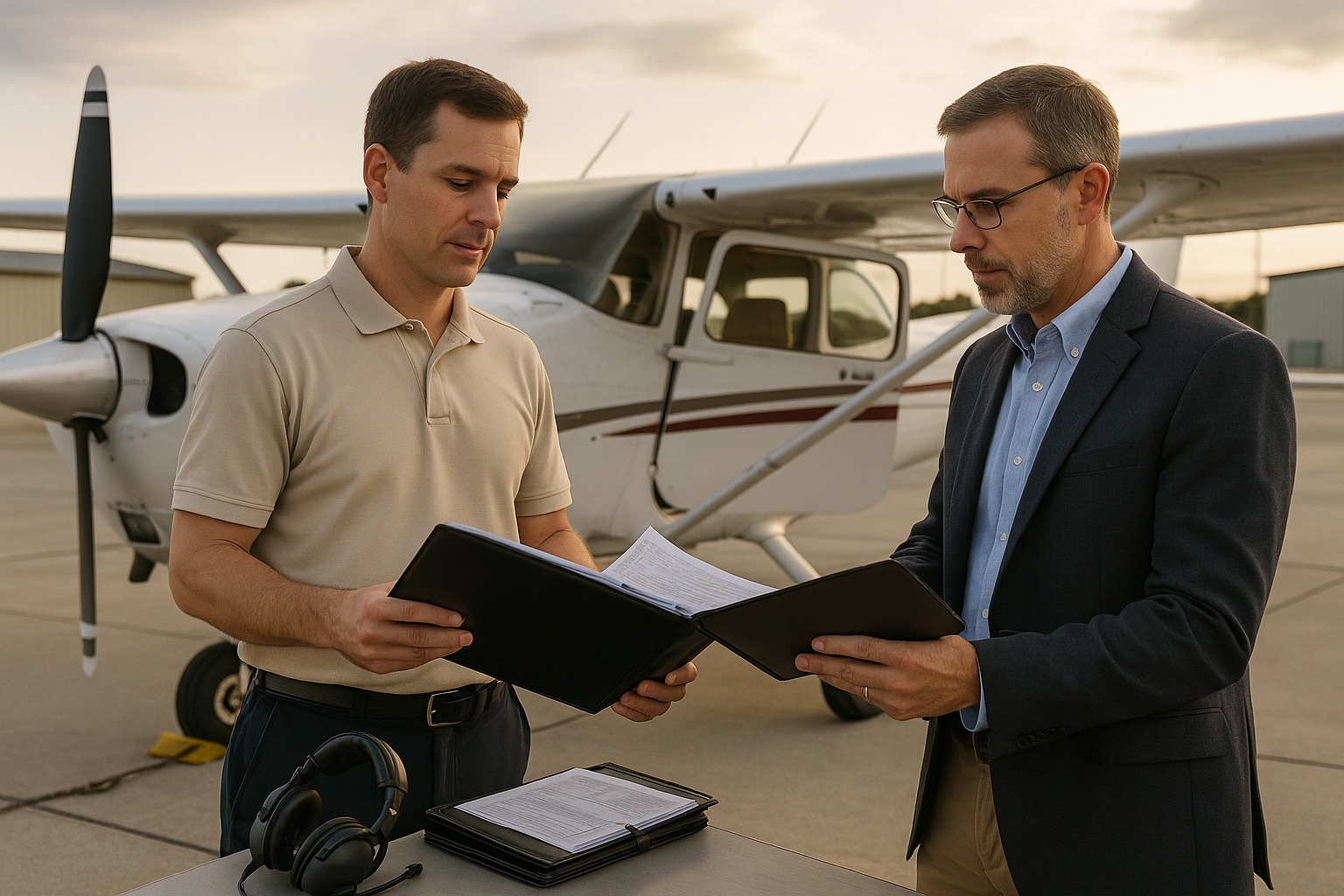
An FAA ramp check can feel intimidating, especially for a student pilot, a new aircraft owner, or a flight instructor trying to keep a lesson on schedule. In practical terms, a ramp check is an on-the-spot inspection by an FAA aviation safety inspector to verify that a pilot, aircraft, and operation appear to comply with applicable requirements. It is not something most pilots encounter every day, but it is part of the operating environment at public-use airports, flight schools, FBO ramps, and aviation events.
The best preparation for an FAA ramp check is not a memorized speech. It is disciplined everyday compliance: current pilot documents, proper aircraft documents, accurate maintenance status awareness, professional communication, and a calm understanding of what the inspector is likely trying to verify. A well-prepared pilot treats a ramp check the same way they treat a weather briefing, a preflight inspection, or an aircraft logbook review: as a normal part of safe and legal aviation operations.
This article explains what pilots should expect during a ramp check, how to prepare without overreacting, what documents are commonly reviewed, and how to avoid the most common mistakes. It is written for pilots, student pilots, flight instructors, aircraft renters, owners, and aviation professionals who want practical guidance without myths, fear, or unnecessary drama.
What Is an FAA Ramp Check?
An FAA ramp check is an inspection conducted by an FAA aviation safety inspector while an aircraft is on the ground. The inspection may occur before departure, after arrival, during a fuel stop, at a flight school, at an FBO, or at an aviation event. The inspector’s focus is typically on whether the pilot and aircraft meet applicable regulatory requirements for the operation being conducted.
For a pilot, the most visible part of a ramp check is usually the request to see pilot documentation and aircraft documentation. Depending on the situation, the inspector may also look at the aircraft’s general condition, required markings, visible equipment, and whether the aircraft appears airworthy for the intended operation. The inspector may ask questions about the flight, the aircraft, or the pilot’s qualifications.
A ramp check is not the same thing as a practical test, a flight review, or a maintenance inspection. The inspector is not there to give dual instruction, test private pilot maneuvers, or troubleshoot the aircraft. However, if something appears inconsistent, unsafe, expired, missing, or noncompliant, the discussion can become more detailed. That is why preparation matters.
For most compliant pilots, the interaction is brief and professional. The pilot provides requested documents, answers reasonable questions clearly, and avoids turning the encounter into a debate. A pilot who is organized, courteous, and familiar with their documents usually makes the inspection easier for everyone involved.
Why Ramp Check Preparation Matters in Real-World Aviation
Ramp check preparation matters because it reflects the same habits that support safe flight operations. A pilot who does not know whether the aircraft registration is onboard may also be the pilot who has not checked the annual inspection date carefully. A pilot who cannot quickly produce a medical certificate when one is required may also be weak on preflight administrative discipline. Documentation is not separate from safety. It is part of the larger system that helps pilots verify that the aircraft, crew, and operation are ready.
In training environments, ramp checks are also valuable teaching opportunities. Student pilots often learn the ARROW document memory aid early in training, but they may not connect it to real ramp operations until an instructor walks them through the aircraft document pouch, the airworthiness certificate, the registration, and the required operating limitations. Flight instructors should go beyond rote memorization and teach students where documents are located, what they mean, and how to recognize obvious issues such as expired registration or missing operating limitations.
Aircraft renters and flying club members face a different challenge. They may not manage the aircraft maintenance program directly, but they are still responsible for determining that the aircraft is legal and safe for the flight they are about to conduct. That means knowing how the operator communicates inspection status, squawks, inoperative equipment, and required documents. A pilot who simply assumes the airplane is legal because the keys were available is not demonstrating strong pilot-in-command judgment.
For aircraft owners, ramp check readiness includes maintaining an organized system for documents and records. Not every maintenance record belongs in the aircraft, and many permanent records are normally kept separately. Still, the pilot should know how to verify the status of required inspections, equipment checks, airworthiness directives when applicable, and any deferred or inoperative equipment procedures that affect the flight. The ramp check itself may be short, but the preparation behind it is ongoing.
What Pilots Should Usually Have Ready
Pilots often ask, “What will the FAA ask for during a ramp check?” The exact scope can vary with the operation, aircraft, and circumstances, but there are several categories every pilot should understand.
First, the pilot should be ready to present personal operating documents. For many operations, this includes a pilot certificate, appropriate medical certificate or qualification basis when required, and government-issued photo identification. Student pilots should understand the specific documents they must carry for solo operations, including any required endorsements for the type of flight being conducted. Flight instructors should be prepared to show instructor credentials when acting in that capacity.
Second, the pilot should know where the aircraft documents are located. A common training memory aid is ARROW: Airworthiness certificate, Registration certificate, Radio station license when required, Operating limitations, and Weight and balance information. The details can vary by aircraft and operation, and not every item applies in the same way to every domestic flight. Still, the memory aid is useful because it prompts pilots to think beyond just the pilot certificate in their wallet.
The airworthiness certificate and registration certificate are core aircraft documents. Operating limitations may be found in an approved aircraft flight manual, pilot’s operating handbook, placards, markings, or other required material depending on the aircraft. Weight and balance information should be available in a form that allows the pilot to determine whether the aircraft is within limits for the intended flight. If the aircraft requires a radio station license for the operation, such as certain international operations, that should be addressed before departure.
Third, the pilot should be aware of maintenance status. The inspector may not ask for full maintenance logs during a simple ramp inspection, and those records are often not carried in the aircraft. However, the pilot should be able to explain how they determined that required inspections and equipment checks are current. This may include annual inspection status, 100-hour inspection status when applicable, transponder and altimeter system checks when applicable to the operation, emergency locator transmitter status, and any other inspection or equipment requirements relevant to the flight. The important point is not to recite a checklist from memory. It is to know the aircraft is legal for the specific operation and to be able to support that conclusion.
Fourth, the aircraft itself should be in a condition that reflects a proper preflight inspection. Obvious discrepancies, missing placards, loose inspection panels, damaged tires, fluid leaks, inoperative lights needed for the operation, or unclear treatment of inoperative equipment can draw attention. A ramp check is not a substitute for a maintenance inspection, but visible condition matters. If something is not right, the time to resolve it is before flight, not after an inspector notices it on the ramp.
How a Ramp Check Typically Unfolds
A ramp check usually begins with an inspector approaching the pilot and identifying themselves. A professional pilot response is simple: stop what can safely be stopped, ask to see identification if appropriate, and communicate respectfully. If you are in the middle of a safety-critical task, such as fueling, securing an aircraft in high wind, managing passengers near a running aircraft, or preparing for an engine start, say so clearly and handle the safety issue first.
The inspector may ask about the flight, the pilot’s role, the aircraft, or the intended operation. They may request pilot documents, aircraft documents, or access to visually inspect items on or in the aircraft. Pilots should respond truthfully and directly. If you do not know an answer, it is better to say that you need to verify it than to guess. Guessing can create confusion and may make a simple issue look like a larger problem.
In many cases, the inspector’s questions are straightforward. For example, they may ask whether you are the pilot in command, where you are departing to, whether the aircraft is rented or owned, or where the aircraft documents are kept. They may compare the aircraft registration with the N-number, look at the airworthiness certificate, or ask how you verified inspection status. None of this should be surprising to a pilot who has done a thorough preflight and understands the aircraft’s administrative status.
The tone of the encounter matters. Pilots sometimes make the mistake of treating a ramp check as an argument before there is any disagreement. That rarely helps. Professional does not mean passive or uninformed. It means calm, accurate, respectful, and attentive to safety. You can ask clarifying questions. You can avoid speculation. You can take notes. You can ask whether a request can wait until passengers are clear of the aircraft or until the aircraft is properly secured. The goal is to cooperate with reasonable inspection activity while continuing to exercise sound pilot-in-command judgment.
Pilot in Command Responsibility During a Ramp Check
The pilot in command remains responsible for the safety of the aircraft, passengers, and operation. A ramp check does not suspend that responsibility. If an inspector approaches while passengers are boarding, fuel is being loaded, weather is deteriorating, or the aircraft is positioned in a congested ramp area, the pilot should manage those risks first. The right approach is not to ignore the inspector, but to communicate clearly: “I will be glad to speak with you. Let me secure the aircraft and move the passengers to a safe area first.”
This is especially important for flight instructors. Students may become nervous and distracted when an FAA inspector appears. The instructor should model calm professionalism and keep the student focused on aircraft safety. If the aircraft is being prepared for a training flight, the instructor can turn the moment into a lesson about documents, certificates, endorsements, and preflight responsibility.
For single-pilot operations, workload management is equally important. Do not allow a ramp check to interrupt a fuel order, weight and balance calculation, passenger briefing, or weather decision in a way that creates a new hazard. If the flight needs to be delayed, delay it. A few extra minutes on the ground is far better than rushing into an incomplete preflight because an unexpected inspection disrupted the rhythm of your normal routine.
How Student Pilots and New Pilots Should Prepare
Student pilots often learn about ramp checks in ground school, but the topic can feel abstract until they operate on a busy ramp. The most important lesson is that preparation starts before solo. A student pilot should know what documents they must carry, what endorsements apply to the flight, and where the aircraft documents are located. They should also know how to contact their instructor or flight school if a question arises.
For solo flights, endorsements are especially important. A student should not simply assume that an endorsement is valid for every solo scenario. Solo flight, solo cross-country, repeated operations to specific airports, make and model considerations, and other training details can involve different endorsement requirements. The safest training habit is to review the logbook and planned operation with the instructor before the flight, not at the hold short line and not after an inspector asks.
New private pilots should also avoid the mindset that passing the practical test means documentation knowledge can fade. A ramp check tests the everyday professionalism of a certificated pilot. You should know how to prove you are qualified for the operation, how to verify aircraft airworthiness, and how to recognize when a flight should not proceed. Those habits are part of being pilot in command.
Aircraft Documents and the ARROW Memory Aid
ARROW is a useful training tool, but pilots should understand what each letter represents rather than treating it as a slogan. The airworthiness certificate confirms that the aircraft has been found to meet its certification basis and is authorized for operation when maintained and operated as required. The registration certificate identifies the aircraft’s registration status. Operating limitations tell the pilot how the aircraft must be operated within approved boundaries. Weight and balance information allows the pilot to determine loading compliance. A radio station license may be required for certain operations, particularly when operating internationally, but domestic requirements vary by operation and equipment.
One common misunderstanding is that the pilot’s operating handbook and the aircraft flight manual are always interchangeable in a casual sense. In some aircraft, an approved aircraft flight manual or approved manual sections may be required. In others, operating limitations may be conveyed through placards, markings, or other approved materials. The practical takeaway is to know your specific aircraft, not just the generic memory aid.
Another misunderstanding involves maintenance records. Pilots sometimes believe that all maintenance logs must be carried in the aircraft. In many general aviation operations, permanent maintenance records are kept elsewhere. However, the pilot still needs a reliable method to determine required inspection status before flight. For a rental aircraft, that may be a dispatch sheet, aircraft status board, digital maintenance tracking system, or direct confirmation from the operator. For an owner, it may be a logbook review, maintenance tracking software, or a current inspection status summary. The method should be accurate and available enough to support good decision-making.
Common Mistakes and Misunderstandings
The first common mistake is being disorganized. A pilot who has to empty a flight bag onto the ramp to find a certificate or medical document creates unnecessary stress. Documents should be easy to locate, protected from damage, and reviewed periodically. Organization is not just about appearances. It helps prevent last-minute uncertainty before flight.
The second mistake is relying on memory instead of verification. A pilot may “know” the annual inspection was completed recently, but if the aircraft status system says otherwise, the pilot needs to resolve the discrepancy. Memory is not a maintenance tracking program. Dates, inspections, endorsements, and limitations deserve deliberate review.
The third mistake is volunteering speculative information. Pilots should be honest and cooperative, but they should not guess at technical answers or offer long explanations that may be inaccurate. If asked about a maintenance item, a reasonable answer might be, “I verified the aircraft status through the dispatch record before departure,” or “I would need to check the maintenance record to answer that precisely.” Clear, factual responses are better than confident guesses.
The fourth mistake is confusing a ramp check with a negotiation over safety. If the inspection reveals a missing document, an expired item, or a questionable aircraft condition, the priority should be resolving the issue properly. Pressing to depart because passengers are waiting, weather is moving in, or a schedule is tight is poor judgment. Compliance and safety are not obstacles to the flight. They are conditions for the flight.
The fifth mistake is allowing the encounter to disrupt cockpit discipline. If the inspection occurs before departure, restart your normal preflight flow afterward. Recheck items that may have been interrupted. Reconfirm fuel caps, baggage doors, oil access panels, chocks, tow bars, passenger briefings, avionics setup, and performance calculations as appropriate. Interruptions are a known source of operational errors, and a ramp check is definitely an interruption.
Practical Example: A Cross-Country Fuel Stop
Consider a private pilot flying a rented Cessna 172 on a daytime VFR cross-country with one passenger. The pilot lands at an intermediate airport for fuel. While the aircraft is parked near the self-serve pump, an FAA inspector approaches, identifies themselves, and asks to speak with the pilot.
A prepared pilot first ensures the aircraft is safe: mixture idle cutoff, ignition off, keys secured, parking brake set as appropriate, passenger clear of the fueling area, and no fuel spill or ramp hazard developing. The pilot then gives the inspector attention and asks any necessary clarifying questions. When requested, the pilot provides a pilot certificate, photo identification, and medical certificate if required for that operation. The pilot knows where the aircraft document pouch is located and can present the airworthiness certificate, registration, operating limitations, and weight and balance information.
If the inspector asks how the pilot verified the aircraft’s inspection status, the pilot explains that the flight school dispatch record showed the annual inspection date, 100-hour status if applicable, transponder check status for the planned airspace use, and no open grounding discrepancies. If asked a detailed maintenance question outside the pilot’s knowledge, the pilot does not guess. The pilot offers to contact the flight school maintenance coordinator or chief instructor for the exact record.
After the ramp check ends, the pilot does not simply jump in and depart. The pilot restarts the preflight flow from an appropriate point, verifies that fueling is complete, checks fuel caps, confirms oil and access panels, reviews weather and performance for the next leg, briefs the passenger, and departs only when ready. This is the right model: cooperative with the inspector, disciplined with the aircraft, and never rushed by the interruption.
Best Practices for Pilots
The best way to prepare for a ramp check is to build habits that make compliance visible and repeatable. The goal is not to create a ramp-check-only routine. The goal is to make every flight administratively and operationally ready.
- Review personal documents before you need them. Check your pilot certificate, medical or qualification basis when required, photo identification, and instructor certificate if applicable.
- Know the aircraft document location. Do not wait until an inspector asks to discover where the registration or operating limitations are kept.
- Verify inspection status before flight. Use the aircraft operator’s system, maintenance records, or owner tracking method to confirm the aircraft is eligible for the planned operation.
- Understand inoperative equipment procedures. If something is not working, know whether the aircraft can legally and safely fly, and how the item must be handled before departure.
- Keep passenger and ramp safety first. Secure the aircraft, manage fueling hazards, and prevent distractions from creating a new risk.
- Answer clearly and truthfully. Provide what is requested, avoid speculation, and verify details when needed.
- Restart your preflight after interruptions. A ramp check can break your flow. Use a deliberate reset before engine start or departure.
Flight instructors can strengthen these habits by including ramp check preparation in normal training. During preflight lessons, ask the student to locate documents, explain the airworthiness certificate, identify operating limitations, and describe how they know the aircraft is ready for the flight. During cross-country planning, include document and inspection status awareness along with weather, fuel, performance, and alternates. This turns ramp check readiness into real pilot competence rather than a one-time memorization exercise.
Professional Communication During a Ramp Check
Professional communication is one of the most overlooked parts of ramp check preparation. Pilots do not need to be defensive, evasive, or overly talkative. A calm, direct style works best. If an inspector requests a document, provide the document. If a question is unclear, ask for clarification. If a safety task must be completed first, explain that briefly and do it.
It is also wise to take notes if the conversation becomes detailed. Write down the inspector’s name, office, date, aircraft N-number, and the general topic discussed. If the inspector identifies a concern, make sure you understand whether the concern must be corrected before flight, whether follow-up is expected, and who should be contacted. Do not rely on memory after a stressful ramp encounter.
If you disagree with something, keep the disagreement professional. The ramp is rarely the best place for a heated legal argument. State your understanding, ask questions, and seek proper follow-up through the appropriate operator, maintenance provider, instructor, or aviation counsel when necessary. For most pilots, the better immediate strategy is to remain factual, protect safety, and avoid making the situation worse through emotion or speculation.
Special Considerations for Flight Schools, Clubs, and Operators
Flight schools, flying clubs, and aircraft operators should treat ramp check readiness as part of their safety culture. A pilot may be the person speaking with the inspector, but the organization’s systems often determine how easy that conversation becomes. If aircraft documents are missing, dispatch records are unclear, squawk sheets are confusing, or maintenance status is hard to verify, pilots are placed in a difficult position.
Good operators make aircraft status easy to understand. They maintain clear dispatch procedures, communicate grounded items unmistakably, keep document pouches complete, and train renters and students on how to verify airworthiness. They also teach pilots what to do if approached by an inspector, including whom to call for maintenance or administrative questions.
Instructors should avoid treating ramp checks as rare events that students do not need to understand. Even if a student never experiences one during training, the preparation supports broader aeronautical decision-making. A student who can explain aircraft documents and inspection status is usually developing the kind of detail-oriented thinking that improves preflight quality overall.
Frequently Asked Questions
Can the FAA conduct a ramp check without advance notice?
FAA ramp inspections are commonly understood to occur without advance scheduling from the pilot’s perspective. Pilots should be prepared during normal operations by carrying required personal documents, knowing where aircraft documents are located, and verifying aircraft status before flight.
What documents should I expect to show during a ramp check?
You should generally be prepared to show pilot qualification documents appropriate to the operation, government-issued photo identification, and required aircraft documents such as the airworthiness certificate, registration, operating limitations, and weight and balance information. Other documents may apply depending on the operation, aircraft, and flight profile.
Should I carry the aircraft maintenance logs in the airplane?
In many general aviation operations, permanent maintenance logs are not carried in the aircraft. However, the pilot should have a reliable way to determine that required inspections, checks, and maintenance status items are current for the planned flight. Aircraft owners and operators should have an organized system for this information.
What should I do if I do not know the answer to an inspector’s question?
Do not guess. Give a truthful answer and explain that you need to verify the detail. If the question involves maintenance records, aircraft ownership, dispatch status, or a technical issue outside your direct knowledge, contact the appropriate instructor, operator, mechanic, or aircraft owner.
Can a ramp check interrupt my preflight inspection?
It can interrupt your normal flow, which is why you should deliberately restart or resume your preflight from a safe point afterward. Make sure the aircraft is secured, passengers are safe, and any interrupted tasks are completed before departure.
How should a student pilot handle a ramp check while solo?
A student pilot should remain calm, be respectful, provide requested documents, and avoid guessing. The student should know what endorsements and documents are required for the flight and should contact their instructor or flight school if questions arise that they cannot answer confidently.
Key Takeaways
- FAA ramp check preparation begins before the inspector arrives: keep pilot documents current, know the aircraft documents, and verify aircraft status before each flight.
- Safety remains the pilot in command’s first responsibility, so secure the aircraft, manage passengers, and restart interrupted preflight tasks before departure.
- Professional communication matters: be respectful, answer truthfully, avoid speculation, and seek verification when a question requires maintenance or regulatory detail.