
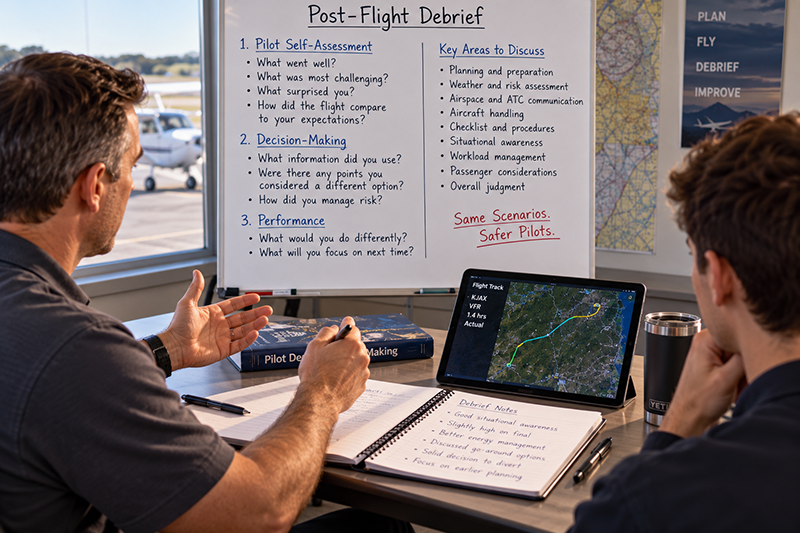
Facilitative debriefing is one of the most powerful tools an instructor, check pilot, mentor, or training manager can use to improve pilot judgment. Instead of simply telling a pilot what went right or wrong, the facilitator uses well-timed questions to help the pilot reconstruct the flight, recognize decision points, evaluate risk, and commit to better choices on the next flight.
This matters because aviation performance is not built only on stick-and-rudder skill. Safe pilots must notice subtle cues, manage workload, communicate clearly, and make sound decisions when conditions change. A good debrief turns a training flight, simulator session, line-oriented scenario, or personal proficiency flight into a structured learning event. The goal is not to make the pilot feel interrogated. The goal is to help the pilot think like a safer, more self-aware aviator.
What Facilitative Debriefing Means in Aviation Training
Facilitative debriefing is a guided conversation after a flight or scenario in which the learner does much of the thinking and explaining. The instructor or facilitator still has responsibility for standards, safety, and accuracy, but the method is different from a lecture. Rather than leading with a list of corrections, the facilitator asks purposeful questions that reveal how the pilot perceived the situation, what options were considered, and why a particular action was taken.
In a traditional critique, the instructor might say, You turned base too close and carried too much energy onto final. In a facilitative debrief, the instructor might ask, What did you notice about your spacing and energy as you turned base? That question invites the pilot to analyze the same event. If the pilot recognizes the issue, learning is deeper because the conclusion came from the pilot's own mental model. If the pilot does not recognize it, the instructor has valuable diagnostic information: the problem may not be the flare, the base turn, or the airspeed number alone. The deeper issue may be perception, planning, workload management, or an incomplete understanding of stabilized approach cues.
Facilitative debriefing does not mean avoiding direct instruction. There are times when an instructor must be specific, especially when safety margins, aircraft limitations, regulatory compliance, or procedural standards are involved. The key distinction is that facilitative debriefing begins with discovery. It helps the pilot explain the thinking behind the flying. Once that thinking is visible, the instructor can correct errors more precisely and reinforce good judgment more effectively.
The best debriefs are not random conversations. They are intentional, evidence-based discussions tied to the lesson objective, the actual events of the flight, and the pilot's next step in training. A student pilot practicing traffic pattern work, an instrument student managing a high-workload approach, and a commercial pilot refining passenger briefings all need different questions. The common thread is that each pilot must leave with a clearer understanding of what happened, why it happened, and what to do differently next time.
Why This Matters in Real-World Aviation
Real-world flying rarely presents itself as a clean classroom problem. Weather evolves, traffic appears, passengers ask questions, runway conditions vary, avionics require attention, and a pilot may be managing fatigue, schedule pressure, or unfamiliar airspace. Good judgment depends on recognizing those factors early and responding before the situation becomes urgent.
Facilitative debriefing strengthens that process because it focuses on decision-making, not just outcome. A landing may look acceptable, but the approach may have included late configuration, unstable energy, or a reluctance to go around. A diversion may look conservative, but the pilot may have delayed the decision longer than necessary. A radio call may be technically correct, but the pilot may have lost aircraft control priority while searching for the right phrase. These are judgment issues, and judgment improves when pilots learn to examine their own reasoning.
For flight instructors, facilitative debriefing is especially valuable because students often know what they did, but not why it happened. A student may say, I floated too far down the runway. The instructor can then ask, What were the clues that the aircraft had more energy than expected? That question moves the discussion from a visible result to the underlying cues: approach speed, descent angle, power reduction, runway picture, wind, and flare timing. Over time, the student becomes better at detecting those cues before the airplane is over the runway.
For certificated pilots, debriefing is just as important. A pilot who flies regularly may still develop habits that go unexamined. A pilot returning after time away may need to rebuild scan, radio rhythm, or weather decision-making. A pilot transitioning to a new aircraft may be competent in general airmanship but unfamiliar with different sight pictures, energy management, automation behavior, or operating procedures. A facilitative debrief helps identify which parts of the pilot's existing experience transfer well and which parts need deliberate adjustment.
In aviation organizations, a facilitative debriefing culture can also support professionalism. When pilots are accustomed to discussing decisions openly, it becomes easier to talk about threat management, communication breakdowns, procedural drift, and workload traps. That culture depends on trust. If every debrief feels punitive, pilots may defend their decisions rather than examine them. If every debrief is vague encouragement, pilots may miss important lessons. Facilitative debriefing sits between those extremes: respectful, specific, and standards-based.
How Pilots Should Understand Facilitative Debriefing
Pilots should understand facilitative debriefing as a method for improving the quality of their thinking. It is not just an instructor technique. Any pilot can use the same approach after a solo flight, proficiency session, simulator scenario, instrument approach, cross-country leg, or challenging weather decision. The central habit is to ask better questions.
A weak debrief question produces a weak learning result. Did that go well? is too broad. Why did you mess up the approach? is defensive and unhelpful. A stronger question points to a specific moment and invites analysis: When the workload increased after the frequency change, what did you prioritize first? That question is precise enough to be useful and open enough to reveal the pilot's reasoning.
Good debrief questions often focus on three areas: perception, decision, and action. Perception questions explore what the pilot noticed. Decision questions explore the options considered and the reason for the choice. Action questions explore how the pilot executed the choice and what the pilot would do next time. Together, they connect mental awareness to aircraft control and operational performance.
For example, after a simulated engine failure, a facilitative debrief might begin with perception: What was your first indication that something was wrong? It might continue with decision-making: How did you choose that field instead of the one off the left wing? Then it might move to action: What would help you establish best glide and complete the memory items with less delay next time? This approach respects the pilot's thought process while still addressing essential performance.
Another useful concept is separating facts from interpretation. The fact might be that the aircraft was high on final. The interpretation might be that the pilot was distracted by radio traffic. The solution might be earlier configuration, a clearer go-around trigger, or better prioritization. A good facilitator helps the pilot move through those layers without jumping too quickly to a conclusion.
Facilitative debriefing also requires patience. Instructors sometimes answer their own questions too quickly. Pilots need a few seconds to think, replay the scenario, and put words around a decision that may have happened under pressure. Silence can feel uncomfortable, but it is often where learning starts. If the facilitator fills every pause, the pilot becomes a listener rather than an analyst.
The Instructor's Role: Guide, Clarify, and Anchor to Standards
A facilitative instructor is not passive. The instructor is actively listening, selecting the most important learning points, and guiding the conversation toward safer future performance. The instructor must know when to ask, when to explain, when to demonstrate, and when to stop a line of reasoning that is inaccurate or unsafe.
One of the most important instructor responsibilities is anchoring the debrief to standards and objectives. A debrief should not become a long discussion of every minor imperfection. If the lesson objective was short-field landings, the debrief should emphasize approach planning, speed control, aiming point discipline, touchdown zone awareness, braking technique, and go-around judgment. If the session was an instrument approach in simulated instrument conditions, the discussion should focus on briefing, course guidance, altitude awareness, automation management, missed approach readiness, and workload control.
Facilitative debriefing works best when the instructor is specific about observed behavior. Vague comments such as Be more ahead of the airplane do not provide enough guidance. A more useful statement is, You delayed the descent checklist until after the final approach fix, and that increased your workload during a high-precision phase of flight. What earlier cue could you use to begin that flow next time? This combines observation, consequence, and a question that leads to practical improvement.
Instructors should also distinguish between a performance error and a judgment concern. A performance error may be a temporary deviation caused by task saturation or developing skill. A judgment concern involves the pilot's choices, risk assessment, or willingness to continue when conditions suggest a safer alternative. Both matter, but they require different debriefing. Performance errors often need technique refinement and repetition. Judgment concerns require deeper questions about assumptions, pressures, personal minimums, and decision triggers.
When a serious safety issue occurs, the instructor should be direct. Facilitative does not mean indirect when clarity is required. If a student descends below a safe altitude, mismanages a runway incursion risk, ignores a go-around cue, or continues an unstable approach in a way that compromises safety, the instructor should state the concern plainly and then use questions to develop understanding. The order matters: stop unsafe ambiguity first, then explore why it happened.
Questions That Improve Pilot Judgment
The quality of the question determines the quality of the debrief. Questions that improve pilot judgment are usually open-ended, specific, and connected to a decision point. They are not traps. They are not trivia quizzes. They are tools for making the pilot's thinking visible.
Effective questions often begin with what, how, or when. What cues told you the approach was becoming unstable? How did the wind affect your base-to-final planning? When did you first consider a go-around? These prompts encourage the pilot to reconstruct the event in operational terms. Why questions can also be useful, but they must be used carefully because they can sound accusatory. Why did you continue? may put a pilot on defense. What factors led you to continue at that point? usually produces a better conversation.
Good debrief questions should also help the pilot connect short-term actions to long-term judgment. For example, a pilot who forgets to lean the mixture during taxi at a high-elevation airport may treat it as a memory lapse. A facilitative instructor can ask, What cues remind you that density altitude and engine performance deserve attention before takeoff? The discussion can then expand from a single checklist item to a broader habit of performance awareness.
Some of the most useful facilitative questions include:
- What was your plan before the maneuver, and how did the actual result compare?
- What cues were you using to judge energy, alignment, altitude, or workload?
- At what point did the situation begin to differ from what you expected?
- What options were available, and what made one option more attractive than the others?
- What risk factors were present that were not obvious at the start?
- What would be your personal trigger to discontinue, delay, divert, or go around in a similar situation?
- What will you do differently on the next flight, and how will you know it is working?
The final question is especially important. A debrief is incomplete until it produces a future action. That action should be practical and observable. Try harder is not a plan. Brief the go-around point before every approach is a plan. Start descent planning at least before the workload increases is more useful than simply saying, Stay ahead. The pilot should leave knowing what behavior to practice and what cues will confirm improvement.
Common Mistakes and Misunderstandings
One common misunderstanding is that facilitative debriefing is soft instruction. In reality, it can be more demanding than a lecture because it requires the pilot to think, explain, evaluate, and commit. A pilot who is simply told the answer may comply for the next flight without deeply understanding the decision process. A pilot who has to analyze the event is more likely to recognize the same pattern later.
Another mistake is asking leading questions that disguise criticism. You knew you were fast on final, right? is not facilitative. It signals the expected answer and may encourage agreement rather than reflection. A better question is, What did the runway picture and airspeed tell you on final? If the pilot misses the point, the instructor can add, I observed the aircraft crossing the threshold with more speed than planned. What effect did that have on the touchdown point?
A third mistake is debriefing too many items. Flights contain endless imperfections. If the facilitator covers every radio hesitation, every altitude correction, every checklist delay, and every taxi technique issue, the important judgment lessons may disappear in the noise. Effective debriefing requires prioritization. Choose the items that matter most to safety, lesson objectives, and the pilot's next stage of development.
Instructors may also confuse self-critique with self-punishment. Some pilots are highly critical of themselves and will identify only what went wrong. The facilitator should help them recognize correct decisions too. Positive judgment deserves reinforcement. If a student discontinued a landing attempt early, requested clarification from ATC, slowed down to manage workload, or admitted confusion before it became unsafe, those are valuable behaviors. A good debrief strengthens them.
Another risk is allowing inaccurate conclusions to stand. If a pilot says, The crosswind pushed me off centerline and there was nothing I could do, the instructor should not simply move on. The statement may reveal a misunderstanding of crosswind correction, drift control, or go-around options. Facilitative debriefing invites pilot ownership, but it still requires technical correction. The instructor might respond, The crosswind was a factor, but let's look at the control inputs available to manage drift and alignment. What could you adjust earlier on final?
Finally, debriefing sometimes happens too late or too casually. A quick comment at the fuel pump may be better than nothing, but important training events deserve focused attention. The pilot should have enough time to mentally replay the flight, compare it against standards, and identify next steps. The best debriefs are timely, specific, and calm.
Practical Example: Debriefing an Unstable Approach
Consider a training flight in a typical single-engine airplane. The student is returning to the home airport after airwork. The wind is gusty but manageable, traffic is moderate, and the tower asks the aircraft to extend downwind for landing traffic. The student acknowledges the instruction, continues downwind, and later receives a base turn. By the time the airplane turns final, it is high, slightly fast, and not fully configured. The student continues, floats beyond the intended touchdown area, and lands longer than planned. The runway length is adequate, but the approach was not as controlled as it should have been.
A purely directive debrief might be brief: You were high and fast. Configure earlier and do not land from an unstable approach. That is accurate, but it may not uncover the judgment chain. A facilitative debrief would explore the event in stages.
The instructor might begin with, Walk me through what changed when tower extended your downwind. The student may say the airplane was farther from the runway than expected, and they were trying to maintain spacing while watching traffic. The instructor can then ask, What did that do to your normal before-landing flow? The student may realize that configuration was delayed. Next, the instructor asks, When you turned final, what cues told you whether the approach was stabilized? The student may identify being high and fast, or may admit they were focused mostly on runway alignment.
Now the instructor has a better picture. The issue was not only airspeed control. The chain included an ATC spacing instruction, a disrupted habit pattern, delayed configuration, reduced attention to energy, and no clear go-around trigger. The instructor can ask, What would be a good decision point next time if you turn final and the aircraft is not configured or on the planned descent path? This moves the discussion toward pilot judgment.
The debrief can close with a specific action plan. On the next pattern, the student will verbalize configuration status before turning base, identify whether the airplane is high, low, fast, or slow as the final turn is completed, and state a go-around decision if the approach does not meet the agreed criteria. The instructor may demonstrate or coach the next circuit, but the learning point is clear: the pilot must connect external changes to internal cockpit priorities and approach stability.
This example shows why facilitative debriefing is so effective. The landing distance was only the final symptom. The debrief revealed the earlier decision points that created the result. When pilots learn to see those earlier points, their judgment improves before the airplane reaches the edge of the safety margin.
Best Practices for Pilots and Instructors
Facilitative debriefing works best when both people understand the purpose. The pilot should expect to participate actively, not passively receive a grade. The instructor should create a professional environment where honest analysis is valued more than saving face. That begins before the flight. If the instructor tells the pilot what will be debriefed, the pilot is more likely to observe those elements during the flight.
A useful preflight briefing might include the lesson objective, expected standards, known risks, and the kind of judgment questions that will be discussed afterward. For example: Today we are going to focus on short-field landings. After each landing, I will ask you what cues you used for airspeed, aiming point, and go-around decision-making. That kind of preview turns the flight into a deliberate learning exercise.
During the debrief, start with the pilot's view. Ask the pilot to describe what happened and compare it to the plan. Then add instructor observations. This sequence prevents the instructor from taking over too soon and gives the pilot a chance to identify issues independently. If the pilot misses a critical point, the instructor should introduce it clearly and professionally.
Keep the debrief focused on behaviors, decisions, and cues rather than personal traits. Saying, You are careless with checklists, is less useful than saying, The before-landing checklist was delayed until the turn to final, which increased workload. What cue can you use to complete it earlier? The second version is specific, correctable, and connected to operational performance.
It is also helpful to end with no more than a few priorities. A pilot can usually act on two or three clear takeaways. Too many action items dilute the lesson. Good debrief closure includes what went well, what needs improvement, how to improve it, and when it will be practiced next.
For pilots debriefing themselves, the same principles apply. After shutdown, take two minutes to reconstruct the flight. Ask what surprised you, where workload increased, what decision you would make earlier next time, and what habit deserves reinforcement. A short written note in a logbook, training journal, or proficiency file can turn casual experience into structured learning.
Practical facilitative debriefing habits include:
- Begin with the flight objective and the most important decision points.
- Ask open-ended questions before giving detailed corrections.
- Use observed facts, not assumptions about attitude or personality.
- Separate aircraft control technique from judgment and risk management.
- Reinforce good decisions as deliberately as you correct poor ones.
- Close with a specific next-flight action, not a vague intention.
The best debriefs also respect workload and emotion. A pilot who just completed a demanding flight may need a brief pause before deep analysis. A student who is embarrassed may need reassurance that errors are part of training. A highly confident pilot may need carefully framed questions that challenge assumptions without becoming confrontational. The facilitator's tone matters. Calm, specific questions create better learning than sarcasm, impatience, or performance theater.
Using Facilitative Debriefing Beyond Primary Training
Although facilitative debriefing is often associated with flight instruction, it has value across aviation. Instrument pilots can use it after approaches to evaluate briefing quality, automation use, missed approach readiness, and weather decisions. Tailwheel pilots can use it to review energy management, directional control, and wind correction. Aircraft owners can use it after maintenance flights to evaluate abnormal indications, cockpit workload, and decision points. Safety officers can use it after proficiency events to improve communication and standardization.
In crew environments, facilitative debriefing can support crew resource management by encouraging pilots to discuss communication, task sharing, monitoring, and challenge-and-response behavior. The facilitator may ask, What information did the pilot monitoring have that could have helped earlier? or How did the crew confirm the mode selection before intercepting the course? These questions examine teamwork without reducing the debrief to blame.
In single-pilot operations, the same discipline is even more important because there may be no second crewmember to catch errors in real time. A single pilot can still debrief decisions after the flight: Was I rushed? Did I accept a clearance or runway assignment that increased workload? Did I continue with a plan after conditions changed? Did I have a clear point where I would divert, hold, delay, or cancel? These questions build self-monitoring, which is a core element of safe single-pilot aviation.
Facilitative debriefing is also useful when introducing technology. Modern avionics can reduce workload when used correctly, but they can also create mode confusion, fixation, or heads-down time. After a flight involving GPS navigation, autopilot use, or electronic flight bag planning, a good debrief should ask how the pilot verified information, managed attention, and maintained basic aircraft control. The technology should support judgment, not replace it.
Frequently Asked Questions
What is facilitative debriefing in flight training?
Facilitative debriefing is a guided post-flight discussion that uses purposeful questions to help a pilot analyze performance, decision-making, risk management, and future improvement. The instructor still provides correction and standards-based feedback, but the pilot is actively involved in identifying lessons from the flight.
How is facilitative debriefing different from a normal critique?
A normal critique often emphasizes what the instructor observed and what the pilot should fix. Facilitative debriefing goes deeper by asking what the pilot noticed, what options were considered, and why a decision was made. It is less about delivering a verdict and more about improving the pilot's judgment process.
Can a student pilot benefit from this method?
Yes. Student pilots often benefit because the method helps them connect aircraft handling outcomes to earlier cues and decisions. Instead of only hearing that a landing was long or an altitude varied, the student learns to recognize the planning, workload, and perception issues that led to the result.
Does facilitative debriefing replace direct instruction?
No. Direct instruction is still necessary when a pilot needs technical explanation, procedural correction, or immediate safety clarification. Facilitative debriefing works best when it is combined with clear standards, accurate instructor feedback, and practical next steps.
What are good questions to ask after a flight?
Useful questions include: What changed from the original plan? What cues did you notice first? When did workload increase? What options did you consider? What would cause you to discontinue or go around next time? What specific action will you practice on the next flight?
Can pilots use facilitative debriefing without an instructor?
Yes. Self-debriefing is valuable for certificated pilots. After shutdown, a pilot can review the flight by asking what went well, what was unexpected, where risk increased, and what decision should be made earlier next time. Written notes can make those lessons easier to retain.
Key Takeaways
- Facilitative debriefing improves pilot judgment by helping pilots analyze what they perceived, why they decided, and how they acted during a flight.
- The most effective debriefs are specific, respectful, and tied to safety, standards, risk management, and the next practical improvement.
- Instructors should ask thoughtful questions, correct unsafe or inaccurate conclusions directly, and close each debrief with clear actions for the next flight.