
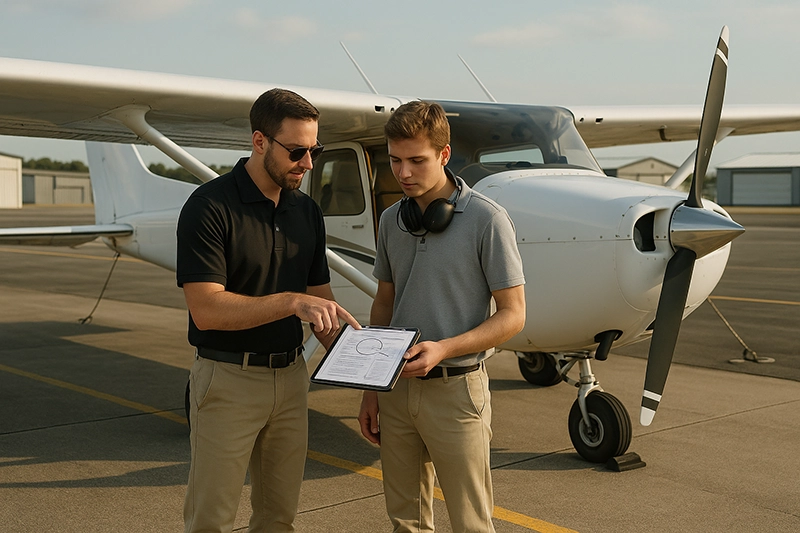
Flight instructor tips for faster skill development begin with a clear training plan focused on deliberate practice, accurate feedback, and safe risk exposure. Whether you are a student pilot trying to shorten the learning curve or a certificated instructor sharpening your coaching methods, effective instructor techniques accelerate skill acquisition and improve retention without compromising safety.
This article pulls together practical teaching strategies, operational reasoning, and training design intended for pilots, student pilots, flight instructors, and aviation professionals. You will find concrete ways to structure lessons, avoid common instructional pitfalls, translate technical concepts into cockpit behavior, and measure progress in meaningful ways. The primary keyword appears early because many readers search for specific instructor methods that lead to faster development without cutting corners.
Clear main idea: What faster skill development actually means
Faster skill development is not the same as rushing training or skipping steps. It means improving the speed and quality with which a student acquires, consolidates, and applies flying skills. For an instructor, that translates to lessons that produce repeatable outcomes: better scan technique, cleaner control coordination, more accurate navigation, improved decision-making, and consistent adherence to procedures. The job of the instructor is to structure learning so each flight teaches something specific, measurable, and transferable to real operations.
In practical terms, faster development comes from three interacting elements: targeted practice, accurate feedback, and progressive challenge. Targeted practice concentrates on a single skill or decision pattern. Accurate feedback tells the student precisely what to adjust and why. Progressive challenge increases complexity or realism as competence grows. Combine these elements inside a safe training environment and the student will make better use of instruction time and replicate performance under operational pressure.
Why this matters in real-world aviation
Time in the cockpit is expensive, and training time is limited. Programs that shorten the path to proficiency can reduce cost and lower operational risk by producing pilots who make sound decisions and demonstrate consistent aircraft control. Faster, but well-structured, skill development leads to better hazard recognition, fewer surprise losses of situational awareness, and more reliable handling during unexpected events.
From an operational perspective, pilots who learn efficiently are more likely to internalize checklists and procedures, anticipate threats, and manage workload. Flight schools and operators benefit when their graduates require fewer remedial flights to meet standards. For flight instructors, improved teaching efficiency increases student throughput while maintaining safety. That said, efficient training must never cut corners on aeronautical knowledge, decision-making, or minimum experience needed for specific privileges.
How pilots and instructors should understand these tips
Teaching and learning flying skills are complex because flying involves psychomotor coordination, cognitive decision-making, and emotional control. Effective instruction respects all three domains. Psychomotor skills include hand-eye-foot coordination, control inputs, and visual scan. Cognitive skills include planning, instrument interpretation, and risk assessment. Emotional control relates to stress management, confidence, and self-monitoring.
When instructors focus on a single domain at a time while keeping the others manageable, students learn faster. For example, when teaching steep turns, emphasize control technique and visual scanning before adding complex radio work or navigation. When introducing instrument flying, separate basic attitude control and instrument interpretation from full cross-country IFR tasks until the student shows stable instrument scan patterns.
Another key point is aligning instructor communication with the student's learning stage. Novice students need simple, concrete instructions and consistent, immediate feedback. More advanced students benefit from Socratic questioning, scenario-based challenges, and opportunities to reflect on decision outcomes. Shifting teaching style to the learner's level reduces confusion and accelerates skill internalization.
Common mistakes or misunderstandings that slow progress
Many instructors have the best intentions, but several recurring errors undermine training speed and quality. Recognizing and correcting these mistakes produces better outcomes.
1. Overloading lessons with too many objectives. A single flight that attempts to teach multiple complex skills at once produces shallow learning. Students end the session with fragmented understanding and uncertain execution. Keep lessons focused on one or two primary objectives and use pre-briefs to set expectations.
2. Vague feedback. Comments like "better" or "try harder" are not useful. Feedback should describe an observable behavior, explain why it matters, and provide a specific corrective action. For example, tell the student to "smooth the throttle changes by timing them with pitch adjustments to maintain altitude during a climb."
3. Fixing immediate control inputs without teaching underlying cues. Instructors often correct a student's control problem directly but fail to teach the sensory or visual cues the student should monitor. Teach the cues so the student can self-correct in the future.
4. Relying too heavily on demonstration without guided practice. Demonstrations are useful, but students learn most when they practice deliberately with targeted repetition and receive timely feedback. After demonstrating, move quickly to structured student practice with coaching.
5. Ignoring mental model development. Procedures are tools, and students need mental models to understand how and why a procedure works. Without models, learners follow steps mechanically and struggle when conditions deviate. Explain causal relationships and decision points within procedures.
6. Insufficient attention to threat and error management. Emphasizing stick-and-rudder skills while downplaying risk management leaves pilots vulnerable. Integrate threat awareness, system limitations, and contingency planning into every lesson, even when the focus is handling technique.
7. Inconsistent standards. If the instructor tolerates variable performance across flights, students receive mixed signals. Establish and maintain clear performance standards and communicate them at the outset of training blocks.
Practical example: Structuring a lesson on short-field landings
Short-field landings are a common training topic that requires coordinated control, power management, and precise judgment. Here is a lesson sequence that models deliberate practice for faster skill development.
Pre-brief: State the objective clearly. "Today we will identify the aim point, manage energy to touch down at or before the first third of the runway, and execute a stabilized approach. Our measurable goal is a consistent touchdown within the first third for three consecutive attempts under normal wind conditions." This sets a specific, measurable target.
Demonstration: Perform one complete short-field approach and landing while narrating key cues: airspeed at flap selection, power reductions, visual references for glidepath, and the flare technique. Keep the demonstration brief and emphasize observable cues.
Guided practice: Let the student perform multiple approaches focusing on one aspect at a time. First, practice stabilized approach speed and runway aim. Next, practice precise power and pitch control on final. Provide immediate, specific feedback after each attempt, for example: "Your approach was high; lower your aim point and reduce power 100 rpm earlier to tighten the glidepath."
Progressive challenge: Once the student can consistently manage approach energy under calm conditions, introduce crosswind or a narrower simulated runway to increase complexity. Maintain the same performance standard and only add complexity when competence is evident.
Debrief: End the lesson with a focused debrief. Ask the student to self-assess, identify one correction they will practice, and summarize what went well. This reflection consolidates learning and promotes self-monitoring.
Best practices for instructors and students
Below are practical actions and habits that support faster and safer skill development.
- Define one primary learning objective per flight. Secondary objectives can be minor but avoid splitting focus across unrelated complex tasks.
- Use measurable performance targets. Replace "better landings" with specific metrics like touchdown zone, heading deviation, or stabilized approach window.
- Give immediate, specific feedback. Describe the behavior, explain the consequence, and prescribe an exact correction the student can try on the next attempt.
- Teach cues and mental models. Help learners identify the sensory and visual cues associated with proper technique so they can correct themselves in the cockpit.
- Schedule spaced repetition. Practice key skills across multiple flights, with spaced intervals between sessions to support retention.
- Integrate scenario-based training. Use realistic scenarios to link technical skills with decision-making, emphasizing threat and error management.
- Encourage reflection and self-assessment. Have students summarize lessons learned and state a single personal performance goal for the next flight.
- Maintain consistent standards. State performance criteria explicitly and apply them uniformly so students know when they meet expectations.
- Focus on transfer. Design exercises so skills learned in training apply to operational contexts, such as abnormal procedures or single-pilot workload management.
How to measure progress
Progress should be assessed by observable, repeatable outcomes rather than subjective impressions. Use objective metrics where possible: approach speeds within a defined tolerance, consistent touchdown position on landings, stabilized instrument scan under a given workload, or correct procedure flows without prompts.
Tools that help measurement include written or digital training logs, video debriefing, and simple scoring rubrics that break a maneuver into key elements. For example, for a steep turn evaluation, track bank angle control, altitude deviation, heading recovery, and g-awareness separately. Over time, review trends rather than single-flight performance to determine whether improvement is sustained.
Training techniques to accelerate learning
Several evidence-based training practices apply to flight instruction and reliably improve learning efficiency.
Deliberate practice: Design activities that target specific subskills with immediate feedback and repetition. Deliberate practice is focused, effortful, and aimed at pushing performance just beyond current capability.
Distributed practice: Space training across multiple sessions instead of massing all practice into one long session. Distributed practice improves long-term retention and reduces fatigue-related errors.
Interleaving: Alternate practice of related but distinct skills rather than repeating the same skill in succession. For instance, rotate circuits between short-field, soft-field, and normal approaches. Interleaving improves discrimination between contexts and strengthens adaptive transfer.
Reflection and mental rehearsal: Encourage students to mentally rehearse maneuvers and procedures between flights. Imagery and mental practice help consolidate motor patterns and decision sequences.
Feedback timing: Provide immediate corrective feedback for motor errors when the student is still processing the maneuver. Use delayed feedback for higher-order decision-making to allow the student to self-evaluate first, then compare with the instructor's assessment.
Common training pitfalls and how to fix them
Pitfall: Trying to fix everything at once. Fix: Prioritize one high-leverage correction per flight and accept manageable errors elsewhere while the student practices the priority.
Pitfall: Over-reliance on instructor demonstration. Fix: After demonstrating, place the student in the control loop quickly and use short practice cycles with feedback.
Pitfall: Ignoring stress and workload effects. Fix: Gradually introduce workload and train students to recognize their own stress signals, then practice coping strategies such as task prioritization and automation management.
Pitfall: Accepting complacency when skills become routine. Fix: Use periodic proficiency checks, scenario-based surprises, and unexpected failures to keep skills sharp and test adaptability.
Integrating safety and regulatory awareness into instruction
Efficient training is not only about handling skills. It must incorporate safety risk management. Every lesson should include explicit discussion about possible hazards (for example, density altitude effects, runway contaminants, or unreliable instruments) and contingency plans. Encourage students to verbalize alternatives and to use personal minimums that reflect their experience and the airplane's capabilities.
Instructors should also ensure students are familiar with applicable operating limitations and procedures for their aircraft and operation. Avoid presenting procedures without context; explain why each limit or checklist item exists and how ignoring it could affect aircraft handling or safety. When regulatory or operational requirements are central to training decisions, remind students to consult current official sources and operator manuals as needed.
Technology and tools that support faster training
Simulation, video analysis, and data recording are powerful aids when used correctly. Desktop flight simulation provides a low-cost environment to practice procedures and cockpit flows. Basic flight simulators are useful for familiarization and repetition, but instructors should make clear the difference between simulator performance and airplane feel.
In-flight video recording and post-flight debriefing let students see their control inputs, head position, and scan technique. Debriefing with annotated video helps translate instructor feedback into concrete visual examples. Data loggers or basic flight instrument overlays can provide objective measurements for elements like approach speed or vertical speed profiles.
Coaching mindset: How to be a more effective instructor
Effective instructors adopt a coaching mindset: they create a safe environment for practice, set clear expectations, provide honest and respectful feedback, and help students develop self-evaluation skills. Instead of simply correcting, ask probing questions to stimulate the student's thinking: "What were you looking at during that turn?" or "What cues told you you were high on final?"
Encourage autonomy by gradually reducing guidance as competence grows. This fades support but retains oversight. Document progress and set explicit goals for each block of lessons so both instructor and student can measure improvement objectively.
Frequently Asked Questions
How many objectives should I set for one lesson?
Set one primary objective per lesson and at most one manageable secondary objective. This keeps student attention focused and allows for measurable progress. Reserve additional objectives for follow-up lessons after the primary goal is met consistently.
When is it appropriate to raise the difficulty of a task?
Raise difficulty when the student demonstrates consistent performance at the current level under normal conditions. Consistency means stable results across multiple attempts and reduced need for instructor prompts. Add complexity only after confirming consolidation of the foundational skill.
How should feedback differ for beginners and advanced students?
Beginners benefit from immediate, specific, and directive feedback. Advanced students gain more from reflective questioning, delayed summary feedback, and opportunities to self-correct. Tailor feedback timing and style to the learner's stage to encourage independent problem-solving.
Can simulators speed up skill development?
Simulators can accelerate cognitive and procedural learning, particularly for cockpit flows, radio work, and instrument procedures. However, they do not fully replicate aircraft control feel. Use simulators for repetition and scenario practice, then transfer skills to the airplane with focused real-world practice.
How do I prevent students from developing bad habits between lessons?
Assign targeted between-flight practice, include short check-ins, and use video or data recording when possible. Set clear, simple drills that focus on correct cues and behaviors. Encourage students to practice mental rehearsal and to bring self-assessments to the next lesson.
Practical wrapping guidance for instructors
End each lesson with a concise plan for what comes next. A good wrap-up includes the student's self-assessment, the instructor's top correction, and one precise practice task for the student to work on before the next flight. This continuity reinforces memory and reduces re-teaching of previously covered basics.
Key Takeaways
- Practical takeaway: Focus each flight on one measurable objective and use targeted practice to build competence faster.
- Safety takeaway: Integrate threat and error management into technical training so skills transfer safely to real operations.
- Training takeaway: Use deliberate, distributed, and interleaved practice with specific, timely feedback to improve retention and adaptability.
Good instruction shortens the path to proficiency by structuring learning around observable outcomes, supporting self-correction, and progressively challenging the student. Use the techniques described here to make every hour of instruction count while maintaining high safety standards and sound operational judgment.