
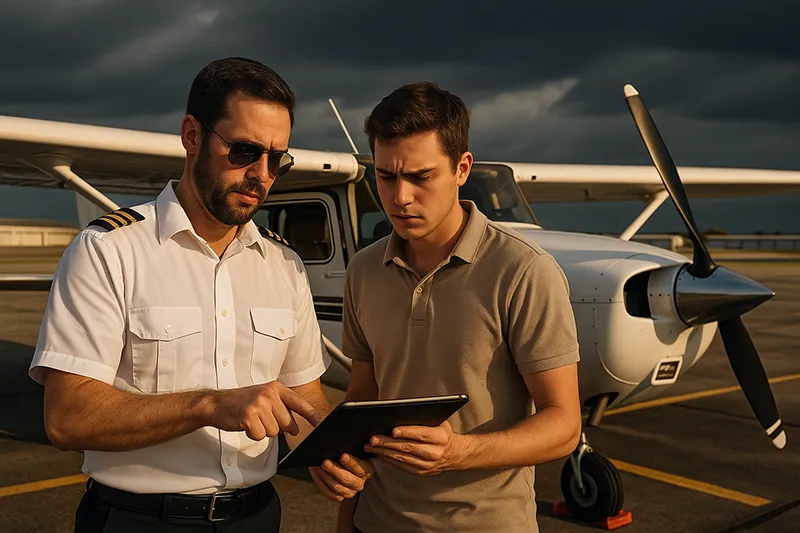
Flight instructor tips that improve safety begin with recognizing the common instructional mistakes that shape student behavior. Whether you teach primary students or advanced pilots, the way you demonstrate decisions, prioritize tasks, and correct errors directly influences safety outcomes in real operations.
This article breaks down the most frequent instructor errors, explains why they matter to pilots and operators, and gives practical alternatives you can adopt tomorrow. The goal is not to provide a checklist but to change how instructors teach judgment, risk management, and airmanship so students fly safer after each lesson.
Core Idea: How Instructor Behavior Shapes Safety
Every training flight is a classroom and a safety exercise. A flight instructor's habits, communication style, and risk tolerance are often absorbed by students. Instructors who emphasize procedural compliance without teaching the underlying rationale create pilots who follow steps but may lack adaptive decision-making. Conversely, instructors who model thoughtful risk assessment and clear priorities produce pilots who can handle unexpected situations and maintain safety margins.
Why This Matters in Real-World Aviation
Instructional mistakes have downstream effects on safety, aircraft operation, and operational decision-making. When instructors normalize shortcuts, ambiguous risk calls, or poor task management, students may later replicate those behaviors during solo flights, cross-country trips, or complex operational sorties. Training that focuses solely on checkride performance rather than operational competence leaves gaps in pilots' ability to handle weather, system failures, ATC changes, or time-critical decisions.
Flight training is the primary period when pilots form habits. These habits affect fuel planning, preflight risk assessment, go/no-go decisions, crosswind technique, approach stability, and emergency handling. Thoughtful instructors teach not just how to fly an airplane but also how to prioritize tasks, communicate effectively, and integrate safety into every phase of flight.
How Pilots and Instructors Should Understand This Topic
Understanding instructional impact requires shifting perspective from isolated maneuvers to systems thinking. A flight is a sequence of decisions influenced by weather, aircraft performance, human factors, and external pressures such as schedules or student expectations. Instructors should teach each maneuver within that broader decision-making framework.
Practical instructional emphasis should include the following: clear explanation of why procedures exist, demonstration of thought processes during complex tasks, explicit coaching on managing distractions, and structured debriefs that focus on decision points rather than just stick-and-rudder errors.
Common Mistakes or Misunderstandings
These are common instructor errors that reduce training effectiveness and increase operational risk. Identifying them helps instructors self-audit and redesign lessons for greater safety value.
1. Teaching to the Test Instead of Teaching Judgment
Many instructors default to teaching the minimum required for a checkride: specific tolerances, precise radio calls, and a linear flow of tasks. That approach can produce technically competent pilots who struggle when conditions diverge from the standard scenario. Judgment requires scenario-based practice, exposure to non-ideal conditions, and discussions about acceptable risk margins.
2. Failing to Model Risk Assessment Out Loud
Students often learn decision-making by example. If an instructor rarely verbalizes why they accepted a weather risk or why they diverted, students miss the mental model behind that decision. Modeling the assessment process—how you evaluate weather, runway condition, fuel, and personal minimums—turns abstract concepts into usable tools.
3. Overloading Students with Tasks Too Quickly
Cognitive overload is a frequent but under-appreciated training hazard. Introducing multiple new elements at once—complex radios, crosswind control, and unfamiliar airspace—reduces retention and increases error rates. Break lessons into digestible components and allow consolidation flights that reinforce new skills before adding more complexity.
4. Not Using Realistic Scenarios or Partial-Panel Training
Simulation and partial-panel work build resilience. Avoid relying exclusively on perfect-weather, textbook scenarios. Introduce degraded communications, partial failures, or time pressures in a controlled way. This prepares students for realistic operational stressors without placing them in undue danger.
5. Dismissing Human Factors and Normalizing Deviations
Human factors like confirmation bias, startle effect, and fixation influence in-flight behavior. Instructors who minimize these topics miss opportunities to teach error management strategies. Normalizing small deviations, such as routinely skipping steps on preflight checks, teaches students that shortcuts are acceptable.
6. Poor Debriefing That Focuses Only on the Negative
Debriefs that concentrate solely on mistakes discourage learning and obscure what went well. Effective debriefs balance correction with reinforcement of correct decisions and procedural strengths. Use specific examples and ask students to self-assess before providing instructor feedback.
7. Overcontrolling the Flight Controls
Some instructors default to immediate takeover for any imprecision. While safety is paramount, repeated instructor control without guided practice denies students the motor learning required to develop feel and judgment. Apply a measured coaching approach that lets students attempt recovery while the instructor intervenes only when safety demands it.
8. Inconsistent Standards Between Instructors
When multiple instructors teach at the same school with differing expectations, students receive mixed signals. Standardize critical items such as crosswind technique, go-around policy, and solo minimums so students experience consistent, predictable training that supports safe decision-making.
Practical Example: A Cross-Country Lesson That Teaches Decision-Making
Scenario: A student is planning a solo cross-country of 180 nautical miles in a single-engine trainer. Forecasts include marginal VFR ceilings along one segment, and there is a potential for stronger headwinds than planned.
Instead of focusing only on navigation and fuel calculations, structure the flight to emphasize operational decision-making. Before departure, model a go/no-go assessment that includes alternate routing options, fuel reserves for anticipated headwinds, diversion planning, and a personal minimums review. During the flight, intentionally present a weather update that reduces the ceiling along the planned route. Ask the student to identify and justify diversion airports, then simulate a diversion and manage radio calls, approach stabilization, and touchdown. Debrief by asking the student why they chose the diversion and what indicators would change that decision on a repeat flight.
This approach trains navigation skills while embedding real-world decision-making, risk assessment, and communication into the lesson.
Best Practices for Pilots and Instructors
Adopt these practical habits to reduce training-related safety risks and create stronger pilots.
- Teach reasoning, not only procedure. Explain why a procedure exists and when it might be adapted.
- Model decision-making. Vocalize your thought process during planning and while handling in-flight changes.
- Use staged complexity. Introduce new skills incrementally and allow retention flights for consolidation.
- Include failure and abnormal scenarios. Practice partial-panel, radio failures, and simulated system faults safely.
- Debrief constructively. Start with student self-assessment, then reinforce correct choices and dissect errors without blame.
- Standardize instruction. Agree on common standards and document school-level policies for crosswind limits, solo sign-offs, and go-around criteria.
- Practice airmanship every flight. Emphasize thorough preflight, go/no-go discipline, and conservative fuel planning.
Training Techniques to Improve Learner Retention
Small changes in lesson design can have outsized effects on retention. Spaced repetition, varied contexts, active recall, and immediate, specific feedback are powerful tools.
Use short prebriefs that set clear objectives, mid-lesson coaching points that refocus attention, and structured debriefs that conclude with concrete action items. Encourage students to verbalize their intended actions before performing maneuvers. This verbalization reinforces mental models and makes errors easier to correct.
Human Factors: What Instructors Must Teach and Model
Human factors are not abstract psychological topics; they are practical performance tools. Teach students about fatigue recognition, effective cockpit communication, threat and error management, and how stress affects decision speed and precision. Use scenario-based training to demonstrate the startle effect and teach recovery strategies such as basic aircraft handling first, then troubleshoot systems.
Model cockpit resource management through clear task allocation, communication during high workload, and cross-checking. Encourage students to use kneeboards, brief approaches, and repeat clearances to reduce miscommunication.
Common Misunderstandings About Safety Culture in Training
Two misunderstandings frequently limit training effectiveness. First, safety culture is not the same as risk avoidance. Good training teaches measured risk-taking with clear escalation and mitigation strategies. Second, students may equate experience with competence. Instructors should emphasize deliberate practice and reflective learning rather than raw hours flown.
How to Conduct Effective Debriefs
Debriefs are where learning consolidates. Structure them to include these steps: student self-assessment, instructor observations, focused discussion on decision points, and agreed action items. Prioritize three key learning objectives for follow-up and schedule reinforcement flights that target those objectives.
Measuring Instructor Effectiveness
Effectiveness is not measured only by checkride pass rates. Evaluate long-term outcomes such as student confidence in nonstandard situations, quality of risk assessments, and habit transfer to solo flights. Use periodic ride-alongs, peer observation, and anonymous student feedback to identify consistency and gaps.
When to Intervene During a Lesson
Intervene when a student’s actions create an imminent safety risk or when reinforcement will solidify a correct technique. Allow students to make recoverable errors to learn muscle memory and decision frameworks. Use a gradient of intervention: verbal coaching, demonstration, shared control, then takeover if safety is compromised.
Common Legal and Operational Considerations
Instructors must be mindful of operational and employer policies, insurance conditions, and aircraft operating limitations. Avoid offering regulatory or legal advice unless you are certain of the applicable rules; instead, emphasize conservative operational choices, clear documentation, and consulting local policies when in doubt.
Frequently Asked Questions
What is the single most important change an instructor can make to improve student safety?
Start modeling decision-making aloud. Students need to see the thought process behind go/no-go calls, diversions, and workload management to internalize those skills. Verbalizing risk assessment turns tacit judgment into teachable steps.
How do I teach judgment without making students dependent on my calls?
Use graduated autonomy. Begin with heavily guided decision-making, then present scenarios where the student must make calls and justify them. Provide feedback that focuses on reasoning rather than only outcomes so students learn how to reach safe decisions independently.
How should instructors handle students who consistently make the same error?
Analyze the error to identify whether it is cognitive, procedural, or skill-based. Break the task into subcomponents, use targeted repetition, and incorporate varied contexts to generalize the skill. Document progress and set measurable milestones for improvement.
Is it better to let a student recover from a near-miss to learn from it?
Allowing recoverable errors within a controlled environment supports learning, provided you maintain a clear safety boundary and intervene before risk becomes unacceptable. The learning value must be balanced against potential consequences and aircraft limits.
How do I keep training realistic without taking unnecessary risks?
Simulate realistic stressors where possible, use simulators for higher-risk scenarios, and design staged in-air encounters that escalate only as student competence is demonstrated. Always have clear abort criteria and ensure students understand the safety boundaries before beginning.
Key Takeaways
- Practical takeaway: Teach the why behind procedures and model decision-making out loud to build student judgment.
- Safety takeaway: Use staged complexity and controlled failures to prepare students for real-world surprises without creating unnecessary risk.
- Training takeaway: Standardize instruction and use constructive debriefs so students form consistent, safety-focused habits.
Effective flight instructor tips are not a set of commands but a set of habits: clear reasoning, staged learning, explicit risk discussion, and balanced intervention. Instructors who integrate these elements will produce pilots who are not only technically proficient but also resilient, adaptable, and safer.