
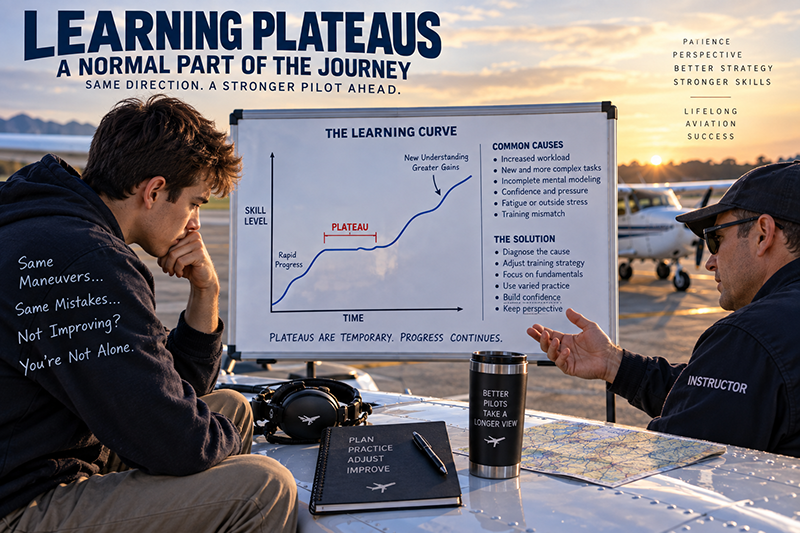
Learning plateaus are one of the most common and most misunderstood parts of flight training. A student pilot may be improving steadily, lesson after lesson, and then suddenly appear to stop progressing. Landings that were getting better become inconsistent. Radio work that was improving becomes hesitant. Maneuvers that seemed nearly checkride-ready begin to look unfinished. To the student, it can feel like failure. To the instructor, it can be frustrating if the reason for the slowdown is not obvious.
In aviation training, a plateau is not simply a bad lesson or a lack of effort. It is a temporary leveling-off in performance where additional repetition does not produce the expected improvement. The student may still be learning, but that learning may not yet be visible in aircraft control, decision-making, workload management, or confidence. Understanding why learning plateaus happen helps instructors respond with better teaching rather than more pressure, and it helps students stay engaged instead of assuming they are not cut out for flying.
This matters because flight training is not only about accumulating hours. It is about building safe, repeatable performance under changing conditions. When progress stalls, the solution is rarely to keep doing the same lesson in the same way until morale declines. The better answer is to diagnose the type of plateau, adjust the training strategy, and rebuild the link between understanding, skill, judgment, and confidence.
What a Learning Plateau Looks Like in Flight Training
A learning plateau in flight training usually appears as a pattern rather than a single disappointing flight. One lesson can be affected by fatigue, weather, aircraft availability, distractions, or a rough day at work before the student arrived at the airport. A plateau becomes more likely when the same performance issue remains across multiple lessons even though the student is showing reasonable effort and the instructor is providing feedback.
Common examples include a student who understands traffic pattern procedures but cannot consistently stabilize the approach, a student who can explain crosswind correction on the ground but overcontrols during landing flare, or an instrument student who can brief an approach but loses situational awareness once frequency changes, intercept angles, and altitude assignments arrive quickly. In each case, the knowledge may exist, but the student is not yet able to apply it smoothly in the airplane.
Plateaus often show up near transitions in training. A new student may progress quickly through basic control familiarization, then stall when the tasks require coordination, timing, and judgment. A pre-solo student may perform well with the instructor on board but become inconsistent as independence approaches. A student preparing for a practical test may know the required tasks but struggle to make them consistent under evaluation pressure. These transition points are demanding because the student is moving from following instructions to managing the flight as a pilot.
Instructors should also distinguish between a true plateau and a training mismatch. If a student repeatedly fails to meet a standard because the task has not been clearly demonstrated, the objective has not been explained, or the feedback is vague, that is not a student plateau. That is an instructional problem. Likewise, if the aircraft, environment, or lesson sequence is inappropriate for the student’s stage of learning, the result may look like poor progress when the real issue is training design.
Why Learning Plateaus Happen
Flight training combines intellectual knowledge, psychomotor skill, perception, judgment, communication, and emotional control. A plateau can occur when one of those elements lags behind the others. A student might know what to do but not yet have the motor skill to do it smoothly. Another student may fly the airplane well but become overloaded by radio calls, airspace awareness, or checklist flow. A third may have the skill but lose performance when confidence drops.
One common cause is task saturation. As training advances, the student is expected to control the aircraft, navigate, communicate, manage configuration, monitor weather and traffic, and make decisions. Each individual task may be manageable, but the combined workload may exceed the student’s current capacity. When this happens, performance can degrade in tasks the student had already demonstrated. This does not mean the student forgot how to fly. It often means the student’s attention is overloaded.
Another cause is incomplete mental modeling. A student may memorize a procedure without fully understanding why each step matters. For example, a student may know to reduce power, set pitch, configure the aircraft, and maintain a target airspeed on downwind and final. But if the student does not understand energy management, sight picture, wind correction, and the relationship between pitch and power, the procedure may collapse when conditions change. The student has a script, but not yet a flexible model.
Plateaus also occur when practice becomes repetitive but not purposeful. Repeating ten landings without a specific training focus may produce fatigue more than improvement. Purposeful practice means each repetition has a clear objective, a measurable cue, and a short debrief. For example, one landing circuit may focus only on maintaining a stable approach speed and glidepath. Another may focus on looking farther down the runway during the roundout. Without that focus, the student may repeat the same error until it becomes more familiar.
Emotional factors can be just as important. A student who feels embarrassed, rushed, or judged may use mental energy to manage anxiety instead of flying the airplane. That anxiety can become linked to a specific maneuver or phase of flight. Landings are a frequent example because they are visible, immediate, and emotionally significant to new pilots. The more the student wants the landing to be good, the more tense and reactive the control inputs may become.
Physical and lifestyle factors are also relevant. Fatigue, dehydration, poor sleep, inconsistent training intervals, and stress outside aviation can affect learning and performance. Flight training demands concentration. When a student trains after a long workday or returns after long gaps between lessons, the instructor may need to adjust expectations and rebuild continuity before pushing for new performance gains.
Why This Matters in Real-World Aviation
Learning plateaus matter because aviation rewards disciplined progress, not rushed progress. A student who is pushed through a plateau without understanding the underlying issue may appear to advance but carry fragile skills into later training. That can show up during solo operations, cross-country planning, instrument training, commercial maneuvers, or aircraft transitions.
In real-world flying, pilots rarely face one isolated task at a time. A pilot on final approach may be correcting for gusty wind, monitoring airspeed, listening for traffic, confirming runway alignment, and preparing for a go-around decision. If a student’s training has only produced performance under ideal, instructor-managed conditions, the skill may not hold up when workload rises. Addressing plateaus properly helps convert isolated ability into operational competence.
Plateaus also influence safety culture. When students believe that struggling means they are failing, they may hide confusion, avoid asking questions, or become overly dependent on the instructor. When instructors treat plateaus as normal learning events, students are more likely to speak honestly about uncertainty. That honesty is essential in aviation because unreported confusion can become poor decision-making in the cockpit.
For instructors, plateaus are a test of teaching skill. The easiest response is to repeat the same explanation louder or fly another lap in the pattern. The more professional response is to analyze what the student is actually experiencing. Is the student missing a visual cue? Is the task being introduced too late in the flight when fatigue is high? Is the student trying to satisfy the instructor rather than manage the aircraft? Is there a knowledge gap that needs ground instruction before more flight time is spent?
For flight schools and operators, plateaus affect training efficiency and retention. Students who feel stuck may cancel lessons, delay training, or quit entirely. Instructors who lack a strategy may become frustrated and inconsistent. A structured approach to diagnosing and restarting progress can improve both safety and training value.
How Pilots Should Understand Learning Plateaus
Pilots should understand a plateau as information. It is a signal that the current training method is no longer producing visible improvement at the expected rate. That signal should prompt a change in diagnosis, not a judgment about the student’s ability.
Learning in aviation is not always linear. Early progress can be fast because the student is learning large, visible concepts. Later improvement often becomes more subtle. A new pilot may quickly learn to hold altitude within a broad range, then spend many lessons refining trim, scan, power coordination, and anticipation. That refinement may not feel dramatic, but it is part of becoming consistent.
It is also important to separate performance from learning. Performance is what the instructor sees on a particular flight. Learning is the durable change that remains after time, distraction, and changing conditions. A student may perform well one day because the conditions are familiar and the instructor is quietly managing workload. That does not necessarily mean the learning is complete. Conversely, a student may perform poorly on a challenging day while still developing the understanding that will produce better performance later.
Instructors can help students by making the invisible parts of learning visible. Instead of saying only, “Your landings are still inconsistent,” an instructor can identify the specific layer being developed: “Your alignment and centerline control are improving. The next step is stabilizing the flare sight picture so you stop chasing small pitch changes.” This kind of feedback shows progress even when the final result is not yet polished.
Students should also recognize that plateaus often precede improvement. When the brain is reorganizing a skill, performance can feel awkward. A student correcting a bad habit may temporarily perform worse because the old habit is being interrupted and the new habit is not yet automatic. That uncomfortable middle stage is normal in complex skill development. The key is to practice correctly, not merely practice more.
The Instructor’s Role in Restarting Progress
When a student stalls, the instructor’s first responsibility is diagnosis. A plateau should not be treated as a generic problem because the same visible symptom can have different causes. A high final approach, for example, might come from poor pattern spacing, late configuration, inadequate wind correction, fixation inside the cockpit, fear of reducing power, or lack of understanding of glidepath control. Each cause requires a different instructional response.
A useful instructor question is: “What is the student paying attention to at the moment the error begins?” Many training problems start before the obvious mistake. The unstable flare may begin with a wide downwind. The poor steep turn may begin with an untrimmed entry. The missed radio call may begin with an incomplete mental picture of the airspace. Identifying the first link in the chain gives the instructor a better place to intervene.
Instructors should vary the method when repetition stops working. A ground briefing with a simple diagram may unlock a concept that repeated flight demonstrations did not. Chair flying may help the student rehearse flows and callouts without aircraft workload. Slow flight or low approach exercises may isolate pitch and power control before returning to full-stop landings. Simulator or aviation training device sessions, when appropriate and available, may allow the student to repeat procedures without the cost and workload of the aircraft environment.
Demonstration can also be refreshed. Students sometimes plateau because they no longer have a clear picture of the desired performance. The instructor may need to demonstrate again, this time narrating sight picture, control pressure, timing, and decision points. A good demonstration is not just “watch me do it.” It is a guided observation that tells the student what to notice.
Feedback should be specific, timely, and limited. Overloading a student with ten corrections after one maneuver can create confusion and discouragement. A more effective debrief identifies the primary error, the likely cause, and one correction for the next attempt. For example: “The approach became unstable because we carried excess airspeed from base to final. On the next pattern, make the power reduction earlier and confirm the target speed before turning final.”
Finally, instructors should protect the student’s confidence without lowering standards. Encouragement is not the same as pretending performance is acceptable. A professional instructor can say, “This is not yet consistent enough for solo, but the reason is identifiable and we have a plan to fix it.” That message preserves both safety and motivation.
Common Mistakes or Misunderstandings
One common mistake is assuming that a plateau means the student needs more pressure. Pressure may temporarily increase effort, but it rarely improves learning if the student is already overloaded. In aviation, stress can narrow attention and reduce working memory. A student who is tense may stop scanning, stop listening, or become mechanical. The instructor may see more effort but less learning.
Another misunderstanding is believing that every plateau is caused by lack of study. Some are. If a student does not know procedures, airspace, weather basics, or aircraft systems, flight performance will suffer. But many plateaus occur in students who are studying hard. Their issue may be application, timing, perception, or integration. Telling a student simply to “study more” may miss the real problem.
A third mistake is allowing the instructor to become the autopilot. If the instructor continually prompts every action, the student may appear smoother but is not truly managing the flight. Overprompting can hide a plateau until the student is asked to perform independently. Instructors should gradually reduce prompts and replace them with questions that encourage anticipation: “What should happen before we turn base?” or “What is your plan if the approach is not stable by short final?”
Students can also misunderstand the purpose of standards. A training standard is not a personal criticism. It is a safety and proficiency target. If the aircraft is not stabilized, if checklist usage is inconsistent, or if airspace awareness is weak, the instructor’s job is to address it before the student operates with less supervision. That is not delaying progress. That is protecting the student and the system.
Another risk is chasing symptoms. A student who lands flat may be told to “hold it off longer,” but the actual cause may be excess speed, poor runway sight picture, or fixation near the nose. A student who drifts from centerline may be told to “use more rudder,” but the cause may be late crosswind correction or looking too close to the airplane. Correcting the visible symptom without understanding the cause can create new problems.
Finally, there is a temptation to change instructors too quickly or never change at all. A fresh instructor can sometimes identify a blind spot and help restart progress. However, changing instructors repeatedly without a clear training plan can create inconsistency. The best approach is deliberate: review the student’s history, identify the specific plateau, agree on a short intervention plan, and evaluate whether the change is helping.
Practical Example: A Pre-Solo Landing Plateau
Consider a student pilot who has completed basic aircraft control, normal takeoffs, traffic pattern operations, and several hours of landing practice. Early progress was steady. The student can brief the pattern, maintain radio communication in a familiar environment, and explain how wind affects base and final. Yet the landings remain inconsistent. Some are acceptable with instructor coaching, while others are high, fast, or misaligned. The student is becoming discouraged and is beginning to dread pattern lessons.
If the instructor treats the issue as a simple need for more landings, the lesson may become a tiring loop of similar mistakes. Instead, the instructor pauses to diagnose. Reviewing several approaches, the instructor notices that the student’s downwind spacing changes from lap to lap. When the downwind is too close, the base turn becomes rushed. When the downwind is too wide, the student adds power late or carries excess airspeed to avoid getting low. The flare inconsistency is not the first problem. The approach geometry is unstable earlier in the pattern.
The instructor changes the next lesson. Before flight, they brief a simple visual reference for downwind spacing, discuss how wind changes groundspeed on each leg, and define a stable approach target. In the aircraft, the first few patterns focus only on downwind spacing and base-to-final planning. The instructor handles some radio calls during the first repetitions to reduce workload. After the student demonstrates improved spacing, the instructor returns the radio work and asks the student to verbalize the plan before each base turn.
The improvement may not be immediate, but the student now has a specific problem to solve. The instructor’s feedback becomes more precise: “That landing was better because the final was not rushed,” or “The flare was late because the approach was fast from the base turn.” The student begins to understand that landings are not a single event at the runway. They are the result of energy management, geometry, wind correction, and visual cues built throughout the pattern.
This example illustrates an important training principle: restart progress by moving upstream. If the final result is poor, find the earliest point where the flight path, workload, or understanding begins to degrade. Fixing that earlier point often improves the later performance without forcing the student to fight the airplane at the end.
Best Practices for Students Working Through a Plateau
Students have an active role in overcoming learning plateaus. The first step is to communicate honestly. If a maneuver feels confusing, if the student is practicing from memory without understanding, or if anxiety is building before a lesson, the instructor needs to know. Silence makes diagnosis harder.
Students should also prepare with purpose. Instead of vaguely reviewing everything before each lesson, focus on the next training objective. If the issue is crosswind landings, review wind correction, runway alignment, control inputs during rollout, and go-around decision-making. If the issue is radio communication, practice expected calls aloud and visualize where each call occurs in the flight.
Chair flying is especially useful during plateaus. Sitting in a quiet room and rehearsing flows, callouts, sight pictures, and decision points can reduce cockpit workload. The goal is not to pretend to fly the airplane perfectly. The goal is to make the sequence familiar enough that the student has more attention available for aircraft control and situational awareness.
Students should keep a short training journal. After each lesson, write what improved, what remained difficult, and what the next lesson will emphasize. This helps identify patterns. A student may discover that performance drops after long gaps between flights, during late evening lessons, or when new radio tasks are added. These observations help the instructor tailor training.
It is also helpful for students to measure progress in layers. A landing may still be firm, but perhaps airspeed control improved. A steep turn may still lose altitude, but perhaps the entry, clearing turns, and rollout heading are better. Recognizing partial improvement keeps motivation alive and supports more accurate self-assessment.
Most importantly, students should avoid comparing timelines. Flight training progress varies because people bring different backgrounds, schedules, learning styles, stress levels, and opportunities for practice. The relevant question is not whether another student soloed sooner or mastered a maneuver faster. The relevant question is whether the student is building safe, repeatable competence.
Best Practices for Instructors Managing Plateaus
Instructors should begin with a structured but flexible assessment. Review the student’s recent lessons, identify the recurring issue, and determine whether the problem is knowledge, skill, perception, workload, confidence, or training design. Many plateaus involve more than one factor, but one factor usually leads.
A short reset briefing can be powerful. The instructor should explain what a plateau is, reassure the student that it is a normal part of skill development, and present a specific plan. Students perform better when they understand that the next few lessons are not random repeats but targeted interventions.
In flight, isolate variables when possible. If the student is struggling with approaches, the instructor may reduce radio workload temporarily, choose a less congested training period, or focus on one runway and wind condition before adding complexity. This is not lowering the bar. It is managing cognitive load so the student can rebuild the skill correctly.
Instructors should also use scenario-based questions carefully. Good questions develop judgment, but too many questions at high workload can become distracting. During early recovery from a plateau, the instructor may need to simplify. As the student regains control and confidence, questions can be reintroduced to test understanding and decision-making.
Documentation matters. Lesson notes should describe not only what was practiced but what diagnosis was made and what strategy will be tried next. This is especially important in a flight school environment where a student may occasionally fly with another instructor. Clear notes prevent conflicting advice and allow continuity.
Professional instructors also know when to seek another perspective. A stage check, chief instructor review, or flight with another qualified instructor can be valuable when progress remains stalled. The purpose is not to embarrass the student or second-guess the primary instructor. It is to bring fresh eyes to the training problem.
How to Restart Progress Without Rushing Safety
The best way to restart progress is to create a short, focused training cycle. First, define the plateau in observable terms. Instead of “bad landings,” use “airspeed varies on final and flare timing changes with excess speed.” Instead of “poor situational awareness,” use “student loses track of position relative to the airport while managing radio calls.” Clear language leads to better solutions.
Second, identify the likely cause. The cause may be a knowledge gap, a visual cue problem, motor skill timing, workload saturation, lack of confidence, or inconsistent lesson spacing. The instructor does not need to solve every possible cause at once. Start with the most likely and most safety-critical factor.
Third, choose a targeted intervention. That may be a ground lesson, a demonstration, a simulator session, a chair-flying assignment, a simplified flight profile, or a change in practice environment. The intervention should be specific enough that both student and instructor know what success looks like.
Fourth, test the result under gradually increasing workload. If the student improves only when the instructor handles all communication and conditions are perfect, the skill is not yet fully integrated. Add complexity carefully: return radio calls, vary pattern entries, introduce wind changes, or ask the student to make more decisions. The goal is durable performance, not a one-time good lesson.
Finally, debrief in a way that strengthens self-assessment. Ask the student what they noticed, where the maneuver began to improve or degrade, and what they will do differently next time. A student who can accurately diagnose their own performance is moving toward pilot-in-command thinking.
Safety Risks When Plateaus Are Mishandled
A mishandled plateau can create safety risks that last beyond the training phase. One risk is habit reinforcement. If a student repeatedly practices an incorrect technique without effective correction, the wrong response can become automatic. Unlearning that habit later may require more effort than teaching the correct technique earlier.
Another risk is false confidence. If an instructor advances a student because the student occasionally performs well, but the performance is not repeatable, the student may face situations they are not ready to manage. Aviation proficiency should be based on consistent performance across appropriate conditions, not isolated success.
A third risk is learned helplessness. If a student receives constant criticism without a clear path to improvement, they may stop actively problem-solving and simply wait for instructor commands. That dependency is the opposite of the independence flight training is meant to build.
There is also a risk of normalization of unstable performance. For example, if a student becomes accustomed to salvaging poor approaches instead of recognizing when to go around, the training environment may unintentionally teach persistence when the safer choice is discontinuing the approach. Instructors should use plateaus as opportunities to reinforce decision-making, not merely technique.
Finally, frustration can affect aeronautical decision-making. A student who is desperate to prove progress may press into conditions, fatigue, or workload that are not appropriate. Instructors must watch for this and keep the training plan aligned with safety rather than emotion.
Frequently Asked Questions
Are learning plateaus normal in flight training?
Yes. Learning plateaus are common in complex skill training, including aviation. They do not automatically mean a student lacks ability. They usually mean that the current training method, workload level, or understanding needs adjustment before progress becomes visible again.
How long should a flight training plateau last?
There is no universal timeline. A short plateau may resolve after one focused ground session or a change in practice method. A deeper plateau may take several lessons, especially if it involves confidence, workload management, or an incorrect habit that has been repeated for some time.
Should a student change instructors if progress stalls?
Sometimes a fresh perspective helps, but changing instructors should be deliberate. Before switching, the student and instructor should define the problem, review the training plan, and consider a stage check or consultation with another experienced instructor. The goal is better diagnosis, not simply a change of personality.
Can studying more fix a learning plateau?
Studying helps when the plateau is caused by a knowledge gap. However, many aviation plateaus involve applying knowledge in the aircraft, managing workload, recognizing visual cues, or developing timing. In those cases, study should be combined with targeted practice and instructor feedback.
What should instructors avoid when a student plateaus?
Instructors should avoid vague criticism, excessive pressure, overprompting, and repetitive lessons without a specific objective. They should also avoid advancing the student based on occasional good performance if the skill is not yet safe and repeatable.
How can a student stay motivated during a plateau?
Students can stay motivated by tracking smaller layers of progress, asking for specific feedback, preparing for each lesson with a focused objective, and remembering that temporary slowdowns are part of learning complex aviation skills. The key is to keep the training purposeful.
Key Takeaways
- A learning plateau is a signal to diagnose and adjust training, not proof that a student cannot succeed.
- Safety improves when instructors address the root cause of stalled progress rather than repeating the same lesson without focus.
- Students and instructors restart progress best through clear objectives, targeted practice, honest debriefing, and gradual workload increases.