
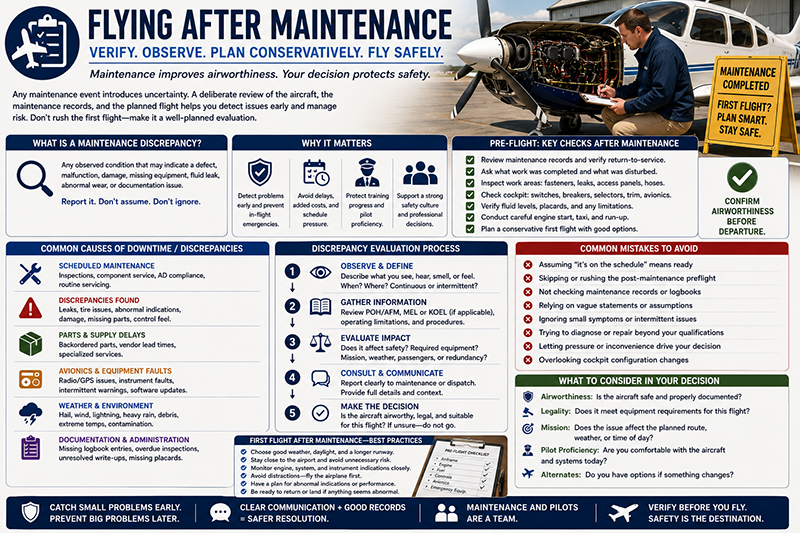
Flying after maintenance deserves more attention than many pilots give it. The aircraft may look familiar, the weather may be good, and the planned flight may seem routine, but any maintenance event introduces a period of elevated uncertainty. Components may have been removed and reinstalled, systems may have been opened, panels may have been disturbed, and normal cockpit indications may need to be rechecked with fresh eyes.
For pilots, student pilots, instructors, aircraft owners, and aviation professionals, the goal is not to distrust maintenance. The goal is to treat the first flight after maintenance as a deliberate operational event. A disciplined review of the aircraft, the maintenance records, the systems affected, and the planned flight profile can reduce surprises and improve the chances of detecting a problem while still on the ground. Flying after maintenance is where good preflight habits, sound aeronautical decision-making, and clear communication with maintenance personnel all come together.
What Makes Flying After Maintenance Different?
A normal preflight inspection is designed to confirm that the aircraft is ready for flight. A post-maintenance preflight has an additional purpose: to verify that the work area, affected systems, and related components appear correct after maintenance activity. The difference is subtle but important. Instead of looking only for the usual defects, the pilot should also ask, “What changed since the last flight?”
Maintenance can range from a simple oil change or tire replacement to avionics work, engine troubleshooting, flight control rigging, fuel system work, annual inspection findings, or major component replacement. The complexity of the work should influence the pilot’s level of preparation. A minor maintenance item may call for extra attention to one area. More involved work may justify a longer ground run, a more conservative flight plan, or a dedicated maintenance check flight profile conducted by an appropriately qualified pilot.
The key concept is configuration awareness. Every aircraft has a known configuration before it enters maintenance. After maintenance, that configuration may have changed. A pilot should understand what was done, what was opened, what was adjusted, what was replaced, and what still requires monitoring. This does not mean the pilot becomes the mechanic. It means the pilot accepts responsibility for operating the aircraft only after developing a practical understanding of its current condition.
Some post-maintenance discrepancies are obvious, such as a missing screw, an unsecured inspection panel, a low fluid level, or a cockpit switch left in an unusual position. Others are more subtle, such as an abnormal engine indication, a trim system that feels different, an autopilot mode that does not behave as expected, or a fuel selector that was disturbed during troubleshooting. The pilot’s best defense is a slow, methodical, questioning approach.
Why This Matters in Real-World Aviation
In real-world flying, maintenance often occurs under time pressure. A flight school needs an airplane back on the schedule. An owner wants to depart before weather changes. A business aircraft has passengers waiting. A mechanic may be managing multiple aircraft. These pressures are common, but they do not change the pilot’s responsibility to make a sound go or no-go decision.
Post-maintenance flying is especially important in training environments. Student pilots may assume that an aircraft coming out of the shop is automatically “better than before.” In many ways it may be, but that assumption can lead to complacency. A newly serviced aircraft still needs a complete preflight, a records check appropriate to the operation, and careful observation during engine start, taxi, runup, takeoff, climb, and the first several minutes of flight.
Instructors have an important role here. They can teach students to ask mature operational questions without becoming adversarial. For example: What maintenance was completed? Were any engine controls adjusted? Were flight controls or trim systems disturbed? Was the fuel system opened? Were avionics updated or replaced? Did the aircraft have a ground run or operational check? Are there any placards, deferred items, or limitations the pilot needs to know before flight?
For aircraft owners and operators, the post-maintenance flight is also a quality control moment. It is not a substitute for maintenance inspection, but it is a practical operational check of how the aircraft behaves in the environment where it matters most. A pilot who notices a small abnormality early and returns for evaluation may prevent a nuisance issue from becoming a serious in-flight problem.
Weather, airport environment, and route selection matter more after maintenance. A pilot may normally depart from a short runway, climb over rising terrain, or launch into marginal weather because the aircraft and pilot are well within their normal comfort zone. After maintenance, a more conservative plan is often wiser. Choosing a longer runway, good visual conditions, daylight, nearby landing options, and a local area profile gives the pilot more time and space to detect and manage anything unusual.
How Pilots Should Understand Maintenance Records
Pilots do not need to be maintenance technicians to review maintenance records intelligently. They do need to understand what the records are supposed to tell them operationally. Before flight, the pilot should verify that the aircraft has been properly returned to service for the intended operation by authorized personnel and that any required entries, approvals, or limitations have been addressed. The exact recordkeeping details depend on the aircraft, type of operation, and maintenance performed, so pilots should use the applicable aircraft records, operator procedures, and regulatory requirements.
A practical records review begins with three questions. First, what work was completed? Second, who approved the aircraft for return to service? Third, are there any remaining discrepancies, limitations, placards, or operational notes that affect the flight? If the pilot cannot answer those questions, the flight should pause until the information is clear.
Maintenance records can contain terms that are easy to skim past. “Removed and replaced,” “adjusted,” “serviced,” “operational check satisfactory,” and “inspected” each communicate something different. If an engine control cable was adjusted, the pilot should pay close attention to throttle, propeller, and mixture operation as applicable. If a landing gear component was replaced, gear indications and extension or retraction behavior deserve careful attention in aircraft equipped with retractable gear. If avionics software was updated, the pilot should verify database status, configuration settings, audio panel routing, transponder behavior, and autopilot coupling before relying on those systems.
Deferred discrepancies require particular care. In many operations, certain inoperative items may be deferred only under specific procedures. A pilot should not treat a deferred item as an informal note. If something is inoperative, placarded, disabled, or deferred, the pilot needs to understand whether the aircraft is legally and operationally suitable for the intended flight. When in doubt, ask the maintenance provider, chief instructor, director of maintenance, or another qualified authority within the operation before accepting the aircraft.
The Post-Maintenance Preflight Mindset
A post-maintenance preflight should be slow, deliberate, and tailored to the work performed. The pilot should begin with the normal checklist, but the checklist is only the foundation. The real value comes from adding context. If the cowling was removed, inspect the cowling installation, fasteners, oil access doors, visible hoses, safetying where visible, fluid levels, and signs of leaks. If an inspection panel was opened, look for missing fasteners or panels that are not flush. If the battery or electrical system was serviced, observe electrical indications carefully during startup and before taxi.
One useful technique is to ask the mechanic or maintenance manager to walk around the aircraft and point out the areas that were disturbed. This is not an interrogation. It is a professional handoff. The mechanic can often identify panels, components, switches, or systems that deserve special attention. A five-minute conversation may reveal details that are not obvious from the cockpit or the maintenance entry alone.
The cockpit deserves equal attention. Maintenance personnel may move switches, circuit breakers, avionics settings, trim wheels, fuel selectors, seat positions, friction locks, alternate air controls, cabin heat controls, or autopilot settings. Before engine start, pilots should slow down and reestablish a known cockpit configuration. Verify that controls move correctly, trim indications make sense, fuel quantity and selector positions are appropriate, and circuit breakers or switches are not in an unexpected state. If a breaker is found pulled or a switch is guarded, placarded, or abnormal, do not simply reset or reposition it without understanding why.
Engine start and runup should be treated as part of the post-maintenance evaluation. Listen for abnormal sounds, watch oil pressure and other engine indications, check charging system behavior, and notice whether the engine responds normally to control inputs. If the aircraft has recently had engine, ignition, fuel, induction, exhaust, or propeller work, a careful ground run is especially valuable. Any roughness, hesitation, unusual vibration, unexplained odor, smoke, fluid leak, or abnormal indication should be resolved before flight.
Systems That Deserve Extra Attention
Every maintenance event is different, but several aircraft systems deserve special attention when they have been disturbed. Flight controls are at the top of the list. Any work involving control cables, pushrods, bellcranks, control surfaces, trim systems, autopilot servos, or rigging should prompt a very careful control check. Pilots should verify full, free, and correct movement using the aircraft’s normal procedures. “Correct” matters as much as “free.” A surface that moves freely but in the wrong direction is not safe.
Fuel systems also require caution. If fuel lines, tanks, drains, selectors, pumps, strainers, or engine fuel controls were serviced, the pilot should be alert for leaks, abnormal fuel pressure or flow indications, unusual fuel selector feel, and engine response during power changes. Fuel contamination checks remain essential, but after fuel system maintenance the pilot should also think about whether the system was opened, drained, reconnected, or otherwise disturbed.
Electrical and avionics work can create subtle distractions. A new radio, transponder, GPS, audio panel, alternator, battery, or wiring repair may seem straightforward on the ground but reveal configuration problems during flight. Before departure, pilots should verify communication quality, navigation source selection, audio routing, intercom behavior, transponder mode, display dimming, and any autopilot interface they intend to use. If the flight can be conducted safely without relying on newly serviced avionics, that may be a prudent choice until the system is proven.
Engine and propeller maintenance deserve a conservative first flight profile. Pilots should monitor temperatures, pressures, RPM, vibration, and power response closely. The purpose is not to stare at the instruments at the expense of flying the airplane. The purpose is to build an early baseline and notice changes quickly. If something does not look, sound, smell, or feel right, the safest decision is often to stop while still on the ground or return for maintenance evaluation promptly.
Landing gear, brakes, and tires are also important. After brake work, taxi slowly at first and verify normal braking action while there is room to stop. After tire or wheel maintenance, check inflation appearance, wheel pant security if installed, brake line condition where visible, and any signs of rubbing or leakage. In retractable gear aircraft, gear maintenance may warrant a carefully planned flight with clear airspace, suitable weather, and enough time to troubleshoot indications without rushing the approach.
Planning the First Flight After Maintenance
The first flight after maintenance should rarely be treated as a normal transportation leg. Even when the maintenance was minor, the pilot should consider whether the flight environment allows safe detection and handling of a problem. A short local flight in day visual conditions may be more appropriate than launching immediately into a long cross-country, night operation, instrument conditions, or flight over inhospitable terrain.
Risk management begins with the runway. Longer runways, favorable winds, and clear departure paths provide more options if the aircraft does not perform as expected. The pilot should brief an early abort point, a plan for abnormal engine indications, and a return strategy. This is especially important if the work involved the engine, propeller, fuel system, flight controls, landing gear, or primary electrical system.
Altitude is also a resource. After takeoff, a pilot may choose to remain within gliding or practical return distance of the departure airport until basic engine and system behavior appears normal, depending on aircraft type, airport environment, and traffic. The first few minutes should be flown with disciplined attention to aircraft control, engine indications, configuration, and escape options. This is not the time for unnecessary cockpit programming or casual conversation.
Passenger carriage deserves thought. When feasible and appropriate, a post-maintenance first flight is often better conducted without passengers who are not necessary for the operation. This reduces pressure, weight, distraction, and expectation. If another pilot or instructor is on board, roles should be briefed clearly. One pilot flies; the other monitors, reads checklists, manages radios, or observes systems as agreed. Ambiguous crew coordination can create its own risk.
Not every post-maintenance flight is a formal maintenance test flight, and pilots should not exceed their qualifications, aircraft limitations, or operator procedures. If the maintenance performed requires a specialized check, the operator should use an appropriately qualified pilot and an approved or accepted procedure for that aircraft and operation. For typical general aviation flying, the practical principle remains the same: keep the first flight simple, local, well-briefed, and conservative.
Common Mistakes and Misunderstandings
One of the most common mistakes is assuming that “maintenance completed” means “nothing can go wrong.” Maintenance improves airworthiness when properly performed, but the transition from shop to flight line still requires verification. A careful pilot is not questioning the professionalism of the mechanic. The pilot is completing the operational side of the safety chain.
Another mistake is failing to ask what was actually done. Pilots sometimes accept a vague statement such as “it’s fixed” without understanding which system was repaired, what was replaced, or whether any related system was disturbed. This can lead to a normal checklist being performed with no extra attention to the area most likely to reveal a post-maintenance issue.
A third misunderstanding involves cockpit configuration. Pilots may focus on the outside of the aircraft and miss changed avionics settings, unusual trim positions, altered fuel selector positions, disabled equipment, or circuit breakers that are not in their usual state. A cockpit reset is an important part of returning the aircraft to a known condition.
Time pressure is another serious hazard. A pilot may be tempted to rush because the aircraft came out of maintenance late, a rental reservation is ending, passengers are waiting, or weather is approaching. Rushing is exactly the wrong response. Post-maintenance flights reward patience. If there is not enough time to review records, inspect the aircraft, conduct a careful runup, and plan a conservative first flight, there may not be enough margin to go.
Some pilots also overestimate their ability to troubleshoot in flight. If an abnormality appears on the ground, the best place to investigate is usually on the ground with the engine shut down and maintenance support available. Launching with a questionable indication, an unexplained odor, or a system that “will probably clear up” removes options. A rejected flight is often a mark of good judgment, not indecision.
Practical Example: First Flight After Engine Maintenance
Consider a pilot preparing to fly a normally aspirated single-engine training aircraft after engine maintenance that included an oil change, spark plug service, and a correction for a rough-running condition. The aircraft is scheduled for a cross-country later in the day, but the pilot chooses to conduct a local evaluation flight first.
Before preflight, the pilot reviews the maintenance entry and confirms that the aircraft has been returned to service for flight. The pilot asks the mechanic what areas were opened and whether any engine controls, ignition components, cowling fasteners, oil lines, or fuel system components were disturbed. The mechanic explains the work and notes that the engine was ground run after maintenance.
During the preflight, the pilot pays particular attention to the cowling, oil level, visible leaks, exhaust area, induction area where visible, fasteners, and anything that appears newly handled. In the cockpit, the pilot verifies switch positions, mixture and throttle friction, fuel selector position, engine controls, circuit breakers, and engine instrument indications before and after start.
The runup is unhurried. The pilot checks engine response, magneto or ignition system behavior as appropriate for the aircraft, idle operation, temperatures and pressures, and any abnormal vibration. Everything appears normal. Instead of departing on the planned cross-country immediately, the pilot briefs a local flight in day visual conditions, stays near the departure airport initially, climbs to an altitude that provides options, and monitors engine indications closely while avoiding unnecessary distractions.
During climb, the pilot notices a faint oil smell that was not present during the runup. Oil pressure and temperature remain in the normal range, but the smell is new and unexplained. Rather than rationalizing it, the pilot levels briefly as appropriate, advises the tower, returns for landing, and taxis to maintenance. The result may turn out to be minor, but the decision-making was sound. The pilot detected a possible issue early, kept the situation simple, and avoided turning a local uncertainty into a cross-country problem.
Best Practices for Pilots
Good post-maintenance flying is built on habits, not heroics. The most important habit is curiosity. A pilot should want to know what changed, what was touched, and what needs special attention. Curiosity leads to better questions, better inspections, and better decisions.
Communication is equally important. A short, respectful maintenance handoff can prevent confusion. Pilots should ask direct operational questions and listen carefully to the answers. Mechanics should not be expected to provide a flight lesson, but they can often highlight the systems or areas that deserve attention. If the answer is unclear, keep asking until the operational significance is understood.
Another best practice is to separate the post-maintenance flight from unrelated mission pressure. If the airplane has just come out of maintenance, consider whether the first flight should be local, short, and conducted in favorable conditions. Avoid combining a post-maintenance evaluation with challenging weather, night operations, heavy passenger loads, tight scheduling, or complex airspace unless the risk is understood and appropriately managed.
Use the normal checklist, then add maintenance-specific attention. A checklist helps prevent missed routine items. Maintenance-specific thinking helps catch the unusual ones. Together they are stronger than either one alone.
The following practices are useful for many general aviation situations, provided they are adapted to the aircraft, maintenance performed, and applicable procedures:
- Review the maintenance records and confirm that the aircraft is approved for the intended flight.
- Ask what systems, panels, controls, lines, or components were disturbed during maintenance.
- Inspect the affected area slowly, including fasteners, access panels, fluid levels, leaks, security, and obvious configuration issues.
- Reset the cockpit to a known configuration before engine start, including switches, selectors, trim, avionics, and circuit breakers.
- Conduct an unhurried engine start, taxi, and runup while watching for abnormal indications, sounds, smells, or control feel.
- Plan the first flight in favorable conditions with good runway options, nearby landing areas, and minimal distractions.
- Stop or return promptly if something does not look, sound, smell, or feel right.
Instructors can turn these practices into meaningful training. Instead of simply telling a student to “be careful after maintenance,” an instructor can demonstrate a maintenance handoff conversation, compare a normal preflight with a post-maintenance preflight, and brief a conservative first-flight profile. That kind of training helps students develop judgment they will use long after the lesson is over.
When to Involve Maintenance Again
Pilots sometimes hesitate to bring an aircraft back to maintenance because they do not want to appear overly cautious. That hesitation is misplaced. Maintenance providers generally prefer a clear, timely report over a vague problem discovered later. If a pilot observes an abnormal indication, leak, smell, sound, vibration, control feel, avionics behavior, or system response, the best action is to document it clearly and involve maintenance before further flight.
A useful pilot report is specific. Instead of saying “the engine seemed weird,” describe when the issue occurred, what power setting was used, what indications were observed, what the outside conditions were, and whether the issue changed with configuration or control input. For avionics issues, note the selected mode, frequency, navigation source, display message, or audio panel setup. For control or trim issues, describe the phase of flight, airspeed range, and control forces without exaggeration.
Do not attempt to fix maintenance discrepancies casually on the ramp unless the action is permitted, appropriate, and within the pilot’s authority and competence. Resetting switches, pushing circuit breakers, tightening components, adding fluids, or repositioning equipment without understanding the underlying issue can mask a problem or create a new one. When maintenance has just been performed, unexplained abnormalities deserve professional attention.
How Flight Schools and Operators Can Build Better Habits
Flight schools, flying clubs, and aircraft operators can reduce post-maintenance risk by making the process routine. A simple aircraft status board, clear maintenance release communication, and instructor emphasis can help pilots understand when an aircraft has recently been worked on and what areas require attention. The goal is not bureaucracy. The goal is shared situational awareness.
Dispatch procedures should make it easy for pilots to ask questions. If a student pilot sees a note that an aircraft just returned from maintenance, that student should know whom to contact, what records to review, and whether an instructor should be involved before flight. Instructors should model this behavior consistently. When experienced pilots skip the maintenance conversation, students learn that it is optional.
Operators should also consider how scheduling affects decision-making. Immediately assigning an aircraft from maintenance to a demanding training flight, night cross-country, or complex instrument lesson may not be the best first use, depending on the work performed. A short local flight or instructor verification flight may be more appropriate in some cases. The decision should be based on aircraft type, maintenance scope, pilot qualifications, weather, and operational needs.
A strong safety culture treats post-maintenance caution as professionalism. The best pilots are not the ones who accept every aircraft without question. They are the ones who ask the right questions, respect maintenance expertise, understand their own responsibilities, and make conservative decisions when uncertainty remains.
Frequently Asked Questions
Is flying after maintenance more risky than a normal flight?
It can involve additional uncertainty because systems may have been opened, adjusted, replaced, or inspected. That does not mean the aircraft is unsafe. It means the pilot should use a more deliberate preflight, records review, and first-flight plan to verify that the aircraft behaves normally.
Should I always do a local flight before a cross-country after maintenance?
Not always, but it is often a prudent choice after work on critical systems such as the engine, propeller, fuel system, flight controls, landing gear, avionics, or electrical system. The decision should reflect the maintenance performed, aircraft type, weather, terrain, pilot experience, and operator procedures.
What should I ask the mechanic before the first flight?
Ask what work was completed, what systems or panels were disturbed, whether the aircraft was ground run or operationally checked, and whether there are any limitations, placards, deferred items, or special observations for the pilot. Keep the conversation professional and focused on safe operation.
What if I find something unusual during preflight?
Stop and resolve it before flight. An unusual switch position, missing fastener, leak, odor, abnormal indication, or uncertain maintenance record should not be ignored. If the aircraft just came out of maintenance, involve maintenance personnel or the appropriate operator representative before accepting the aircraft.
Can a student pilot fly an aircraft right after maintenance?
A student pilot should follow instructor guidance, school procedures, and applicable operating rules. Even if solo flight is otherwise authorized, it is wise for a student to involve an instructor when an aircraft has recently undergone maintenance, especially if the work involved major systems or the student does not fully understand the maintenance status.
What is the most important post-maintenance habit?
The most important habit is asking what changed. Once the pilot understands what was touched, adjusted, replaced, or inspected, the preflight and first flight can be tailored intelligently rather than treated as just another routine departure.
Key Takeaways
- Flying after maintenance should begin with a clear understanding of what work was completed and how the aircraft was returned to service.
- A careful post-maintenance preflight focuses on both the normal checklist items and the specific systems or areas that were disturbed.
- The first flight should be planned conservatively, with favorable conditions, good landing options, and a willingness to stop or return if anything seems abnormal.