
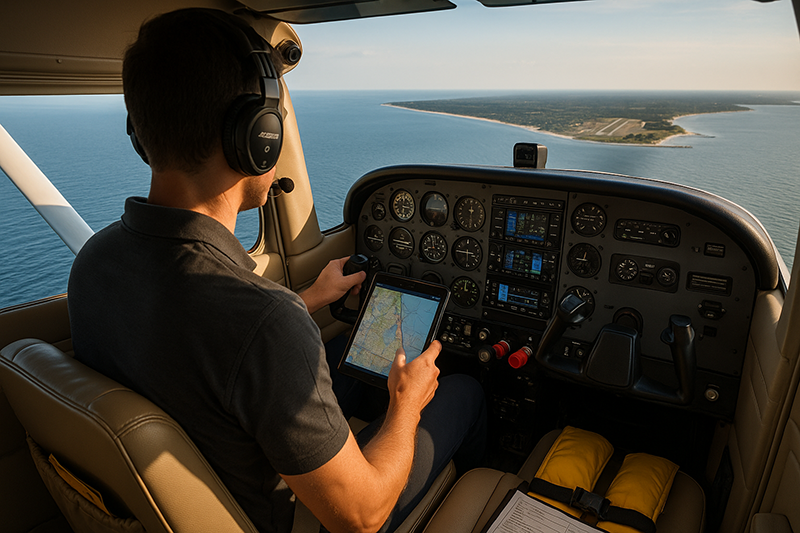
Flying over water changes the way a pilot should think about route selection, altitude, weather, emergency planning, passenger briefing, and personal readiness. The airplane may be the same airplane you fly over land every week, but the risk picture is different when suitable landing areas disappear and an engine problem could lead to ditching instead of a forced landing on a field, road, or airport. For student pilots, flight instructors, private pilots, and aviation professionals, flying over water is not a reason to avoid a trip automatically. It is a reason to plan with more discipline.
The most effective overwater planning starts before the aircraft ever moves. It means asking practical questions: How far from shore will the aircraft be? What altitude gives the best options? What weather could reduce visibility, increase workload, or complicate a return to land? What survival equipment is appropriate? What do the passengers need to know before departure? This article focuses on the operational thinking behind overwater flights, not on one-size-fits-all answers. Regulations, aircraft equipment, insurance requirements, and local procedures vary, so pilots should verify the requirements that apply to their aircraft, route, and type of operation.
What Makes Flying Over Water Different?
Overwater flying compresses the pilot’s options. Over land, a pilot who loses power may still have choices: open fields, roads, airport ramps, dry lakebeds, or other survivable landing areas. Over water, the surface may look open and forgiving from altitude, but it introduces different hazards. Waves, wind direction, water temperature, distance from shore, rescue access, passenger egress, and the ability to stay afloat become central planning concerns.
The first mental shift is to stop treating the shoreline as just scenery. It is a boundary between two very different emergency environments. A route that looks direct on a chart may place the aircraft beyond comfortable gliding range of land for a substantial portion of the flight. That may be acceptable in some aircraft and conditions, but it should be an intentional decision rather than an accident of convenience.
The second shift is recognizing that altitude becomes more than a performance number. Altitude buys time, communication range, glide distance, troubleshooting opportunity, and passenger preparation time. In many light airplanes, a few thousand feet of additional altitude can significantly change the pilot’s ability to reach land or select a more favorable ditching area. The exact glide distance depends on the aircraft, configuration, wind, pilot technique, and condition of the airplane, so pilots should use the aircraft flight manual or pilot’s operating handbook rather than estimates from memory.
The third shift is understanding that the emergency is not over when the aircraft touches down. In an off-airport landing on land, the pilot’s immediate priorities are stopping safely, shutting down, evacuating, and managing injuries or fire risk. In a water landing, evacuation, flotation, signaling, hypothermia risk, and rescue visibility may become equally important. A successful ditching followed by poor egress or inadequate flotation can still become a serious survival problem.
Why This Matters in Real-World Aviation
Overwater operations appear in many ordinary flights. A pilot may cross a bay, a large lake, a sound, a coastal inlet, an island channel, or a short offshore segment to save time. A flight instructor may introduce a student to coastal navigation. A commercial pilot may ferry an aircraft along a shoreline. A recreational pilot may take family or friends to an island airport. None of these flights necessarily involves long oceanic distances, but each can place the aircraft over an environment where the usual forced-landing assumptions no longer apply.
Training often emphasizes engine failure procedures, best glide speed, restart flows, and landing site selection. Those skills remain essential, but over water the pilot must also think about buoyancy, cabin doors, life vests, rafts, passenger anxiety, radio calls, and whether the aircraft can remain within gliding distance of land. The best overwater plan blends normal flight planning with emergency planning. It is not enough to say, “The airplane is running fine.” Reliable engines still require risk management, because aviation safety planning is built around credible contingencies, not optimism.
Weather is another reason overwater flying deserves special attention. Water can reduce visual reference, make the horizon less distinct, and create a deceptively smooth-looking environment that masks wind and wave conditions. Coastal areas can also produce localized changes in visibility, ceilings, sea breeze effects, haze, fog, and convective development. A pilot who is comfortable flying along a highway over land may face a very different workload when the shoreline disappears in reduced visibility or when a layer forces the aircraft lower than planned.
Communication and surveillance also matter. Depending on altitude and location, radio coverage may be weaker than expected, especially at low altitude or beyond line-of-sight limitations. Radar or ADS-B coverage can vary by area and altitude. A pilot should not assume that being close to water traffic or a populated shoreline guarantees rapid assistance. Filing an appropriate flight plan, using flight following when available, maintaining situational awareness, and briefing responsible people on the intended route can improve the quality of the safety net.
Route Planning: Direct Is Not Always Best
The shortest line on the chart is not automatically the safest overwater route. A direct route may reduce flight time and fuel burn, but it can also maximize the time spent beyond gliding distance of land. A slightly longer shoreline-hugging route, island-hopping route, or route between airports may provide better emergency options. The best route depends on aircraft performance, altitude, weather, terrain along the shoreline, airspace, fuel planning, passenger considerations, and the pilot’s experience level.
One useful planning technique is to evaluate the flight in segments. Instead of asking, “Can I cross this water?” ask, “For each segment of this route, what are my options if the engine fails right here?” This forces the pilot to think dynamically. Early in the crossing, turning back might be the best option. Near the midpoint, neither shore may be reachable unless altitude is sufficient. Near the destination side, continuing might be best. Wind can change these answers. A headwind on one side of the crossing can reduce practical glide range toward that shore, while a tailwind may improve the chance of reaching the opposite side.
Pilots should avoid relying on a single mental glide estimate. Published glide performance is often based on a specific configuration, speed, aircraft condition, and pilot technique. Real-world glide performance can be affected by propeller condition, weight, wind, turbulence, bank angle, pilot workload, and whether the pilot maintains the correct glide speed. For practical planning, many pilots use conservative assumptions and review aircraft-specific data before departure. If the route requires staying within gliding distance of land, the pilot should calculate that margin deliberately rather than guessing.
Airspace and navigation planning also require care. Overwater routes may pass near special use airspace, coastal restricted areas, military operations areas, national security areas, international boundaries, or areas with specific transponder, communication, or flight plan expectations. Some routes may involve customs, border, or defense identification requirements. These details are location-specific, so they should be verified during preflight planning using current charts, NOTAMs, official briefings, and applicable procedures.
Altitude, Glide Range, and Decision Points
Altitude is one of the most powerful tools a pilot has when crossing water. Higher altitude can increase glide range, extend radio line of sight, provide more time for troubleshooting, and reduce the sense of urgency during an abnormal event. It can also create oxygen, weather, cloud clearance, airspace, and aircraft performance considerations. The correct altitude is not simply “as high as possible.” It is the altitude that gives the best overall balance of safety, legality, aircraft performance, passenger comfort, weather clearance, and emergency options.
Before an overwater leg, pilots should identify decision points. A decision point is a location along the route where the best emergency action changes. For example, before reaching a certain point, a turn back toward the departure shoreline may be preferable. After that point, continuing toward the destination shoreline may offer a better chance of reaching land. At the midpoint, the pilot may need to plan for ditching if neither shore is within reach. These points should be considered before the flight, not discovered under stress after an engine failure.
Decision points should account for wind. A surface wind report at either shore may not represent wind at altitude, and winds aloft can materially affect groundspeed and glide. If the crossing is close to the limit of glide capability, a conservative pilot will treat wind uncertainty as a planning factor. The same is true for visibility and cloud bases. If the pilot climbs for glide range but is forced to descend by weather, the plan changes. If the pilot descends for sightseeing or passenger comfort, the emergency margin changes.
In training, instructors can make this practical by asking students to verbalize options during a coastal or lake crossing. “If the engine failed now, where would you go?” is a simple question, but over water it exposes whether the student is thinking ahead or merely following the magenta line. The goal is not to create fear. The goal is to develop a habit of continuous option management.
Weather Considerations Over Water
Weather over water can be visually and operationally deceptive. A smooth layer of haze can make the horizon hard to distinguish. Sun angle and glare can reduce outside visibility. Low clouds or fog can develop near shorelines and move across coastal routes. Wind over water can build waves that matter in a ditching scenario, even when the flight itself remains smooth. Convective weather can form or move over water with limited ground references to help the pilot judge distance and movement.
For VFR pilots, maintaining a clear horizon and adequate visual reference is especially important. Over featureless water, visual illusions can increase the risk of disorientation. A pilot who is not instrument proficient should be conservative about marginal visibility, haze, night conditions, or routes that offer few outside references. Even instrument-rated pilots should think carefully about workload, alternates, icing potential, thunderstorms, and the consequences of an abnormal event over water.
Wind affects more than groundspeed. It affects drift during a crossing, the ability to reach shore in a glide, and the direction of waves or swells during a ditching. Pilots should review winds aloft, coastal forecasts, destination and departure weather, and nearby observations. If the aircraft is equipped with datalink weather, the pilot should use it as a situational awareness tool, not as a substitute for a preflight weather briefing or real-time judgment.
Night overwater flight deserves special caution. The lack of ground lights can make it difficult to maintain visual orientation, judge altitude visually, or select a ditching area. A dark water surface may provide little useful texture. If a pilot is considering night VFR over water, the planning standard should be higher than for a familiar daytime local flight. Instrument proficiency, aircraft equipment, weather margins, route selection, and emergency equipment all become more important.
Aircraft Readiness and Performance Planning
Aircraft mechanical condition matters on every flight, but over water the consequences of a mechanical failure can be more severe. Preflight inspection should be thorough and unhurried. Fuel quantity, oil quantity, fuel caps, cowlings, engine compartment condition, belts, hoses visible during inspection, landing gear condition, and any abnormal leaks or odors deserve attention. A pilot should not launch over water with an unresolved mechanical question that would make them uncomfortable over hostile terrain.
Fuel planning is also part of overwater risk management. A route over water may offer fewer diversion airports, fewer landmarks, and fewer opportunities to stop if headwinds are stronger than expected. Fuel reserves should be planned conservatively, with realistic groundspeed estimates and consideration of alternates. If the destination is an island airport or coastal airport affected by fog, wind, or low ceilings, the pilot should identify a practical alternate before departure.
Weight and balance can affect climb performance, cruise altitude selection, handling, and glide performance. A heavily loaded aircraft may not climb as quickly to a desired crossing altitude and may handle differently during an emergency. Pilots should use the aircraft’s approved data and avoid assuming that a familiar airplane will perform the same in every loading condition. Passenger baggage, survival equipment, life rafts, and additional fuel all have weight and balance implications.
Equipment should be considered before the trip, not as an afterthought at the ramp. Depending on the route and operation, appropriate equipment may include life preservers, a life raft, signaling devices, a personal locator beacon or emergency locator equipment, waterproof lights, handheld radio protection, and clothing suitable for the water and weather conditions. The right answer depends on the flight. A short daytime crossing of a narrow bay is different from a long cold-water route far from shore. Regulations may also specify equipment for certain operations, so pilots should verify the rules that apply rather than relying on habit or hangar conversation.
Passenger Briefing and Ditching Preparation
A calm, specific passenger briefing is one of the most practical overwater safety tools available. Passengers do not need to be frightened, but they do need to know how to help themselves. A useful briefing explains seat belts, doors and exits, flotation equipment, sterile cockpit expectations during critical phases, and what to do if the pilot announces an emergency. If life vests are carried, passengers should know where they are, how to put them on, and when to inflate them. In many small aircraft, inflating a life vest inside the cabin can obstruct egress, so this point should be clearly briefed according to the equipment instructions and aircraft situation.
The briefing should match the passengers. A pilot flying with another pilot can assign tasks such as radio calls, checklist reading, transponder setting, or passenger management. A pilot flying with non-aviation passengers should keep instructions simple and action-oriented. Children, elderly passengers, nervous passengers, or passengers with limited mobility may require additional thought. Overwater safety planning is not complete unless the pilot has considered how each person will exit the aircraft and stay afloat if needed.
Ditching preparation also includes cockpit organization. Loose items can become hazards or disappear at the moment they are needed. A flashlight, handheld radio, locator device, knife or belt cutter if carried, and emergency checklist should be accessible. Survival equipment stored in the baggage compartment may be difficult or impossible to retrieve after a water landing, depending on aircraft attitude, cabin damage, or time before sinking. If equipment is essential for immediate survival, it should be reachable and secured appropriately.
Doors and exits require aircraft-specific thinking. Some pilots brief unlatching a door before touchdown in a ditching scenario to reduce the risk of deformation trapping occupants. Whether, when, and how to do that should be based on the aircraft’s emergency procedures and pilot judgment. The important point is that the pilot should not be thinking about cabin egress for the first time at 500 feet above the water during an engine failure.
Emergency Communications and Rescue Awareness
Emergency communication planning should begin before takeoff. The pilot should know what frequency to use for air traffic control, flight following, local advisory services, or emergency calls. If available and appropriate, radar services or flight following can add a valuable layer of monitoring. A filed flight plan, activated and closed properly, can also support search and rescue if the aircraft does not arrive as expected.
Position reporting is especially important over water because landmarks may be sparse. GPS has made navigation easier, but pilots should still be able to communicate a useful position in plain language. “Ten miles west of the shoreline at 5,500 feet, crossing from Airport A to Island B” may be more useful in an emergency than a vague statement that the aircraft is “over the water.” Knowing nearby fixes, VOR radials if applicable, GPS coordinates, shoreline references, and distance from airports can help rescuers and controllers understand the situation.
Transponder use and emergency codes should be understood before flight. Pilots should follow applicable procedures and ATC instructions. In a serious emergency, communicating clearly, setting the appropriate emergency transponder code when warranted, and activating emergency equipment as appropriate can improve the chances that help is directed to the right area. A pilot should not delay flying the airplane to make a perfect radio call. Aviate, navigate, and communicate remains a sound priority structure.
Rescue assumptions should be conservative. Seeing boats below does not guarantee they can see the aircraft, understand the emergency, or reach the ditching location quickly. A shoreline that looks close from altitude may be difficult to reach in water, especially in cold temperatures, wind, waves, or with injured occupants. Signaling equipment, flotation, and staying with a visible floating object when appropriate may matter. Pilots should consider local conditions and available survival guidance before flying over remote or cold water areas.
Common Mistakes or Misunderstandings
One common mistake is treating all water crossings as the same. Crossing a warm, narrow river on a clear day at an altitude that keeps land within reach is not the same as crossing a cold offshore channel at night below a cloud layer. The word “overwater” covers a wide range of risk profiles. Good pilots define the actual exposure rather than relying on a broad label.
Another common misunderstanding is assuming that a short crossing does not require planning. Many overwater segments are short, but a short exposure can still become critical if the engine fails at the wrong point, the aircraft is low, the water is cold, or passengers are unbriefed. The planning effort should be proportional to the consequence, not just the distance.
A third mistake is overconfidence in glide range. Pilots sometimes remember a rule of thumb but fail to account for wind, altitude loss during troubleshooting, turns, configuration changes, or stress. If reaching land is part of the safety plan, the pilot should calculate it conservatively and maintain the altitude required to make that plan credible. Descending below the planned altitude for sightseeing can quietly remove the safety margin.
A fourth mistake is carrying survival equipment without briefing or accessibility. A life vest buried under baggage or a raft secured where it cannot be reached quickly may provide less practical benefit than expected. Equipment is useful only if occupants can access it, deploy it, and use it correctly under stress. A preflight demonstration or briefing can turn equipment from baggage into a real safety tool.
A fifth mistake is failing to consider passenger behavior. A startled passenger may freeze, inflate a vest at the wrong time, block an exit, or attempt to retrieve personal items. The pilot can reduce that risk with a calm briefing before departure. Passengers are more likely to cooperate during an emergency if they have heard the plan before the emergency begins.
Finally, pilots sometimes let schedule pressure influence overwater decisions. Island trips, coastal vacations, and business flights can create strong motivation to continue. Weather that would be merely inconvenient over land may be unacceptable when it removes altitude, visibility, or diversion options over water. A safe pilot remains willing to delay, reroute, climb, turn around, or land short when the margins no longer make sense.
Practical Example: A Coastal Island Flight
Consider a private pilot planning a daytime VFR flight from a mainland airport to an island airport across a broad coastal channel. The direct route is attractive because it saves time, but it places the aircraft beyond comfortable gliding distance of land for part of the crossing at the pilot’s originally planned altitude. The weather is legal VFR, but haze is present along the coast, and the forecast suggests the sea breeze may increase during the afternoon. The passengers are friends who have never flown in a small airplane over water.
A rushed pilot might simply load the airplane, depart, and follow the GPS direct course. A more disciplined pilot takes a different approach. First, the pilot reviews aircraft performance, fuel, weight and balance, and the climb needed to reach a more useful crossing altitude. Next, the pilot compares the direct route with a slightly longer route that follows the shoreline before crossing at a narrower point. The longer route adds time but reduces the portion of the flight where land is out of reach. The pilot also identifies a mainland diversion airport and a return decision point if the haze is worse than expected.
Before departure, the pilot briefs passengers on seat belts, sterile cockpit expectations, exits, and flotation equipment. The life vests are not left in the baggage compartment. They are accessible, and passengers know not to inflate them inside the cabin unless specifically directed and appropriate. The pilot arranges the cockpit so the checklist, handheld backup device, and emergency equipment are reachable. During the climb, the pilot requests flight following if available and monitors weather and visibility ahead.
As the aircraft approaches the shoreline, the pilot confirms altitude, engine indications, fuel status, winds, and the next decision point. During the crossing, the pilot periodically asks, “Where would I go right now?” Early in the crossing, a turn back is still practical. Later, the destination shoreline becomes the better option. If the visibility lowers or clouds prevent maintaining the planned altitude, the pilot is prepared to turn around rather than press into a narrowing set of options.
This example illustrates the core idea: overwater safety is not based on one dramatic decision. It is built from a chain of small decisions that preserve options. Route selection, altitude, passenger briefing, weather assessment, equipment accessibility, and communication planning all work together. None of them guarantees a perfect outcome, but together they give the pilot more time, more choices, and better control of risk.
Best Practices for Pilots
Good overwater planning is practical, not theatrical. It does not require a pilot to imagine every possible disaster. It requires the pilot to identify the most credible problems and build margins before departure. The following practices are useful for many general aviation overwater flights, but they should be adapted to the aircraft, route, regulations, and operating environment.
- Plan the route around options, not just distance. Compare direct, shoreline, and island-hopping routes. Consider whether a longer route meaningfully improves emergency options.
- Use aircraft-specific glide and performance information. Avoid relying on memory or generic estimates when overwater exposure depends on altitude and glide range.
- Choose altitude deliberately. Consider glide distance, weather, oxygen needs, airspace, aircraft performance, and passenger comfort.
- Brief passengers before engine start. Explain exits, seat belts, flotation equipment, sterile cockpit expectations, and emergency behavior in plain language.
- Make survival equipment accessible. Equipment that cannot be reached quickly may not help when time matters.
- Think about water conditions. Wind, waves, cold water, current, and distance from rescue resources can change the risk picture.
- Maintain communication awareness. Know the frequencies, consider flight following or an active flight plan when appropriate, and be able to report position clearly.
- Set personal minimums for overwater conditions. Visibility, ceiling, wind, night, temperature, passenger experience, and aircraft condition should influence the go or no-go decision.
Flight instructors can strengthen training by incorporating overwater decision-making into cross-country planning scenarios. Even if the training area is inland, a large lake or reservoir can support meaningful discussion. Ask the student to compare routes, calculate glide options, review weather, brief passengers, and explain when they would turn around. This develops judgment without needing to create unnecessary risk.
Experienced pilots should also revisit their assumptions. Familiarity can be useful, but it can also lead to shortcuts. A pilot who has crossed the same bay many times may gradually stop calculating, briefing, or checking equipment. The water does not become less unforgiving because the route is familiar. A professional habit pattern keeps routine flights from becoming casual flights.
Regulatory and Operational Considerations
Overwater equipment and operating rules can depend on the aircraft, type of operation, route, distance from shore, number of occupants, and whether the flight is conducted privately, commercially, or under a specific operating rule. Pilots should avoid casual assumptions such as “life vests are always required” or “nothing is required because it is only a short crossing.” The correct answer may depend on details that must be verified for the specific flight.
For practical planning, pilots should review the applicable regulations, aircraft operating limitations, operator procedures, insurance requirements, and destination requirements. If the flight involves international boundaries, island destinations, customs procedures, defense identification areas, or remote areas, additional planning may be required. Flight schools and operators should provide clear guidance to their pilots so overwater decisions are not improvised flight by flight.
Regulatory compliance is the minimum standard, not the full safety plan. A flight may be legal yet still unwise if weather is marginal, passengers are unprepared, the aircraft has questionable maintenance status, or survival equipment is inadequate for the conditions. Conversely, adding thoughtful equipment and briefing can improve safety even when not specifically required for a particular flight. The pilot’s job is to combine compliance with judgment.
How Pilots Should Understand Overwater Risk
The best way to understand overwater risk is to think in layers. The first layer is prevention: aircraft condition, fuel planning, weather selection, and conservative routing reduce the chance of needing an emergency landing. The second layer is options: altitude, glide planning, communication, and decision points improve the pilot’s ability to manage an abnormal event. The third layer is survivability: flotation, passenger briefing, egress planning, signaling, and clothing improve the chances after a water landing.
No single layer is enough. A well-maintained aircraft is important, but it does not eliminate the need for survival planning. A life vest is important, but it does not replace conservative weather decisions. A filed flight plan is useful, but it does not make low-altitude flight over cold water a good idea in marginal visibility. Overwater planning works best when each layer supports the others.
This layered approach also helps pilots avoid extremes. One extreme is dismissing the risk because the flight is short or familiar. The other is treating any water crossing as unacceptable. Professional judgment lives between those extremes. The pilot evaluates the actual exposure, uses available tools, and makes a decision based on margins rather than emotion.
Frequently Asked Questions
Do pilots need special equipment for every flight over water?
Not every overwater segment has the same equipment requirement or risk level. Requirements can vary by operation, aircraft, route, and distance from shore. Pilots should verify the applicable rules for the specific flight and then consider whether additional flotation, signaling, or survival equipment is prudent for the conditions.
Is it safer to fly higher when crossing water?
Higher altitude often improves glide range, communication range, and troubleshooting time, but it must be balanced against weather, airspace, oxygen requirements, aircraft performance, and pilot proficiency. The key is to choose an altitude deliberately and verify that it supports the emergency plan.
Should a pilot always stay within gliding distance of shore?
Staying within gliding distance of shore can be a strong risk-reduction strategy, especially in single-engine aircraft, but it may not be practical for every route. If the route goes beyond gliding distance, the pilot should recognize that exposure, plan for ditching and survival, and ensure the decision is intentional.
What should passengers be told before an overwater flight?
Passengers should receive a calm briefing on seat belts, exits, sterile cockpit expectations, flotation equipment, and emergency behavior. If life vests are carried, passengers should know where they are, how to put them on, and when inflation is appropriate.
What weather conditions deserve extra caution over water?
Low visibility, haze, fog, low ceilings, thunderstorms, strong winds, cold water conditions, night operations, and limited horizon definition all deserve extra caution. These conditions can reduce emergency options, increase pilot workload, or complicate rescue and survival.
How should student pilots train for overwater decision-making?
Student pilots should learn to compare routes, evaluate glide options, choose altitudes thoughtfully, brief passengers, and identify decision points. Instructors can teach these skills through cross-country planning scenarios and in-flight questioning when appropriate.
Key Takeaways
- Flying over water requires deliberate planning for route, altitude, weather, communications, passenger briefing, and survival equipment.
- The main safety issue is reduced emergency landing flexibility, so pilots should preserve options through conservative routing and altitude selection.
- Regulatory requirements can vary by operation and route, so pilots should verify applicable rules and then apply sound risk management beyond minimum compliance.