
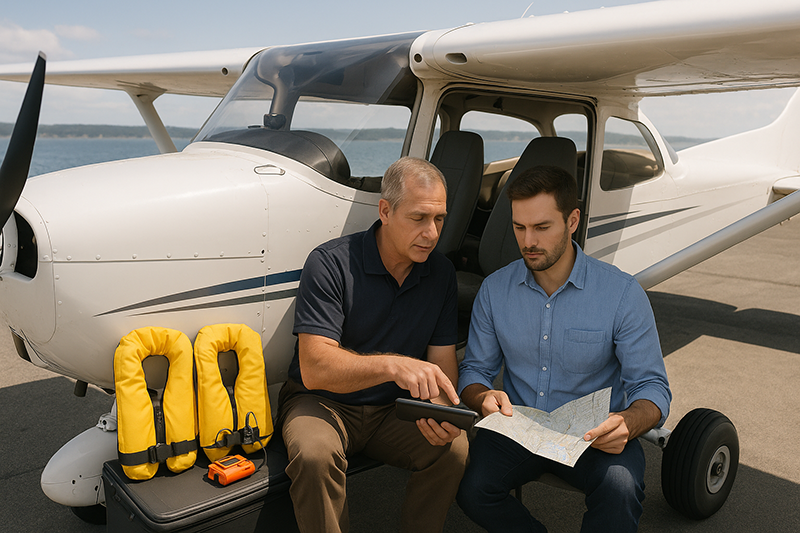
Flying over water changes the risk picture for every pilot, whether the route crosses a wide bay, follows a shoreline, transits the Great Lakes, or heads toward an island airport. The airplane may fly the same way, the engine indications may look familiar, and the navigation task may appear straightforward, but the consequences of a malfunction, weather diversion, or navigation error can become more serious when landable terrain is limited or absent. Good overwater flight planning is not about fear. It is about making deliberate choices before the flight so the pilot is not trying to solve avoidable problems after the shoreline has disappeared behind the tail.
For student pilots, flying over water is an excellent lesson in risk management because it brings together performance, weather, route selection, fuel planning, emergency equipment, pilot proficiency, and passenger briefing. For instructors and aviation professionals, it is a useful way to teach that a legal flight is not automatically a well-planned flight. This article focuses on practical planning considerations pilots can apply to general aviation overwater operations while recognizing that regulatory requirements, aircraft equipment, and operational rules vary by aircraft, operation, route, and jurisdiction.
What Makes Flying Over Water Different?
The most obvious difference is the lack of conventional forced landing options. Over land, a pilot may be able to choose a road, field, airport, dry lakebed, or other suitable area depending on terrain and aircraft type. Over water, the emergency landing site is usually the water itself unless the aircraft can remain within gliding range of land, a shoreline, an island, a bridge area with adjacent land, or another suitable surface. That changes the planning standard. The pilot is not only asking, “Can I navigate this route?” The pilot is also asking, “If the engine quits or the weather changes, what are my realistic options right now?”
Water also affects perception. A large body of water can make altitude, distance, cloud base, and visibility harder to judge, especially when the horizon is indistinct. Haze, low sun angle, smooth water, night lighting, and featureless surfaces can reduce visual cues. Pilots who are comfortable over land may find that overwater flying increases workload because there are fewer landmarks and fewer immediate diversion choices.
Another difference is survivability after landing. A successful ditching or water landing is only the first step. The pilot and passengers must be able to exit, remain afloat, stay together, communicate, and be found. That is why overwater planning is not complete when the route line is drawn on the chart. It also includes personal flotation equipment, emergency signaling, passenger briefing, water temperature awareness, and rescue considerations appropriate to the flight.
Start With the Route, Not Just the Destination
Many overwater planning problems begin with a straight line. A direct route may be efficient, but it may also place the aircraft outside gliding range of shore for a longer period than necessary, reduce alternate choices, or cross an area where weather and communication options are less favorable. The better starting point is to evaluate several route shapes and decide what each one gives up or gains.
A shoreline-hugging route may add miles but preserve more options. A route that crosses at the narrowest practical point may reduce total time over open water. A route that uses island stepping stones may provide alternates, visual checkpoints, and psychological relief for passengers. A higher cruise altitude may allow a wider glide footprint and more time for troubleshooting, communication, and preparation. None of these choices is automatically right for every flight. The pilot must compare them against weather, performance, airspace, terrain near the shoreline, fuel, winds, passenger condition, and the aircraft’s capabilities.
When planning the route, pilots should avoid thinking of water as a single hazard. A calm lake near populated shorelines in daylight is not the same as cold offshore water with low ceilings, limited communications, and no nearby boats. A short crossing in a well-maintained training aircraft may be very different from a long single-engine flight with marginal weather and inexperienced passengers. The route should reflect the actual operating environment rather than a generic comfort level.
Glide Distance and Altitude Planning
Glide distance is one of the most important planning concepts for overwater flight. In simple terms, glide distance is how far the aircraft can travel forward without engine power while descending at or near the best glide configuration recommended for that aircraft. The actual distance depends on aircraft type, weight, wind, pilot technique, configuration, and altitude above the surface.
Pilots should use the aircraft’s approved flight manual, pilot’s operating handbook, or manufacturer guidance to understand glide performance. A rule-of-thumb mental estimate can be useful in flight, but it should not replace aircraft-specific knowledge. Winds matter significantly. A strong headwind can reduce the distance the aircraft covers over the water during a glide, while a tailwind can extend groundspeed distance but may affect the practical choice of landing direction and touchdown conditions.
Altitude is not just a comfort factor. More altitude usually means more time. Time allows the pilot to identify the problem, establish best glide, select a ditching area or return option, communicate, secure the cabin, brief passengers, and configure the aircraft properly. However, altitude must be balanced against weather, oxygen considerations where applicable, aircraft performance, airspace, icing risk, turbulence, and engine management practices appropriate to the aircraft.
A useful planning exercise is to mark the points along the route where the aircraft enters and exits gliding range of land based on conservative assumptions. That exercise may reveal that a small route change or altitude increase materially reduces exposure. It may also reveal that the proposed flight places the aircraft beyond practical glide options for longer than the pilot is willing to accept. That does not necessarily make the flight impossible, but it should trigger a more serious review of equipment, weather, proficiency, and rescue planning.
Weather Planning for Overwater Flights
Weather deserves special attention because water can create or amplify operational challenges. Coastal fog, sea breezes, lake-effect clouds, convective activity, localized showers, haze, and rapidly changing ceilings can all affect a route that looked simple during preliminary planning. Even when broad-area forecasts appear acceptable, the local shoreline environment may be different from conditions inland.
Visibility is particularly important for visual flight. Over featureless water, legal visibility may not feel operationally comfortable, especially if the horizon is indistinct or the pilot is transitioning between visual and instrument references. A pilot flying under visual flight rules should have a conservative personal minimum for overwater visibility and ceiling, and should be prepared to turn around before visual cues degrade. Continuing over water in marginal conditions can leave the pilot with fewer outs than the same decision over familiar land terrain.
Wind also matters. Surface wind affects wave direction and ditching considerations. Winds aloft affect groundspeed, fuel burn, and glide distance. A strong crosswind on a coastal route may drift the aircraft away from land if the pilot is not carefully tracking the intended course. In training, this is a good opportunity to reinforce the difference between heading and course. The airplane points one direction, but the flight path over the water is what determines whether the aircraft remains near a safe option.
Thunderstorms and convective weather require wide margins. Water crossings can tempt pilots to continue because there is no obvious place to stop between shorelines. That is precisely why the weather decision must be made early. A pilot should not rely on the ability to pick through developing weather over water unless the operation, aircraft equipment, pilot proficiency, and available information support that decision with adequate margins.
Fuel, Alternates, and Diversion Thinking
Fuel planning over water should be conservative because the cost of a delay, headwind, reroute, or missed approach can be higher when nearby options are limited. The legal fuel reserve is only one part of the planning discussion. Pilots should also ask whether the planned fuel provides enough flexibility to return, divert, hold for weather, reach a better airport, or accommodate stronger-than-expected winds.
Alternates should be practical, not merely names on a chart. A suitable alternate is one the pilot can actually reach with the fuel available, in the weather expected, using the aircraft and pilot qualifications involved. For a VFR pilot, an airport that is reachable only through deteriorating ceilings may not be a meaningful alternate. For an IFR pilot, an alternate may require careful review of approaches, weather trends, lighting, fuel services, runway length, terrain, and missed approach options.
Overwater route planning should include decision points. A decision point is a location or time by which the pilot will either continue, turn back, climb, divert, or land based on fuel, weather, aircraft status, and passenger condition. The value of a decision point is that it removes some of the emotional pressure from the cockpit. Instead of negotiating with the situation in real time, the pilot follows a plan created while workload was low.
Aircraft Condition and Systems Readiness
Flying over water places a premium on aircraft reliability and systems knowledge. This does not mean a pilot can guarantee mechanical perfection. It means the pilot should be especially thoughtful about maintenance status, recent discrepancies, engine indications, fuel system operation, electrical system reliability, and the availability of backup equipment.
Before an overwater flight, a pilot should review recent maintenance, open discrepancies, abnormal trends, and any unresolved squawks. A small concern that might be acceptable for local pattern work may deserve a different decision when the route crosses open water. Fuel system familiarity is critical. The pilot should understand tank selection, fuel pump use, fuel quantity indications, unusable fuel, crossfeed procedures if applicable, and any aircraft-specific limitations. That information must come from the aircraft’s approved operating information and training, not from generic habit.
Electrical planning is also important. Navigation, communication, transponders, ADS-B equipment, electronic flight bags, panel displays, and autopilots may all depend on electrical power. A pilot should consider what remains available after a charging system failure, battery limitation, radio issue, or tablet overheating problem. Backups should be realistic. A charged handheld radio, portable GPS, paper or offline charting, spare headset batteries, and power banks can be helpful, but only if the pilot knows how to use them and they are accessible in flight.
Emergency Equipment and Passenger Briefing
Emergency equipment for overwater flight should match the exposure. Personal flotation devices, life rafts where appropriate, signaling devices, waterproof lighting, a personal locator beacon or emergency locator equipment, and survival items may be part of the planning conversation. The exact equipment required or advisable can vary based on operation, aircraft, route, distance from shore, number of occupants, season, water temperature, and applicable rules. Pilots should confirm current requirements for their specific operation rather than relying on informal summaries.
Carrying equipment is not the same as being ready to use it. Flotation gear that is unreachable after impact, still in packaging, or unfamiliar to passengers may provide little practical value. Passengers should know where flotation devices are, when to put them on, when not to inflate them, how to open doors or exits, and what to expect if the pilot announces an emergency. The briefing should be calm and concise. It should not frighten passengers, but it should prepare them.
Door and exit planning is especially important. Some aircraft doors may be difficult to open after structural deformation or water pressure changes. Pilots should understand aircraft-specific procedures for emergency exit preparation and ditching, including seatbelt use, shoulder harnesses, loose items, and post-landing egress. Those details should come from the aircraft’s approved guidance and training materials.
Water temperature deserves practical consideration. Cold water can reduce survival time and physical capability. Warm water may reduce some hazards but does not eliminate the need for flotation, signaling, and rescue planning. A pilot does not need to become a survival expert for every short shoreline flight, but the planned equipment should make sense for the water environment beneath the route.
Navigation and Communication Over Water
Modern avionics make overwater navigation much easier than it once was, but they can also create overconfidence. GPS, moving maps, datalink weather, and autopilots are excellent tools when used properly. They do not remove the need to monitor position, fuel, weather, and options. A pilot should know where the nearest shore, airport, and diversion route are without relying solely on one screen.
Overwater navigation should include positive course tracking. Even a small heading error can become meaningful over time when there are few visual references. Pilots should use available navigation sources to confirm that the aircraft is tracking the intended route, not merely pointing in the intended direction. Cross-checking GPS track, heading, distance to shore, and estimated time to landfall helps prevent drift from becoming a surprise.
Communication planning should consider radio coverage and who the pilot will contact if needed. At lower altitudes, VHF communication may be limited by distance and line of sight. Higher altitudes often improve reception, but terrain, antenna location, and distance still matter. Flight following or an IFR clearance can provide useful communication and traffic services when available, but pilots should understand what services they are receiving and what responsibilities remain with the pilot in command.
It is also wise to file or otherwise communicate a flight plan or route information appropriate to the operation. Someone responsible should know the planned route, departure time, destination, and expected arrival. For flights that cross remote water or travel offshore, the communication plan becomes more than a convenience. It is part of the rescue chain.
Why This Matters in Real-World Aviation
Overwater planning matters because it exposes the difference between normal operations and abnormal outcomes. In normal cruise, the route may be peaceful and efficient. In an abnormal situation, every decision made before takeoff becomes more important. Altitude affects time. Route affects options. Equipment affects survival. Passenger briefing affects egress. Weather decisions affect whether the pilot has room to maneuver.
In flight training, overwater planning is a strong scenario for teaching aeronautical decision-making. It requires the student to consider risk in layers rather than treating safety as a yes-or-no answer. A flight can be legal, the airplane can be airworthy, and the weather can appear acceptable, yet the overall plan may still be weak if it leaves the pilot with minimal fuel flexibility, no realistic diversion plan, insufficient emergency equipment, and no passenger briefing.
For experienced pilots, the risk may come from familiarity. A pilot who has crossed the same bay or lake many times may stop actively planning it. Routine can be useful when it reflects disciplined habits, but it can be dangerous when it replaces current analysis. Each flight deserves a fresh look at weather, aircraft status, fuel, passenger load, daylight, water temperature, and pilot readiness.
How Pilots Should Understand Overwater Risk
A practical way to understand overwater risk is to divide it into three timeframes: before the emergency, during the emergency, and after the landing. Before the emergency, the pilot can choose the route, altitude, fuel load, equipment, and timing. During the emergency, the pilot must fly the aircraft, communicate, navigate, prepare the cabin, and execute the best available landing plan. After the landing, survival depends on egress, flotation, signaling, weather, water conditions, and rescue response.
The first timeframe is where pilots have the most control. Once the engine fails or the weather closes in, options narrow quickly. That is why preflight planning should not focus only on probability. A low-probability event can still deserve preparation if the consequences are high. This is the same reasoning pilots use for fire extinguishers, seatbelts, alternates, and emergency procedures. The goal is not to predict exactly what will happen. The goal is to make sure a survivable plan exists if something does happen.
Risk management also includes personal minimums. A pilot might decide not to cross beyond gliding distance from shore in a single-engine aircraft without specific equipment, altitude, and weather conditions. Another pilot, with different aircraft, training, equipment, and operational requirements, may make a different decision. The important point is that the standard should be deliberate, written or briefed, and reviewed before the flight. Personal minimums created in the cockpit while pressure is rising are not true minimums. They are negotiations.
Common Mistakes and Misunderstandings
One common mistake is assuming that a short water crossing is automatically low risk. A short crossing may be reasonable, but it still deserves planning. If the aircraft is low, the weather is marginal, the water is cold, and the pilot has no flotation equipment, even a brief exposure can become significant.
Another misunderstanding is treating flotation equipment as optional because the pilot intends to remain within gliding distance of land. Glide range can change with altitude, wind, aircraft configuration, and pilot response time. A planned route may remain within range on paper but not in actual conditions. Equipment decisions should reflect realistic margins, not idealized geometry.
Pilots also sometimes overestimate their ability to judge distance and weather over water. Without familiar terrain features, a shoreline can appear closer or farther than it is, and low visibility can degrade gradually. This is especially relevant in haze or at night, when the visual horizon may be weak or misleading.
Another error is delaying the turn-back decision. Over land, a pilot may have many airports and fields along the way. Over water, the point of no return can arrive sooner than expected, especially with headwinds or deteriorating weather at the destination. A planned decision point helps prevent “just a little farther” thinking.
Finally, some pilots carry emergency equipment but do not brief it. A life vest under a seat may be of limited value if the passenger cannot find it, open it, put it on, or understand when to inflate it. A passenger briefing is not a formality. It is part of the equipment system.
Practical Example: A Day VFR Island Flight
Consider a pilot planning a day VFR flight in a normally aspirated single-engine airplane from a mainland airport to an island airport across a broad section of water. The direct route is attractive because it saves time. The forecast is generally favorable, but there is a possibility of coastal haze in the afternoon. The passengers are not pilots, and one is nervous about flying over water.
A weak plan would simply load the direct route into the GPS, verify fuel for the trip, and depart. A stronger plan would compare at least two routes: the direct crossing and a route that follows the shoreline longer before crossing at a narrower point. The pilot would evaluate whether a higher altitude provides a better glide footprint and more communication range, while remaining appropriate for weather and aircraft performance. The pilot would review fuel with enough margin to return, divert, or hold for improving visibility. The pilot would check whether flotation equipment is required for the operation and, regardless of minimum requirements, decide what equipment is prudent for the exposure.
The pilot would also establish a decision point before crossing. For example, if visibility ahead is worse than expected, if the shoreline behind begins to disappear in haze, if groundspeed is lower than planned, or if any engine indication is abnormal, the pilot will turn back or divert before reaching the longest overwater segment. Before takeoff, the pilot gives passengers a calm briefing on seatbelts, exits, flotation gear, sterile cockpit expectations during takeoff and crossing, and what to do if the pilot gives emergency instructions.
In flight, the pilot tracks actual groundspeed and fuel, confirms the aircraft remains on course, monitors weather ahead and behind, and avoids pressing into conditions that reduce options. This is not complicated flying, but it is disciplined flying. The difference is that the pilot is managing the flight as a system rather than treating the water crossing as empty space between two airports.
Best Practices for Pilots Planning Overwater Flights
Effective overwater planning combines conservative judgment with aircraft-specific knowledge. The following practices are not a substitute for regulations, approved aircraft procedures, or formal training, but they provide a practical framework for safer decision-making.
- Choose the route for options, not only distance. A slightly longer route may keep the aircraft closer to land, improve alternate access, or reduce time beyond glide range.
- Use aircraft-specific performance information. Understand best glide, descent planning, fuel system operation, and emergency procedures from approved aircraft materials.
- Build fuel flexibility. Plan for winds, reroutes, delays, weather changes, and diversion options rather than using minimum fuel thinking.
- Set decision points before departure. Decide in advance where you will turn back, climb, divert, or stop if conditions do not match the plan.
- Match emergency equipment to the exposure. Consider flotation, signaling, survival, communication, and rescue needs based on the actual route and environment.
- Brief passengers clearly. Explain seatbelts, exits, flotation equipment, sterile cockpit expectations, and emergency instructions in calm, plain language.
- Keep navigation and communication redundant. Use panel avionics, portable devices, charts, radios, and flight following or IFR services when appropriate and available.
- Respect changing weather. Overwater conditions can reduce visual cues quickly, and the best time to turn around is before the route becomes committed.
Training Considerations for Student Pilots and Instructors
Instructors can use overwater planning to teach real aeronautical decision-making without requiring a dramatic scenario. A ground lesson might ask the student to compare three routes across a lake, calculate approximate time beyond gliding distance, evaluate weather minimums, select alternates, and brief emergency equipment. The learning objective is not to make the student afraid of water. It is to show how planning changes when the environment changes.
Students should learn to ask better questions. How high would we need to be to make land under conservative assumptions? What happens if the wind is stronger than forecast? Where is the last reasonable turn-back point? What equipment is required, and what equipment is prudent? What will we tell passengers? What is our plan if visibility is lower over the water than it was at the departure airport?
For instrument students, overwater planning can include lost communication considerations, alternate selection, approach options at island or coastal airports, and the difference between strategic weather avoidance and tactical weather avoidance. For commercial and professional pilots, the same topic can expand into operational control, company procedures, passenger management, and survival equipment standards.
Regulatory and Operational Considerations
Regulatory requirements for overwater operations can depend on the type of operation, aircraft, distance from shore, route, number of occupants, and applicable jurisdiction. Some operations may have specific requirements for flotation equipment, rafts, signaling devices, or survival equipment. International flights, extended overwater operations, commercial operations, and certain training or rental policies may add additional requirements beyond what a pilot uses for a local personal flight.
The practical takeaway is simple: do not rely on memory or hangar talk for overwater equipment rules. Before the flight, confirm the current regulations and any operating rules that apply to the aircraft and mission. Review the aircraft documents, company procedures if applicable, rental or flight school policies, insurance requirements, and destination country requirements for international flights. When in doubt, obtain authoritative guidance before departure.
Frequently Asked Questions
Is flying over water safe in a single-engine airplane?
It can be conducted safely when the pilot plans conservatively, understands the aircraft, evaluates weather carefully, carries appropriate equipment, and maintains realistic options. The risk is not defined by engine count alone. Route, altitude, water temperature, weather, maintenance condition, pilot proficiency, and emergency readiness all matter.
Should pilots always stay within gliding distance of land?
Staying within gliding distance of land is a valuable risk-reduction strategy when practical, especially in single-engine aircraft. It is not always possible for every mission, so pilots should evaluate the exposure and decide whether the aircraft, equipment, weather, altitude, training, and rescue plan make the flight acceptable.
What emergency equipment should be carried for overwater flying?
The answer depends on the operation and route. Pilots should verify applicable requirements and then consider practical needs such as flotation, signaling, lighting, emergency communication, survival gear, and life rafts when appropriate. Equipment should be accessible, serviceable, and understood by the occupants.
How does weather affect overwater flight planning?
Weather can reduce visual references, alter fuel planning through wind changes, affect wave conditions, and limit diversion options. Coastal fog, haze, low ceilings, convective activity, and changing winds deserve conservative planning because turning around late may be more difficult over water.
What should passengers be told before an overwater flight?
Passengers should receive a calm briefing on seatbelts, exits, flotation devices, sterile cockpit expectations, and what to do if the pilot gives emergency instructions. The briefing should be specific enough to be useful but delivered in a reassuring, professional manner.
Does filing a flight plan replace emergency equipment?
No. A flight plan or flight following can support communication and search efforts, but it does not keep occupants afloat, help them exit the aircraft, or provide signaling after landing. Administrative planning and survival preparation serve different purposes.
Key Takeaways
- Overwater flight planning should begin with route, altitude, fuel, weather, alternates, and glide options rather than a simple direct-to course.
- Emergency equipment only improves safety when it is appropriate, accessible, serviceable, and included in a clear passenger briefing.
- Pilots should verify current regulatory, aircraft, and operational requirements for their specific flight and use personal minimums that reflect real conditions.