
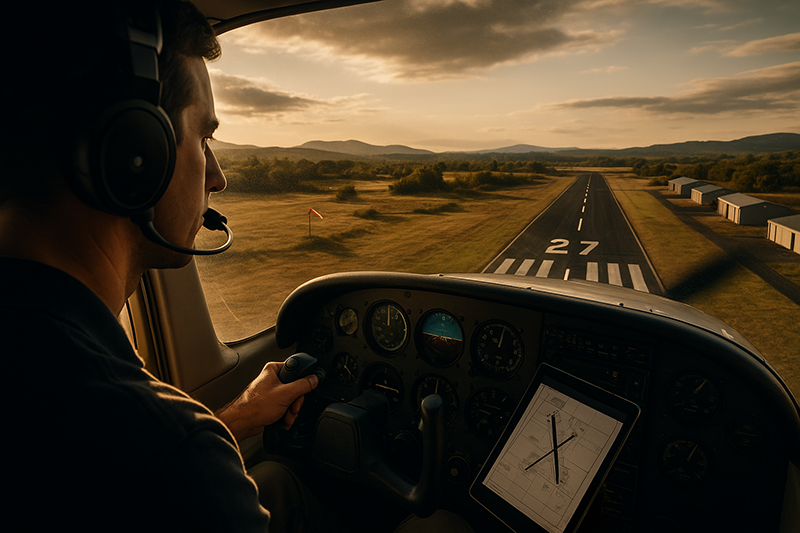
Flying into unfamiliar airports safely is one of the most important cross-country skills a pilot can develop. The runway may be the same length on paper, the traffic pattern may look simple on the chart, and the weather may be legal, but a new airport adds workload at exactly the time when the pilot needs spare attention for navigation, communication, configuration, and collision avoidance.
For student pilots, unfamiliar airports are a training milestone. For certificated pilots, they are a routine part of personal travel, business flying, aircraft repositioning, and continuing proficiency. For instructors, they are a useful way to teach planning discipline and aeronautical decision-making. The difference between a smooth arrival and a rushed, unstable, or confusing one often comes down to preparation before the descent begins.
This article explains how to approach unfamiliar airport operations in a practical, safety-focused way. It is not a substitute for current charts, NOTAMs, airport publications, aircraft operating guidance, or air traffic control instructions. Instead, it provides a structured way to think about the risks: airport layout, traffic flow, terrain, airspace, communications, runway selection, stabilized approach discipline, and the willingness to go around when the picture does not look right.
What Makes an Airport Unfamiliar?
An unfamiliar airport is not simply an airport you have never visited. It can also be a familiar destination under unfamiliar conditions. A pilot who normally arrives in daylight may find the same airport much more demanding at night. A runway that feels comfortable in calm wind can become more challenging with a crosswind, gusts, nearby terrain, or a displaced threshold. A towered airport may feel different when the tower is closed. A non-towered airport may be easy on a quiet weekday and significantly more complex during a fly-in, training rush, or weekend traffic peak.
Unfamiliarity increases workload because the pilot must build a mental model while flying the aircraft. Where is the airport relative to surrounding roads, lakes, towns, towers, or terrain? Which runway is most likely in use? Are there right traffic patterns, noise-sensitive areas, glider operations, parachute activity, special taxi instructions, or hotspots on the airport surface? Is the airport surrounded by controlled airspace, special use airspace, rising terrain, or obstacles? These questions are manageable when answered early. They become distractions when discovered late.
A safe arrival begins by accepting that a new airport deserves deliberate attention. The goal is not to memorize every detail. The goal is to know the details that affect decision-making, anticipate likely threats, and leave enough time to adapt when the actual situation differs from the plan.
Start With a Real Preflight Briefing
The preflight briefing for an unfamiliar airport should go beyond checking weather and fuel. A pilot needs to understand the airport as a working environment. That includes the runway system, published procedures, communications, lighting, terrain, obstructions, available services, and likely traffic pattern flow. The more complex the airport environment, the more valuable it is to brief it before engine start rather than while approaching the destination.
Begin with the basics: runway lengths, widths, elevations, surface types, lighting, slope information if published, displaced thresholds, declared distances if applicable, and available approaches if operating IFR or considering an instrument backup. For general aviation pilots, runway width can be as important visually as runway length. A very wide runway can make an aircraft appear lower than it is. A narrow runway can make the aircraft appear higher than it is. Either illusion can lead to an unstable flare or an incorrect approach path if the pilot is not prepared.
Next, study the airport diagram and surface layout. Identify the expected runway turnoff, taxi route to parking, hotspots if published, hold short lines, and any areas that may be confusing after landing. Many pilots prepare well for the airborne portion of an unfamiliar arrival but give less attention to taxi. That is a mistake. A clear landing can be followed by surface confusion if the pilot is unsure where to exit, when to stop, or how to request progressive taxi instructions.
Weather deserves special attention. Current wind, gust spread, ceiling, visibility, temperature, altimeter setting, density altitude considerations, and runway conditions can change the plan. Pilots should compare forecast conditions with actual reports and maintain a realistic alternate plan. If the destination has no weather reporting, nearby stations can help build a picture, but they do not guarantee conditions at the field. Local terrain, water, surface heating, and wind channeling can create meaningful differences over short distances.
Finally, review NOTAMs, airport remarks, and any published operational notes. Unfamiliar airports sometimes have details that are easy to miss but operationally important, such as lighting limitations, runway closures, construction, communications changes, fuel availability changes, wildlife activity reports, or temporary obstacles. A pilot does not need to be surprised by information that was available before departure.
Why This Matters in Real-World Aviation
In real-world flying, unfamiliar airports combine several high-workload tasks. The pilot may be descending, navigating visually, listening for traffic, configuring the aircraft, speaking with ATC or CTAF, verifying runway alignment, monitoring airspeed, and adjusting for wind. Any one of these tasks is normal. The risk comes from stacking them together while the pilot is still trying to figure out where everything is.
Human factors are central to this topic. Pilots are vulnerable to expectation bias, which means seeing what they expect to see rather than what is actually there. If a pilot expects a certain runway, the aircraft may be aligned with the wrong pavement, a taxiway, or a nearby airport unless the pilot verifies the runway environment. If a pilot expects left traffic, a right traffic pattern may be missed. If a pilot expects a quiet non-towered airport, other aircraft may be overlooked until late in the pattern.
Unfamiliar airports also challenge time management. A pilot who delays descent planning may arrive high and fast. A pilot who starts searching for the airport too close in may stop managing airspeed or spacing. A pilot who is unsure of the runway may continue an approach that should be discontinued. These are not failures of basic skill. They are workload management problems, and workload management is a core part of safe piloting.
The solution is to reduce uncertainty before it becomes urgent. Good pilots do not try to prove they can handle surprises. They arrange the flight so fewer surprises occur during critical phases. They brief the airport, slow down when appropriate, ask for help when needed, and use a go-around as a normal tool rather than a sign of poor performance.
How Pilots Should Understand Airport Familiarization
Airport familiarization is the process of building a practical mental picture before arrival. It is not simply reading data. It is connecting information to actions. If the runway is short for the aircraft and conditions, what does that mean for approach speed control, touchdown point discipline, and go-around planning? If the taxi route crosses another runway, where will the aircraft stop after landing? If terrain rises on one side of the airport, how might that affect pattern entry, missed approach planning, or wind flow?
A useful mental model includes three layers. The first layer is the outside environment: terrain, obstacles, roads, water, lights, and nearby airports. The second layer is the airborne traffic environment: airspace, pattern direction, approach paths, helicopter activity, training traffic, and any special operations. The third layer is the airport surface: runway geometry, taxiways, ramps, hold short points, and parking location.
For VFR operations, the pilot should know how the airport will appear from the direction of arrival. Many airports are easier to find from one side than another. A runway aligned with surrounding roads may blend into the background. A grass runway may be difficult to identify until close. A runway near another airport can create confusion if both facilities have similar alignments. Satellite imagery and current airport diagrams can be useful planning tools, but they must be treated as planning aids rather than replacements for current aeronautical information.
For IFR operations, familiarity still matters. An instrument approach provides lateral and vertical guidance according to the procedure, but the pilot still needs to understand runway environment, lighting, missed approach expectations, circling considerations if applicable, and taxi after landing. Breaking out of the clouds at minimums into an unfamiliar airport environment is not the time to begin thinking about runway length, lighting, or the first taxi turnoff.
Whether VFR or IFR, the pilot should have a clear plan for the arrival and a clear trigger for abandoning that plan. If the runway is not positively identified, if spacing becomes uncertain, if the aircraft is not stabilized, if the wind changes beyond pilot or aircraft comfort, or if the airport environment looks different than expected, the conservative choice is to climb away, communicate as appropriate, and reset.
Brief the Arrival Before You Get Busy
The best time to brief an unfamiliar arrival is early enough that the airplane is still easy to manage. In a light aircraft, that may be 30 to 50 nautical miles from the destination, depending on speed, weather, airspace, and pilot workload. In faster aircraft, the briefing needs to occur earlier. The exact distance is less important than the principle: brief before the descent, before frequency congestion, before traffic pattern decisions, and before the airport search becomes urgent.
A practical arrival brief should answer a few essential questions. Which runway do you expect, and why? What is the wind doing now? What is the field elevation? What traffic pattern or arrival procedure applies? What radio frequency will you use next? What altitude will you use to approach the airport environment? What terrain, towers, or airspace boundaries matter? What will you do if the runway, weather, or traffic picture does not match expectations?
For towered airports, pilots should anticipate instructions but avoid assuming them. ATC may assign a different runway, traffic pattern, reporting point, or sequence than expected. A pilot should listen carefully, read back required items accurately, and ask for clarification if unsure. If the airport layout is complex, requesting progressive taxi instructions after landing is a professional use of available assistance.
For non-towered airports, communication and visual scanning take on additional importance. A pilot should monitor the appropriate frequency early enough to develop situational awareness. Position reports should be clear, concise, and useful. At the same time, radio calls do not guarantee that all traffic is transmitting, hearing, or using the expected phraseology. The pilot must continue to look outside, use exterior lights as appropriate, and fit into the traffic flow without relying solely on the radio.
Runway Selection and Approach Planning
Runway selection at an unfamiliar airport should be based on current conditions, published information, aircraft performance, pilot capability, and traffic flow. Wind is a primary consideration, but it is not the only consideration. Runway length, slope, surface condition, obstacles, lighting, approach path, sun angle, terrain, and available instrument procedures may all matter.
Before committing to a runway, compare the expected landing distance with the available runway using the aircraft flight manual or pilot operating handbook guidance and an appropriate safety margin. This article does not provide aircraft-specific performance rules because limitations and performance data vary by aircraft, configuration, weight, conditions, and manufacturer guidance. The important habit is to calculate rather than guess. A runway that looks adequate on a map may be less forgiving with a tailwind, high density altitude, wet or contaminated surface, gusty wind, or an imprecise touchdown.
The pilot should also decide where a stabilized approach should be achieved. Stabilized approach criteria vary by operation and aircraft, but the concept is universal: the aircraft should be on the correct flight path, at an appropriate speed, properly configured, and under control with only small corrections required. If that condition is not met by the pilot’s chosen gate, the safest decision is often to go around and try again.
At unfamiliar airports, the desire to salvage an approach can be strong. The pilot may have already invested effort in finding the field, entering the pattern, and sequencing with traffic. That investment is not a reason to continue. A go-around preserves options. Continuing an unstable approach removes options rapidly.
Airspace, Communications, and Traffic Flow
Unfamiliar airports often sit inside or near airspace that deserves careful planning. A small airport may be under a shelf of controlled airspace, near a busy approach corridor, adjacent to restricted or prohibited airspace, or close to another airport with similar runway alignment. The pilot should know which airspace boundaries matter before reaching them.
Frequency planning is part of the same picture. Pilots should know when to leave one frequency, which frequency comes next, and what information should be gathered before switching. For a towered destination, that may include ATIS or AWOS, approach control, tower, ground, and clearance delivery where applicable. For a non-towered destination, it may include monitoring CTAF, obtaining weather from an automated source if available, and understanding nearby ATC services.
Traffic flow can be especially challenging at airports with mixed users. A training airport may have student pilots practicing touch-and-go landings. A rural airport may have agricultural aircraft operating nearby. A resort airport may receive faster business aircraft mixed with light piston traffic. Some airports may have gliders, helicopters, parachute operations, or ultralight activity in the vicinity. The pilot should not assume that every aircraft will fly the same pattern at the same speed or communicate in the same way.
Good communication does not mean long communication. It means providing the information other pilots need: who you are, where you are, what you intend to do, and which runway or airport you are referencing. At non-towered airports, using the airport name at the beginning and end of a call can reduce confusion when nearby airports share a frequency. The pilot should keep transmissions brief enough that others can use the frequency.
Common Mistakes or Misunderstandings
One common mistake is treating the airport search as the primary task. Finding the airport matters, but flying the airplane comes first. If the pilot’s attention narrows to the GPS screen, moving map, or outside search, altitude, heading, airspeed, and traffic scanning may suffer. The correct response is to slow the process down when possible, maintain aircraft control, use available navigation tools, and ask ATC for assistance if appropriate.
Another mistake is assuming that a runway number alone confirms runway identity. Runway numbers are based on magnetic direction and may be similar at nearby airports. A pilot should verify the airport using multiple cues: charted location, distance and bearing, runway layout, surrounding features, airport lighting, instrument guidance when applicable, and ATC or traffic information. Wrong-airport and wrong-surface approaches are preventable when pilots maintain healthy skepticism until the runway environment is positively identified.
Pilots also sometimes underestimate taxi risk. After landing at an unfamiliar airport, the workload shifts from flying to surface navigation. The airplane is still moving, radio instructions may arrive quickly, and signage may not look exactly as expected. A pilot who is uncertain should stop in a safe location if able, advise ground control or other traffic as appropriate, and clarify before crossing or entering any runway or movement area.
A fourth misunderstanding is believing that technology eliminates the need for airport study. Moving maps, synthetic vision, electronic flight bags, and GPS are valuable tools, but they can also create overconfidence. Databases may require currency, displays can be misread, and heads-down time near the airport can reduce visual scanning. Technology should support situational awareness, not replace pilot judgment.
Finally, some pilots view a go-around at an unfamiliar airport as an embarrassing outcome. It is not. A go-around is a normal maneuver that allows the pilot to correct spacing, configuration, wind correction, runway alignment, or situational uncertainty. Instructors should present it that way from the beginning of training. The pilot who goes around early usually has more options than the pilot who waits until late.
Practical Example: A First Arrival at a Busy Non-Towered Airport
Consider a private pilot flying a single-engine airplane to a non-towered airport for lunch with a passenger. The airport has two paved runways, a busy flight school, and several nearby airports using similar frequencies. The pilot has never landed there before. The weather is good VFR, but winds are gusty and traffic volume is high.
Before departure, the pilot reviews the airport diagram, runway lengths, pattern information, field elevation, frequencies, services, and NOTAMs. The pilot notes that one runway is longer and better aligned with the forecast wind, while the crossing runway is shorter and may be used by some local traffic depending on conditions. The pilot also identifies a nearby highway and lake that should help confirm the airport visually.
About 35 nautical miles out, the pilot listens to the weather broadcast and begins monitoring the common traffic advisory frequency. Several aircraft are using the longer runway. The pilot updates the arrival plan, descends early enough to avoid arriving high, and makes a concise position report with distance, direction, altitude, and intention. While approaching the airport, the pilot keeps scanning outside and confirms the correct airport using the runway layout and surrounding landmarks.
Entering the traffic flow, the pilot realizes spacing behind a slower aircraft is tighter than expected. Rather than forcing the pattern or making aggressive S-turns close to final, the pilot extends slightly while maintaining awareness of other traffic and communicates intentions clearly. On final, gusts require active correction. The aircraft is slightly fast and drifting as it approaches the pilot’s chosen stabilization point. The pilot goes around, announces the maneuver, climbs to a safe altitude, and re-enters the flow.
The second approach is stable. After landing, the pilot exits the runway, stops clear, and takes a moment to review the taxi diagram before moving toward parking. The passenger sees a calm, professional arrival. The important lesson is not that the pilot executed every detail perfectly on the first try. The lesson is that preparation, communication, and an early go-around turned a potentially rushed situation into a controlled one.
Best Practices for Pilots
Safe unfamiliar airport operations are built on habits. The following practices are useful for students, instructors, and experienced pilots because they reduce uncertainty and protect decision-making time.
- Study the airport before departure. Review runway data, airport diagrams, communications, lighting, remarks, NOTAMs, terrain, airspace, and services while workload is low.
- Build a visual picture. Know how the airport should look from your arrival direction, including runway orientation, surrounding landmarks, nearby airports, and possible visual illusions.
- Plan the descent early. Avoid arriving high, fast, or compressed by calculating a reasonable descent profile and adjusting before the terminal area gets busy.
- Use current performance data. Confirm that runway length, surface, wind, elevation, temperature, and aircraft weight support the operation with an appropriate margin.
- Brief communications. Know the frequencies you expect to use and listen early enough to understand traffic flow, weather, and runway use.
- Keep the airplane stabilized. If the approach becomes rushed, misaligned, too fast, too high, or uncertain, go around and reset.
- Respect taxi complexity. Review the airport diagram before landing and again after clearing the runway if needed. Ask for help rather than guessing.
- Debrief after arrival. Note what surprised you, what worked, and what you would brief differently next time.
For flight instructors, unfamiliar airport training should be intentional. The instructor can have the student brief the airport, predict runway use, identify risks, and state go-around triggers before arrival. After landing, the debrief should include not only stick-and-rudder performance but also workload management, communication clarity, airport identification, and decision-making.
Training Value for Student Pilots and Instructors
Unfamiliar airports are excellent training environments because they reveal whether a pilot can transfer skills beyond the home field. A student who can fly a good traffic pattern at a familiar airport may still struggle when runway sight picture, traffic flow, or radio expectations change. That is normal. The purpose of training is to build adaptable skill, not memorized routines.
Instructors should introduce unfamiliar airports progressively. A first visit might be to a simple nearby airport in good weather. Later flights can include busier airports, towered operations, night arrivals, crosswind conditions within training limits, or airports with more complex taxi layouts. Each scenario should be matched to the student’s stage of training and aircraft capability.
The most valuable learning often happens before and after the flight. Before the flight, the student explains the airport plan. After the flight, the instructor asks what changed, what cues were useful, what radio calls were effective, and when workload felt highest. This teaches the student to think like a pilot in command rather than simply follow instructions.
Night and Low-Visibility Considerations
Night arrivals at unfamiliar airports require additional caution. Airport lighting can be difficult to distinguish from surrounding roads, buildings, or other airports. Black-hole approaches, reduced terrain cues, and limited depth perception can affect glidepath judgment. A pilot should be especially disciplined about using available visual glidepath indicators, instrument cross-checks, published procedures, and stabilized approach criteria when operating at night.
Before a night flight, verify lighting availability, activation methods if applicable, runway environment, obstacles, terrain, and alternates. A runway that is easy to identify in daylight may be far less obvious after dark. If the airport is in a rural area, the lack of surrounding lights can affect visual perception. If it is in an urban area, excess lighting can make the runway blend into the background.
Reduced visibility, haze, smoke, precipitation, or sun glare can create similar problems during the day. The pilot may have legal visibility but still experience difficulty acquiring the airport or judging distance. When visual cues are degraded, conservative planning becomes more important. Slowing down, using all available navigation references, maintaining altitude discipline, and delaying descent until the airport environment is positively identified can prevent a rushed arrival.
Using Technology Without Becoming Dependent on It
Modern cockpit technology is extremely helpful when flying to unfamiliar airports. Electronic charts, moving maps, terrain displays, traffic information, weather datalinks, airport diagrams, and GPS navigation can improve situational awareness when used correctly. The key phrase is used correctly.
A pilot should configure avionics and tablets before the busy phase of flight. The airport diagram, approach chart if applicable, frequencies, and backup navigation information should be easy to access. Searching through menus while descending into the traffic pattern is poor workload management. If a tablet overheats, loses power, or becomes unreadable in sunlight, the pilot should still be able to continue safely using installed equipment, paper backup if carried, ATC assistance, or a diversion plan.
Traffic displays are helpful, but they are not a substitute for visual scanning. Not all aircraft may be displayed, and displayed position information can vary depending on equipment and reception. Treat traffic technology as an aid that prompts where to look, not as proof that the sky is clear.
Likewise, GPS guidance can take the pilot to the airport, but it does not decide whether the runway is suitable, the pattern is safe, or the approach is stable. Those decisions remain with the pilot.
When to Divert or Delay the Arrival
Sometimes the safest way to fly into an unfamiliar airport is not to do it right now. Diverting, holding outside the area, delaying the arrival, or choosing a more suitable alternate can be the mark of a disciplined pilot. Reasons may include weather below personal minimums, unexpected runway closure, excessive traffic, uncertain wind, fuel planning concerns, passenger pressure, fatigue, night conditions, or aircraft performance margins that are too thin.
A diversion decision should not be framed as failure. It is part of normal flight management. The pilot’s responsibility is not to complete the original plan at any cost. It is to manage the flight safely as conditions develop. When the destination becomes less suitable than expected, the plan should change.
Good preflight planning makes diversion easier because the pilot has already considered alternates, fuel, weather, and services. Poor planning can trap the pilot into pressing on because no better option has been identified. Before launching toward an unfamiliar airport, know where you will go if the runway is unavailable, the weather changes, or the airport environment becomes uncomfortable.
Frequently Asked Questions
How early should I start preparing for an unfamiliar airport arrival?
Begin during preflight planning, then refresh the arrival brief well before the descent and terminal area workload. The faster the aircraft, the more complex the airspace, or the less familiar the airport, the earlier the briefing should occur.
What is the most important thing to review before landing at a new airport?
No single item is enough. Review runway suitability, current wind and weather, traffic pattern or arrival procedures, communications, airport diagram, terrain, obstructions, NOTAMs, and taxi plan. The safest approach comes from connecting these details into one practical plan.
Should I use satellite imagery to prepare for a new airport?
Satellite imagery can help a pilot understand surrounding landmarks and airport orientation, but it should not replace current aeronautical charts, airport publications, NOTAMs, or approved navigation information. Treat it as a planning aid only.
Is it better to fly a straight-in or enter the traffic pattern at a non-towered airport?
The best choice depends on traffic flow, runway use, local procedures, aircraft position, and safety. The pilot should communicate clearly, observe traffic, avoid disrupting established flow, and choose an arrival that provides adequate spacing and situational awareness.
When should I go around at an unfamiliar airport?
Go around whenever the approach is unstable, the runway is not positively identified, spacing is unsafe, configuration is incorrect, the aircraft is too high or fast, wind correction is not under control, or anything about the situation feels uncertain. An early go-around is usually simpler than a late correction.
What should I do if I am confused while taxiing after landing?
Stop in a safe location if able, remain clear of runways and hold short lines unless cleared or otherwise appropriate, and ask ground control or local traffic for clarification. At towered airports, requesting progressive taxi instructions is a normal and professional option.
Key Takeaways
- Prepare for an unfamiliar airport before the descent by studying runway data, airport layout, communications, terrain, weather, NOTAMs, and taxi routes.
- Protect safety margins by verifying runway suitability, maintaining a stabilized approach, and using a go-around whenever the arrival becomes rushed or uncertain.
- Good pilot judgment means adapting the plan. Ask for help, hold, divert, or reset the approach when the airport environment does not match expectations.