
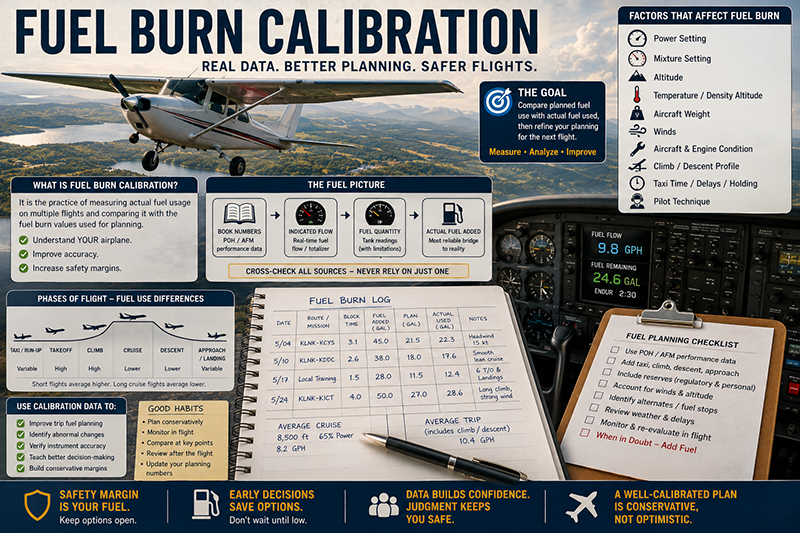
Fuel burn calibration is the practice of comparing planned fuel consumption against what the airplane actually used, then turning that real-world flight data into better fuel planning. For pilots, student pilots, instructors, aircraft owners, and operators, it is one of the most practical ways to improve dispatch decisions, cross-country planning, fuel reserve awareness, and overall risk management.
Published performance charts, fuel flow indicators, engine monitors, flight planning apps, and pilot experience all have value, but none of them should be treated as a substitute for disciplined fuel management. A handbook cruise chart may describe a carefully defined configuration at a specified altitude, power setting, mixture setting, temperature, and aircraft condition. A flight planning app may apply its own assumptions. A fuel totalizer may be accurate only if it was programmed correctly and verified. The pilot still has to ask the operational question that matters: how much fuel does this aircraft actually use in the way we fly it?
This article explains how to build a practical fuel burn calibration habit without drifting into guesswork. The goal is not to replace the aircraft flight manual, pilot operating handbook, approved supplements, or required fuel reserves. The goal is to use real flight data to make planning more conservative, more repeatable, and more honest. When pilots understand the difference between book fuel burn, indicated fuel flow, usable fuel, and actual fuel required for the mission, they are better equipped to make safe decisions before and during flight.
What Fuel Burn Calibration Really Means
Fuel burn calibration is the process of measuring actual fuel usage across multiple flights and comparing it with the fuel burn values used for planning. In simple terms, the pilot records what was planned, what was flown, what the engine instruments indicated, and what fuel was actually added or measured afterward. Over time, the pilot develops a realistic operating profile for that specific aircraft.
This matters because aircraft fuel planning is not based on a single number. Fuel consumption changes with engine type, power setting, mixture control, altitude, temperature, aircraft rigging, propeller condition, engine condition, climb duration, cruise technique, routing, winds, vectors, holding, and pilot technique. Even two aircraft of the same make and model may produce different real-world fuel burn numbers because of equipment, condition, engine monitor calibration, propeller configuration, and how they are operated.
A well-calibrated planning number is not necessarily the lowest fuel burn you have ever observed. It is a realistic number that accounts for how the aircraft is normally flown while preserving appropriate margins. For example, a pilot may observe several cruise segments at a lean cruise fuel flow that looks impressively efficient. That does not mean the entire trip can be planned at that number. Taxi, run-up, takeoff, climb, cruise, descent, approach, missed approach risk, alternates when applicable, and reserve fuel all have to be considered separately.
Good fuel burn calibration also distinguishes between phases of flight. A climb at high power usually consumes more fuel per hour than an economy cruise setting, while descent may consume less. A short cross-country with a long climb and limited cruise time may average significantly higher gallons per hour than a long cruise flight at a stabilized setting. If a pilot uses only cruise fuel flow for the whole trip, the plan may look better than reality.
Why This Matters in Real-World Aviation
Fuel planning is one of the classic places where small assumptions compound into significant risk. A few minutes of unexpected taxi delay, a climb into a stronger-than-forecast headwind, an altitude change for turbulence, a slightly rich mixture, or an unplanned vector can erode margin. None of these events is unusual. The safety problem appears when the original plan was built on optimistic fuel numbers and minimum margins.
For student pilots, calibrated fuel planning builds a stronger connection between preflight planning and cockpit decision-making. It turns fuel from an abstract calculation into a visible resource that must be managed continuously. For instructors, it creates a useful teaching opportunity: compare the student’s planned fuel with actual fuel used after the flight, then discuss why they differ. This develops judgment much better than treating the nav log as paperwork completed before engine start.
For aircraft owners, calibration can also identify maintenance or instrumentation issues. A fuel flow indication that consistently disagrees with fuel added at the pump may need verification. A sudden change in fuel burn at a familiar power setting may deserve attention, especially if accompanied by changes in engine indications, performance, or engine smoothness. Fuel burn data should not be used as a stand-alone maintenance diagnosis, but it can help a pilot notice when something has changed.
For operators and flying clubs, real-world fuel burn tracking can improve dispatch planning and standardization. If different pilots are using different fuel burn assumptions for the same aircraft, the organization may have inconsistent margins. A standardized planning profile, based on the aircraft’s approved data and tempered by actual operating experience, helps everyone start from the same baseline while still allowing conservative pilot judgment.
Most importantly, calibration supports better decisions when conditions change. A pilot who understands normal fuel burn behavior can recognize when actual fuel remaining no longer supports the original plan. That recognition may prompt an earlier fuel stop, a diversion, a route adjustment, or a decision not to launch. Fuel discipline is not only about arithmetic; it is about avoiding the trap of continuing with a plan that no longer matches reality.
How Pilots Should Understand Fuel Burn Data
Fuel burn data comes from several sources, and each has strengths and limitations. The pilot operating handbook or aircraft flight manual is the primary starting point for aircraft performance planning. It provides manufacturer performance information under defined conditions and is essential for understanding how the aircraft is intended to be operated. However, pilots must read the conditions behind the numbers. A table that assumes a specific power setting, pressure altitude, temperature, mixture technique, and aircraft configuration may not match the flight being planned.
Engine monitors and fuel flow systems can provide valuable real-time information, especially when the installation is properly configured and the pilot understands what the system is displaying. Fuel flow indicates the rate at which fuel is being consumed at that moment. A totalizer estimates fuel used or fuel remaining based on flow measurement and pilot-entered starting fuel. If the starting fuel quantity was entered incorrectly, if the usable fuel assumption was wrong, or if the system has not been verified, the displayed fuel remaining can be misleading.
Fuel gauges are also part of the picture, but pilots should understand their limitations. Regulations require fuel quantity indication, yet cockpit fuel quantity displays may not provide the precision pilots would like across the entire operating range. Pilots should not build fuel management around a single instrument alone. The strongest approach is cross-checking: planned fuel, time flown, fuel flow, totalizer data when available, tank selection history, and actual postflight fuel added.
Actual fuel added after flight is one of the most useful calibration points, but it must be interpreted carefully. If the aircraft is not fueled to the same level each time, or if the pilot does not account for whether tanks were filled to tabs, a known quantity, or full, the data may be inconsistent. Fueling technique, ramp slope, bladder tank behavior in some aircraft, temperature effects, and the precision of the fuel dispenser can all affect the comparison. The point is not to create laboratory data. The point is to collect enough consistent information to identify reliable planning values and avoid optimistic assumptions.
A practical fuel burn calibration log should capture the major variables that affect fuel use. It does not need to be complicated. Useful entries include aircraft identification, date, route, engine start and shutdown times, takeoff and landing times if available, fuel added before or after flight, fuel level reference, planned fuel burn, actual fuel used, cruise altitude, approximate power and mixture settings, winds, and any abnormal circumstances such as extended taxi, practice approaches, holding, or pattern work.
When reviewing the data, pilots should separate mission types. Pattern training, local maneuvers, short cross-countries, long cross-countries, high-altitude cruise, and instrument training may all produce different average fuel burn. A single blended average can hide important differences. For example, a training flight with repeated climbs, slow flight, and traffic pattern work may not resemble a cross-country cruise profile. Likewise, a long cruise segment leaned carefully at altitude should not be used to estimate fuel use during repeated instrument approaches at changing power settings.
Building a Useful Calibration Method
A good calibration method begins before engine start. The pilot should calculate fuel required using approved aircraft performance data, expected route, forecast winds, anticipated altitude, and applicable reserves. Then the pilot should choose a conservative planning fuel burn for the mission. If real-world calibration data already exists, it can help refine the plan. If not, start with the handbook and add appropriate operating margin rather than trying to prove the most efficient possible number.
During flight, the pilot should track time and fuel trend at logical points. This does not need to become a distraction. At top of climb, midway through cruise, before descent, and at major decision points, the pilot can compare actual groundspeed, fuel flow, and fuel remaining against the plan. If the numbers are trending worse than expected, the pilot should respond early. The safest fuel decision is usually the one made while options are still convenient.
After flight, the calibration work becomes most valuable. Compare actual time and fuel used to the plan. If the aircraft was refueled, record how much fuel was added and what level it was filled to. If the aircraft was not refueled, record the best available fuel state information, but treat it as less precise. Review whether the difference between planned and actual fuel was caused by known factors: wind, altitude, mixture, taxi delay, reroute, ATC vectoring, training maneuvers, or a change in power setting.
Over several flights, patterns emerge. A pilot may discover that climb fuel on warm days is more significant than expected, or that a particular aircraft’s real-world cruise burn is consistently above the optimistic value used in early planning. Another pilot may find that their planning method is conservative and repeatable, which is useful information as well. Calibration is not only about finding a lower number. In safety terms, confirming that a planning value is appropriately conservative is just as valuable.
The best calibration habits keep separate planning numbers for different purposes. One number may represent normal cruise fuel flow at a specific power and mixture setting. Another may represent average trip fuel burn for short cross-country flights. Another may be used for training flights with repeated climbs and maneuvering. The pilot can then choose the appropriate value instead of forcing every flight into the same average.
Book Fuel Burn Versus Actual Fuel Burn
One of the most common misunderstandings in fuel planning is treating handbook cruise fuel burn as total flight fuel burn. Cruise fuel burn is only one part of the fuel picture. A flight includes engine start, taxi, run-up, takeoff, climb, cruise, descent, approach, landing, and possible delays. The shorter the flight, the more the high-power and non-cruise segments influence the average.
Book values also depend on the assumptions behind the chart. Some performance tables are based on a properly leaned engine, a defined percent power, a specified altitude, and a standard configuration. If the pilot flies richer, lower, faster, heavier, or in less favorable atmospheric conditions, actual fuel burn may differ. In piston aircraft, mixture management has a direct effect on fuel consumption and engine operation. In turbine aircraft, fuel planning has its own performance considerations, including phase-specific fuel flows, altitude, power setting, and operating procedures.
Another difference is aircraft condition. Airframe rigging, tire pressure, propeller condition, engine health, and installed equipment can influence performance. A small loss of speed at the same fuel flow affects fuel efficiency because the aircraft covers fewer miles per gallon. From a planning perspective, fuel burn per hour matters, but fuel used to reach the destination also depends on groundspeed.
That distinction is important. A pilot can have a normal fuel flow and still arrive with less fuel than expected if groundspeed is lower than planned. Headwinds, route changes, altitude changes, and ATC delays can reduce fuel margin even when the engine is consuming fuel at the expected rate. Calibration should therefore consider both fuel per hour and fuel per trip.
Common Mistakes or Misunderstandings
A frequent mistake is using the most favorable observed fuel burn as the planning number. A pilot may remember a smooth flight at an efficient altitude with a favorable power setting and then use that value for a very different mission. Fuel planning should be built around realistic and conservative expectations, not best-case memories.
Another mistake is failing to verify starting fuel. A fuel totalizer can be extremely useful, but it is only as good as its starting point and configuration. If the pilot assumes full fuel when the aircraft is not actually full, or forgets to update the system after partial fueling, the totalizer may display a reassuring number that is wrong. Visual confirmation using approved or appropriate methods, careful fueling records, and conservative assumptions all matter.
Pilots also sometimes average away important differences. If a pilot calculates one overall gallons-per-hour figure from a mix of short training flights and long cruise flights, the result may not represent either mission well. Calibration data should be grouped by how the airplane was actually used.
Another misunderstanding is believing that fuel burn calibration allows a pilot to reduce reserves. It does not. Real-world data can improve planning accuracy, but it should not be used to justify operating with minimal margins. Required reserves and prudent personal minimums exist because weather, traffic, runway availability, ATC instructions, human performance, and mechanical issues do not always follow the plan.
A subtle risk is focusing only on arrival fuel and ignoring decision points. Fuel management should be monitored throughout the flight. If the aircraft is behind the fuel plan at the first checkpoint, the pilot should not wait until the destination area to solve the problem. Early diversion decisions are usually simpler, lower stress, and safer than late decisions made with fewer options.
Finally, some pilots underestimate the effect of human factors. Desire to complete the trip, passenger expectations, schedule pressure, and confidence in previous experience can all push a pilot toward optimistic fuel decisions. A calibrated fuel plan helps reduce subjectivity because it gives the pilot a factual trend to compare against the original plan.
Practical Example: Turning One Flight Into Better Planning
Consider a pilot planning a daytime cross-country in a normally aspirated piston airplane. The aircraft handbook provides cruise fuel information for several power settings and altitudes. The pilot plans the route, reviews forecast winds, selects a cruise altitude, and calculates fuel required using a conservative trip profile. The pilot also accounts for taxi, climb, descent, anticipated routing, and required reserve fuel.
Before departure, the aircraft is fueled to a known level. The pilot records the planned fuel burn, expected time en route, selected power setting, and expected cruise altitude. During the flight, the climb takes longer than expected because of warm conditions and a step climb for traffic. At cruise, the groundspeed is lower than forecast due to stronger headwind components. The engine monitor shows a fuel flow close to the expected cruise number, but the time en route is increasing.
At the midpoint, the pilot compares the original plan with actual progress. Fuel flow is normal, but the trip fuel estimate has worsened because the aircraft is covering ground more slowly. The pilot evaluates options and decides that continuing is still acceptable with planned reserve intact, but identifies an intermediate airport as a practical fuel stop if the headwind trend continues. Thirty minutes later, groundspeed has not improved, and the estimated arrival fuel is now lower than the pilot’s personal comfort margin. The pilot lands at the intermediate airport, refuels, and continues with no drama.
After the flight, the pilot reviews the fuel added and compares it with the engine monitor’s fuel used calculation. The totalizer was close, but the overall trip fuel was higher than the original planning estimate because climb and wind effects were greater than expected. The pilot updates the aircraft’s planning notes: for similar warm-weather trips with extended climb time, use a higher climb fuel allowance and reassess headwind trends earlier. The lesson is not that the original plan was reckless. The lesson is that real data improved the next plan and supported a timely decision.
Best Practices for Pilots
The most effective fuel burn calibration habits are simple enough to use consistently. A complicated spreadsheet that no one updates is less useful than a concise log kept after every meaningful flight. The key is to make the data comparable and to preserve the context behind the numbers.
- Start planning with the aircraft’s approved performance information and operating limitations, then apply conservative real-world adjustments.
- Record actual fuel used whenever the aircraft is fueled to a known level, and note whether the flight was training, local, or cross-country.
- Separate taxi, climb, cruise, and descent assumptions when practical, especially for longer flights or aircraft with significant phase-to-phase fuel differences.
- Cross-check fuel flow, time, groundspeed, fuel quantity indication, and fuel added instead of relying on one source alone.
- Use calibration data to improve planning accuracy, not to reduce required or prudent reserves.
- Reevaluate the plan in flight when winds, routing, altitude, or fuel flow differ from expectations.
In training, instructors can make this habit part of every cross-country debrief. Ask the student what they planned, what happened, why it changed, and what number they would use next time. This turns fuel planning into a learning loop. The student begins to understand that flight planning is not finished when the nav log is complete. It continues until the airplane is parked and the flight is reviewed.
For instrument pilots, calibrated fuel planning is especially valuable because reroutes, holds, approaches, missed approaches, and alternate planning can change the fuel picture quickly. The principle is the same: plan conservatively, monitor continuously, and make fuel decisions early enough that they remain routine.
For aircraft owners, consider creating a brief aircraft-specific fuel planning page that summarizes observed fuel burn under normal operating profiles. Include the assumptions behind the numbers. A note such as normal cruise at a selected power setting and altitude range is more useful than a single unexplained gallons-per-hour value. If multiple pilots fly the aircraft, standardize the recording method so that the data remains comparable.
Using Technology Without Letting It Replace Judgment
Modern cockpit technology can make fuel management more precise, but it can also create false confidence if pilots do not understand the assumptions. Flight planning applications can calculate fuel based on aircraft profiles, forecast winds, expected altitude, and route data. Engine monitors can display real-time fuel flow and calculated fuel remaining. Electronic logs can store trend data. These tools are valuable, but the pilot remains responsible for validating the information.
An aircraft profile in a planning app should be treated as a living estimate. If the profile was created from generic model data, it may not match the actual airplane. After several flights, update the profile to reflect observed performance while staying conservative. If the application allows separate climb, cruise, and descent profiles, those may provide more accurate results than one average fuel burn number.
Engine monitor data should also be verified periodically against fuel added. If the monitor says the aircraft used a certain amount, and the fuel pump consistently shows a materially different amount when the aircraft is refilled to the same reference level, the pilot should investigate. The issue may be setup, calibration, fueling inconsistency, or pilot entry error. Until resolved, use conservative planning values and do not assume the most favorable source is correct.
Technology works best when it supports a disciplined mental model. A pilot should be able to estimate whether the displayed fuel remaining makes sense based on time flown and expected burn. If the airplane normally burns around a known trip average and has been flying for a known time, the pilot should have an approximate independent expectation. Large discrepancies deserve attention, not blind acceptance.
Safety Margins, Reserves, and Decision-Making
Fuel burn calibration should make a pilot more conservative, not less. The purpose is to reduce uncertainty and reveal trends early. It is not a method for planning closer to the edge. Fuel reserves exist because aviation operations contain variables that cannot be perfectly predicted. Weather may change, traffic may delay the approach, a runway may close, an airport may become unsuitable, or a pilot may need extra time to resolve an abnormal situation.
Personal minimums should add another layer of protection. A pilot may legally be able to conduct a flight under certain fuel planning assumptions, but still decide that the margin is not appropriate for the route, weather, terrain, airport availability, night conditions, passenger considerations, or personal experience level. Calibration data helps make that decision with less guesswork.
A useful habit is to define fuel decision points before departure. For example, a pilot may decide that if estimated arrival fuel drops below a chosen margin by a certain checkpoint, a fuel stop will be made. This reduces the chance of negotiating with yourself in flight. The decision is based on a preplanned trigger rather than pressure to continue.
Good fuel management also respects the difference between fuel on board and usable fuel. Pilots should understand the aircraft’s usable fuel information and any limitations or procedures that affect fuel availability. Tank selection, fuel imbalance, unusable fuel, fuel venting, and aircraft attitude can all matter depending on aircraft design. Aircraft-specific procedures should always be followed.
Frequently Asked Questions
What is fuel burn calibration in aviation?
Fuel burn calibration is the practice of comparing planned fuel usage with actual fuel used in a specific aircraft. Pilots use the results to refine flight planning assumptions, improve fuel monitoring, and better understand how the aircraft performs in normal operations.
Can I use actual fuel burn data instead of the POH or AFM?
No. Approved aircraft performance information remains the starting point for planning and operating the aircraft. Actual fuel burn data can help refine conservative planning assumptions, but it should not be used to ignore operating limitations, approved procedures, or required fuel reserves.
How many flights are needed before fuel burn data is useful?
Even one flight can teach something, but several comparable flights are needed before a pattern becomes meaningful. Data is most useful when flights are grouped by mission type, such as local training, short cross-country, long cruise, or instrument training.
Why does my actual fuel burn differ from the flight planning app?
The aircraft profile in the app may use assumptions that differ from your aircraft and technique. Differences in climb time, altitude, mixture, power setting, winds, routing, aircraft condition, and taxi time can all affect actual fuel used.
Should I plan using average fuel burn or cruise fuel burn?
Use the number that matches the purpose. Cruise fuel burn is useful for stabilized cruise planning, but total trip fuel must also account for taxi, takeoff, climb, descent, approach, delays, and reserves. Short flights often require a higher average trip fuel number than cruise fuel alone.
Does fuel burn calibration reduce the need for fuel reserves?
No. Calibration improves accuracy, but it does not eliminate uncertainty. Pilots must comply with applicable fuel requirements and should maintain prudent personal margins based on the operation, weather, route, and available alternates or fuel stops.
Key Takeaways
- Fuel burn calibration turns actual aircraft fuel use into better flight planning data when it is recorded consistently and interpreted conservatively.
- Real-world fuel planning must account for taxi, climb, cruise, descent, routing, winds, delays, and reserves, not just a favorable cruise fuel flow.
- Use aircraft-approved performance data as the foundation, then apply verified operating experience to improve decision-making without reducing safety margins.