
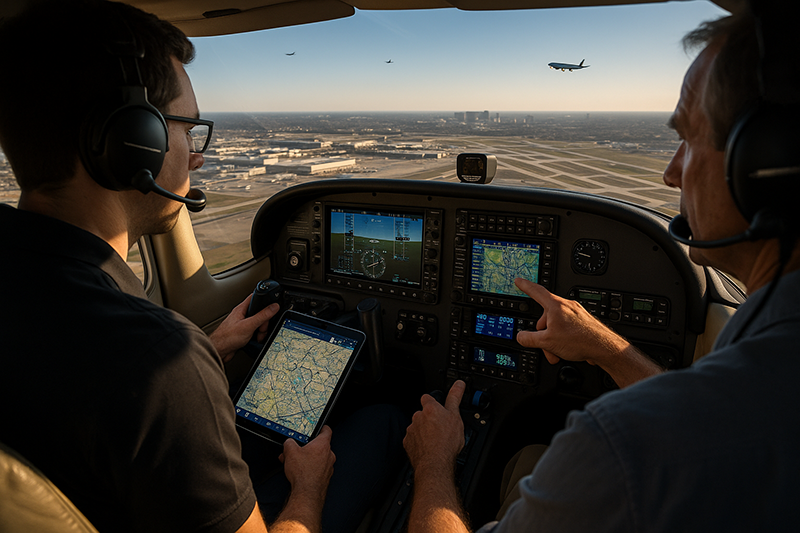
High-density airspace operations challenge a pilot in ways that are very different from quiet practice-area flying. The aircraft may be the same, the weather may be good, and the route may look simple on the chart, but the workload can rise quickly when multiple airports, complex airspace boundaries, rapid radio exchanges, wake turbulence considerations, and changing ATC instructions all converge in a small geographic area.
For student pilots, private pilots, instrument pilots, flight instructors, and professional crews, preparation is the difference between staying ahead of the aircraft and merely reacting to the next call. This article explains how to prepare for busy airspace in a practical, training-focused way. It is not a substitute for current charts, NOTAMs, airport publications, regulations, or ATC instructions, but it will help you build the mental framework needed to operate more confidently around terminal areas, towered airports, arrival and departure corridors, special use airspace, and congested training environments.
What High-Density Airspace Really Means
High-density airspace is not defined only by the number of aircraft on a frequency. It is better understood as any operating environment where traffic volume, airspace complexity, communication demand, aircraft performance differences, or procedure density increases pilot workload. A major metropolitan terminal area is an obvious example, but a non-towered airport with heavy training activity on a clear Saturday morning can also be high-density in a practical sense.
In busy airspace, several tasks compete for attention at the same time. The pilot may need to maintain aircraft control, comply with altitude and heading assignments, monitor traffic advisories, scan for aircraft, manage navigation, brief the next airspace boundary, update the approach or arrival plan, and communicate clearly on a congested frequency. None of these tasks is unusual by itself. The challenge is that they often arrive together.
High-density operations also involve mixed expectations. Airline crews, business jets, training aircraft, helicopters, military aircraft, skydiving aircraft, banner towers, and transient general aviation pilots may share nearby routes, frequencies, and traffic patterns. Their speeds, climb rates, turning radii, radio habits, and operational priorities can vary significantly. A well-prepared pilot anticipates that the other aircraft may not behave exactly like the aircraft encountered during local training.
The goal is not to become intimidated by busy airspace. The goal is to convert complexity into a manageable sequence of tasks. Good preparation allows the pilot to know what comes next, where the aircraft should be, what to say, what to listen for, and when to slow the operation down before workload exceeds capacity.
Why This Matters in Real-World Aviation
High-density airspace exposes weaknesses in planning and cockpit discipline faster than many other environments. A pilot who is slightly behind during cruise may recover easily in quiet airspace. In a busy terminal area, that same delay can lead to a missed radio call, an altitude deviation, an incorrect frequency change, an unstable approach, or a rushed traffic pattern entry.
For student pilots, busy airspace is where book knowledge becomes practical judgment. It is one thing to identify Class B, Class C, Class D, and special use airspace on a chart. It is another to plan a route that avoids unnecessary compression, confirm the correct communication sequence, recognize a hot spot on an airport diagram, and maintain situational awareness while ATC is issuing instructions to multiple aircraft.
For instrument pilots, high-density airspace often adds procedure management to an already demanding environment. A pilot may be assigned a different runway, a vector, a speed request, a hold, or a revised approach clearance. The pilot must keep the airplane under control first, then manage automation, navigation, and communication without accepting an instruction that cannot be safely complied with.
For flight instructors, high-density operations are a valuable training opportunity but require careful risk management. The instructor must decide when the training value is appropriate and when workload is too high for the student’s current stage. A first exposure should be structured, briefed, and debriefed. It should not become a surprise workload test disguised as a normal lesson.
For professional pilots and aviation operators, busy airspace reinforces standardization. Clear briefings, defined roles, sterile cockpit discipline during critical phases, and disciplined radio communication help crews maintain a shared mental model. Even in single-pilot operations, the same habits apply. The pilot can brief aloud, organize cockpit resources, and use flows or checklists to reduce memory dependency.
How Pilots Should Understand This Topic
The best way to understand high-density airspace is to think in layers: airspace structure, traffic flow, communication flow, aircraft performance, and pilot workload. Each layer affects the others. A route that looks short may be poor if it crosses multiple arrival paths. A runway that looks convenient may require a pattern entry across heavy training traffic. A direct clearance may not be the best choice if it places a slow aircraft in a fast-moving stream without enough time to brief the next step.
Airspace structure is the first layer. Before departure, pilots should review the classes of airspace along the route, nearby airports, expected transition routes, charted landmarks, altitude shelves, and any special procedures that may apply. In complex terminal areas, a small altitude error or navigation error can create a significant problem. The more crowded the chart, the more valuable it becomes to slow down the planning process on the ground.
Traffic flow is the second layer. Busy airports often have predictable flows based on runway configuration, wind, terrain, noise-sensitive areas, arrival routes, and departure routes. Even when not flying a published arrival or departure, pilots can improve situational awareness by asking: Where are arrivals likely coming from? Where are departures likely climbing? Where do helicopters typically operate? Where do training aircraft practice? Where might aircraft be descending through my altitude?
Communication flow is the third layer. In high-density airspace, frequency congestion is common. A pilot who waits until the last possible moment to call may have difficulty getting a word in. A pilot who transmits too much may block necessary communication. Good radio technique is concise, complete, and predictable. Know what you need before keying the microphone: who you are calling, who you are, where you are, altitude, request, and any relevant information such as ATIS code when appropriate.
Aircraft performance is the fourth layer. A light trainer, a high-performance piston aircraft, a turboprop, and a jet do not integrate the same way. Speed management matters. So do climb rate, descent planning, turning radius, and wake turbulence awareness. A pilot should avoid assuming that a clearance, sequence, or spacing plan will remain comfortable without active energy management.
Pilot workload is the fifth layer and often the limiting factor. A pilot can be legal, current, and technically proficient yet still become overloaded if the operation is poorly organized. The solution is not simply to try harder. The solution is to prepare earlier, simplify the task, delegate when possible, use automation appropriately, and tell ATC when unable or when more time is needed.
Preflight Planning for Busy Airspace
Preparation for high-density airspace begins well before engine start. The planning process should identify the moments when workload will likely increase, then reduce surprise. The most important question is not only whether the route is legal and technically possible. It is whether the route gives the pilot enough time and space to manage communication, navigation, traffic awareness, and aircraft configuration.
Start with current aeronautical charts and airport information. Review airspace boundaries, altitudes, frequencies, arrival and departure notes, runway layouts, taxiway geometry, and known surface movement complexity. Pay particular attention to airports located near overlapping airspace shelves, multiple towered airports, or major arrival corridors. A route that threads tightly between boundaries may look efficient but provide little margin for workload or navigation error.
Next, consider timing. Traffic volume can vary by time of day, weather, local training schedules, airline banks, and special events. A pilot does not need to predict the entire traffic picture, but should recognize that a clear weekend morning near training airports may be more demanding than expected, while an IFR arrival into a major terminal area during a busy period may require faster decision-making and more precise cockpit organization.
Weather also shapes workload. Marginal visibility, haze, low sun angles, convective weather avoidance, gusty winds, and low ceilings can reduce visual acquisition and increase the need for precise navigation. Even when conditions are VFR, visibility and lighting can make traffic harder to see. In IFR conditions, the challenge shifts toward procedure compliance, automation management, and anticipation of ATC changes.
A strong preflight plan includes alternatives. If the radio is saturated, where can you hold outside the busiest area while you organize? If you cannot obtain a requested transition, what route will you fly instead? If the destination runway changes, what is the likely taxi or approach impact? If the workload becomes excessive, where can you exit the flow safely and reset? These decisions are easier on the ground than in the middle of a frequency handoff.
Communication Discipline in High-Density Airspace
Radio communication is one of the most visible differences between quiet and busy airspace. In a slow environment, a slightly wordy call may not create a problem. On a congested frequency, long transmissions, uncertain phraseology, and repeated corrections can interfere with the entire flow. A pilot does not need to sound like an airline crew, but the call should be brief, accurate, and useful.
Before transmitting, listen long enough to understand the rhythm of the frequency. Identify whether ATC is handling arrivals, departures, pattern traffic, or multiple sectors combined. Avoid stepping on another transmission. When ready, make the call with the necessary information and then listen carefully for the reply. Many errors occur not because the pilot did not transmit, but because the pilot was not ready to receive and correctly process the answer.
Readbacks matter because they close the loop. Altitudes, headings, runway assignments, hold short instructions, route changes, and clearances should be acknowledged accurately when required or operationally necessary. If something is unclear, ask. A short clarification request is better than acting on an assumption. In a busy environment, controllers also benefit from pilots who are direct about limitations. If you are unable to accept a speed, heading, climb rate, visual approach, or immediate turn safely, say so using plain, professional language.
Single-pilot operations deserve special attention. Copying a clearance, reprogramming avionics, scanning for traffic, and flying the aircraft can exceed available attention if attempted all at once. Use cockpit organization to reduce this load. Have a kneeboard or note method ready. Set up expected frequencies. Load likely procedures before they are needed, while verifying that nothing is activated prematurely. If the task stack becomes too large, ask for delaying vectors, a repeat, or a simpler instruction when appropriate.
Navigation and Situational Awareness
Modern avionics can greatly improve situational awareness in busy airspace, but they do not remove the pilot’s responsibility to understand the operation. Moving maps, traffic displays, electronic flight bags, and GPS navigation are valuable tools when used correctly. They can also become distractions if the pilot spends too much time heads-down at the wrong moment.
Situational awareness in high-density airspace has three parts: where you are, where you are going, and what is likely to happen next. A moving map can answer the first question quickly, but the pilot must still understand airspace altitudes, course guidance, ATC expectations, and traffic flow. The display should support the mental model, not replace it.
Traffic displays require the same balanced thinking. They can help identify traffic that might otherwise be missed, but they do not guarantee visual separation or complete traffic awareness. Pilots should continue to scan outside when operating visually and use ATC traffic advisories, onboard systems, and visual scanning as complementary tools. A target on a screen can also pull attention inside at a time when the primary need is to look outside and fly the aircraft.
In complex terminal areas, navigation errors often begin with small distractions. A frequency change, a runway reassignment, or a traffic advisory can interrupt the pilot just before an altitude step-down, boundary crossing, or course change. This is why verbalizing the next expected action can be useful, especially in training. A pilot might say, for example, after this frequency change, maintain present altitude until clear of the shelf, then turn toward the reporting point. That brief self-brief helps protect the plan from interruption.
Managing Workload Before It Manages You
Workload management is central to safe high-density airspace operations. The pilot should always be asking whether the current pace is sustainable. If the answer is no, the operation needs to be simplified. That may mean reducing speed, requesting delay, declining a shortcut, asking for vectors, remaining outside the airspace until ready, or choosing a less complex alternate.
One useful technique is to identify the next high-workload point before reaching it. Examples include the initial call to approach, the transition through a shelf, the downwind entry at a towered airport, the approach clearance, the final descent, or the runway exit and taxi phase. Once that point is identified, complete as much preparation as possible before arrival. Tune radios, brief taxi routes, review missed approach or go-around expectations, verify altitudes, and organize charts or displays.
Automation should reduce workload, not create a new layer of confusion. In many aircraft, autopilots, flight directors, GPS navigators, and electronic checklists can be excellent resources. But in busy airspace, a pilot who is uncertain about automation mode status can become dangerously distracted. If automation is not doing what you expect, maintain aircraft control first. Use the level of automation you can confidently manage, and be ready to hand-fly when that is the simpler choice.
For two-pilot crews and instructor-student flights, task sharing should be clear. Who is flying? Who is handling radios? Who is programming avionics? Who is looking outside? Ambiguity wastes time and creates duplicated or missed tasks. In training, instructors should avoid taking over every task too early, but they also need to intervene before the student becomes saturated. The learning value comes from guided exposure, not unmanaged overload.
Common Mistakes or Misunderstandings
One common mistake is treating high-density airspace as primarily a radio challenge. Radio skill is important, but it is only one part of the operation. A pilot can sound polished on the frequency and still be behind on navigation, altitude control, configuration, or traffic awareness. The objective is not to sound busy. The objective is to remain organized and predictable.
Another misunderstanding is assuming that ATC will prevent all conflicts or correct every pilot mistake. ATC services are valuable, and controllers play a major role in traffic flow, but pilots must still comply with applicable procedures, maintain awareness, and speak up when uncertain. In visual conditions, pilots must not let a clearance or advisory replace disciplined visual scanning and aircraft control.
A third error is overloading the route with unnecessary complexity. Some pilots plan tight transitions through multiple airspace shelves to save a few minutes. That may be appropriate for a proficient pilot in good conditions with a well-briefed plan, but it may be a poor choice for a new pilot, an unfamiliar aircraft, or a flight with marginal weather and busy frequencies. Conservative routing is not a sign of weak skill. It is often a sign of mature judgment.
Rushed cockpit setup is another frequent problem. If the pilot starts taxiing before the radios, navigation, charts, airport diagram, and departure plan are organized, the workload debt appears later. The same issue occurs before arrival. A pilot who delays the arrival brief until entering the terminal area may find that there is no quiet time left to think.
Finally, pilots sometimes accept instructions too quickly. A controller may issue a clearance or request that works well for traffic flow but is difficult for a particular aircraft or pilot at that moment. If the instruction cannot be safely complied with, the correct response is to say unable or request an alternative. Professional communication includes both cooperation and honest limitation reporting.
Practical Example: Transitioning Near a Busy Terminal Area
Consider a private pilot flying a single-engine training aircraft from a suburban airport to another airport located on the far side of a major terminal area. The direct route crosses near several towered airports and passes below layered controlled airspace. The weather is VFR, visibility is acceptable, and the pilot is comfortable with the aircraft. At first glance, the trip looks routine.
During planning, the pilot notices that the direct route would require careful altitude management below one airspace shelf while also contacting approach control near a busy arrival corridor. The destination airport has multiple runways, and the expected arrival path may cross a training practice area. Rather than simply drawing a straight line, the pilot chooses a route that uses clear visual checkpoints, provides more lateral spacing from the busiest arrival path, and allows time to contact ATC before reaching the most complex segment.
Before departure, the pilot writes down likely frequencies, reviews the destination airport diagram, checks the expected runway based on wind, and identifies a holding area outside the complex airspace in case communication is delayed. The pilot also briefs a personal rule: if not established in communication by a specific checkpoint, turn toward the preplanned holding area rather than pressing closer to the boundary while trying to call.
In flight, approach control is busy. The pilot listens, waits for an opening, and makes a concise request with position, altitude, destination, and desired transition. ATC responds with a route that differs slightly from the pilot’s expectation. Because the pilot has already studied the area, the change is manageable. The pilot reads back the instruction, verifies the new course on the moving map, and maintains the assigned altitude.
Closer to the destination, ATC advises traffic and then changes the expected runway. The pilot avoids rushing. The aircraft is slowed early, the new runway is identified, and the pattern entry is briefed before switching to the tower. On landing rollout, the pilot exits the runway and stops short where instructed, then requests clarification before taxiing because the airport layout is unfamiliar. The flight remains smooth not because it was simple, but because the pilot anticipated complexity before it arrived.
Best Practices for Pilots
Preparing for high-density airspace is best viewed as a habit pattern rather than a one-time checklist. The following practices are useful because they reduce uncertainty and preserve attention for the parts of the flight that cannot be fully predicted.
- Brief the airspace, not just the route. Know the boundaries, altitudes, frequencies, and likely traffic flows that affect the flight.
- Plan communication early. Identify who you will call, when you will call, and what information you need ready before transmitting.
- Use simple routing when it improves safety. A slightly longer route may reduce frequency congestion, altitude compression, or last-minute maneuvering.
- Stay ahead of aircraft configuration. Slow down early when appropriate, especially before pattern entry, approach clearance, or a busy merge point.
- Protect visual scanning. Use avionics as aids, but do not allow displays to pull your attention inside for too long in visual traffic environments.
- Speak up early. Ask for clarification, delay, vectors, or an alternative when workload or aircraft capability makes an instruction unsuitable.
- Debrief after the flight. Review radio calls, navigation decisions, workload peaks, and any moments of confusion while they are still fresh.
Flight instructors can strengthen these habits by designing progressive exposure. Begin with ground briefings and chair-flying, then fly near the edge of complex airspace, then practice communication with ATC, and only later combine multiple demands. The student should learn not only what to do, but why the timing matters.
Instrument training should include realistic changes whenever appropriate and safe. A runway change, a vector, a hold, a revised approach, or a missed approach briefing can teach pilots to manage change without panic. The lesson should emphasize aircraft control, prioritization, and clear communication rather than perfect button pushing.
Professional pilots can apply the same principles through standard operating procedures and disciplined briefings. High-density airspace rewards crews that communicate early, use standard callouts, verify automation, and maintain shared awareness. The aircraft may be more capable, but the human factors remain familiar.
Training Strategies for Building Confidence
Confidence in busy airspace comes from structured repetition, not from hoping the next flight will be easier. A pilot who avoids all complex airspace may remain uncomfortable indefinitely. A pilot who enters it without preparation may develop poor habits or unnecessary anxiety. The best path is deliberate exposure with clear objectives.
On the ground, practice reading terminal area charts, airport diagrams, and approach plates with a specific scenario in mind. Ask where you would call, what altitude you would choose, what clearance or communication you might need, and where you would go if the plan changed. Chair-fly the radio calls. The objective is to make the first real transmission feel familiar.
In the airplane, start with manageable tasks. A flight instructor might first have the student monitor a busy frequency without transmitting, then identify traffic flow, then make a simple call, then navigate a planned transition. Each step builds capacity. The instructor can increase complexity only after the student demonstrates that aircraft control and situational awareness remain stable.
Simulator or aviation training device sessions can also help, especially for instrument pilots. While a simulator cannot perfectly reproduce real frequency congestion or visual traffic scanning, it can help pilots practice reroutes, workload spikes, avionics setup, and decision-making. The key is to train priorities: aviate, navigate, communicate, and manage systems in a logical order.
Frequently Asked Questions
What is the best first step before flying into high-density airspace?
The best first step is a detailed preflight review of the airspace structure, airport layout, expected frequencies, likely traffic flow, and alternate plan. Do this before engine start, not while approaching the busiest part of the flight.
Should student pilots practice in busy airspace?
Yes, when it is appropriate for their stage of training and supervised by an instructor who has briefed the lesson carefully. The exposure should be progressive. The student should not be pushed into a workload level that prevents basic aircraft control and learning.
How can pilots improve radio communication in congested airspace?
Listen before transmitting, prepare the call before keying the microphone, keep transmissions concise, and read back important instructions accurately. If a clearance or instruction is unclear, ask for clarification rather than guessing.
Is it better to use avionics or visual references in busy airspace?
Both are useful. Avionics can improve navigation and traffic awareness, while visual references and outside scanning remain essential in visual conditions. The safest approach is to integrate both without becoming fixated on the screen.
What should a pilot do when workload becomes too high?
Maintain aircraft control first, simplify the operation, and communicate early. Depending on the situation, that may mean slowing down, requesting vectors, asking for a repeat, declining an instruction that cannot be safely accepted, or holding outside the busy area until ready.
Does high-density airspace always mean controlled airspace?
No. Controlled terminal areas are common examples, but high-density conditions can also occur at non-towered airports, popular training areas, fly-ins, or regions with concentrated helicopter, glider, parachute, or banner towing activity. The key issue is workload and traffic complexity, not only the airspace label.
Key Takeaways
- Prepare for high-density airspace by briefing structure, communication, traffic flow, aircraft performance, and workload before the flight reaches the busy segment.
- Safety depends on staying ahead of the aircraft, protecting visual scanning, using concise radio communication, and asking for clarification or alternatives when needed.
- Training should build exposure progressively so pilots learn to manage complexity with sound judgment rather than relying on last-minute reactions.