
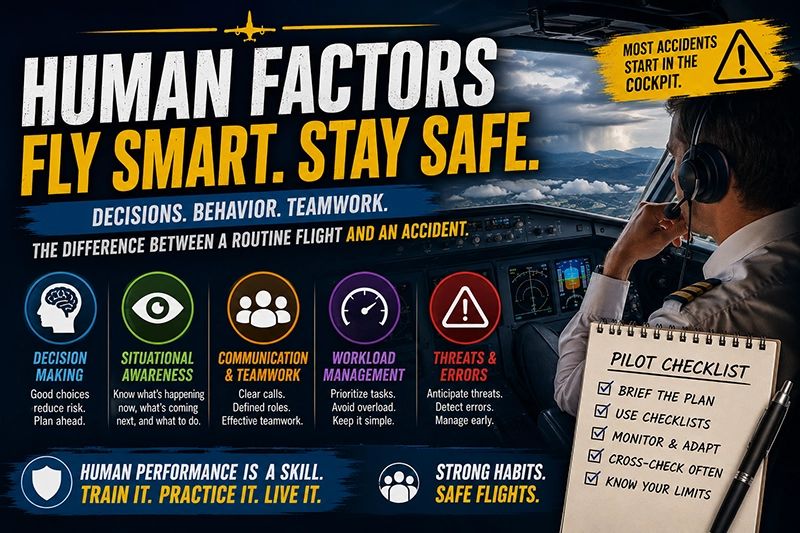
Human factors shape nearly every flight we fly. From preflight planning through shutdown, decisions, communication, attention, and teamwork influence outcomes as much as aircraft performance. This article explores human factors in aviation accidents and offers practical guidance pilots, student pilots, flight instructors, and aviation professionals can use to reduce risk and improve safety.
Understanding human factors is not academic. It changes training priorities, preflight habits, cockpit communication, and how you respond to unexpected events. Read on for practical explanations, a realistic scenario, common mistakes, and action-oriented best practices you can apply on the ramp and in the cockpit.
What are human factors and why they matter
Human factors is the study of how people interact with systems, equipment, tasks, and each other. In aviation, that covers cognitive skills such as decision-making and attention, physical abilities like control handling and vision, and social elements including communication and teamwork. The term also includes environmental influences such as fatigue, stress, workload, and organizational culture.
When pilots talk about human factors they are usually thinking about how errors occur and how to manage them. Error is a normal part of human performance. The difference between a routine flight and an accident often comes down to how errors are anticipated, detected, and managed. That makes training, procedures, and cockpit discipline essential elements of risk control.
Why this matters in real-world aviation
Pilots operate complex aircraft in dynamic environments. Weather, air traffic, performance margins, and time pressure all add demands on attention and judgement. Human factors influence everything from the quality of preflight planning to in-flight decision-making and postflight reporting. Good human factors practices increase resilience. Poor human factors practices let small mistakes cascade into larger events.
In practical terms, human factors affect:
Decision-making: Choice of route, fuel reserves, diversion decisions, and whether to continue a flight into changing weather.
Situational awareness: Accurate perception of aircraft state, traffic, weather, and fuel.
Workload management: Prioritizing tasks during high-demand phases such as takeoff, approach, or emergency handling.
Communication and teamwork: Clarity with air traffic control, passengers, and crewmembers, and the effectiveness of verbal briefings and callouts.
Automation interaction: How pilots use, monitor, and intervene when automation behaves unexpectedly.
How pilots should understand human factors
Understanding human factors begins with clear, practical categories that relate to everyday flying. Use these mental models to diagnose risks and to design countermeasures you can practice and teach.
1. Types of human error
Errors are often grouped by where they occur in the human-information loop. Common operational categories include:
Slips: Actions that go wrong despite correct intention, typically during execution of routine tasks. Example: selecting the wrong switch because of muscle memory.
Lapses: Failures of memory such as forgetting to set fuel pumps or neglecting to retract flaps after takeoff checklist was skipped.
Mistakes: Flawed intentions based on incorrect planning or decision-making, like misreading a weather briefing and continuing into conditions beyond capability.
Recognizing which type of error you're dealing with guides recovery. Slips often require better cockpit organization and physical checks. Lapses point to checklist discipline. Mistakes need better planning, training, or decision frameworks.
2. Threat and error management
Threat and Error Management, often shortened to TEM, frames how threats arise and how crews detect and respond. Threats are conditions or events that increase operational risk, such as unforecast weather or a maintenance irregularity. Errors are undetected or unmitigated deviations from expected actions. Effective TEM anticipates threats, monitors for emerging errors, and applies mitigation strategies before the situation deteriorates.
3. Situational awareness and mental models
Situational awareness means understanding the current situation, how it will change, and what actions are required. Pilots build mental models—simplified internal representations of the aircraft, weather, traffic, and system state. When those models are incomplete or incorrect, actions can follow that increase risk. Cross-checks, briefings, and timely information updates help keep mental models accurate.
4. Human performance factors
Fatigue, stress, illness, medication, alcohol, emotional distractions, and environmental factors like heat or noise degrade performance. Recognize how these conditions affect attention, decision-making, and motor skills. Practical mitigation is often straightforward: adjust schedules, delay flights when performance is impaired, or use a safety pilot or another crewmember when workload is high.
5. Automation management
Automation offers performance benefits but also creates new risks. Issues include overreliance, mode confusion, and complacency. Good automation management means clear understanding of system modes, active monitoring of automation behavior, and hands-on practice with manual flying so skills are maintained.
Common mistakes or misunderstandings
Pilots and instructors often misunderstand how human factors interact with operations. Here are recurring themes that increase risk.
Assuming checklists and SOPs are optional
Standard operating procedures and checklists exist to reduce variability and prevent lapses. Treat them as core safety tools rather than optional time-savers. Skipping items or doing a mental checklist instead of a physical flow invites lapses and slips.
Tolerating marginal decisions
Small compromises—departing with minimal fuel, pushing slightly past weather minimums, or accepting ambiguous briefings—can accumulate. Each compromise reduces safety margins. Make limits explicit and conservative in practice and training so marginal decisions are obvious and questioned.
Overconfidence and normalization of deviance
When crews routinely deviate without immediate consequence, risky behaviors can become normalized. This cultural drift is hazardous because it undermines formal safeguards. Encourage open discussions and a culture where deviations are examined rather than buried.
Poor communication and ambiguous responsibilities
Unclear callouts, unstructured briefings, or failure to assign roles in a multi-crew or pilot-in-command/pilot-monitor dynamic leads to missed cross-checks and delayed intervention. Clear, concise, and purpose-driven communication prevents many routine errors.
Relying on automation without monitoring
Automation can hide subtle changes in aircraft state or environmental inputs. Pilots must monitor automation actively and be ready to disconnect when the system is not delivering the expected outcome.
Practical example: Cross-country VFR into deteriorating weather
Imagine a VFR cross-country in a single-engine airplane. The pilot is experienced on the route but is behind schedule. En route, the weather begins to lower with scattered clouds thickening into broken ceilings. Forecasts showed a chance of degradation later in the day. The pilot decides to press on rather than divert, hoping for a brief window to get through.
As visibility reduces, the pilot becomes task-saturated managing orientation, navigating around clouds, and monitoring instruments. The pilot's mental model—expectation of VFR conditions—does not match the reality developing outside. Without an immediate decision to divert or land, the situation escalates. Spatial disorientation becomes a risk when the pilot transitions to partial instrument conditions without current instrument proficiency or reference to instruments.
This scenario illustrates several human factors at work: a decision error influenced by schedule pressure, underestimation of threat, degraded situational awareness, and potential automation or skill deficits if the pilot is not current in instrument flying. The practical response path includes early recognition of weather trends, conservative diversion planning, timely communication with ATC or flight service, and using a personal minimums framework that triggers diversion sooner than the legal minimums.
Best practices for pilots
Human factors risk is manageable with deliberate habits and training. The list below focuses on practical actions. Use them as starting points for recurrent training and personal SOPs.
Adopt personal minimums: Define conservative fuel, weather, and daylight minimums that prompt diversion before conditions degrade to an operational emergency.
Use structured briefings: Before critical phases like takeoff and approach, brief expected conditions, roles, and contingency plans out loud.
Practice threat and error management: During training flights, discuss potential threats and the actions to take if they appear. Make TEM a routine part of postflight debriefs.
Maintain manual flying skills: Allocate training time to hand-flying the airplane without automation to prevent skill fade.
Standardize cockpit flows and checklists: Keep physical flows consistent and use read-verify-callout patterns between crewmembers when available.
Manage fatigue proactively: Prioritize rest, plan duty cycles with recovery time, and be conservative about flying when sleep debt or illness is present.
Encourage a reporting culture: Use safety reports to capture near-misses and deviations so the organization can learn instead of penalizing individuals for honest errors.
Training recommendations for instructors and operators
Instructors and operators should integrate human factors into routine training, not treat it as a one-time lecture. Some effective approaches include:
Scenario-based training that simulates real workload and decision points rather than only procedural practice.
Threat and error management exercises where students identify threats, predict likely errors, and rehearse mitigations.
Line-oriented flight training (LOFT) style sessions that focus on crew coordination, communication, and leadership in realistic missions.
Instructor modeling: Instructors should demonstrate disciplined checklist use, concise briefings, and transparent decision-making to set expectations.
Organizational and maintenance human factors
Human factors are not only a cockpit problem. Maintenance actions, organizational culture, training policies, and scheduling practices all influence safety. For example, maintenance technicians working under schedule pressure can make errors in inspections or logbook entries. Organizations that reward on-time performance without balanced safety metrics may unintentionally incentivize risky decisions. Address these through human-centered maintenance procedures, robust handover practices, and management attention to safety culture.
Common misunderstandings about human factors
Several misconceptions hinder effective human factors interventions. Clarifying them helps pilots and organizations adopt better practices.
Myth: Human factors training is only for airline crews. Truth: Every flight benefits from human factors awareness. Single-pilot operations face different but equally important human performance challenges.
Myth: Checklists are bureaucratic. Truth: Checklists restore cognitive bandwidth and reduce memory reliance under stress.
Myth: Automation eliminates pilot error. Truth: Automation changes error types and introduces oversight demands; pilots still need to manage the automation effectively.
Frequently Asked Questions
How do I tell the difference between a slip and a mistake in flight?
A slip occurs when your intended action is correct but the execution fails, often due to distraction or habit. A mistake is when the plan itself is flawed. If you intended to perform the right action but reached for the wrong control, that is a slip. If you planned a route that exposes you to weather beyond your capability, that is a mistake. Identifying which occurred helps determine the training or procedural fix.
What should I do when fatigue is reducing my performance?
If fatigue is present, the safest options are to delay the flight, split duties with another qualified pilot, or land at the nearest suitable airport. Avoid relying on caffeine or other temporary measures as substitutes for adequate rest when making risk-sensitive decisions.
How can I maintain situational awareness in high workload situations?
Prioritize tasks, use brief pause points to re-establish the big picture, and use checklists and quick callouts to confirm critical parameters. Delegating or deferring nonessential tasks during high workload phases also preserves attention for key flying tasks.
Is automation always beneficial for safety?
Automation reduces workload for routine tasks but requires careful monitoring and understanding of system behavior. Treat automation as a tool that extends capability, not a substitute for vigilance. Regularly practice manual flying to preserve the skills needed when automation is not available or appropriate.
How do I build a reporting culture in a small operation?
Start by encouraging nonpunitive reporting of safety concerns and near misses. Use reports as learning tools rather than avenues for blame. Leadership should review reports transparently and implement straightforward corrective actions to reinforce trust that reporting leads to positive change.
Practical checklist of behavioral habits
Adopt these compact habits to reduce human factors risk on each flight.
Preflight: Use a written plan including fuel, alternates, weather minimums, and decision points.
Brief: Verbally confirm roles, approach and missed approach plans, and go-around criteria with any crewmember or safety pilot.
Flow: Use consistent physical flows for instrument and control checks, and then verify with a checklist readout.
Monitor: Check automation modes and performance frequently during cruise and critical phases.
Debrief: After the flight, note any threats or errors and identify mitigation steps for next time.
Key Takeaways
- Practical takeaway: Anticipate threats and manage errors with structured briefings and conservative personal minimums.
- Safety takeaway: Early recognition and timely diversion decisions preserve margins and reduce accident risk.
- Training takeaway: Integrate threat and error management, scenario-based exercises, and manual flying practice into recurrent training.
Human factors are rarely a single cause. They are an interacting set of influences that shape how you plan, fly, and manage unexpected events. By treating human performance as a system to be understood and trained, you create more predictable outcomes and safer flights. Make human factors an explicit part of training and daily habits, and the cockpit becomes a controlled environment where small errors are detected and corrected before they grow into serious incidents.