
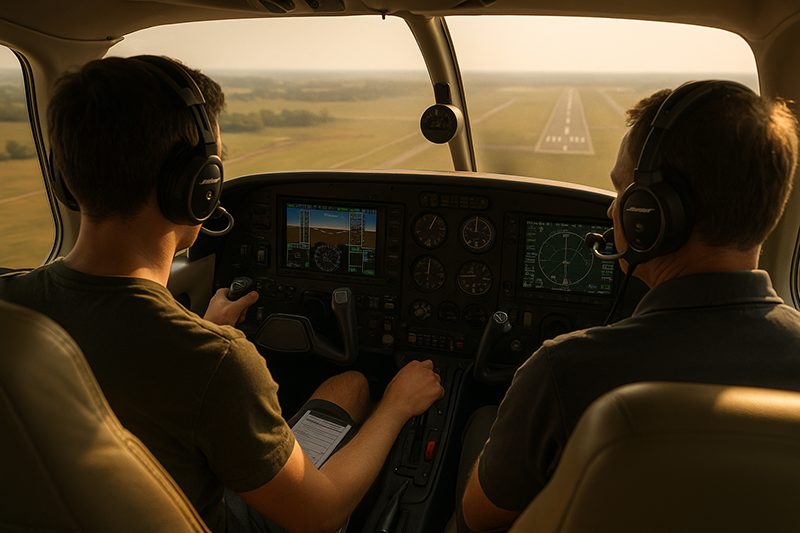
Human factors in aviation are the everyday human influences that shape how pilots perceive, decide, communicate, and act in the cockpit. They are not a side topic reserved for accident investigators or airline safety departments. They show up in a student pilot’s first traffic pattern, a flight instructor’s judgment during changing weather, a corporate crew’s workload on arrival, and a maintenance or dispatch conversation that affects how a flight begins.
Common aviation incidents often appear technical on the surface: a runway incursion, a fuel problem, an altitude deviation, an unstabilized approach, a navigation error, or a delayed go-around. Behind many of these events is a chain of human performance factors such as fatigue, distraction, expectation bias, stress, complacency, time pressure, poor communication, or an incomplete mental model of what is happening. Understanding those factors helps pilots move beyond the question, “What did the pilot do wrong?” and toward the more useful question, “What conditions made the wrong action more likely?”
This article explains human factors in practical cockpit language. It is written for pilots, student pilots, flight instructors, aviation professionals, and serious aviation enthusiasts who want to improve decision-making, training quality, and operational safety. The goal is not to create fear or blame. The goal is to help aviators recognize the traps before they become events.
What Human Factors Means in Aviation
Human factors is the study of how people interact with aircraft, procedures, equipment, weather, other people, and the operating environment. In aviation, it includes attention, perception, memory, decision-making, communication, workload management, fatigue, stress, automation use, and crew coordination. It also includes the design of cockpit controls, checklists, displays, training programs, and operating procedures.
A helpful way to think about human factors is this: aircraft do exactly what the laws of physics and their systems allow, but pilots must interpret, prioritize, and manage those systems under changing conditions. That human layer is powerful. It allows flexibility, judgment, and creativity. It also introduces vulnerability when workload rises, information is incomplete, or the pilot’s expectations do not match reality.
Human factors is not an excuse for poor airmanship. It is a disciplined way to understand why good people can make poor decisions, miss obvious cues, or continue a plan longer than they should. It also helps instructors teach prevention rather than simply correction. A pilot who understands why distraction affects checklist discipline is better prepared than a pilot who only says, “I will be more careful next time.”
In flight training, human factors connects directly to aeronautical decision-making, risk management, and situational awareness. These terms are often used together, but they are not identical. Aeronautical decision-making is the process of choosing a safe course of action. Risk management is the process of identifying and controlling hazards. Situational awareness is the pilot’s understanding of what is happening now, what it means, and what may happen next. Human factors influence all three.
Why Human Factors Matter in Real-World Aviation
Real-world flying rarely unfolds exactly like a lesson plan. Weather changes, radios get busy, passengers ask questions, traffic appears where the pilot did not expect it, and a simple delay can create pressure to keep moving. Human factors matter because incidents often form in the gap between a pilot’s plan and the actual operating environment.
Consider a routine cross-country flight. The pilot checks the weather, plans the fuel, briefs the route, and departs with a reasonable plan. Later, a headwind is stronger than expected, a fuel stop looks inconvenient, and the passenger has a meeting. None of those items alone creates an emergency. Together, they can nudge the pilot toward continuing with reduced margins. The human factors issue is not just fuel planning. It is the way time pressure, optimism, social pressure, and confirmation bias can combine to make a conservative option feel unnecessarily cautious.
The same pattern appears in approach and landing incidents. A pilot may be slightly high, slightly fast, configured late, and still mentally committed to landing. Each deviation may seem manageable in isolation. The risk grows when the pilot normalizes the unstable condition, delays the go-around decision, and focuses on salvaging the landing rather than restoring margins. The human factors issue is not simply airspeed control. It is plan continuation bias, workload, and a reluctance to abandon an approach that has almost reached the runway.
Human factors also matter in communication. A readback that is technically spoken but not mentally processed can lead to altitude, heading, runway, or taxi errors. A cockpit conversation that distracts during a critical phase of flight can interrupt a checklist. A flight instructor who assumes the student understood a correction may miss a training gap. Clear communication is not just about words. It is about attention, confirmation, timing, and shared understanding.
Common Human Factors Behind Aviation Incidents
Human factors rarely appear as a single isolated cause. More often, they form a chain. A fatigued pilot may be more susceptible to distraction. A distracted pilot may miss a checklist item. A missed checklist item may increase workload later. Higher workload may reduce the pilot’s ability to notice a developing deviation. The practical value is learning to recognize the chain early enough to break it.
Distraction and Interruption
Distraction is one of the most familiar human factors in aviation because it can occur in any cockpit. A radio call, passenger question, tablet alert, traffic advisory, unexpected instruction, or dropped object can interrupt a normal flow. The danger is not the interruption itself. The danger is returning to the task at the wrong point or believing the task was completed when it was not.
Checklist discipline is especially vulnerable. Pilots often build flows that are then verified with a checklist. When an interruption occurs during the flow, the pilot may resume from memory rather than restart or verify the entire affected section. Instructors can help by teaching students to verbalize interruptions and deliberately re-enter the checklist process.
Expectation Bias
Expectation bias occurs when a pilot sees or hears what they expected rather than what is actually present. A pilot expecting a familiar runway may identify the wrong surface. A pilot expecting a clearance may miss a restriction. A pilot expecting good visibility may underestimate a weather trend. The brain is efficient, but it sometimes fills in gaps with assumptions.
The antidote is active verification. Instead of asking, “Does this look right?” the better habit is, “What would prove this is wrong?” Cross-checking runway numbers, approach fixes, altitude assignments, and fuel values is not a sign of mistrust. It is a defense against a normal human tendency.
Fatigue and Reduced Performance
Fatigue affects attention, mood, reaction time, memory, and judgment. It can also reduce a pilot’s willingness to reassess a plan. A tired pilot may become more task-focused, less patient, and more likely to accept a marginal option. Fatigue is not limited to long-haul operations. It can affect general aviation pilots after work, instructors on busy training days, and crews operating at unusual hours.
One challenge with fatigue is that people are not always reliable judges of their own impairment. A pilot may feel functional but still have reduced capacity. Conservative personal minimums, honest preflight self-assessment, and willingness to delay or decline a flight are practical defenses.
Complacency and Overfamiliarity
Complacency is not laziness. It is often the result of repeated success. A pilot who has flown the same route many times may stop briefing it carefully. An instructor who has watched hundreds of student landings may miss a subtle pattern until it becomes obvious. A pilot using reliable automation may monitor less actively.
Familiar operations deserve fresh attention because the environment still changes. Winds shift, runway surfaces vary, NOTAMs affect operations, aircraft equipment differs, and human performance changes from day to day. A disciplined briefing is valuable precisely because it forces the pilot to update the mental model before the flight or phase of flight begins.
Workload Saturation
Workload saturation occurs when task demand exceeds available mental capacity. In the cockpit, it may feel like falling behind the airplane. The pilot may stop scanning effectively, miss radio calls, fixate on one instrument, or delay decisions. High workload is common during abnormal situations, busy airspace, weather deviations, avionics programming, and training maneuvers.
Good pilots manage workload before it peaks. They slow down when possible, use available automation appropriately, ask for clarification, request vectors or delay if needed, and prioritize aircraft control. Instructors should teach students that asking for help from air traffic control or choosing a simpler option is not weakness. It is workload management.
Plan Continuation Bias
Plan continuation bias is the tendency to continue with an original plan despite cues that suggest a change is needed. It is common because pilots invest time, effort, and identity in completing a flight as planned. The closer the aircraft gets to the destination or runway, the stronger the pull to continue may feel.
This factor can appear in deteriorating weather, fuel decisions, approaches, landing attempts, and maintenance-related go or no-go decisions. A useful defense is to define decision points in advance. For example, a pilot might decide before departure what weather, fuel state, daylight condition, or approach stability cue will trigger a diversion, delay, or go-around.
Communication Breakdowns
Communication errors can occur between pilots, between pilot and controller, between instructor and student, or between pilot and maintenance personnel. A message may be spoken but not understood. A readback may be correct but not absorbed. A cockpit briefing may be too vague to guide action when workload rises.
Effective aviation communication is specific, timely, and confirmed. “I have the airplane” and “You have the airplane” are stronger than vague assumptions about who is flying. “If we are not configured and stable by this point, we will go around” is stronger than “Let’s see how it looks.” Precision reduces ambiguity.
How Pilots Should Understand Human Factors
Pilots should understand human factors as part of a normal safety system, not as a personal criticism. Every pilot has limits. Every cockpit has distractions. Every operation has pressures. The professional response is to build habits that make safe action more likely when human performance is stressed.
One useful concept is margin. Margin is the space between the current operation and the edge of safety, legality, performance, or pilot capability. Human factors often reduce margin quietly. A late departure reduces daylight margin. A rushed preflight reduces error-detection margin. A tired pilot reduces cognitive margin. A complex arrival in unfamiliar airspace reduces workload margin. Incidents become more likely when several margins shrink at the same time.
Another useful concept is mental modeling. A mental model is the pilot’s internal picture of the situation: where the aircraft is, what it is doing, what the weather is doing, what ATC expects, what the aircraft systems are showing, and what options remain. When the mental model is accurate, decisions tend to improve. When it is outdated or incomplete, pilots may act confidently on wrong assumptions.
Cross-checking is the practical method for keeping the mental model honest. Cross-checking includes comparing instruments, verifying navigation sources, confirming clearances, reviewing fuel against actual progress, and asking whether the plan still fits the conditions. It also includes inviting challenge in crew or instructional environments. A student who is comfortable saying, “I am not sure that looks right,” is contributing to safety.
Human factors also explain why procedures matter. A checklist is not just a memory aid. It is a barrier against interruption, habit slip, and assumption. A briefing is not just a formality. It creates a shared plan before workload rises. A personal minimum is not just a number. It is a pre-made decision designed to protect the pilot from pressure in the moment.
Common Mistakes and Misunderstandings
A common misunderstanding is that human factors only apply after something goes wrong. In reality, human factors are present on every flight. Good outcomes often occur because the pilot managed them well, not because they were absent. A normal flight may include fatigue, distraction, or time pressure that never becomes visible because the pilot used sound habits to contain the risk.
Another mistake is treating human factors as soft knowledge compared with aircraft systems or regulations. Technical knowledge matters, but it must be applied by a human being in a changing environment. A pilot can know the correct procedure and still fail to use it if workload, stress, or expectation bias interferes. Training should connect knowledge to realistic operating conditions.
Some pilots also believe experience automatically eliminates human factors risk. Experience is valuable, but it can cut both ways. It improves pattern recognition and judgment, yet it can also create overconfidence if not paired with discipline. Experienced pilots may be more comfortable deviating from conservative habits because past outcomes were successful. The safer approach is to let experience refine discipline, not replace it.
In flight training, a common gap is focusing only on maneuver performance. A student may learn to perform steep turns, stalls, takeoffs, and landings but receive less structured practice in recognizing deteriorating decisions. Instructors can improve training by asking students to explain their risk picture, identify alternatives, and make conservative decisions before conditions become urgent.
Automation creates another misunderstanding. Modern avionics can reduce workload and improve situational awareness when used correctly. They can also create head-down time, mode confusion, programming distractions, and overreliance. Pilots should know what the automation is doing, what it will do next, and how to return to basic aircraft control if the automation does not behave as expected.
Practical Example: A Routine Flight That Starts to Drift
Imagine a private pilot planning a short afternoon flight to a familiar airport for dinner. The airplane is airworthy, the route is familiar, and the weather is acceptable for the pilot’s experience. Departure is delayed because a passenger arrives late. The pilot feels mild pressure because sunset is approaching and the restaurant reservation may be missed.
During preflight, the passenger asks several questions. The pilot answers while checking fuel and oil, then receives a text message about the reservation. Nothing dramatic has happened, but the preflight flow has been interrupted. A disciplined pilot recognizes this and restarts the affected portion rather than trusting memory.
After departure, the headwind is a little stronger than expected. The pilot notices the groundspeed is lower but initially assumes the delay is minor. The passenger asks whether they will still make it on time. The pilot says yes, partly to reassure the passenger and partly because the destination is familiar. This is where plan continuation bias and social pressure begin to appear.
Approaching the destination area, the frequency is busy and the pilot must extend downwind for traffic. The aircraft is slightly high and fast on base. The pilot still expects to land because the runway is long enough for normal operations, but the approach is no longer as organized as it should be. A safer mental habit is to identify the unstable cues early and treat a go-around as normal, not as a failure.
In this scenario, no single factor is extreme. The risk comes from accumulation: delay, passenger pressure, interruption, stronger headwind, busy radio environment, and a rushed approach. Human factors training helps the pilot see the drift while there is still time to correct it. The best outcome may be a restarted checklist, an updated fuel and time assessment, a clear passenger briefing, a request for spacing, or a go-around. None of those actions is dramatic. They are simply professional corrections that restore margin.
Best Practices for Pilots
The most effective human factors defenses are usually simple, repeatable habits. They work because they reduce reliance on memory and willpower during high workload. Pilots should build these habits in normal operations so they are available when conditions become more demanding.
- Use briefings as decision tools. A good briefing states what will happen, what could change, and what action will be taken if the plan stops working.
- Restart or verify after interruptions. If a checklist, setup, or inspection is interrupted, deliberately return to a known point rather than guessing where you left off.
- Set decision points before pressure rises. Define weather, fuel, approach, daylight, and fatigue triggers before the flight or phase of flight becomes urgent.
- Protect aircraft control first. When workload increases, fly the airplane, manage configuration and energy, then communicate and navigate as appropriate.
- Invite challenge and clarification. In crew and instructional environments, make it normal to speak up when something does not look right.
- Practice conservative go-around thinking. A go-around is a normal maneuver and should be treated as a timely decision, not a last-resort admission of failure.
- Use automation deliberately. Know the mode, monitor the result, and remain ready to hand-fly or simplify the operation.
For flight instructors, the best practice is to teach human factors during ordinary lessons, not only during ground discussions. Ask students what pressures they feel, what cues would cause them to discontinue an approach, how they would explain a delay to a passenger, and what they would do if a clearance or instruction did not match their expectation. These conversations build judgment in a way that maneuver repetition alone cannot.
For aviation organizations, human factors should be treated as a normal part of safety culture. Training, standard operating procedures, reporting systems, and leadership behavior all influence whether pilots feel comfortable slowing down, asking questions, and making conservative choices. A culture that quietly rewards completion at all costs will create different decisions than a culture that visibly supports margin and professionalism.
Human Factors in Flight Training
Student pilots often experience human factors intensely because nearly everything is new. Radio communication, aircraft control, navigation, traffic scanning, checklist use, and instructor feedback all compete for attention. This is normal. The training challenge is to build capacity without allowing the student to believe that overload is a personal failure.
Instructors can help by identifying the factor at work. Instead of only saying, “You missed the altitude,” the instructor might say, “Your attention narrowed when the radio got busy, and the altitude drifted. Let’s practice dividing attention and using a verbal reminder.” This connects the correction to a cause and gives the student a tool.
Scenario-based training is especially useful. A simulated diversion, unexpected runway change, deteriorating weather discussion, or passenger-pressure role play can reveal decision-making habits before the stakes are high. The goal is not to surprise the student for entertainment. The goal is to help the student recognize cues, communicate clearly, and choose safe alternatives.
Human factors training should also include positive examples. When a student decides to go around early, asks for clarification, admits confusion, or pauses to recheck a setup, the instructor should reinforce that behavior. Those moments are signs of developing airmanship.
Human Factors and Safety Culture
Safety culture is the operating environment that shapes what people believe is acceptable, expected, and rewarded. In a strong safety culture, pilots can report hazards, admit uncertainty, and make conservative decisions without embarrassment. In a weak culture, pilots may hide errors, rush operations, or continue because they believe stopping will be judged harshly.
Individual pilots influence safety culture through daily behavior. A flight instructor who treats go-arounds as routine teaches students that safety margins matter. A chief pilot who supports a weather cancellation teaches that judgment is valued. A pilot who debriefs a mistake honestly helps others learn from it. Human factors improve when the aviation community treats learning as a professional responsibility.
At the same time, safety culture does not remove personal responsibility. Pilots remain responsible for preparation, judgment, and compliance with applicable rules and procedures. Human factors simply gives pilots and organizations better tools to understand and manage the conditions that affect performance.
Frequently Asked Questions
What are human factors in aviation?
Human factors in aviation are the human performance elements that affect flight safety, including attention, fatigue, workload, communication, perception, decision-making, stress, and interaction with aircraft systems and procedures.
Are human factors the same as pilot error?
No. Pilot error describes an action or inaction, while human factors examine why that action became more likely. The human factors view looks at workload, training, environment, equipment, communication, and decision pressure so pilots can prevent similar errors.
How can a pilot reduce human factors risk?
A pilot can reduce risk by using disciplined checklists, setting decision points, managing fatigue, briefing realistic alternatives, verifying assumptions, keeping workload under control, and treating go-arounds, delays, and diversions as normal safety tools.
Why do experienced pilots still make human factors mistakes?
Experience improves judgment, but it does not remove fatigue, distraction, expectation bias, or pressure. Experienced pilots can also become vulnerable to complacency when familiar operations begin to feel routine.
How should flight instructors teach human factors?
Flight instructors should connect human factors to actual training events. When a student misses a callout, becomes overloaded, or delays a decision, the instructor can identify the human factor, explain it, and practice a practical defense.
Does automation eliminate human factors risk?
No. Automation can reduce workload and improve awareness when used correctly, but it can also introduce mode confusion, programming distraction, and overreliance. Pilots still need to monitor, verify, and remain proficient in basic aircraft control.
Key Takeaways
- Human factors are present on every flight and influence how pilots perceive, decide, communicate, and manage workload.
- Common incidents often develop from several small pressures or assumptions combining, rather than from one dramatic mistake.
- Strong briefings, checklist discipline, conservative decision points, and honest self-assessment help pilots preserve safety margins.
- Flight instructors should teach human factors during real training scenarios so students learn judgment as well as maneuver performance.
- A healthy aviation safety culture treats clarification, go-arounds, delays, and diversions as professional tools, not failures.