
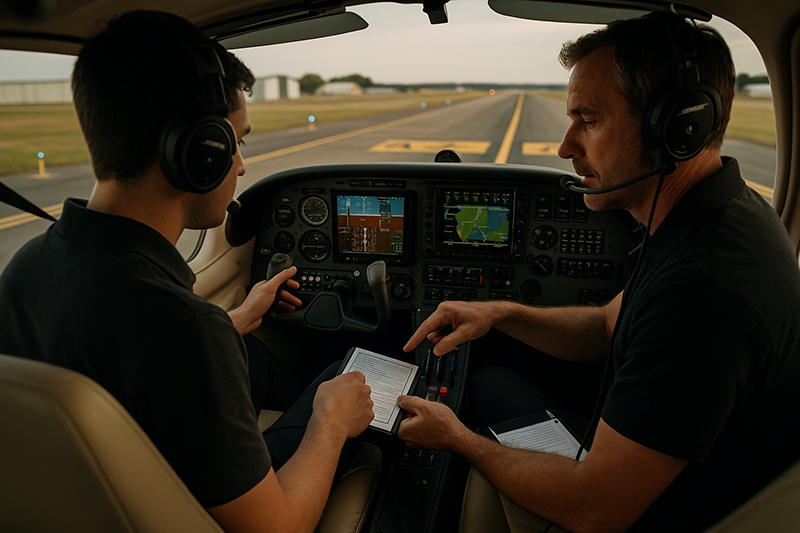
Human factors in aviation are the practical realities of how pilots, instructors, mechanics, dispatchers, controllers, and passengers think, communicate, perceive risk, manage workload, and make decisions under pressure. They matter because many common aviation incidents are not the result of a single dramatic failure. More often, they grow from ordinary conditions: a rushed preflight, a subtle weather change, an incomplete briefing, a distraction in the cockpit, a fatigue-compromised decision, or a crew member who notices something wrong but does not speak up clearly enough.
For pilots and aviation professionals, understanding human factors is not an academic exercise. It is a daily operating skill. Aircraft systems, weather information, checklists, automation, air traffic control, and training procedures all depend on human interpretation and human action. This article explains the human factors behind common incidents in practical aviation language, with emphasis on how pilots can recognize risk earlier, build better cockpit habits, and teach these concepts more effectively during flight training.
What Human Factors Mean in Aviation
In aviation, human factors refers to the interaction between people, equipment, procedures, the operating environment, and organizational culture. It includes individual performance issues such as attention, memory, fatigue, stress, decision-making, and situational awareness. It also includes team and system issues such as communication, cockpit resource management, maintenance coordination, training quality, dispatch pressure, and standard operating practices.
A useful way to think about human factors is this: the airplane may be mechanically airworthy, the weather may be technically legal for the operation, and the pilot may be qualified, yet the flight can still become unsafe if the people involved misunderstand the situation or fail to manage changing risk. Human factors bridge the gap between what is possible on paper and what is actually safe in the airplane at that moment.
Common incidents often begin with small deviations from normal practice. A pilot accepts a short taxi clearance while still programming avionics. A student reads back an instruction correctly but turns toward the wrong taxiway. A flight instructor notices the approach is unstable but waits too long to call for a go-around. A pilot departs with legal weather but continues toward deteriorating visibility because the destination is close and the plan feels familiar. None of these situations requires bad intent or lack of skill. They require normal human limitations meeting an unforgiving operating environment.
That is why human factors training is especially important for pilots who are technically proficient. Skill can sometimes create confidence that outpaces the situation. The goal is not to make pilots fearful. The goal is to make pilots self-aware, disciplined, and willing to interrupt an error chain before the aircraft, weather, or runway environment removes the margin for recovery.
The Error Chain: How Small Issues Become Incidents
The term error chain describes a sequence of events, decisions, assumptions, and missed opportunities that gradually reduce safety margins. An incident rarely develops from one isolated mistake. More commonly, several manageable problems line up: time pressure, incomplete information, distraction, confirmation bias, communication gaps, and delayed corrective action.
For example, a pilot running late may shorten the weather briefing, assume fuel is sufficient based on a previous trip, accept a passenger’s schedule pressure, and skip a more detailed discussion of alternates. Each decision might appear minor in isolation. Together, they create a flight with less flexibility. If the destination weather declines or an unexpected headwind appears, the pilot now has fewer good options and more pressure to continue.
The most valuable point about the error chain is that it can be broken. A pilot does not have to wait for a warning light, a missed approach, or an ATC query to intervene. Human factors awareness encourages earlier recognition: “I am rushing,” “I am not comfortable with this clearance,” “I need to stop taxiing before I troubleshoot,” or “This plan no longer matches the weather.” These statements may seem simple, but they are powerful because they convert vague concern into deliberate action.
Flight instructors can teach this concept by asking students to identify decision points, not just technical errors. After a training flight, the debrief should explore where workload increased, where assumptions entered the plan, and where the student had an opportunity to slow down. That style of debrief builds judgment rather than only correcting maneuvers.
Why This Matters in Real-World Aviation
Real-world flying is dynamic. Pilots operate in changing weather, changing traffic, changing aircraft status, changing passenger expectations, and changing personal condition. Even a local training flight can involve maintenance questions, runway closures, radio congestion, turbulence, automation surprises, or a student who is task saturated. Human factors help pilots understand why technically simple flights can still become demanding.
In flight training, human factors show up early. Student pilots are often learning aircraft control, radio communication, navigation, checklist discipline, traffic scanning, and instructor feedback at the same time. It is normal for attention to narrow. A student concentrating on altitude may miss a heading. A student trying to copy a clearance may allow the aircraft to drift. These are not character flaws. They are predictable workload effects that instructors must manage with pacing, scenario design, and clear cockpit roles.
In everyday aircraft operation, human factors influence preflight planning and in-flight decision-making. Weather interpretation requires more than reading a forecast. Fuel planning requires considering realistic routing, delays, winds, reserves, and alternates appropriate to the operation. Aircraft performance planning requires an honest look at weight, runway conditions, density altitude, and pilot technique. None of these areas is improved by wishful thinking or schedule pressure.
In professional aviation, human factors extend beyond the cockpit. A maintenance discrepancy may be written unclearly. A dispatcher may not know how a crew is interpreting a route change. A captain may unintentionally discourage input by appearing rushed. A first officer may hesitate to challenge a plan because the captain is experienced. These dynamics affect safety even when every person involved is competent and well-intentioned.
The practical lesson is that aviation safety depends on systems and habits that compensate for human limits. Checklists, briefings, standard callouts, sterile cockpit practices, stabilized approach concepts, and crew resource management all exist because memory, attention, and judgment are not perfect. They are safeguards against ordinary human variability.
Situational Awareness: Knowing What Is Actually Happening
Situational awareness is a pilot’s accurate understanding of the aircraft, environment, mission, and likely future state. It includes where the aircraft is, what it is doing, what is around it, what weather or terrain matters, what ATC expects, what the aircraft systems are indicating, and what is likely to happen next.
Loss of situational awareness does not always feel dramatic. It may feel like mild uncertainty: “I think that was our taxiway,” “The approach should intercept soon,” or “The fuel should be fine.” That uncertainty deserves attention. When pilots rely on a mental picture that no longer matches reality, the risk of wrong-airport approaches, altitude deviations, runway incursions, airspace violations, or unstable approaches increases.
A common human factors trap is fixation. Fixation occurs when attention becomes locked on one task or problem while other important cues are missed. A pilot troubleshooting a radio issue may stop monitoring altitude. A student looking for traffic may let airspeed decay. A pilot programming a GPS during taxi may miss signage or hold short instructions. The task itself may be legitimate, but the timing and attention allocation may be unsafe.
Good situational awareness is active. Pilots should regularly compare the plan with reality. Is the aircraft where it should be? Is the weather doing what was expected? Is the energy state appropriate? Is the cockpit workload increasing? Are we ahead of the aircraft or behind it? These questions help reveal whether the pilot is managing the flight or simply reacting to it.
Decision-Making Pressure and Risk Perception
Aviation decision-making is affected by pressure, even when the pressure is subtle. Pilots may feel pressure from passengers, employers, personal goals, aircraft availability, training schedules, weather windows, or the simple desire to complete the flight as planned. The danger is not pressure itself. The danger is failing to recognize how pressure changes risk perception.
When pilots want a plan to work, they may give more weight to information that supports continuing and less weight to information that suggests stopping, delaying, diverting, or requesting assistance. This is commonly described as confirmation bias. In practical terms, it means a pilot may focus on the one improving weather report while minimizing several warning signs. Or a pilot may accept a marginal fuel situation because the trip has been flown before without issue.
Another common issue is plan continuation bias, which is the tendency to continue with an original plan after conditions have changed. Pilots can be especially vulnerable when they are close to the destination, when the flight has been uneventful so far, or when changing the plan would be inconvenient. The antidote is to define decision points before the workload rises. For example, a pilot can decide before departure that if ceilings drop below a personal minimum, fuel reaches a defined level, or the approach becomes unstable, the next action is already known.
Risk perception also changes with familiarity. A familiar airport, familiar route, or familiar airplane can reduce vigilance. Familiarity is valuable, but it can lead to shortcuts. A pilot who has landed on the same runway many times may be slower to notice a runway change, tailwind concern, or unusual traffic pattern instruction. Human factors awareness helps pilots treat routine flights with appropriate respect.
Fatigue, Stress, and Personal Readiness
Fatigue affects attention, memory, reaction time, mood, and judgment. A fatigued pilot may still speak clearly, complete checklists, and appear functional, but the quality of decision-making can degrade. Fatigue can make small problems feel irritating, reduce patience with delays, and make it harder to integrate new information.
Stress has a similar effect. Some stress can sharpen attention, but excessive stress narrows focus and reduces flexibility. In the cockpit, stress may appear as rushed checklist use, abrupt control inputs, incomplete radio communication, or reluctance to ask for help. A pilot under stress may become more reactive and less strategic.
Personal readiness is not limited to illness or obvious impairment. Hydration, nutrition, sleep, medication, emotional distraction, and workload outside aviation all influence performance. A pilot may be legally qualified and current but still not personally ready for a demanding flight. That distinction matters. Legal eligibility is not the same as good judgment for today’s conditions.
Student pilots should learn early that canceling, delaying, or modifying a flight because of personal readiness is a professional decision, not a weakness. Flight instructors can reinforce this by discussing fitness to fly in normal training conversations rather than treating it as a rare emergency topic.
Communication Breakdowns in the Cockpit and on the Radio
Communication is one of the most visible human factors in aviation. Clear communication helps align mental models between pilots, instructors, crew members, ATC, passengers, and maintenance personnel. Poor communication creates ambiguity, and ambiguity increases workload.
In single-pilot operations, communication still matters. A pilot must communicate with ATC, passengers, line personnel, and sometimes maintenance. A passenger question during a high-workload phase can distract the pilot. A vague maintenance write-up can leave uncertainty about aircraft status. A rushed radio exchange can result in an incomplete understanding of a clearance or instruction.
In instructional flying, cockpit communication is especially important because authority and responsibility can shift. The instructor may be demonstrating, the student may be practicing, and both may be monitoring safety. If the transfer of controls is not explicit, confusion can develop quickly. A disciplined “you have the flight controls” and “I have the flight controls” habit is a simple but important human factors defense.
In crewed operations, communication quality includes tone, timing, assertiveness, and listening. A pilot who notices a deviation must be willing to speak up early and clearly. The other pilot must be willing to receive that input without defensiveness. Crew resource management is not about committee flying. It is about using all available resources while preserving clear command responsibility.
Automation and Avionics: Help and Hazard
Modern avionics and automation can significantly improve navigation, workload management, terrain awareness, traffic awareness, and aircraft control when used appropriately. However, automation also introduces human factors challenges. Pilots must understand what the system is doing, what mode it is in, what data it is using, and what the pilot will do if the automation behaves unexpectedly.
A frequent automation issue is mode confusion. The pilot believes the autopilot or flight director is capturing, tracking, or descending as intended, but the selected mode does not match the pilot’s expectation. In that moment, the aircraft may be operating exactly as commanded, but not as desired. The human factors problem is not that automation failed. The problem is that the pilot’s mental model and the avionics mode no longer match.
Another issue is heads-down time. Entering flight plans, loading procedures, acknowledging alerts, and changing settings can pull attention away from aircraft control, traffic, terrain, and taxi routing. This is especially important during taxi, departure, arrival, and approach. The more capable the avionics, the more disciplined the pilot must be about when to program and when to simply fly.
Automation should be treated as a tool, not a substitute for pilot understanding. Pilots should remain capable of hand-flying, navigating with basic references, and simplifying the operation when workload increases. Sometimes the safest automation decision is to reduce complexity: use heading mode, maintain altitude, request vectors, go around, or disconnect and fly the aircraft if appropriate for the situation and training.
Common Mistakes or Misunderstandings
One common misunderstanding is that human factors are mainly about inexperienced pilots. In reality, experience changes the type of risk but does not remove human limitations. Experienced pilots may be better at recognizing patterns, but they can also become vulnerable to routine, confidence, or assumptions based on previous flights.
Another mistake is treating checklists as paperwork rather than as cognitive support. Checklists are designed to protect against memory limits, interruptions, and assumptions. A pilot who rushes or performs a checklist from memory without verification may miss exactly the kind of item the checklist was meant to catch. In training, instructors should teach not only what the checklist contains, but when and how to use it without losing aircraft control or situational awareness.
Pilots also sometimes confuse being decisive with continuing the plan. Good decision-making may mean diverting, delaying, canceling, slowing down, or asking for clarification. A professional pilot is not the one who forces every flight to completion. A professional pilot is the one who manages risk honestly and chooses the safest practical option as conditions change.
Another common trap is silence. A pilot may notice something wrong but wait because it seems minor, because they do not want to appear uncertain, or because they assume the other person has already seen it. In aviation, timely communication is a safety tool. A clear statement such as “airspeed is low,” “we are left of course,” “confirm this taxiway,” or “I am not comfortable continuing” can interrupt an error chain before it becomes serious.
Finally, many pilots underestimate the effect of workload saturation. When workload is high, the brain does not simply perform all tasks slightly worse. It may drop tasks entirely. Radio calls are missed, altitude drifts, checklist items are skipped, and time seems to compress. Recognizing saturation early is crucial. The appropriate response may be to aviate, simplify, communicate, and create time.
Practical Example: A Training Flight That Starts to Unravel
Consider a realistic training scenario. A student pilot and instructor are scheduled for a cross-country lesson in a single-engine training aircraft. The weather is VFR, but winds are stronger than forecast and the destination airport has a runway closure that changes the expected traffic flow. The student arrives late after a difficult morning, and the aircraft was returned with a minor avionics note that requires clarification.
No single factor makes the flight unsafe. The weather is usable, the student is legal to fly, the airplane may be airworthy after review, and the lesson objective is reasonable. The human factors risk comes from accumulation. The student feels rushed. The instructor wants to keep the schedule moving. The avionics note distracts both pilots. The wind requires more performance and fuel awareness than expected. The runway closure changes the arrival plan.
During taxi, the student begins reprogramming the GPS while also listening to ground control. The aircraft approaches an unfamiliar intersection. The instructor notices the student slowing but still looking inside. This is a decision point. The instructor could let the situation continue and correct only if the student makes a wrong turn. A better instructional response is to stop the aircraft in a safe location if appropriate, clarify the taxi route, and discuss workload management before continuing.
Later in flight, the student becomes focused on correcting a navigation deviation and misses a gradual altitude change. The instructor prompts the student to level off and asks what changed. The debrief is not simply “hold altitude better.” The more useful lesson is that attention narrowed under workload. The student was not lazy or careless. The student was saturated. The corrective strategy is to prioritize aircraft control, use available automation or instructor support appropriately, verbalize uncertainty earlier, and reduce cockpit tasks during high-workload phases.
On arrival, the stronger wind and runway closure require a different entry than originally planned. The student tries to salvage the original plan, becomes late configuring the aircraft, and turns final high and fast. The instructor calls for a go-around. Again, the lesson is bigger than one approach. The human factors lesson is that changing conditions require a changing plan. A go-around is not a failed landing. It is a normal risk management tool when the approach no longer meets safe expectations.
Best Practices for Pilots
Human factors risk cannot be eliminated, but it can be managed. The most effective pilots build habits that create time, reduce ambiguity, and make it easier to detect errors early. These habits are not limited to airline crews or advanced aircraft. They apply to student pilots in basic trainers, instrument pilots in technically advanced aircraft, instructors in busy patterns, and professional crews in complex operations.
First, slow down before workload peaks. Many incidents become harder to manage because pilots wait too long to simplify. If uncertainty appears during taxi, stop when safe and clarify. If the avionics are not set before takeoff, use a simpler plan or delay. If weather is changing faster than expected, reassess early rather than after options narrow.
Second, verbalize important risks. Speaking a concern out loud improves shared awareness in a crew and helps single pilots organize thought. Statements such as “we are getting behind,” “this is not the runway I expected,” or “I need to re-brief the approach” are not signs of weakness. They are signs of active risk management.
Third, protect the basics. Aviate, navigate, and communicate remains a useful priority concept because aircraft control is foundational. When workload rises, pilots should ensure pitch, power, airspeed, altitude, and aircraft configuration are under control before becoming absorbed in secondary tasks.
Fourth, use personal minimums thoughtfully. Personal minimums are not a replacement for regulations or aircraft limitations. They are a self-management tool that helps pilots make better decisions before pressure increases. A pilot’s personal minimums should reflect experience, proficiency, aircraft equipment, terrain, weather, recency, and mission complexity.
Fifth, debrief human factors after normal flights, not only after mistakes. Ask what increased workload, what cues were missed, what went well, and what could be simplified next time. This turns every flight into judgment training.
- Pause or stop when safe if uncertainty develops during taxi, setup, or clearance interpretation.
- Brief threats before they become urgent, including weather, terrain, traffic, runway changes, and personal condition.
- Keep cockpit tasks appropriate to the phase of flight, especially during taxi, takeoff, arrival, and approach.
- Invite and give clear communication, especially when something does not look or feel right.
- Use checklists and standard procedures as protections against normal human memory and attention limits.
How Flight Instructors Can Teach Human Factors Better
Flight instructors play a central role in shaping how pilots understand human factors. Students learn not only from what instructors say, but from what instructors tolerate, model, and debrief. If an instructor consistently rushes checklists, dismisses fatigue, or treats go-arounds as embarrassing, the student absorbs those attitudes. If the instructor models calm reassessment, clear communication, and disciplined procedures, the student learns that professionalism includes self-correction.
Good human factors instruction should be scenario-based and specific. Instead of asking only whether the student can perform a maneuver, instructors can ask how the student would manage competing tasks, changing weather, a passenger distraction, or an unexpected runway change. The goal is not to overload the student artificially. The goal is to build recognition and decision-making at a pace appropriate to training stage.
Debriefs should separate technical skill from judgment while also showing how they interact. A poor landing may be partly a flare technique issue, but it may also involve an unstable approach, late configuration, tailwind acceptance, or reluctance to go around. When instructors debrief only the touchdown, they miss the larger safety lesson.
Instructors should also normalize speaking up. Students should feel able to say “I am saturated,” “I missed that call,” or “I need help.” Those statements allow the instructor to coach workload management before the student becomes unsafe. In advanced training, instructors can gradually expect students to identify these moments independently and take corrective action.
Human Factors in Maintenance and Ground Operations
Although pilots often think of human factors in flight, many incidents begin on the ground. Maintenance communication, fueling, towing, loading, dispatch, and preflight inspection all involve human performance. A missed panel, unclear discrepancy, incorrect fuel assumption, or rushed walkaround can affect the flight before the engine starts.
Pilots should approach ground operations with the same discipline used in flight. If a discrepancy is unclear, ask for clarification. If fueling does not match the requested quantity or grade, resolve it before departure. If loading changes, revisit weight and balance as appropriate for the aircraft and operation. If the aircraft has been moved, maintained, or exposed to weather, conduct the preflight with fresh attention rather than habit.
Ground movement is also a human factors environment. Taxi operations combine aircraft control, radio communication, signage interpretation, airport diagram use, traffic awareness, and sometimes complex clearances. Heads-down tasks during taxi should be minimized. If a task requires significant attention, it is often better to stop in a safe location than to divide attention poorly.
Frequently Asked Questions
What are human factors in aviation?
Human factors in aviation are the ways human performance, communication, decision-making, equipment, procedures, and operating environments interact. They include fatigue, attention, workload, stress, situational awareness, cockpit communication, automation management, and organizational influences.
Are human factors mainly a concern for new pilots?
No. Student pilots, experienced pilots, instructors, and professional crews all face human factors risks. Experience can improve pattern recognition and skill, but it can also introduce complacency, routine-based assumptions, or overconfidence if not managed carefully.
How do human factors contribute to common incidents?
Human factors often contribute through a chain of small issues rather than one obvious mistake. Examples include distraction during taxi, incomplete checklist use, miscommunication, fatigue, fixation on avionics, delayed go-around decisions, or continuing a plan after conditions change.
What is the best way for a pilot to reduce human factors risk?
The best approach is to build habits that create time and reduce ambiguity. Use checklists carefully, brief threats, manage workload by phase of flight, speak up early, maintain aircraft control as the first priority, and reassess the plan when conditions change.
How should instructors teach human factors during flight training?
Instructors should teach human factors through realistic scenarios, clear modeling, and thoughtful debriefs. A strong debrief discusses not only what happened, but why workload increased, what cues were available, and where the error chain could have been interrupted.
Does automation reduce human factors risk?
Automation can reduce workload and improve capability when used correctly, but it can also create mode confusion, heads-down distraction, and overreliance. Pilots should understand automation modes, monitor aircraft behavior, and remain ready to simplify or hand-fly when appropriate.
Key Takeaways
- Human factors in aviation are practical safety issues involving attention, workload, communication, fatigue, decision-making, and situational awareness.
- Common incidents often develop from an error chain of small, manageable problems that are not recognized or interrupted early enough.
- Pilots and instructors can reduce risk by slowing down, verbalizing concerns, using checklists properly, managing automation, and debriefing decision-making after every flight.